

Your domain authority is 70. Your keyword rankings are solid across every target term. But none of that tells you whether Perplexity is recommending your competitor instead of you. Traditional rank trackers were built for a world where search results were a list. That world is changing fast, and the monitoring gap it’s created is costing brands visibility they don’t even know they’re losing.
Your Rank Tracker Has a Blind Spot
Google Search Console and conventional rank tracking tools were designed for the “ten blue links” paradigm. They monitor SERP positions. They track clicks from a structured results page. That model worked when search meant a list.
AI search engines don’t return lists. Perplexity, ChatGPT, and Gemini generate dynamic paragraphs synthesized from dozens of sources. There’s no “position #1” in the traditional sense. There’s “cited” or “not cited,” “recommended” or “ignored.”
The gap this creates is real. A brand can rank #1 on Google for a target keyword and be completely absent from the AI-generated answer to the same query. Traditional tools will show green across the board while the actual visibility problem goes undetected.
This is the core challenge AI search monitoring is built to solve.
What AI Search Monitoring Actually Covers
AI search monitoring is the practice of systematically tracking how your brand appears, how it’s described, and how it ranks within AI-generated responses, across multiple AI platforms over time.
It’s not a single metric. It’s a framework built around five core dimensions:
| Metric | What It Measures |
|---|---|
| Visibility Rate | The percentage of high-intent prompts where your brand appears in the AI response |
| Position Rank | Whether your brand is the primary mention, a secondary reference, or buried in a list |
| Citation Source Authority | The specific domains AI models cite when referencing your brand (the “backlink” equivalent for AI) |
| Sentiment Score | The qualitative framing of your brand: positive, neutral, or negative context |
| Share of Voice | Your brand’s presence relative to direct competitors across identical prompts |
These five metrics replace what “keyword rank” used to mean. Being mentioned is step one. Where you’re mentioned, how you’re described, and whether the sources AI cites include your content are what determine whether that mention drives results.
Why Perplexity Needs Its Own Tracking Strategy
Not all AI platforms behave the same way, and a rank tracking tool built for Perplexity looks different from one built for ChatGPT.
Perplexity operates on explicit, real-time web retrieval. It surfaces citations visibly and attributes them to specific URLs. That means your content either earns a citation link or it doesn’t, and you can trace which domains are winning those citations in your category.
ChatGPT’s Search integration pulls from real-time web results too, but citation behavior is less consistent. Gemini layers in Google’s own index authority. Each platform has a different weighting logic, and a visibility win in one doesn’t translate automatically to the others.
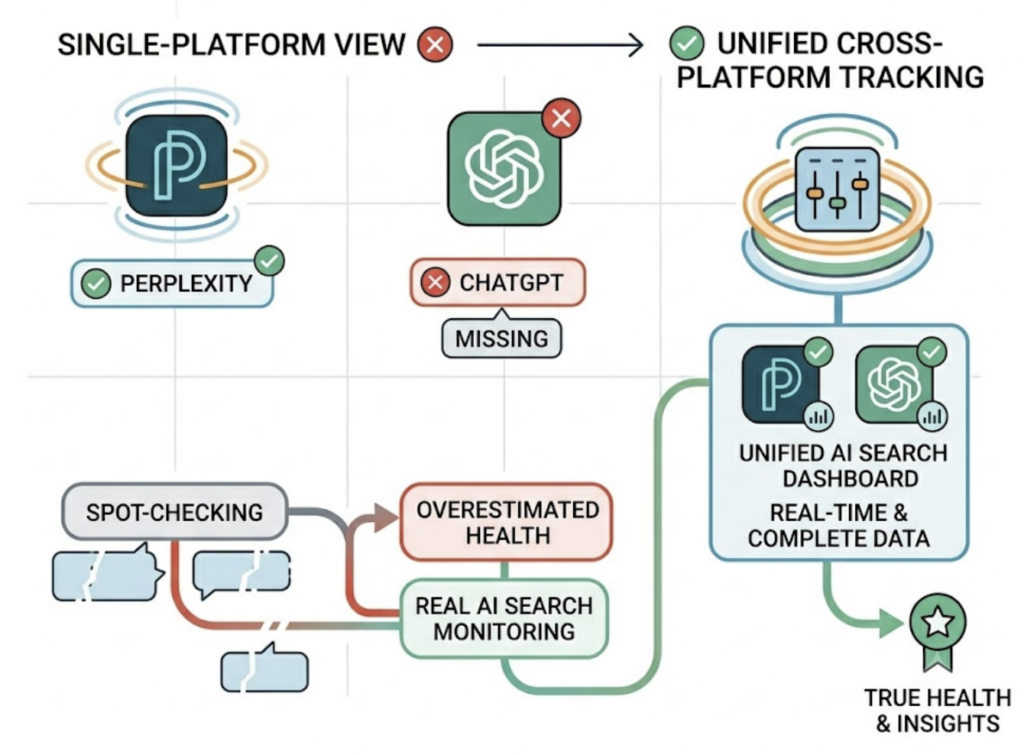
Teams that monitor only one AI platform typically overestimate their overall AI search health. A brand that performs well in Perplexity’s research mode may be entirely absent from ChatGPT’s category recommendations. Unified cross-platform tracking is what separates real AI search monitoring from spot-checking.
How AI Search Monitoring Works, Step by Step
Professional AI monitoring moves beyond manual queries. Here’s what a systematic approach looks like:
Step 1: Build a prompt matrix. Identify 50–100 high-intent prompts that reflect how your target buyers actually search. This means category discovery queries (“best [software] for [use case]”), comparison queries (“[your brand] vs [competitor]”), and problem-framing queries (“how do I solve [problem your product addresses]”). Branded prompts alone are insufficient because they miss the discovery phase entirely.
Step 2: Automate execution across platforms. Programmatically trigger these prompts against ChatGPT, Perplexity, Gemini, and other relevant platforms on a scheduled cadence, typically daily or weekly. Manual querying introduces inconsistency and can’t generate the longitudinal data you need.
Step 3: Parse and normalize the outputs. Use LLM-based parsers to extract brand mentions, identify citation sources, and score sentiment from unstructured text responses. This is where structured data replaces screenshots.
Step 4: Track changes over time. Map results against a baseline. When visibility shifts, you need enough historical data to correlate the change with specific content updates, PR coverage, or competitor activity.
That last step is where most teams underinvest. AI answers aren’t static. Citation patterns shift as models update and as the web changes around them. Trend data is what turns monitoring into a usable optimization signal.
5 Mistakes That Make AI Monitoring Useless
Most teams that start AI search monitoring fall into at least one of these traps:
Tracking only branded queries. Monitoring “What is [your brand]?” tells you nothing about discovery. Buyers evaluating your category don’t start with your brand name. They start with a problem or a category, and that’s where the visibility gap tends to be widest.
Ignoring competitor intelligence. Knowing you’re not mentioned isn’t enough. You need to know which competitors the AI is citing, what content they’ve published that’s earning those citations, and how their sentiment scores compare to yours. That’s the intelligence that drives action.
Treating platforms as interchangeable. A monitoring strategy that only checks one AI platform creates a false sense of coverage. Platform heterogeneity is a structural feature of the current AI ecosystem, not a temporary condition.
No temporal data. AI answers change frequently. A single snapshot tells you your current state. A time series tells you whether your optimization efforts are working. Without longitudinal data, you’re flying blind on whether anything you’re doing is moving the needle.
Using screenshots instead of structured records. Screenshots can’t be queried, aggregated, or used to calculate trend lines. AI search monitoring requires a database, not a folder of images.
Tools Built for AI Search Monitoring
The core requirement for a credible AI monitoring tool is cross-platform coverage with automated execution and structured data output. A tool that only covers one or two platforms, or that requires manual query runs, can’t support the kind of trend analysis that makes monitoring actionable.
Topify is currently one of the most complete platforms in this space. Its monitoring stack covers seven metrics simultaneously: Visibility, Sentiment, Position, Volume, Mentions, Intent, and CVR (Conversion Visibility Rate). That breadth matters because visibility and sentiment are correlated but distinct: a brand can have high visibility with negative framing, which is worse than low visibility.
For teams focused on citation-layer intelligence, Topify’s Source Analysis feature identifies the specific domains and URLs that AI platforms cite when referencing brands in a category. This is the equivalent of backlink analysis for AI search. Knowing which sources are earning AI citations in your space directly informs where to build content authority.
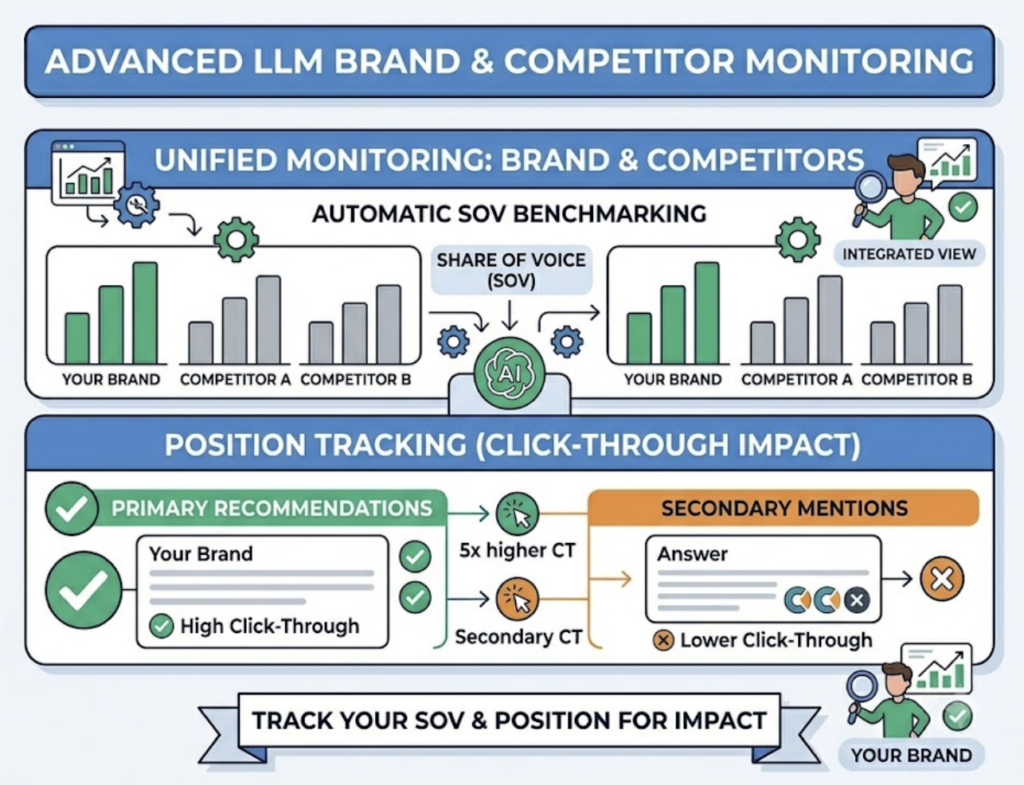
Competitor Monitoring runs automatically alongside brand tracking, so you can benchmark your Share of Voice without running separate analyses. Position Tracking shows whether your brand appears as a primary recommendation or a secondary mention, which carries significant weight for click-through behavior in AI-generated responses.
On pricing, Topify’s Basic plan at $99/mo covers 100 prompts across core platforms with 9,000 AI answer analyses per month, which is sufficient for single-brand monitoring. The Pro tier at $199/mo expands to 250 prompts and adds full competitor benchmarking. Enterprise starts at $499/mo for custom prompt engineering and deeper entity-level tracking.
Building a Practical AI Search Monitoring Strategy
The goal isn’t just monitoring. It’s building a feedback loop between what AI says about your brand and what your content strategy does next.
Start with a content audit oriented around citation-worthiness. AI models tend to cite sources that provide direct, clear answers to category-level questions. If your content is optimized for keyword density rather than answer quality, it’s less likely to earn citations regardless of your domain authority.
Set a baseline in the first 30 days. Measure Visibility Rate, Sentiment Score, and Share of Voice across your core prompt matrix before you make any changes. Without a baseline, you can’t attribute improvement to specific actions.
Review citation source data monthly. Which domains are AI platforms pulling from when they answer questions in your category? If those domains aren’t yours, that’s your content gap. Publishing direct-answer content on those topics, or earning coverage on the sites AI consistently cites, is how you close it.
The brands that will build durable AI search visibility aren’t waiting to see how things develop. They’re measuring now, so they know which direction things are moving.
Conclusion
AI search monitoring isn’t a replacement for SEO. It’s the layer your current analytics stack doesn’t cover. Your rank tracker shows what Google thinks of your content. AI search monitoring shows what ChatGPT, Perplexity, and Gemini say about your brand when someone asks for a recommendation.
Those two signals are increasingly divergent. The gap between them is where brand visibility is either being built or quietly eroding. Get started with Topify to establish your baseline before your competitors do.
FAQ
Q: What is AI search monitoring?
A: AI search monitoring is the systematic practice of tracking how your brand appears in AI-generated search responses across platforms like ChatGPT, Perplexity, and Gemini. It covers metrics including visibility rate, position rank, citation source domains, sentiment framing, and share of voice relative to competitors, measured over time through automated prompt execution.
Q: How does AI search monitoring work?
A: At a technical level, it involves building a matrix of high-intent prompts that reflect buyer search behavior, running those prompts automatically against major AI platforms on a scheduled basis, parsing the outputs for brand mentions and citation data, and tracking results longitudinally to identify trends. The data is structured into a database rather than captured manually, which is what makes trend analysis possible.
Q: What’s the difference between AI search monitoring and traditional rank tracking?
A: Traditional rank trackers monitor SERP positions in link-based search results. AI search monitoring tracks brand presence in generated paragraphs, which don’t have positions in the traditional sense. The relevant signals are citation inclusion, mention context, sentiment framing, and source authority, not keyword rank. The two tools measure different things and neither replaces the other.
Q: How much does AI search monitoring typically cost?
A: Entry-level AI monitoring tools typically start around $99/month for core brand tracking across major platforms. Mid-tier plans covering full competitor benchmarking and sentiment analysis typically run $150–$250/month. Enterprise-grade solutions with custom prompt engineering and API access start at $499/month and scale with usage. Topify’s pricing follows this structure across its Basic, Pro, and Enterprise tiers.

