

Your Google rankings look fine. But open Perplexity and ask “best [your category] tools”—your brand might not appear at all. That’s the visibility gap most marketing teams haven’t accounted for yet.
Traditional rank trackers were built for a world where search returns a list of links. AI search doesn’t do that. It synthesizes an answer, recommends a handful of brands, and moves on. If you’re not in that answer, no amount of SERP optimization tells you why.
This guide covers what AI search monitoring actually measures, how to track keyword rankings on Perplexity specifically, and how to build a monitoring workflow that doesn’t break down after the first report.
Your Rank Tracker Can’t See What AI Search Does
Traditional SEO tools measure one thing well: where your URL appears in a ranked list of links. That’s not how AI search works.
When a user asks Perplexity “what’s the best project management tool for remote teams,” the platform doesn’t return ten blue links. It synthesizes a recommendation using sources it trusts, mentions two or three brands by name, and assigns each an implicit level of confidence. Your position in that answer depends on your visibility rate, how you rank relative to other mentioned brands, and whether the sources Perplexity pulls from support your brand or your competitor’s.
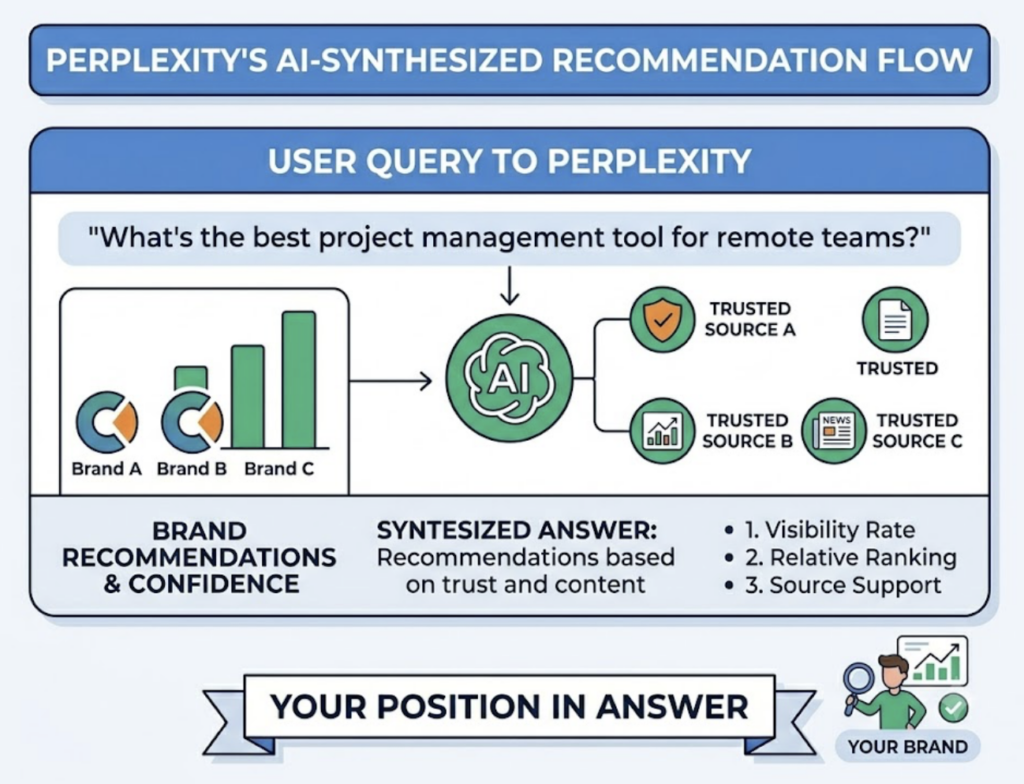
Search Console data doesn’t capture any of that. Backlink indices don’t either. The gap between “we rank #3 on Google” and “we’re not mentioned in 80% of relevant AI answers” is the visibility gap—and it’s growing.
That’s the gap an AI search monitoring tracker is designed to close.
What AI Search Monitoring Actually Measures
Effective AI search monitoring isn’t about replacing your existing analytics stack. It’s about tracking the five metrics that determine brand presence in AI-generated answers.
Visibility Rate measures the percentage of high-intent prompts where your brand gets mentioned at all. A brand can rank #1 on Google and have a 20% visibility rate on Perplexity. Those are independent outcomes.
Position Rank tracks your relative order when multiple brands are mentioned. Being cited first versus fourth in the same AI answer carries very different conversion weight.
Citation Source Mapping identifies which domains AI platforms rely on to support claims about your brand. If Perplexity cites a two-year-old review site article every time it mentions you, that’s a content vulnerability. If a competitor dominates G2 citations, that explains their position advantage.
Sentiment Score captures the qualitative tone of the AI’s recommendation—whether it describes your brand positively, neutrally, or with caveats. An 80% visibility rate with neutral-to-negative sentiment doesn’t drive conversions.
Share of Voice compares your visibility against primary competitors across the same prompt set. This is the competitive benchmark that traditional SEO tools have never been able to provide for AI search.
How to Track Keyword Rankings on Perplexity
Tracking rankings on Perplexity requires a different process than traditional keyword monitoring. There’s no “keyword position” in the conventional sense—you’re tracking whether your brand appears, where it appears, and how it’s described across a library of prompts.
Here’s a practical step-by-step framework.
Step 1: Build a Prompt Matrix
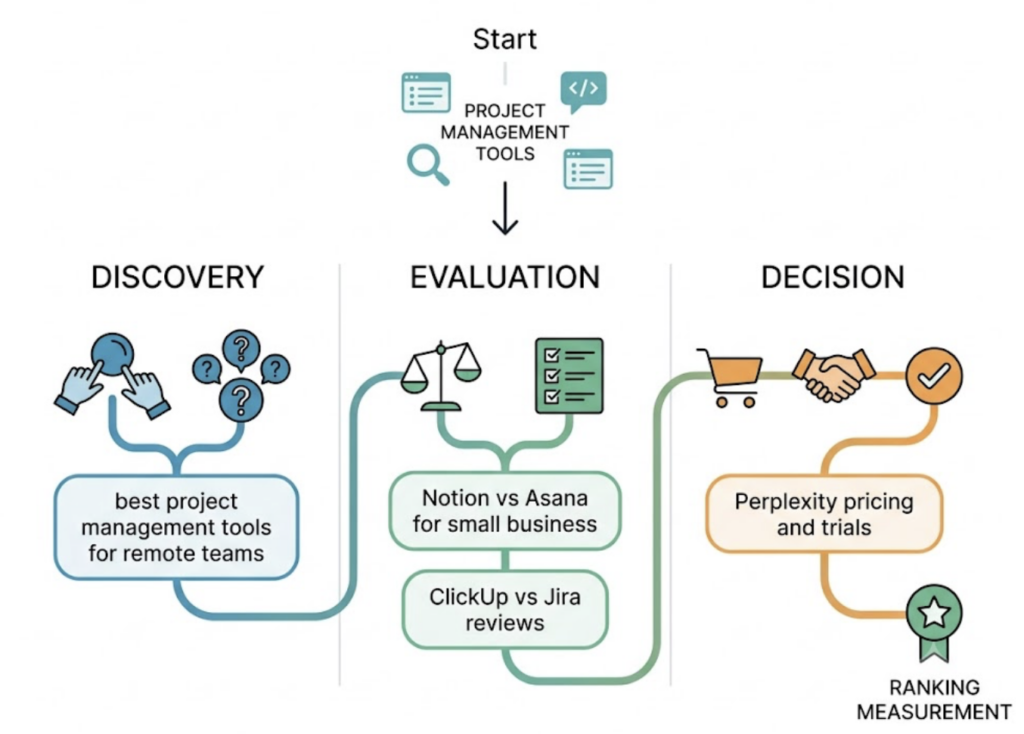
Don’t track generic keywords. Translate them into the actual queries a buyer would type into Perplexity. “Project management tools” becomes “best project management tools for remote teams” and “Notion vs Asana for small business.” Aim for 50 to 100 prompts covering discovery, evaluation, and decision stages of the buyer journey. This prompt matrix is the foundation of every AI ranking measurement you’ll do.
Step 2: Execute Prompts Systematically
Run each prompt and record whether your brand appears, at what position, what sources Perplexity cites, and how the brand is described. Manual execution across 50+ prompts is time-consuming and prone to inconsistency. AI responses are stochastic—the same prompt can yield meaningfully different answers on different runs. You need repeated sampling, not a single snapshot, to build a statistically valid baseline.
Step 3: Parse and Log the Results
For each prompt execution, capture: brand mention (yes/no), position in the answer (1st, 2nd, 3rd, or not mentioned), cited URLs, and sentiment. Without structured logging, you can’t identify trends over time or diagnose why your visibility rate dropped.
Step 4: Set a Monitoring Cadence
AI answers evolve faster than Google rankings. A citation source gets updated, a new review appears on a consensus domain, a competitor publishes content that gets picked up—any of these can shift your AI rankings within days. Weekly monitoring is the minimum viable cadence for most teams. Daily monitoring makes sense for competitive categories or high-stakes brand moments.
Step 5: Automate
Manual execution doesn’t scale. Topify automates this entire pipeline—prompt execution across Perplexity, ChatGPT, and Gemini, response parsing, brand mention detection, citation URL extraction, and sentiment scoring—on your defined cadence without manual workflows.
Track AI Rankings Across Platforms, Not Just Perplexity
Perplexity-only monitoring is one of the most common pitfalls teams fall into when they start tracking AI rankings. Different AI platforms draw different user segments, reference different source types, and produce meaningfully different brand recommendations.
A brand that appears first in ChatGPT’s recommendations for a given prompt might not appear at all in Perplexity’s answer to the same query. That’s not a data anomaly—it reflects different training emphasis, different citation preferences, and different user intent profiles across platforms. Users at different stages of the buying journey increasingly default to different AI tools.
Cross-platform coverage isn’t optional if you want an accurate picture of your AI search visibility.
Topify monitors brand performance across ChatGPT, Perplexity, Gemini, DeepSeek, and other major AI platforms simultaneously. Its seven-metric system—visibility, sentiment, position, volume, mentions, intent, and CVR—provides a unified view across platforms rather than requiring separate monitoring setups for each.
The Position Tracking feature specifically shows your brand’s relative rank compared to competitors across the same prompt set, on each platform. That’s the data that tells you whether a Perplexity visibility problem is platform-specific or a broader AI search visibility issue.
Build a Monitoring Workflow That Actually Scales
Having a prompt matrix and a tracking tool is the start. The harder problem is building a workflow that generates actionable data consistently, not just a one-time audit.
Structure your prompt library by intent stage. Discovery-stage prompts (“what tools help with X”) surface brand awareness gaps. Evaluation-stage prompts (“X vs Y,” “best X for Z use case”) show competitive positioning. Decision-stage prompts (“[brand name] review,” “is [brand] worth it”) reveal how AI handles bottom-of-funnel queries about your brand directly. Each stage requires different optimization responses.
Set competitive baselines from day one. Tracking your own brand in isolation tells you very little. The meaningful number is your share of voice relative to the three or four brands you actually compete against. If your visibility rate is 45% but the category leader is at 78%, that gap is your optimization target.
Flag citation fragility early. One of the risks the external research identifies is “citation fragility”—being cited by only one unstable source. If Perplexity consistently references one domain when it mentions your brand and that domain goes offline or updates its content, your AI rankings can drop significantly. Topify’s Source Analysis feature maps the domains AI platforms rely on to support your brand, so you can identify and address this before it becomes a problem.
Assign clear ownership. AI search monitoring data needs an owner. Someone on the team should review the weekly report, flag sentiment shifts, and translate citation source gaps into content briefs. The monitoring workflow generates the intelligence; execution is still human.
What Good AI Search Monitoring Data Tells You
A reliable AI search monitoring tracker gives you three things a traditional SEO tool can’t.
First, it tells you whether you have a visibility problem or a position problem. A low visibility rate means AI isn’t surfacing you for relevant prompts—a content and citation coverage issue. A high visibility rate with poor position means AI mentions you but ranks competitors ahead—a sentiment and source authority issue. These require different responses.
Second, it tells you where competitor advantage comes from. Topify’s Competitor Monitoring feature tracks visibility, position, and sentiment for your competitors across the same prompt set. When a competitor consistently outranks you, the citation source data usually explains why. They’re getting cited by a domain you’re not present on, or their G2 reviews are more recent.
Third, it gives you a feedback loop. AI rankings shift more dynamically than Google rankings. A content update, a new citation source, or a change in how an industry forum discusses your brand can move your visibility rate within weeks. That feedback loop—monitor, identify gap, execute, remeasure—is what turns AI search monitoring from a reporting exercise into a growth channel.
Topify’s Basic plan starts at $99/month and covers ChatGPT, Perplexity, and AI Overviews tracking across 100 prompts with 9,000 AI answer analyses. The Pro plan at $199/month adds competitive benchmarking and deeper sentiment analysis across 250 prompts. For teams managing multiple brands or clients, the Enterprise plan starts at $499/month with custom configuration.
Conclusion
AI search monitoring isn’t a nice-to-have extension of your SEO stack. It’s the only way to know whether your brand is being recommended, how it’s being described, and why a competitor keeps appearing ahead of you in AI-generated answers.
The core workflow is straightforward: build a prompt matrix, execute and parse results systematically, track visibility and position over time, and use citation source data to drive content decisions. The hard part is doing it at scale, across platforms, on a cadence that catches ranking shifts before they compound.
That’s what a purpose-built AI search monitoring tracker is for.
FAQ
How do I track keyword rankings on Perplexity specifically?
Perplexity doesn’t expose a public rankings API, so tracking requires executing prompts directly and recording the output. You translate your target keywords into natural-language prompts, run them against Perplexity, and log whether your brand appears, at what position, and which sources are cited. Automated tools like Topify handle this at scale, executing a full prompt library on a defined cadence and parsing results without manual effort.
Is AI search monitoring different from traditional SEO tracking?
Yes, fundamentally. Traditional rank trackers measure URL position in a SERP—a deterministic list. AI search monitoring measures brand presence in synthesized natural language answers, which is probabilistic, context-dependent, and varies by platform. The metrics are different (visibility rate, position rank, citation sources, sentiment), the data collection method is different (prompt execution vs. crawl-based), and the optimization levers are different (content authority and citation coverage vs. on-page optimization and backlinks).
How often do AI rankings change?
More frequently than Google rankings. AI platforms update their knowledge synthesis in response to new content, updated citation sources, and changes in how consensus domains discuss a brand. For competitive categories, AI recommendations can shift meaningfully within days. Weekly monitoring is the minimum viable cadence; daily monitoring makes sense for high-stakes brand or product categories.
Can I track competitors’ AI search rankings?
Yes. Most AI search monitoring platforms, including Topify, support competitor monitoring as a core feature. You set up the same prompt matrix and track visibility rate, position, and citation sources for your competitors alongside your own brand. This is how you identify whether a competitor’s AI ranking advantage comes from better sentiment, stronger citation coverage, or simply more prompt coverage.
What’s the difference between visibility rate and position rank?
Visibility rate measures how often your brand appears in AI answers at all—across your full prompt library. Position rank measures where you appear when you do get mentioned. A brand can have high visibility but poor position (mentioned frequently, always second or third). Both metrics matter, but they point to different optimization responses.

