

Your domain rating is 72. Your core keywords sit on page one. By every metric your SEO stack reports, the brand looks healthy. Then a prospect asks ChatGPT for the top platforms in your category, and the answer lists three competitors, cites a review site you never optimized for, and skips you entirely. None of your current tools flagged it, because none of them were built to look.
That blind spot is exactly what an AI search monitoring tool exists to close. Understanding what these platforms measure, how they work, and what they cost is the difference between buying a dashboard and buying an advantage.
What an AI Search Monitoring Tool Actually Tracks
An AI search monitoring tool systematically audits what generative AI platforms like ChatGPT, Perplexity, Gemini, and Google AI Overviews say about your brand. Instead of tracking where a URL ranks on a results page, it tracks whether and how a brand appears inside synthesized AI answers.
The shift matters because the answers are replacing the links. AI search traffic has grown by more than 500% year over year, and over 60% of information-seeking queries now resolve without a single click to an external website. When the answer is the destination, presence inside that answer becomes the metric.
In practice, a monitoring platform evaluates four things for every tracked prompt. Is the brand present in the response at all? Is it prominent, meaning early in the list rather than buried at the end? Is it persuasive, framed with language that matches your positioning? And is it cited, backed by sources like G2, Reddit, or industry publications that the model treats as authoritative?
Traditional rank trackers can’t answer any of those questions. There’s no fixed position 1 through 10 in a ChatGPT response, no official reporting API, and no guarantee the same question returns the same answer twice.
How Does an AI Search Monitoring Tool Work Behind the Dashboard
The mechanics follow a consistent pipeline. The tool starts with a prompt library, a set of high-intent queries your buyers actually ask, such as “best [category] software” or “[Brand] vs. [Competitor].” It then runs those prompts against each AI platform on a schedule, parses every response for brand mentions, position, sentiment, and cited sources, and aggregates the results into trend lines.
The scheduling part is not a convenience feature. It’s the whole point.
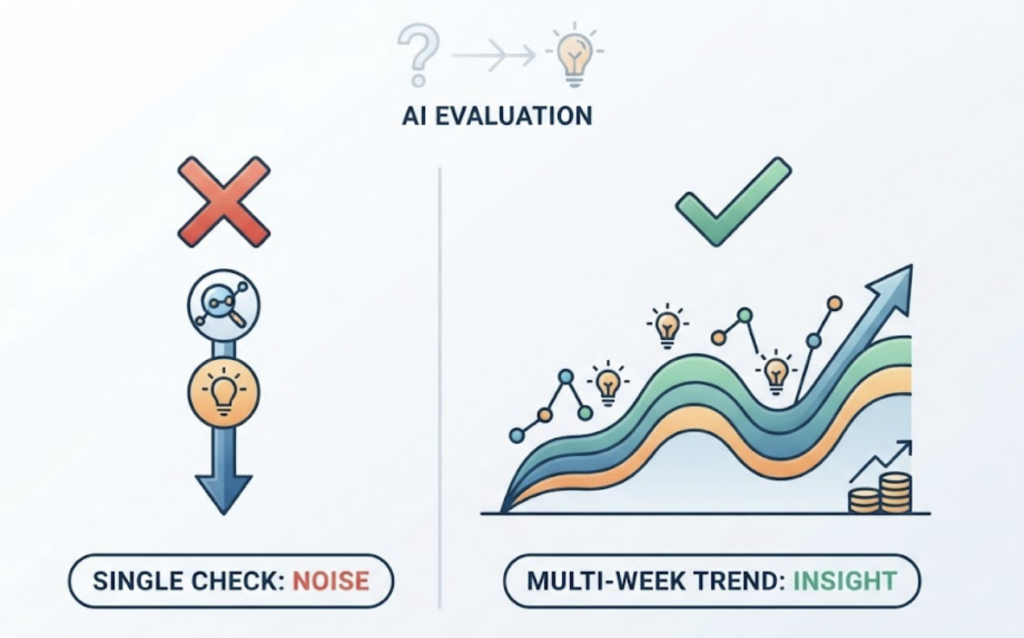
LLMs are probabilistic, not deterministic. Research shows that even at zero temperature settings, responses still vary between runs. A single manual check captures one data point from what is actually a distribution, which is why serious tools sample repeatedly and report rolling 7-day or 30-day averages instead of snapshots.
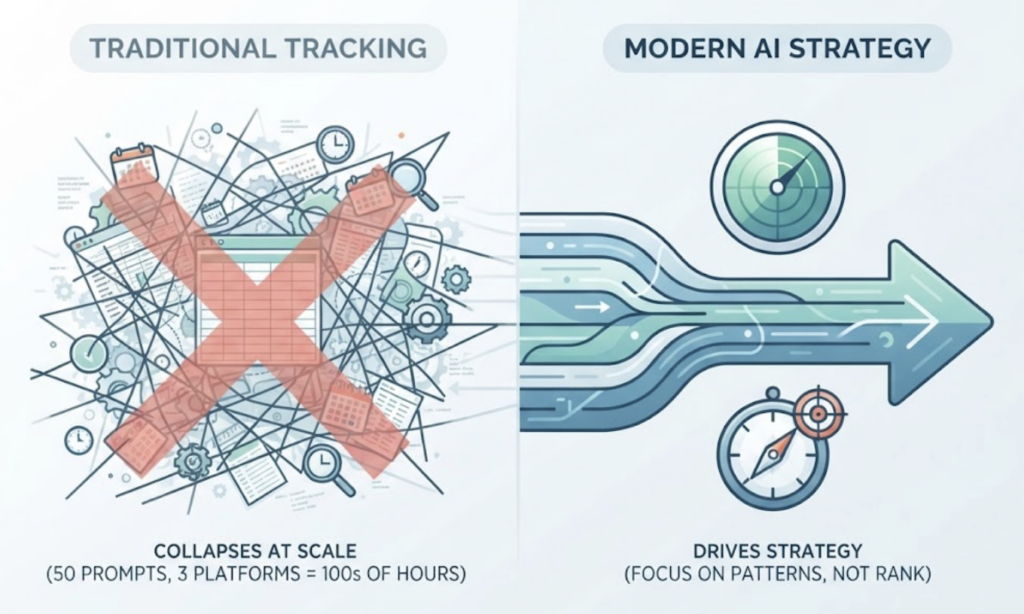
That’s also why spreadsheet-based tracking collapses at scale. Monitoring even a modest cluster of 50 prompts across three AI platforms consumes dozens of manual hours every week, and the resulting snapshots go stale within days as models update their indexes. As the ROI·DNA team puts it, treating volatile AI performance like a static SEO rank means chasing noise instead of driving strategy.
Why an AI Overview Monitoring Tool Belongs in the Same Stack
Google AI Overviews and standalone AI assistants are two different battlegrounds, but they demand one unified measurement approach. An ai overview monitoring tool tracks when Google’s generative summaries appear for your target queries, whether your brand or domain gets cited inside them, and how that placement shifts over time.
The stakes are asymmetric. An AI Overview sits above every organic result, so even a page-one ranking can lose most of its clicks to a summary that cites someone else. Meanwhile, ChatGPT and Perplexity operate on entirely different citation logic, often pulling from review platforms and community discussions rather than your own domain.
Monitoring only one surface means seeing half the picture.
This is why platform coverage should be the first filter in any tool evaluation. A tool that tracks ChatGPT but ignores AI Overviews misses the surface with the largest search volume. A tool that only watches Google misses the assistants where high-intent product research increasingly starts.
How to Measure Results From an AI Search Monitoring Tool
Raw mention counts are vanity metrics. A useful measurement framework tracks four dimensions that map directly to business questions.
Visibility rate answers “how often do we show up.” It’s the percentage of relevant AI responses that include your brand, tracked per prompt cluster and per platform.
Position answers “how early do we show up.” This matters more than most teams expect, because AI models concentrate attention on the first 30-40% of a response, making early mentions disproportionately valuable for consideration.
Sentiment answers “how are we framed.” An AI describing your enterprise product as “budget-friendly” is a positioning problem no traffic report will surface.
Source attribution answers “why does the AI say this.” Tracking which domains fuel AI answers reveals the upstream supply chain. If ChatGPT cites G2 to validate recommendations in your category, your G2 presence matters as much as your own website.
The measurement sequence matters as much as the metrics: establish a baseline first, watch trends over rolling windows, then attribute changes to specific citation or content shifts. Platforms like Topify formalize this into seven tracked dimensions, adding volume, intent, and conversion visibility rate on top of the core four, so a drop in ChatGPT mentions can be traced to the specific source that stopped citing you.
The Checklist for Picking the Best AI Search Monitoring Tool
The market is crowded and the demos all look similar. This checklist separates tools that measure from tools that merely display.
- Cross-platform coverage. ChatGPT, Gemini, Perplexity, and Google AI Overviews at minimum. Single-platform tools produce single-platform blind spots.
- Prompt capacity that fits your funnel. You’ll want room for at least 25-50 decision-stage prompts per brand, with headroom to expand.
- Sampling frequency and rolling averages. Daily or near-daily sampling with 7/30-day trend views, not one-off snapshots.
- Competitor benchmarking. Share of voice at the prompt level, not just your own numbers in isolation.
- Citation and source analysis. The tool should show which domains AI engines cite, and where competitors are cited but you aren’t.
- A path from data to action. Insights that connect to content strategy, not rows in a database.
- Transparent pricing. Per-prompt and per-platform costs you can calculate before the sales call.
There’s also a build-versus-buy question worth settling early. Some engineering-heavy teams consider scraping AI platforms themselves, but the economics rarely work out: fragile APIs, ongoing maintenance debt, and cloud costs typically exceed a commercial subscription, and the output is often a data silo nobody acts on.
Against this checklist, Topify tends to stand out as the option built for the full loop rather than just the monitoring step. It tracks brand presence across ChatGPT, Gemini, Perplexity, DeepSeek, and other major engines, benchmarks share of voice against auto-detected competitors, and reverse-engineers the exact URLs each platform cites, mapping the gap between sources that mention your rivals and sources that ignore you.
The differentiating layer is execution. Instead of exporting findings into a separate workflow, you can define a goal in plain English, review the proposed strategy, and deploy it with one click. For teams whose real constraint is time rather than data, that closed loop is the difference between a report and a result. You can get started with a 30-day trial to establish a baseline before committing.
Common Mistakes That Waste Your Monitoring Budget
Even with the right tool, teams sabotage their own data in predictable ways.
Judging from a single check. One query, one answer, one conclusion. AI responses vary run to run, so any decision made from a single sample is a decision made from noise. Fix: only act on rolling multi-week trends.
Building a prompt library that’s too narrow. Ten branded prompts tell you nothing about the category conversations where buyers actually discover alternatives. Fix: weight the library toward unbranded, decision-stage queries.
Counting mentions while ignoring framing. Showing up as “a cheaper alternative to [Competitor]” is not the same as showing up as the recommended pick. Fix: review sentiment and position alongside visibility rate.
Monitoring without acting. Dashboards that never change a content calendar are an expense, not an investment. Fix: tie every monthly review to at least one citation-building or content action.
Forgetting AI Overviews. Teams fixated on ChatGPT routinely miss the generative surface sitting on top of their existing Google traffic. Fix: treat AI Overview tracking as non-negotiable scope.
AI Search Monitoring Tool Pricing: What You’ll Actually Pay
Most commercial platforms cluster into three bands. Entry plans run roughly $99-199 per month, mid-tier plans with larger prompt capacity and more seats land around $200-500, and enterprise plans with dedicated support start at $500 and climb from there.
Topify’s pricing follows a usage-based structure designed to start small and expand with proven value:
| Plan | Price | What’s included |
|---|---|---|
| Basic | $99/mo, save 17% yearly | 30-day trial, ChatGPT, Perplexity and AI Overviews tracking, 100 prompts, 9,000 AI answer analyses, 4 projects, 4 seats |
| Pro | $199/mo, save 17% yearly | 250 prompts, 22,500 AI answer analyses, 8 projects, 10 seats |
| Enterprise | From $499/mo, save 16% yearly | Dedicated account manager, custom scope |
The smarter comparison isn’t monthly price. It’s cost per tracked prompt per platform. A $99 plan covering 100 prompts across three engines works out to roughly $0.33 per prompt-platform per month, a fraction of what the equivalent manual tracking hours would cost in salary. Bottom line: price the coverage, not the sticker.
Conclusion
The gap this article opened with, a healthy SEO dashboard next to an invisible AI presence, doesn’t close on its own. AI visibility is now a distinct metric system with its own volatility, its own citation supply chain, and its own tooling.
The practical path is short: define 25-50 decision-stage prompts, measure your baseline presence across ChatGPT, Perplexity, and AI Overviews, audit which sources feed the answers, and move to tool-based tracking before the manual hours pile up. Monitoring is the starting point. What you change because of it is the strategy.
FAQ
Q: What is an AI search monitoring tool?
A: It’s a platform that automatically queries AI engines like ChatGPT, Perplexity, Gemini, and Google AI Overviews with buyer-relevant prompts, then measures whether your brand appears, where it’s positioned, how it’s framed, and which sources the AI cites. It replaces manual spot-checks with longitudinal trend data.
Q: How do I improve the results my AI search monitoring tool reports?
A: Work upstream. Use source attribution data to find the domains AI engines cite in your category, then build presence there through reviews, contributed content, and structured, cite-able pages on your own site. Improvements typically show in visibility trends over 30-90 days, not overnight.
Q: What are examples of what an AI search monitoring tool catches?
A: Typical finds include a competitor entering the top three recommendations for your core prompt, Perplexity describing your premium product as “budget,” a review site becoming the dominant citation source in your category, or your brand disappearing from AI Overviews after a model update.
Q: What’s a good starting strategy for AI search monitoring?
A: Start with a focused library of 25-50 decision-stage prompts, sample across at least three platforms, and let a 30-day baseline accumulate before making changes. Then run a monthly loop: review trends, identify one citation gap, act on it, and measure the shift in the next cycle.

