

Your domain rating is solid. Your keyword rankings haven’t moved. And yet none of that data can tell you what happened yesterday when 800 people asked ChatGPT for a recommendation in your category. Traditional SEO tools measure positions on a results page. An AI query tracking platform measures something different: whether generative engines mention you at all, where they place you, and which sources they trust when they decide.
That gap between what your dashboard shows and what AI actually says is now where deals are quietly won or lost.
What an AI Query Tracking Platform Actually Measures
An AI query tracking platform systematically monitors how AI engines like ChatGPT, Perplexity, Gemini, and Google AI Overviews respond to the prompts your buyers actually type. Instead of tracking a keyword’s rank on a results page, it audits the AI’s synthesized answer: is your brand present, how prominently, and in what tone.
The shift matters because the underlying behavior has changed. AI search traffic has grown more than 500% year-over-year, and over 60% of information-seeking queries now resolve without a single click to an external website. When the answer is the destination, the answer is what you need to measure.
One clarification worth making early: query tracking isn’t prompt engineering. You’re not writing instructions for the AI. You’re auditing its outputs for high-intent queries like “best CRM for small agencies” or “your brand vs. competitor” to see how the model characterizes you.
A useful mental model comes down to four questions. Is the brand present in the answer? Is it prominent, meaning early in the response rather than buried? Is it persuasive, framed positively rather than as a budget afterthought? And is it cited, backed by sources the AI treats as authoritative?
Inside the Mechanics: Why One Query Proves Nothing
Here’s the part most teams get wrong on day one. They open ChatGPT, type their category query, screenshot the answer, and treat it as ground truth.
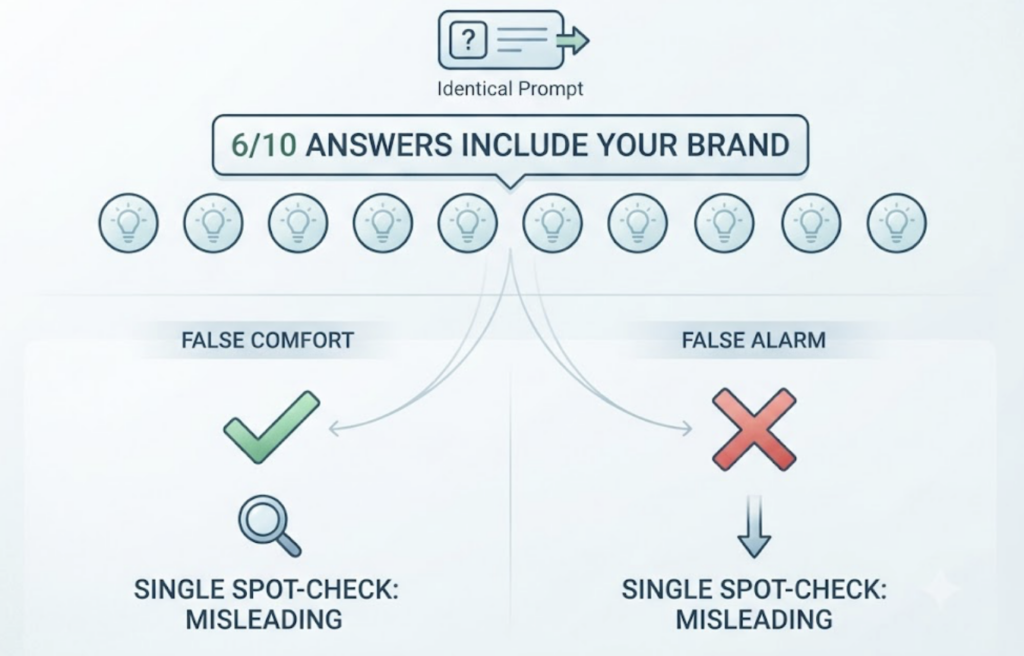
LLMs are probabilistic, not deterministic. Research shows that even at zero temperature settings, responses still vary between runs. Your brand might appear in 6 out of 10 answers to the identical prompt. A single spot-check captures one data point from a distribution, which is why manual tracking tends to produce false alarms and false comfort in equal measure.
A proper AI query tracking platform handles this with a repeatable pipeline:
- Prompt library design. Define the 25 to 50 decision-stage queries that matter for your category.
- Scheduled multi-platform sampling. Run each prompt repeatedly across ChatGPT, Perplexity, Gemini, and other engines on a fixed cadence.
- Answer parsing. Detect brand mentions, extract position within the response, and score sentiment.
- Citation extraction. Log which domains the AI referenced to justify its recommendations.
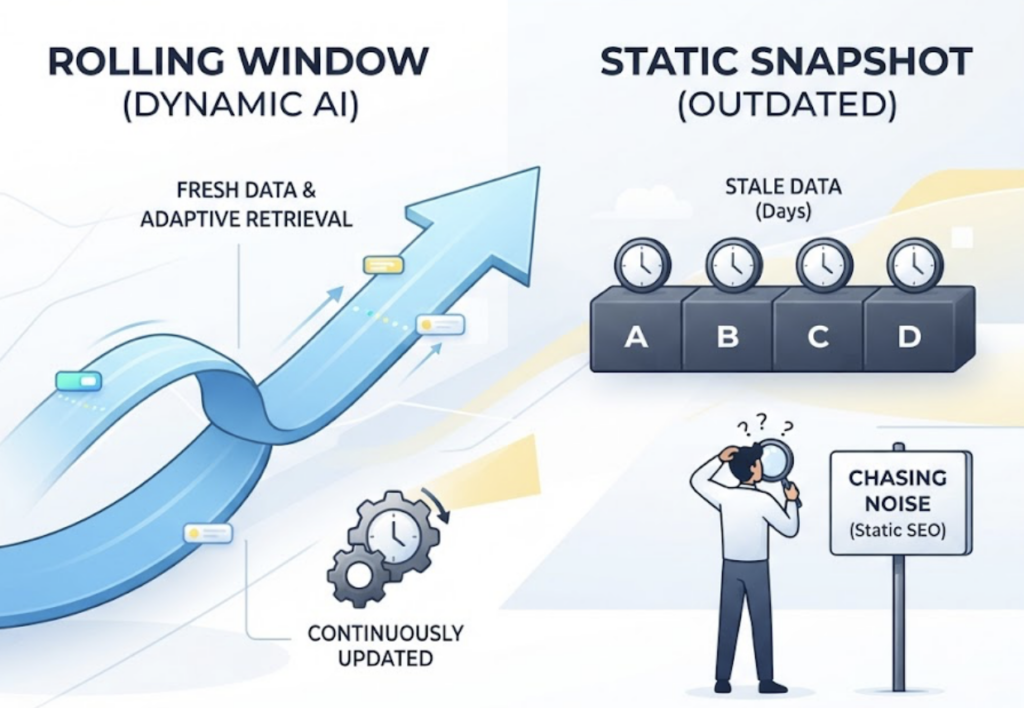
- Longitudinal aggregation. Roll results into 7-day or 30-day windows so you’re reading trends, not noise.
The rolling window is the piece manual workflows can’t replicate. AI models update their indexes and retrieval logic frequently, so snapshots go stale within days. As one analyst at ROI·DNA put it, treating AI performance like a static SEO rank means chasing noise instead of driving strategy.
The Four Metrics That Separate Signal from Vanity
Knowing how to measure an AI query tracking platform’s output starts with four core dimensions.
Visibility rate. The percentage of relevant AI responses that include your brand. This is your baseline: a brand at 12% visibility for its core prompts has a discovery problem, not a conversion problem.
Position, or salience. Where you appear in the answer. AI-generated responses concentrate attention heavily, and models tend to prioritize the first 30 to 40% of content, so a mention in position seven is worth a fraction of a mention in position two.
Sentiment and framing. How the AI describes you. “Enterprise-grade” and “a cheaper alternative” are both mentions, but they send buyers in different directions.
Source attribution. The domains fueling the AI’s answers. This is the upstream layer most teams miss: if Perplexity consistently cites G2 and an industry journal for your category, your visibility on those third-party sources matters as much as your own site. In practice, platforms like Topify operationalize this by tracking all four dimensions plus volume, intent, and a conversion visibility rate at the individual prompt level, so a drop in ChatGPT mentions can be traced back to the specific source that stopped citing you.
Five Mistakes That Turn Tracking Data into Noise
Even teams that buy the right tooling often undermine it in the setup phase. The recurring failures:
Trusting single samples. One query, one screenshot, one conclusion. Variance makes this meaningless.
Tracking only one AI platform. ChatGPT, Perplexity, and Gemini pull from different retrieval systems and cite different sources. Coverage on one says little about the others.
Monitoring branded queries instead of category queries. “What is [your brand]” flatters you. “Best [category] tool” is where buying decisions happen and where you’re most likely invisible.
Keeping the prompt library too small. Ten prompts can’t represent a category. Tracking a modest cluster of 50 prompts across three platforms manually already consumes dozens of hours weekly, which is exactly why teams under-sample.
Using SEO rank as a proxy. Ranking position and AI mention behavior are correlated at best. Plenty of page-one brands never appear in generated answers.
Avoid these five and even a basic setup starts producing decisions instead of dashboards.
Leading AI Visibility Optimization Tools, Compared
Once the framework is clear, the practical question becomes build versus buy. Some engineering-heavy teams consider scraping AI answers themselves, but the build-versus-buy math rarely favors building: fragile APIs, constant maintenance debt across five or more engines, and hidden cloud costs typically exceed a subscription within the first quarter.
Among the leading AI visibility optimization tools, the differences show up in engine coverage, metric depth, and whether the platform helps you act on the data or just look at it.
| Platform | Engine Coverage | Metric Depth | Execution Layer | Starting Price |
|---|---|---|---|---|
| Topify | ChatGPT, Gemini, Perplexity, AI Overviews, DeepSeek, Doubao, Qwen | 7 metrics per prompt | One-click strategy deployment | $99/mo |
| Self-built system | Depends on engineering capacity | Raw mentions only | None, data silo | Engineering time + API costs |
| Generic brand monitoring tools | Usually 1-2 AI engines | Mention alerts | None | Varies |
Topify covers the widest engine set in this group, including Chinese platforms like DeepSeek and Qwen, which matters for any brand with international buyers. Its analytics track visibility, sentiment, position, volume, mentions, intent, and CVR for every prompt in your library, and its prompt discovery engine surfaces high-value queries where your brand is currently dark, so the library grows with the market instead of freezing at setup.
The execution layer is the less obvious differentiator. Most tools stop at reporting. Topify maps citation gaps to content strategy and lets teams deploy an optimization plan in one click, which closes the loop between “we found a problem” and “we did something about it.”
Other tools in the category tend to focus on a narrower slice, often ChatGPT-only monitoring or citation alerts without competitive benchmarking. They can work for single-platform needs, but cross-engine coverage is where most category buyers end up.
A 30-Day Checklist to Build Your Baseline
A workable strategy for an AI query tracking platform rollout fits in one month:
- Week 1: Define 25 to 50 decision-stage prompts. Prioritize category queries and comparison queries over branded ones.
- Week 1: Select at least three AI platforms to sample. Match them to where your audience actually asks questions.
- Weeks 1-4: Let the platform sample continuously. Resist reading daily fluctuations; the 30-day rolling average is your baseline.
- Week 2: Run competitor benchmarking. Share of voice at the prompt level shows exactly which queries you’re losing.
- Week 3: Audit the citation supply chain. List the domains AI engines cite for your category and check your presence on each.
- Week 4: Convert gaps into a content plan. Missing citations and dark prompts become your editorial queue.
That’s the whole playbook. Baseline first, optimization second.
What AI Query Tracking Platform Pricing Looks Like in 2026
Pricing in this category generally scales with three variables: how many prompts you track, how many engines you cover, and how often answers are re-sampled.
Topify’s pricing is a representative reference point. Basic runs $99/month for 100 tracked prompts and 9,000 AI answer analyses across ChatGPT, Perplexity, and AI Overviews, with a 30-day trial. Pro is $199/month for 250 prompts and 22,500 analyses across 8 projects. Enterprise starts at $499/month with a dedicated account manager. Annual billing saves roughly 17%.
The sizing logic is straightforward: count your decision-stage prompts, add headroom for discovery, and pick the tier that fits. A brand with 60 core queries doesn’t need an enterprise contract on day one. Usage-based tiers exist precisely so you can start small and expand once the baseline data proves its value.
Compare that against the self-built alternative, where engineering hours and API usage costs are unpredictable and the output is often just rows in a database. Predictable subscription pricing is part of what you’re buying.
Conclusion
The dashboard you’ve relied on for a decade measures a channel that’s shrinking in relative importance. An AI query tracking platform measures the one that’s growing: the synthesized answers where 60% of queries now end. The brands building baselines today will have twelve months of trend data when their competitors are still taking screenshots.
Start with a 50-prompt library, sample across at least three engines for 30 days, and audit the sources feeding the answers. The gap between knowing and guessing has never been cheaper to close.
FAQ
Q: What is an AI query tracking platform?
A: It’s software that repeatedly samples how AI engines like ChatGPT, Perplexity, and Gemini respond to a defined set of user prompts, then measures whether a brand appears, where it’s positioned, how it’s framed, and which sources the AI cites.
Q: What are examples of AI query tracking platform use cases?
A: Common examples include monitoring share of voice for “best [category]” prompts against competitors, detecting when an AI engine starts describing a premium product as “budget,” and identifying third-party sites whose citations drive AI recommendations.
Q: How do I improve results from an AI query tracking platform?
A: Expand your prompt library beyond branded queries, act on citation gaps by building presence on the domains AI engines trust, and review 30-day rolling trends monthly instead of reacting to single-day changes.
Q: How often should AI answers be sampled?
A: Continuously, on an automated cadence. Because LLM outputs vary between identical runs, visibility is a distribution, and 7-day or 30-day rolling windows are the minimum for separating real trend shifts from model noise.

