

Your brand might rank on page one of Google. But if ChatGPT doesn’t mention you, a growing share of your potential customers will never find you.
That’s not a hypothetical. AI-powered search engines like Perplexity, ChatGPT Search, and Google AI Overviews are changing how people get answers. Instead of clicking through a list of blue links, users get synthesized responses drawn from sources the AI has already decided to trust. If your brand isn’t in that shortlist, you’re invisible at the moment of decision.
AI search optimization is the discipline that closes this gap.
What AI Search Optimization Actually Means
AI search optimization is the systematic process of improving how AI engines understand, reference, and recommend your brand. The goal isn’t a higher ranking. It’s citation-worthiness: the likelihood that an AI selects your content as a trusted source within a generated response.
That’s a fundamentally different target than traditional SEO.
| Dimension | Traditional SEO | AI Search Optimization |
|---|---|---|
| Primary goal | Higher SERP ranking | Cited as a trusted AI source |
| Success metric | CTR, organic traffic | Citation frequency, sentiment, share of model |
| Key driver | Backlinks and keyword volume | Contextual authority, semantic clarity |
| Output type | URL list | Synthesized natural-language answers |
| Engine behavior | Crawling and indexing | Retrieval-Augmented Generation (RAG) |
The shift matters because the two systems reward different things. You can have a strong backlink profile and still never appear in a ChatGPT response. AI visibility requires its own strategy.
How AI Search Engines Decide What to Recommend
When a user submits a query to an AI engine, the system doesn’t browse the web in real time. It runs a process called Retrieval-Augmented Generation (RAG): retrieve relevant documents from its corpus, evaluate their credibility, and synthesize an answer using an LLM.
The citation decision follows a clear hierarchy.
First, semantic completeness: the content must answer the query directly and comprehensively. AI models favor front-loaded answers where core information appears in the first 30% of the content. Second, entity authority: a brand is considered authoritative if it’s consistently mentioned across high-trust platforms like industry news sites, G2, or Trustpilot. Third, source verifiability: AI systems prefer content backed by original data or proprietary statistics, since these reduce the risk of hallucination.
Why Traditional SEO Isn’t Enough
A strong domain authority doesn’t translate automatically into AI citations. Keyword density doesn’t influence how an LLM weighs your content. The signals that move you up Google’s SERP and the signals that get you cited in a ChatGPT response are largely independent.
That’s the gap most brands still haven’t addressed.
5 Strategies That Actually Move the Needle
1. Build Content That Provides Information Gain
AI systems are specifically trained to deprioritize content that restates commonly available facts. To get cited, you need original insights, proprietary data, or a perspective that adds something new to the existing corpus. Think primary research, case studies, or expert analysis.
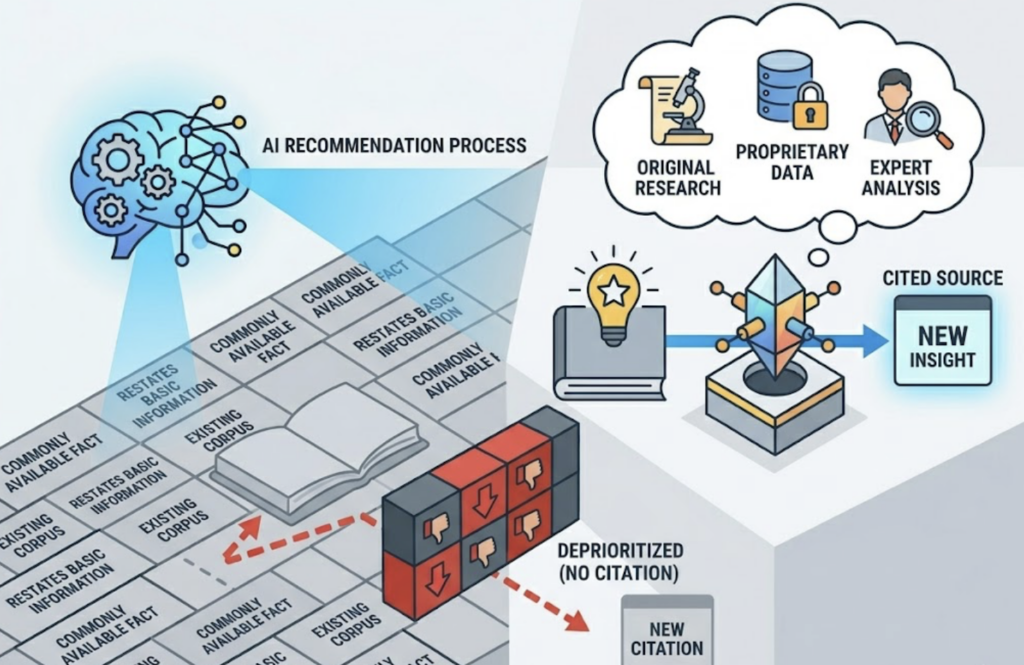
Generic content doesn’t earn citations. Authoritative content does.
2. Structure Content for Machine Extraction
Clean heading hierarchies (H1 through H3), clear HTML, and structured data markup make your content machine-readable. AI parsers extract information from well-structured documents far more reliably than from dense, unformatted prose.
FAQ sections, definition blocks, and comparison tables are all formats AI engines handle well. Adding an llms.txt file to your site provides a machine-readable summary of your most important content.
3. Expand Your Entity Footprint Across the Web
AI doesn’t only read your website. It aggregates signals from across the web. If your brand is consistently mentioned in industry forums, third-party review platforms, and news outlets, the model builds a richer, more authoritative entity profile for you.
Targeting only your own domain is a siloed strategy. Cross-web presence is how you build AI trust.
4. Monitor Prompt Coverage and Fill the Gaps
Your brand might be visible for some queries and completely absent for others. Identifying which prompts your audience actually uses, and tracking whether you appear in those specific AI answers, is the core operational loop of AI search optimization.
Topify‘s Competitor Monitoring and Source Analysis features surface exactly this: which prompts your competitors own, which domains AI engines are citing in your category, and where your brand has coverage gaps. You can track up to 250 prompts on the Pro plan and benchmark your citation share against direct competitors in real time.
5. Benchmark Against Competitors, Not Just Yourself
Your absolute visibility rate matters less than your relative position. If your main competitor is cited in 60% of relevant AI responses and you’re at 20%, that’s the gap you need to close, regardless of your raw score.
Competitor benchmarking gives you a map. Without it, you’re optimizing blind.
How to Measure AI Search Optimization Performance
Ranking positions aren’t the right proxy here. AI search optimization requires a different measurement framework.
Topify tracks seven metrics across major AI platforms including ChatGPT, Perplexity, Gemini, and Google AI Overviews:
| Metric | What It Measures |
|---|---|
| Visibility | Percentage of target prompts where your brand is cited |
| Sentiment | Whether AI mentions of your brand are positive, neutral, or negative (0-100 score) |
| Position | Your brand’s ranking order relative to competitors in AI responses |
| Volume | Estimated search volume for tracked AI prompts |
| Mentions | Raw frequency of brand citations across platforms |
| Intent | The user intent category behind prompts where you appear |
| CVR (Conversion Visibility Rate) | Likelihood that an AI answer guides a user toward your brand |
A Practical Measurement Checklist
| Task | Frequency |
|---|---|
| Track brand visibility across target prompts | Weekly |
| Review sentiment score and flag negative mentions | Weekly |
| Audit competitor position for top 20 prompts | Monthly |
| Identify new high-volume prompts in your category | Monthly |
| Review which domains AI is citing in your category | Monthly |
| Correlate AI visibility changes with direct traffic | Quarterly |
| Update content strategy based on citation gaps | Quarterly |
Start with a baseline. Without one, you can’t tell whether your optimization efforts are working.
Common Mistakes That Kill Your AI Visibility
Treating AI visibility like a rank-tracking project. Page-one Google rankings don’t guarantee a single ChatGPT citation. The two systems are independent. Brands that assume SEO success transfers to AI visibility consistently underperform.
Weak entity positioning. If your website doesn’t clearly define what your brand does and what problem it solves, AI models develop “entity ambiguity” about you. That ambiguity translates to fewer citations, or worse, inaccurate ones.
Mass-producing generic content. High-volume, undifferentiated content actively works against AI visibility. LLMs are trained to identify and deprioritize content that adds no new information. One authoritative piece outperforms twenty generic ones.
Ignoring external signals. Optimizing only your own website while ignoring third-party platforms misses most of how AI builds trust. Cross-web presence drives entity authority.
No baseline, no benchmark. Many teams optimize content without knowing their starting visibility rate. Without a baseline, you can’t measure ROI, justify budget, or identify what’s actually working.
Best Tools for AI Search Optimization
The AI search optimization tooling market is still relatively early, but a few platforms have emerged with purpose-built infrastructure for tracking and improving brand visibility in AI responses.
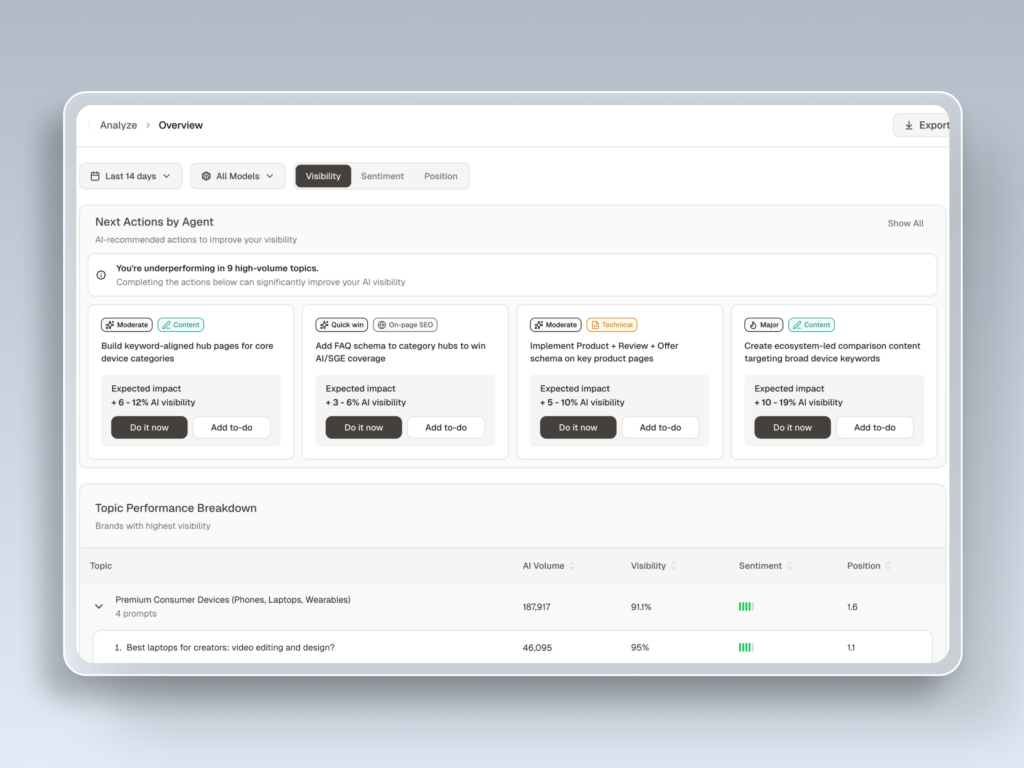
Topify covers the full workflow: prompt discovery, cross-platform visibility tracking across ChatGPT, Perplexity, Gemini, and DeepSeek, competitor benchmarking, source analysis, sentiment scoring, and one-click GEO strategy execution. It’s built specifically for this use case, which is why teams use it instead of adapting traditional SEO tools to a problem they weren’t designed to solve.
| Plan | Price | Key Limits |
|---|---|---|
| Basic | $99/mo | 100 prompts, 9,000 AI answer analyses, 4 projects |
| Pro | $199/mo | 250 prompts, 22,500 AI answer analyses, 10 seats |
| Enterprise | From $499/mo | Custom prompts, dedicated account manager |
A 30-day trial is available on the Basic plan. For teams that want managed execution rather than a self-serve platform, Topify also offers a full-service GEO package starting at $3,999/mo, which includes content production, Reddit visibility, and SEO alongside AI monitoring.
FAQ
What is AI search optimization?
AI search optimization is the process of improving how AI-powered search engines understand, reference, and recommend your brand. The goal is to increase citation frequency, sentiment quality, and position within AI-generated responses across platforms like ChatGPT, Perplexity, and Google AI Overviews.
How does AI search optimization work?
AI engines use a process called Retrieval-Augmented Generation (RAG): they retrieve relevant documents, evaluate credibility, and synthesize an answer. Optimization means making your content more authoritative, better structured, and more widely referenced so that the AI selects it as a trusted source.
What are examples of AI search optimization?
Common tactics include publishing original research to establish topical authority, adding structured data markup so AI can parse your content, expanding brand presence on third-party platforms to build entity authority, and monitoring which prompts your competitors own so you can target the gaps.
What’s the difference between AI SEO and traditional SEO?
Traditional SEO targets search engine rankings using backlinks and keyword optimization. AI search optimization targets citation inclusion in AI-generated answers, which is driven by semantic authority, structured content, and cross-web entity presence. The signals, tools, and success metrics are largely distinct.
How much does AI search optimization cost?
Self-serve platforms like Topify start at $99/month. Managed GEO services typically run $3,999-$5,999/month and include content production and active optimization alongside monitoring.
How do I measure AI search optimization performance?
The core metrics are visibility rate (what percentage of target prompts your brand appears in), sentiment, position relative to competitors, and CVR (the likelihood an AI answer leads to a brand interaction). Tools like Topify track all seven of these metrics across major AI platforms.

