

Your brand ranks #1 on Google. You’ve optimized every meta tag, earned the backlinks, and the organic traffic is solid. Then someone asks ChatGPT to recommend a solution in your category, and your brand doesn’t appear once.
That’s not a fluke. It’s a structural gap that traditional analytics can’t even detect.
AI search monitoring analytics is the discipline built to close that gap. It tracks how AI models mention, cite, and position your brand across platforms like ChatGPT, Perplexity, and Gemini, giving you the data layer that Google Search Console was never designed to provide.
What AI Search Monitoring Analytics Actually Measures
Traditional SEO focuses on a single dimension: where does your page rank for a given query? AI search analytics operates on a completely different model.
When an AI engine generates a response, it synthesizes information from across its training data and live sources. Your “position” in that output isn’t a URL slot. It’s whether your brand gets mentioned at all, where in the response it appears, and what the AI says about you.
That requires a different set of metrics. Five of them matter most:
Visibility Rate tracks how often your brand appears across a standardized library of high-intent industry prompts. Think of it as share of answer, not share of SERP.
Position Rank measures where in the AI response your brand appears. The first cited source captures significantly higher trust than the third or fourth mention buried in a list.
Sentiment Score evaluates tone. Being mentioned as “the expensive, slow option” in a comparison is technically a mention. It’s not a win. AI models synthesize attitude, not just facts.
Citation Source Authority monitors which domains the AI consistently cites alongside your brand. LLMs pull from “consensus” across the web, not just the highest-authority single source.
AI Search Volume (Proxy) estimates the downstream impact of AI visibility on brand-driven search behavior. Since LLM environments are largely zero-click, tracking spikes in branded Google searches is the most reliable proxy for AI-driven intent.
Why Your LLM Rank Tracker Tool Is Probably Missing Half the Picture
Most teams that want a rank tracker tool for LLM visibility make the same mistake: they apply their existing SEO toolset and expect it to work.
It doesn’t.
Traditional rank trackers are built to scrape SERP positions for specific keywords. They pull a URL, find a ranking, log a number. That logic breaks completely in a generative environment where there are no blue links, no SERP slots, and no concept of “page 1.”
A standard rank tracker won’t tell you whether ChatGPT mentioned your brand in response to a category-level question. It won’t detect that Perplexity is recommending a competitor while your brand is absent. It won’t flag that the AI’s description of your product is outdated by 18 months.
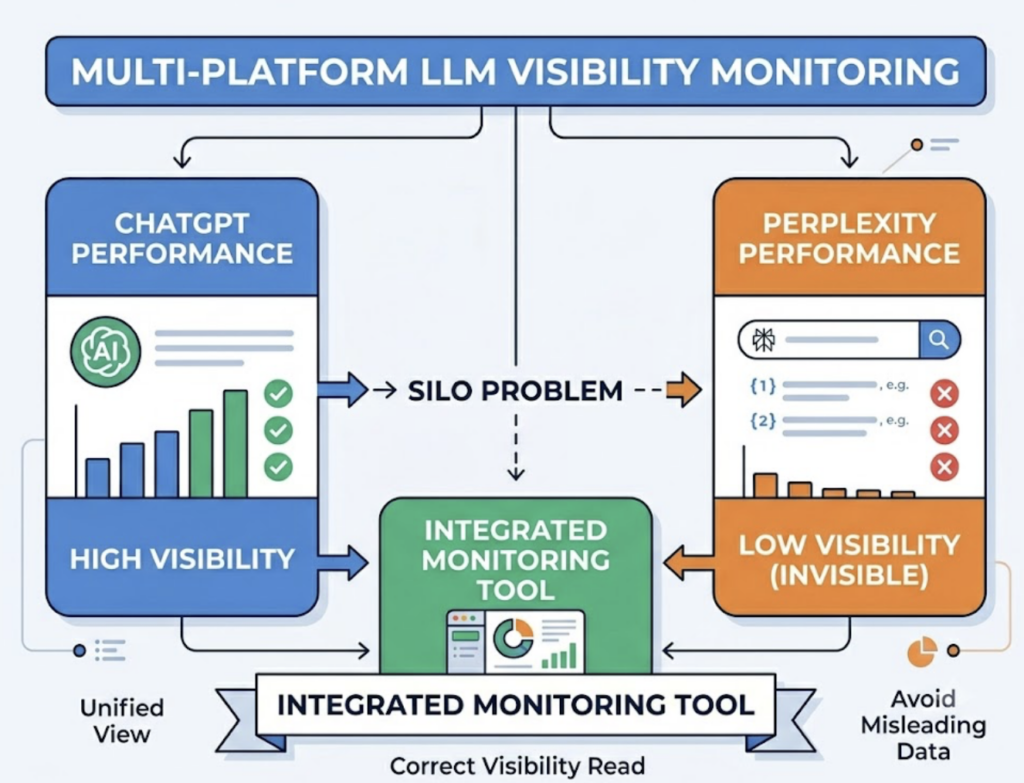
There’s also the platform silo problem. A brand might perform well in ChatGPT responses but be nearly invisible in Perplexity, which pulls from different data sources and weights citations differently. A tool that only monitors one engine gives you a misleading read on your actual LLM visibility.
The measurement gap is real, and it’s widening. Every week that passes without proper AI search monitoring is a week of compounding missed data.
How AI Search Monitoring Analytics Works, Step by Step
Understanding the technical pipeline helps you evaluate whether a tool is actually doing the job or just showing you a dashboard.
Step 1: Prompt Simulation. The system engineers a library of questions that represent how your target audience actually searches in AI environments. These aren’t keyword lists. They’re natural language prompts like “What’s the best project management tool for remote teams?” or “Which CRM is recommended for B2B SaaS companies?” A good library runs 50 to 100 prompts covering both branded and unbranded category queries.
Step 2: LLM Response Parsing. The platform executes those prompts via API or headless interaction and extracts the raw AI responses. This is where the actual data is captured: who got mentioned, in what order, with what language.
Step 3: Cross-Platform Aggregation. The same prompts run across multiple models. GPT-4o, Gemini, Perplexity, Claude, and others each have different training data, different citation behaviors, and different “personalities.” Aggregating across platforms gives you a real picture, not a single-engine snapshot.
Step 4: Trend Analysis. The system maps visibility, sentiment, and citation sources over time. This is where monitoring becomes actionable. If you publish a new article, earn coverage in a major publication, or update your structured data, you need to know whether any of it actually shifted the AI’s response about your brand.
This pipeline can’t be replicated with manual spot-checks. The scale and frequency required make automation non-negotiable.
5 Common Mistakes Brands Make When Monitoring AI Search
Most of the teams that struggle with AI search monitoring aren’t missing resources. They’re applying the wrong mental model.
Mistake 1: Only monitoring branded queries. Searching for your own brand name tells you how AI describes you to people who already know you exist. It misses the discovery phase entirely, the moment someone asks “what’s the best tool for X” and AI either includes or excludes you.
Mistake 2: Assuming Google rank equals AI visibility. If your page isn’t structured in a way that’s easy for an LLM to extract and quote directly, the model will skip it even if it’s ranking #1. AI engines value clarity, conciseness, and factual extraction. A page optimized for click-through rate isn’t the same as a page optimized for citation.
Mistake 3: Ignoring sentiment. Appearing in an AI comparison list as “suitable for users on a budget who don’t need advanced features” is a brand problem dressed up as a visibility win. Monitoring mentions without monitoring tone gives you incomplete data.
Mistake 4: The platform silo trap. Brands often check one AI engine and extrapolate. In practice, different LLMs cite different sources, pull from different data vintages, and weight consensus signals differently. A multi-platform read is the only accurate read.
Mistake 5: No competitor benchmarking. Knowing your own visibility score in isolation tells you very little. The relevant question is always relative: are you appearing more or less often than the two competitors your audience is also considering?
A Practical Checklist for AI Search Monitoring Analytics
If you’re building or auditing an AI search monitoring setup, use this as a baseline:
- Prompt library maintained at 50-100 queries, covering both branded and unbranded category questions
- Multi-platform coverage across at least ChatGPT, Perplexity, and Gemini
- Visibility rate tracked weekly, not just at campaign milestones
- Sentiment score logged for each major prompt cluster, not just averaged across all queries
- Citation audit running monthly, identifying which third-party domains (forums, review sites, industry publications) are consistently cited when AI discusses your category
- Competitor benchmarking active for at least two direct competitors, with position tracking to detect shifts
- Content structured for extractability on high-priority pages, leading with a direct “quotable” answer rather than a long preamble
- Schema markup in place to help LLMs explicitly connect your brand to your products, use cases, and industry
This isn’t a one-time setup. AI models update. Citation patterns shift. A monitoring system that isn’t refreshed becomes stale faster than most teams expect.
The Best Tool for LLM Visibility: What to Look For (and Where Topify Fits)
The market for LLM visibility tools has grown quickly, and the quality gap between them is significant. The right tool for LLM visibility needs to do more than count mentions.
Here’s what actually matters:
| Capability | Why It Matters |
|---|---|
| Multi-platform coverage | Single-engine tools produce misleading data |
| Prompt simulation at scale | Manual spot-checks don’t scale to 100+ prompts |
| Sentiment analysis | Mentions without tone context are incomplete |
| Competitor benchmarking | Absolute scores without relative context aren’t actionable |
| Citation source tracking | Understanding why AI cites certain domains drives content strategy |
| Trend data over time | Point-in-time snapshots don’t show whether your actions are working |
Topify is built around all six of these. The platform runs seven core metrics: visibility, sentiment, position, volume, mentions, intent, and CVR (Conversion Visibility Rate). It covers ChatGPT, Gemini, Perplexity, DeepSeek, and several other major AI platforms, including non-English ones relevant to global brands.
Where Topify separates from simpler monitoring tools is in the execution layer. Most platforms stop at data. Topify’s One-Click Execution lets you define a GEO goal in plain English, review the proposed strategy, and deploy it without manual workflows. The platform’s Source Analysis also reverse-engineers the exact domains and URLs AI platforms cite, so you can identify whether your brand or your competitors dominate those references.
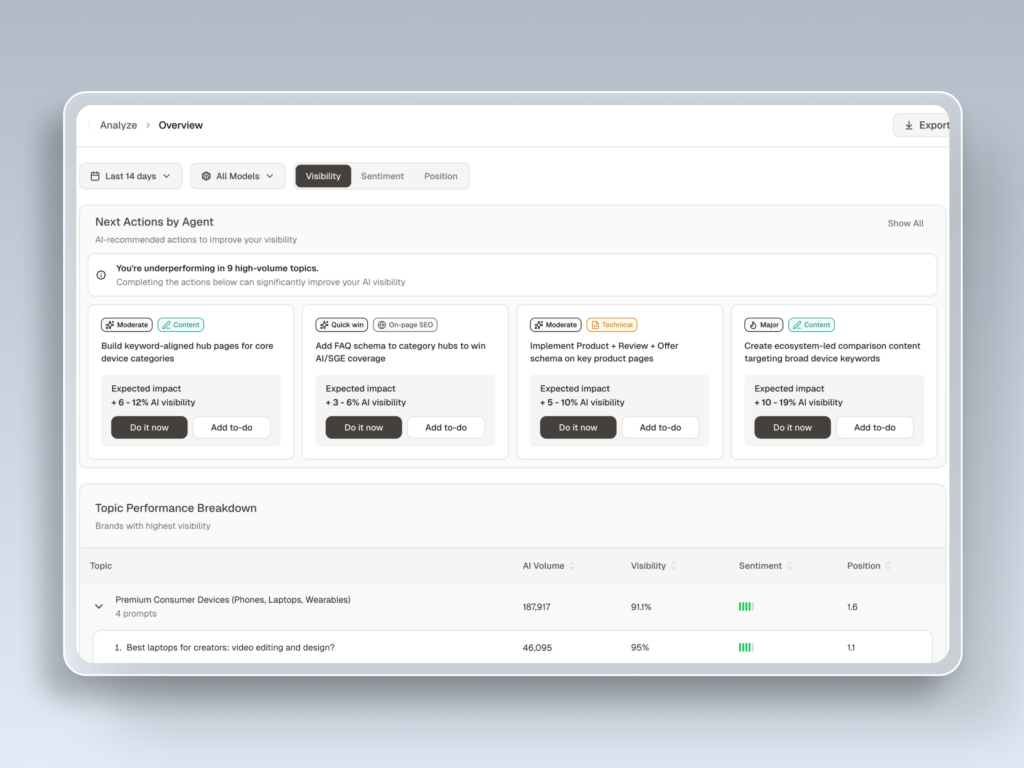
It’s not a passive dashboard. It’s a monitoring and action system.
AI Search Monitoring Analytics Pricing: What to Expect
Entry-level AI search monitoring tools typically start around $99/month. That’s roughly where the basic tier of a purpose-built platform begins to make economic sense for a marketing team running active brand monitoring.
Here’s how Topify’s tiers map to common use cases:
| Plan | Price | Best For |
|---|---|---|
| Basic | $99/mo | Startups and small teams running 100 prompts across 4 projects |
| Pro | $199/mo | Growth teams needing 250 prompts, 10 seats, and deeper competitive analysis |
| Enterprise | from $499/mo | Large brands requiring custom coverage, dedicated account management, and API access |
The $99 Basic plan covers ChatGPT, Perplexity, and AI Overviews tracking with 9,000 AI answer analyses per month. That’s sufficient for a single brand in a focused category. Teams managing multiple brands or clients need the Pro tier, which expands to 22,500 answer analyses across 8 projects.
See the full breakdown on Topify’s pricing page.
One practical note: the ROI calculation on AI search monitoring isn’t complicated. If AI-influenced purchase decisions are growing in your category (and in most B2B and high-consideration B2C categories, they are), the cost of not monitoring is real and compounding. A month of missed data is a month of optimization you can’t recover.
Conclusion
Google rank is no longer the complete picture. As AI search becomes a primary discovery channel for high-intent buyers, the brands that build systematic monitoring now will have a structural advantage over those who add it reactively later.
The discipline of AI search monitoring analytics isn’t complex. It requires the right metrics, multi-platform coverage, a consistent prompt library, and tools that can turn data into action. If you’re starting from zero, get started with Topify and run a baseline visibility check across your core category prompts. The data will tell you more about your actual competitive position than your current SEO dashboard can.
FAQ
Q: What is AI search monitoring analytics?
A: It’s the practice of tracking how AI models like ChatGPT, Perplexity, and Gemini mention, cite, and characterize your brand in their responses. It measures visibility rate, sentiment, position, and citation sources across a standardized prompt library, giving you the equivalent of rank tracking for LLM environments.
Q: How do you measure AI search monitoring analytics?
A: The core measurement framework uses five metrics: visibility rate (how often your brand appears across high-intent prompts), position rank (where in the response you’re cited), sentiment score (what tone the AI uses), citation source audit (which domains the AI pulls from), and competitor benchmarking (your visibility relative to direct rivals). Platforms like Topify automate all five.
Q: How to improve AI search monitoring analytics results?
A: The highest-leverage actions are restructuring key pages to lead with a direct, extractable answer (sometimes called the “atomic answer” format), building citations on third-party sources like industry publications and review sites that LLMs treat as consensus signals, and implementing entity-focused schema markup to help AI systems accurately associate your brand with your category and use cases.
Q: What are examples of AI search monitoring analytics in practice?
A: A SaaS company runs weekly prompt simulations across 80 category queries and discovers their brand appears in 34% of ChatGPT responses but only 11% of Perplexity responses. They identify that Perplexity heavily cites a review aggregator where their profile is outdated. They update the profile, earn two new industry publication mentions, and Perplexity visibility moves to 28% over the following six weeks. That’s the monitoring-to-action loop working correctly.

