

Your team can tell you exactly how many people clicked through from Google last quarter. You can pull bounce rates, session duration, and conversion paths down to the individual page. But ask a simpler question, what does ChatGPT say about your brand when a buyer asks for a recommendation in your category, and the dashboard goes quiet.
That gap isn’t a reporting oversight. Traditional analytics were built to measure what happens after someone lands on your site. The decision that sends them there, or doesn’t, now often happens inside an AI answer you never see. AI response monitoring analytics exist to close that blind spot.
What AI Response Monitoring Analytics Actually Measure
AI response monitoring analytics is the practice of turning unstructured LLM outputs into structured, trackable data points. Instead of guessing how AI assistants describe you, you measure it.
Here’s the key distinction. Traditional analytics measure outbound traffic: clicks, sessions, conversions. AI monitoring measures inbound influence: presence, context, and authority. It doesn’t track your position in a list of blue links. It tracks whether your brand entity exists inside the model’s working knowledge, and how the model chooses to surface you when answering a real prompt.
That’s a different unit of measurement than anything in your current stack. You’re no longer asking “did they visit,” but “did the AI mention us, frame us accurately, and recommend us before a competitor.”
How AI Response Monitoring Analytics Work, Step by Step
Monitoring a generative system is harder than scraping a search results page, because the output isn’t fixed. Ask the same question twice and the wording shifts. So the work depends on continuous sampling, not one-time checks.
Most monitoring pipelines run four stages:
- Baseline construction. Teams build a “golden set” of 50 to 200 prompts that mirror real high-intent buyer queries, like “What are the best enterprise CRMs for small teams?”
- Cross-platform sampling. Automated systems feed those prompts into multiple engines at once, typically ChatGPT, Perplexity, Claude, Gemini, and Google AI Overviews.
- Natural language parsing. The responses get processed with NLP to extract brand and competitor entity mentions.
- Signal aggregation. The raw mentions are normalized into metrics so you can watch drift over time as models retrain or change their citation patterns.
That last point matters more than it sounds. Models update often, sometimes weekly, so a brand can lose visibility overnight without any change on its own site.
The Metrics That Make AI Visibility Monitoring Useful
The fastest way to waste a monitoring budget is to count total mentions and call it a day. Effective AI visibility monitoring tracks a small set of metrics that each answer a specific business question.
| Metric | The question it answers |
|---|---|
| Visibility Score | Are we showing up in our core category conversations at all? |
| Mention Rate | How consistently do we land in the AI’s recommendation list? |
| Citation Share | Is the AI trusting us enough to link to us as a source? |
| First-Mention Position | Are we the top pick, or a footnote near the end? |
| Sentiment Index | Is the AI describing us accurately and favorably? |
| Entity Accuracy | Is the AI hallucinating basic facts, like our founding date or pricing? |
The gap between Mention Rate and Citation Share is often the most revealing number. High mentions with low citations point to an authority deficit: the AI knows who you are, but doesn’t trust your domain enough to cite it.
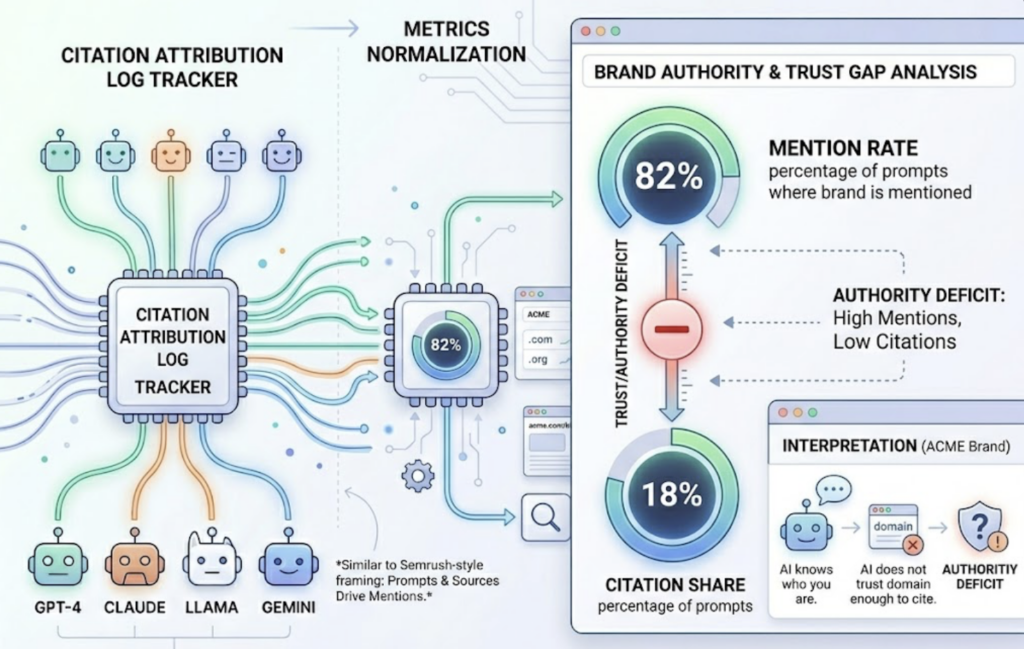
That’s the signal most brands miss. They celebrate being named while quietly losing the source layer to a competitor.
Common Mistakes in AI Response Monitoring Analytics
Knowing how to measure AI response monitoring analytics is only half the job. The other half is avoiding the errors that make the data misleading.
Four mistakes show up again and again.
The vanity mention trap. Counting mentions without context. A mention inside a negative comparison isn’t a win, it’s a reputational risk you’re miscounting as success.
Snapshot bias. Judging AI performance from a single audit. Because models shift constantly, a one-time check tells you about one moment, not a trend.
Siloed reporting. Treating AI data as unrelated to SEO. In practice they’re interdependent, since AI models often pull from the same high-authority content your SEO program already works to strengthen.
Ignoring the citation-to-mention gap. Tracking mentions but never checking whether the AI actually links to you. That gap is where authority quietly leaks to competitors.
How to Improve and Measure AI Response Monitoring Analytics
Improving your numbers means shifting from keyword optimization to entity and source optimization. The strategy is less about ranking for a phrase and more about becoming a source the model trusts.
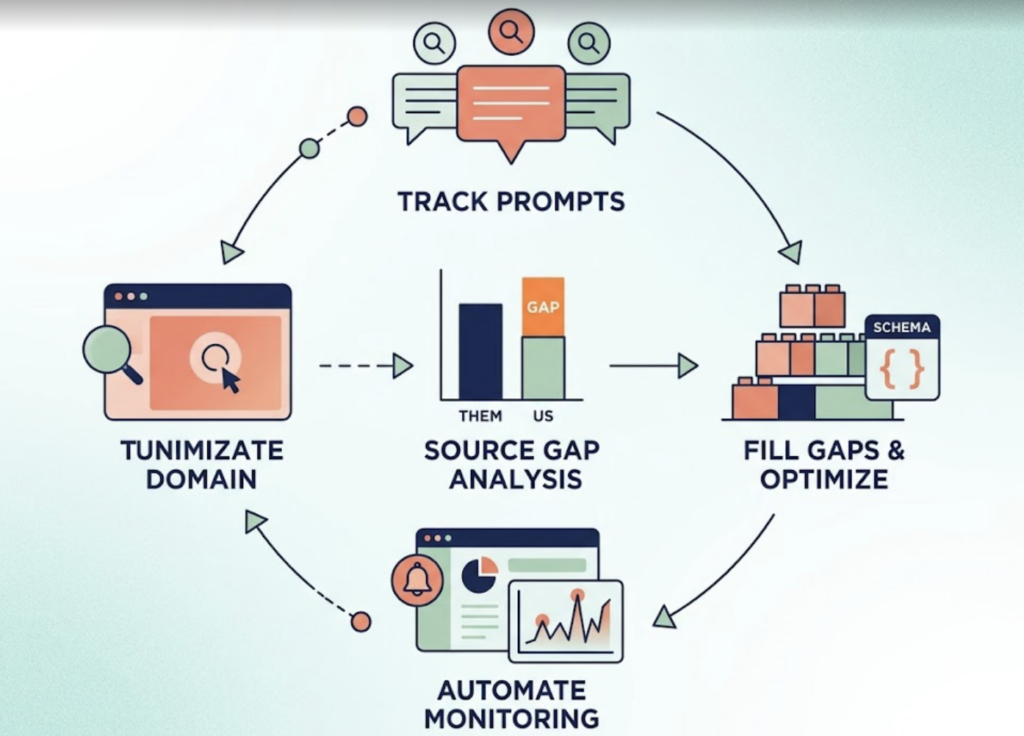
A practical sequence works like this. Start by tracking your north-star prompts, the queries that define your category. Then run a source gap analysis: identify the domains the AI cites instead of you, and shape your content roadmap to fill those gaps. Make your information easy to extract with clean schema markup and answer-first summaries. Finally, automate the monitoring so anomalies surface on their own instead of waiting for a quarterly review.
This is where a dedicated platform earns its place. For teams tracking influence across several engines, Topify tends to stand out by folding Visibility, Sentiment, Position, and Citation data into a single view through its comprehensive GEO analytics. In practice, that means you can spot a drop in ChatGPT mentions and trace it to a specific source that stopped citing your brand, all in one dashboard.
It also leans on its Source Analysis to reverse-engineer which exact domains and URLs each engine cites, so the source gap stops being guesswork. With one-click execution, a flagged anomaly like a falling citation share can route straight into a content action instead of a backlog ticket.
Best Tools for AI Response Monitoring Analytics, Compared
When you evaluate AI search visibility monitoring tools, three capabilities separate useful platforms from dashboards that just look busy.
Multi-platform coverage comes first. Monitoring only ChatGPT gives you a skewed view, since your audience also asks Perplexity, Gemini, and AI Overviews. Second is citation-layer analysis, the ability to see the precise URLs an engine cites. Third is automated alerting, so a sentiment shift or visibility drop reaches you in real time rather than at quarter’s end.
Pricing for AI visibility monitoring tools generally scales with prompt depth and update frequency. Entry-level tracking starts around $99 per month, while enterprise systems for global brands begin near $499 per month. Here’s how Topify’s tiers map to those capabilities, with full detail on its pricing page:
| Capability | Basic, $99/mo | Pro, $199/mo | Enterprise, from $499/mo |
|---|---|---|---|
| Prompts tracked | 100 | 250 | Custom |
| Engine coverage | ChatGPT, Perplexity, AI Overviews | 4+ engines | Multi-engine, custom |
| Analytics depth | Visibility and mentions | Sentiment and citation | Full source gap analysis |
| Execution | Manual review | Guided actions | Dedicated account manager |
Other categories of tools handle parts of this well. Some focus on a single engine, others on alerting alone. The trade-off is coverage versus depth, and the right pick depends on how many engines and prompts your category actually demands.
A Quick Checklist Before You Start Monitoring
Before you commit to a tool, a short setup pass prevents most of the mistakes above.
- Define intent. Pick 50 to 100 prompts drawn from real search data, not an internal brainstorm.
- Set cadence. Match monitoring frequency to your industry’s volatility, weekly for fast-moving tech, monthly for stable B2B.
- Identify peers. Define a competitor baseline so you can measure your Share of Model, not just your own mentions.
- Integrate. Connect the AI monitoring dashboard to your existing SEO reporting stack so the two data streams inform each other.
Run through this before you get started and your first month of data will be a usable baseline rather than noise.
Conclusion
The blind spot is real: your analytics stack can describe everything that happens on your site and nothing about the AI answer that decides whether buyers ever reach it. AI response monitoring analytics is how you make that invisible layer measurable.
Start small. Build a prompt baseline, monitor across more than one engine, and watch the gap between mentions and citations. Once those signals are stable, layer in source analysis and competitor benchmarking to turn the data into action. Track it, understand why the AI recommends what it does, then close the gaps.
FAQ
Q: What is AI response monitoring analytics?
A: It’s the practice of quantifying your brand’s presence, authority, and narrative framing inside the generated responses of LLMs like ChatGPT, Perplexity, and Gemini. It converts unstructured AI answers into trackable metrics such as visibility, sentiment, and citation share.
Q: Can you give examples of AI response monitoring analytics in action?
A: A common one: a brand ranks #1 on Google for “best CRM” but is never recommended by ChatGPT, because the model keeps citing a competitor’s comparison guide instead. Monitoring surfaces that gap, so the team knows to publish a more authoritative guide and recover the citation.
Q: How much does AI response monitoring analytics cost?
A: Pricing usually scales with the number of prompts tracked and how often they’re refreshed. Entry-level tools start around $99 per month, mid-tier plans land near $199 per month, and enterprise systems for global brands begin at $499 per month or more.
Q: How is this different from traditional web analytics?
A: Traditional analytics measure what happens after a user leaves the search engine and reaches your site. AI monitoring measures what happens before they even know your brand exists, at the moment the AI is synthesizing an answer to their question.

