

Search “best visibility tracking tools” and every platform on the first page says the same thing: track your brand across ChatGPT, Perplexity, and Google AI Overviews. What none of them tell you upfront is what they actually measure. Some count how many times your name appears. Others stop at a citation link. Very few show you how the model describes you, where you rank against competitors, or why a rival keeps getting recommended instead. So you end up comparing dashboards that look identical and price differently, with no clear way to tell which one answers the question that matters: not whether AI mentions you, but how it talks about you.
Why Mention Counts Aren’t AI Response Monitoring
Most teams start by counting mentions. They run their brand name through ChatGPT a few times, see it show up, and call it a win. That number feels reassuring, and it tells you almost nothing.
A mention only confirms the model knows you exist. It doesn’t tell you whether you were recommended first or buried in a footnote, whether the description matched your positioning, or whether the AI linked to your site as the source. HubSpot’s guide to AI citation tracking draws the same line: a mention reflects recall, while a citation attributes information directly to your domain and is becoming the trust signal that counts.
AI response monitoring is the systematic version of that distinction. Instead of asking “how often does my name appear,” it asks how language models represent your brand across the prompts your buyers actually type.
That representation has three moving parts. Position, or whether you’re the top pick or an afterthought. Sentiment, or whether the model frames you as a leader or a legacy option. And citation, or whether it trusts your content enough to link to it.
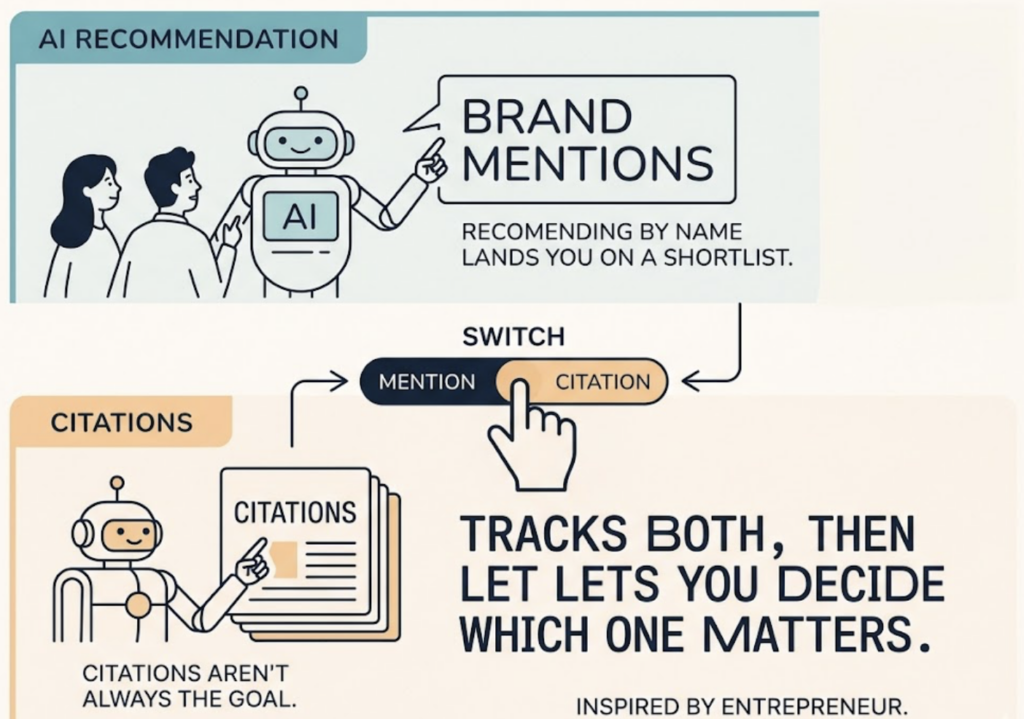
Here’s the catch most comparison lists miss. Citations aren’t always the goal. In many commercial contexts, Entrepreneur argues that brand mentions move the needle more than citations, because the AI recommending you by name is what lands you on a shortlist. The right tool tracks both, then lets you decide which one matters for a given prompt.
This shift isn’t optional anymore. Roughly 60% of searches now end without a click, and 31% of Gen Z users start their queries inside AI tools rather than a search bar. If you’re not watching what those answers say, you’re flying blind on a channel that’s already shaping demand.
How AI Response Monitoring Works in Practice
The method that separates real monitoring from spot-checking is prompt-level tracking. You don’t track keywords. You track a fixed set of prompts that mirror real buyer intent, run on a schedule.
Built In describes the same approach: build prompt clusters grouped by intent, such as product comparisons or “best tool for X,” then run them consistently across ChatGPT, Perplexity, Google AI Overviews, and Gemini.
The reason cadence matters is that AI answers are non-deterministic. Ask the same question twice and you can get two different brand lists. A single screenshot proves nothing. What you need is the probability that you appear over dozens of runs, tracked over weeks.
That’s the gap most brands still can’t see.
Once you’re capturing responses at scale, the analysis becomes about displacement: spotting the moment a competitor enters an answer where you used to be, then tracing it back to the source that shifted.
The Best Visibility Tracking Tools for AI Response Monitoring
Here’s how the current crop of platforms stacks up. The dividing line isn’t features, it’s depth: how many engines they cover, and whether they go past mention counts into position, sentiment, and citation source.
| Tool | Engine coverage | Tracks beyond mentions | Starting price | Best for |
|---|---|---|---|---|
| Topify | ChatGPT, Gemini, Perplexity, AI Overviews, plus DeepSeek, Doubao, Qwen | Position, sentiment, citation source, competitor benchmarking, CVR | $99/mo | Teams that want monitoring plus execution |
| Lebesgue | Major AI engines | Visibility tied to traffic and conversion | Varies | Ecommerce and high-intent brands |
| Conductor | ChatGPT, Gemini, Perplexity | SEO rankings plus AEO in one view | Enterprise | Enterprise SEO-to-AEO teams |
| Allmond | Multiple LLMs, 60+ countries | Prompt-level monitoring at country scale | Varies | Agencies and multi-brand teams |
| Otterly AI | ChatGPT, Perplexity, AI Overviews | Share of voice, prompt monitoring | Varies | GEO-focused single brands |
Now the detail behind the ranking.
Topify: Built for AI Response Monitoring and the Action After It
Most tools stop at the dashboard. They show you a number and leave the next step to you. Topify is built around the assumption that monitoring is only useful if it leads somewhere.
On the monitoring side, it tracks your brand across ChatGPT, Gemini, Perplexity, and Google AI Overviews, and extends into engines most platforms skip, including DeepSeek, Doubao, and Qwen. For brands with audiences outside the US, that coverage matters more than it sounds.
What makes it a full response-monitoring tool, not a mention counter, is the metric set. Visibility Tracking shows how often you appear. Position Tracking shows where you rank against competitors inside a given answer. Sentiment Analysis scores how the model describes you on a 0 to 100 scale. Source Analysis reverse-engineers the exact domains AI cites, so you can see whether your content or a competitor’s is feeding the answer.
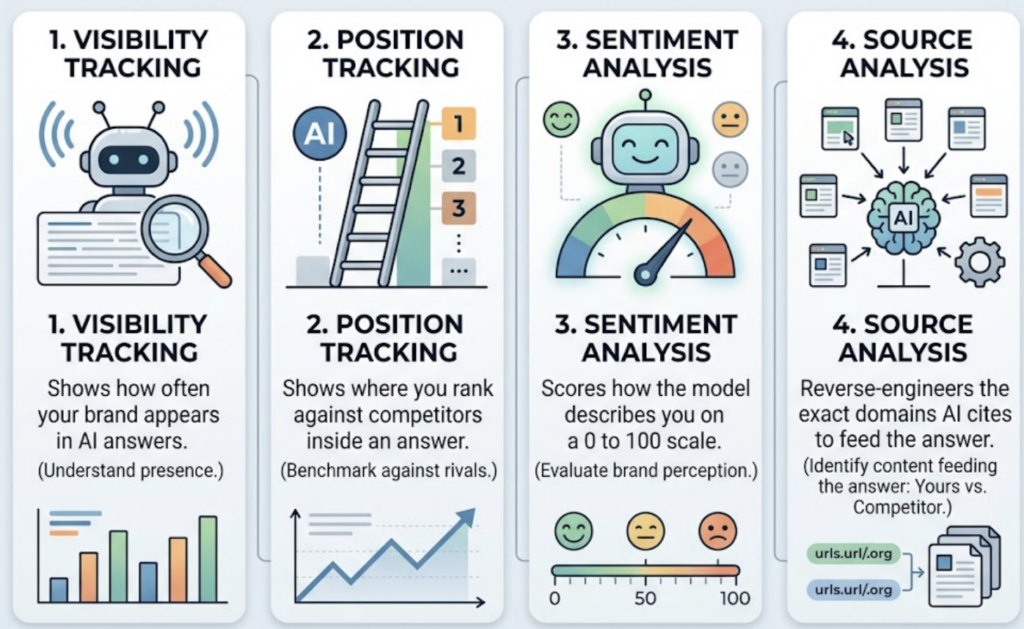
Here’s where it gets practical. Say your ChatGPT mentions drop one week. With most tools, you’d see the dip and start guessing. With Topify’s combined view, you can trace it to a specific source that stopped citing you, check whether a competitor took your position, and read how the sentiment shifted, all in the same dashboard.
Competitor Monitoring runs alongside this, detecting rivals automatically and benchmarking your visibility, sentiment, and position against theirs in real time.
Then there’s the part that separates it from pure analytics. One-Click Execution lets you state a goal in plain English, review the proposed GEO strategy, and deploy it without building a manual workflow. The monitoring data feeds the action, and the action feeds the next round of monitoring.
On pricing, the Basic plan starts at $99 per month and covers ChatGPT, Perplexity, and AI Overviews tracking with 100 prompts and a 30-day trial. Pro runs $199 per month for 250 prompts, and Enterprise starts at $499 with dedicated support. For a team replacing manual prompt checks, that tends to pay for itself in the hours it saves.
It’s a reasonable fit for marketing teams, SEO professionals moving into GEO, and agencies reporting AI visibility to clients. You can get started with a trial before committing.
Other Visibility Tracking Tools Worth Knowing
No single tool wins for every team. A few alternatives are worth a look depending on your priorities.
Lebesgue leans toward ecommerce, tying AI visibility to downstream traffic and conversion data, which suits high-intent retail brands. Conductor is built for enterprise teams that want traditional SEO rankings and answer-engine optimization bridged inside one dashboard.
Allmond handles prompt-level monitoring across 60-plus countries and multiple LLMs, which makes it a fit for agencies juggling several brands. Otterly AI focuses on generative engine optimization with prompt monitoring designed to mimic how real users query AI interfaces. Peec AI emphasizes source identification and competitor benchmarking, with granular data on why specific sources earn citations.
Each does one thing well. The question is whether you need that one thing, or a platform that connects monitoring to action.
How to Choose the Right AI Response Monitoring Tool
Start with your use case, not the feature list. The best visibility tracking tool for a solo founder running monthly checks is rarely the same one an agency needs.
Run through a short checklist before you commit:
- Does it cover every engine your audience uses, or just ChatGPT? Single-platform tracking leaves blind spots.
- Does it go past mentions into position, sentiment, and citation source? If it only counts names, it’s a vanity metric in a nicer wrapper.
- Does it monitor on a recurring schedule, or rely on one-off snapshots? Non-deterministic answers demand repeated sampling.
- Does it connect to action, or hand you a dashboard and walk away?
- Can you cancel monthly? The space moves fast, and annual lock-in without proven value is a real risk.
If you manage one brand and check quarterly, a lighter tool may be enough. If you report to clients or a leadership team, you’ll want multi-engine coverage, competitor benchmarking, and a number you can defend.
Common Mistakes That Make AI Response Monitoring Useless
Even with a good tool, teams undercut themselves in predictable ways. Entrepreneur catalogs several of the most common, and they line up with what the data shows.
The volume trap is first. Chasing mention counts over citation authority feels productive, but presence without trust doesn’t win recommendations.
Static monitoring is second. A single screenshot ignores the non-deterministic nature of AI. You need the probability of appearance over time, not one lucky result.
Treating GEO and SEO as separate silos is third. AI engines weigh the same trust signals, including reviews, editorial mentions, and technical authority, that traditional search rewards. Splitting the two wastes effort.
Ignoring localized context is fourth. AI responses vary by region, so global-only reporting hides how you perform in the markets that matter.
And the quiet one: tracking performance with dashboard numbers that don’t connect to anything real. If your visibility score can’t be tied to traffic, pipeline, or a specific action, it’s decoration.
Conclusion
AI response monitoring isn’t about gaming an algorithm. It’s about knowing, with evidence, how language models describe and recommend your brand, then acting on what you find.
The tool you pick should match how your team works: enough engine coverage to avoid blind spots, metrics that go past mention counts, and a path from insight to action. Start by defining the prompts your buyers actually ask, run them on a schedule, and watch position and sentiment, not just whether your name shows up. The brands that treat this as a measurable channel, not a curiosity, are the ones AI keeps recommending.
FAQ
Q: What is AI response monitoring?
A: It’s the systematic tracking of how AI engines like ChatGPT, Perplexity, and Gemini represent your brand across a fixed set of prompts. Instead of counting how often your name appears, it measures position, sentiment, and whether the AI cites your content, giving you a picture of how models actually talk about you over time.
Q: How do you measure and improve AI response monitoring?
A: Measure it with prompt-level tracking: run consistent buyer-intent prompts across multiple engines on a recurring schedule, and watch share of voice, position, and citation source. To improve it, strengthen the trust signals AI relies on, including authoritative content, editorial mentions, and clear entity information, then re-run your prompts to confirm the shift.
Q: How much do AI response monitoring tools cost?
A: Pricing ranges widely. Entry-level platforms start around $99 per month for limited prompts and a few engines, mid-tier plans run $199 to $500 for more prompts and competitor tracking, and enterprise tiers climb higher with dedicated support. Match the plan to your prompt volume and the number of brands you track.
Q: What’s an example of AI response monitoring in action?
A: A SaaS team tracks the prompt “best project management tool for remote teams” weekly across four engines. One week their brand drops out of ChatGPT’s answer. The tool shows a competitor took the slot and traces it to a review site that stopped citing them, which tells the team exactly where to focus next.

