

For years, managing a brand’s reputation meant watching review sites, social mentions, and press coverage. That still matters. But a new layer sits above all of it now, and most teams haven’t started watching it. When a buyer asks ChatGPT, Gemini, or Perplexity to recommend something in your category, they get one synthesized answer that describes your brand in specific words. Sometimes it names you the leader. Sometimes an alternative. Sometimes it skips you entirely. That verdict forms an impression before anyone reaches your website, and 62% of consumers now trust AI for brand decisions.
That’s the gap an AI reputation monitoring platform is built to close.
What an AI Reputation Monitoring Tool Actually Watches For
Most people hear “AI reputation” and picture visibility: does my brand show up in the answer or not. That’s part of it, but it’s the smaller part.
Visibility asks whether you’re mentioned. Reputation asks how you’re described. An AI reputation monitoring tool tracks both, but the second question is where the value lives.
Here’s why the distinction matters. Two brands can appear in the same AI answer, and one gets called “the standard choice for enterprise teams” while the other gets “a lower-cost option for smaller projects.” Same visibility. Very different reputations. The framing does the selling, and buyers rarely see the alternative.
So AI reputation monitoring software does three things at once. It queries AI models the way a customer would, captures how each engine describes and positions your brand, and flags when that description is inaccurate, outdated, or drifting away from how you position yourself. Traditional social listening reads what humans publish. This reads what the machine synthesizes and presents as the answer.
How an AI Reputation Monitoring System Works
An AI reputation monitoring system runs on a loop: sample, analyze, track over time.
The sampling step matters more than it sounds. AI answers are non-deterministic, which means the same query can produce different mentions, sentiment, and citations on every run. A single check tells you almost nothing. A monitoring system runs the same prompts repeatedly, across multiple platforms, to capture the real range of how your brand shows up.
Then it analyzes what came back. Every response gets parsed for whether the brand appeared, what tone the language carried, how it ranked against competitors, and which sources the answer leaned on.
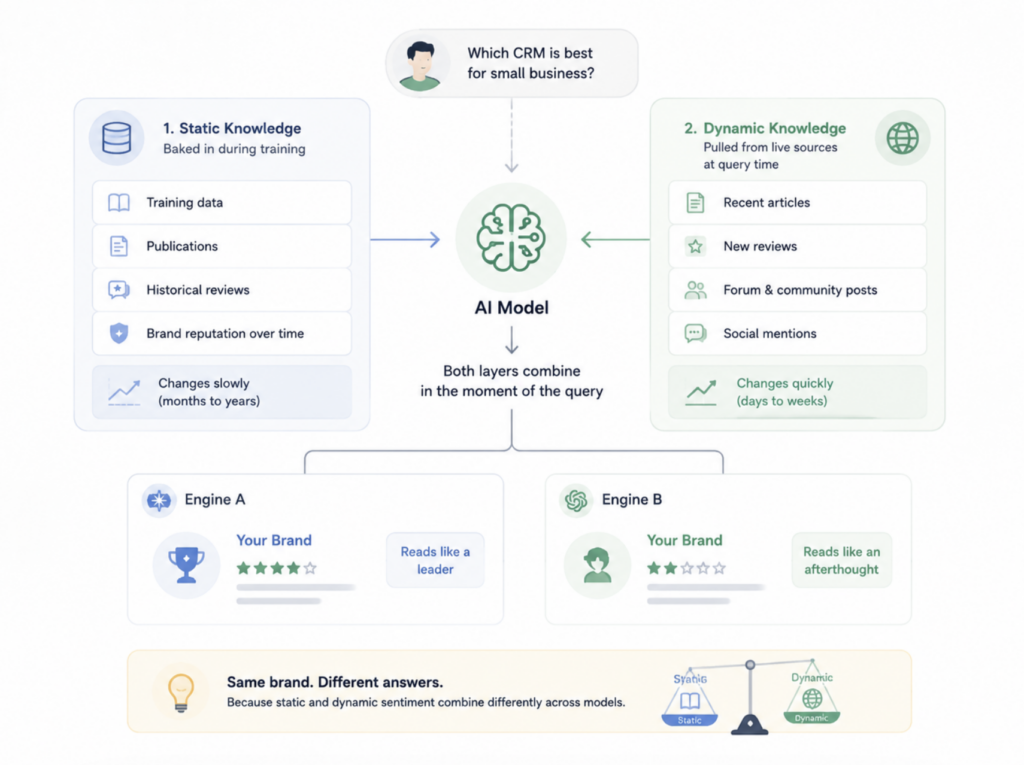
The last part is where it gets technical. Models hold two layers of brand knowledge: a static layer baked in during training, and a dynamic layer pulled from live sources at query time. Static sentiment shifts slowly. Dynamic sentiment can move within days when a new review or article gets cited. Both combine at the moment someone asks, which is exactly why the same brand can read like a leader on one engine and an afterthought on another.
What an AI Reputation Monitoring Dashboard Should Measure
If you’re evaluating what to measure, a good AI reputation monitoring dashboard tracks four signals, not one.
Sentiment. The emotional tone of how AI describes you. Sentiment skews positive across most engines, but the gaps between platforms are where positioning quietly slips. Averaging them into a single score hides the one platform where your framing is weakest.
Mentions. How often your brand surfaces across a defined set of prompts. This is your raw presence, and it only means something when tracked over time rather than screenshotted once.
Position. Where you land relative to competitors in the answer. AI recommendations often name just one to three brands, so ranking fourth is functionally invisible.
Sources. The domains and URLs the AI cites when it describes you. This is the layer most tools skip, and it’s the one that explains everything else.
From Sentiment Score to Source Attribution
Sentiment tells you there’s a problem. Source attribution tells you why.
If an engine describes your product as outdated, the cause is usually a specific page or forum thread it keeps pulling from. That’s not a guess you want to make blind. Analytics that trace sentiment back to the cited source turn a vague “AI doesn’t like us” into a fixable “this review page from 2023 is shaping the answer.” Brand web mentions correlate at 0.664 with AI citation rates, roughly three times stronger than page-level SEO signals, which tells you where the leverage actually sits.
Where Most AI Reputation Data Goes Wrong
The most common mistake is checking one platform and assuming it represents the whole picture.
It doesn’t. Brand recommendations differ 40 to 60% across AI platforms for the same query. One study of over 300,000 citations found only 11% platform overlap, and citation volume for a single brand varied by up to 615x between engines. A brand that dominates Perplexity can be nearly absent from ChatGPT. Track one, and you’re blind to where your biggest gap lives.
The second mistake is measuring mentions but ignoring tone. Presence without framing is a vanity metric. Being mentioned as “the budget option” isn’t a win.
The third is treating AI monitoring like a Google rank check: verify once, log the number, move on. AI answers update as their sources change, so a one-time audit is stale within weeks. Reputation monitoring has to be continuous, or it catches drift only after it’s hardened into the model’s default answer.
There’s a fourth, quieter mistake: leaning on the tools you already have. Your existing SEO stack, your keyword rankings, your search console data, none of it captures what an AI engine says about you. 62% of enterprise brands have zero AI search visibility despite heavy SEO investment, largely because they’re measuring the wrong surface.
What a Full AI Reputation Monitoring Platform Adds
A single-signal tool tells you sentiment dropped. A platform tells you what to do about it.
That’s the practical difference between a point tool and an AI reputation monitoring platform. Topify approaches reputation as a connected system rather than a set of separate readouts, tracking visibility, sentiment, position, mentions, and cited sources across ChatGPT, Gemini, Perplexity, DeepSeek, and other major engines in one view.
In practice, that connection is the point. You can spot a drop in ChatGPT sentiment, trace it to the exact source that started framing you as an alternative, and see which competitor gained the position you lost, all without stitching together three dashboards. Because the platform stores the full response behind each score, you’re reading how a specific engine actually characterized you, not an average that blurs the differences.
Competitor benchmarking runs on the same data. You see who AI recommends instead of you, on which prompts, and how the framing differs. That turns reputation from something you react to into something you can plan around.
The reason this depth matters comes back to how AI answers work. When an engine gives one synthesized verdict instead of a page of links, there’s no scrolling past a bad description. A large MIT experiment across 12,000 queries found that citations raise user trust in an AI answer even when those citations are wrong. The answer carries authority regardless of accuracy, which raises the cost of a reputation problem you can’t see. Gartner projects 30% of brand perception will be shaped by generative AI in 2026.

A Checklist for Picking an AI Reputation Monitoring Solution
Not every tool that claims to track AI reputation measures the same things. Use this checklist to compare an AI reputation monitoring solution against what actually moves the needle:
| Criterion | Why it matters | What to look for |
|---|---|---|
| Multi-platform coverage | Recommendations differ 40 to 60% across engines | ChatGPT, Gemini, Perplexity, and more, not just one |
| Sentiment plus framing | Presence alone is a vanity metric | Tone analysis, not just mention counts |
| Source attribution | Sentiment tells you what, sources tell you why | Traces cited domains and URLs per answer |
| Time-series tracking | One-time checks go stale in weeks | Continuous sampling, historical trends |
| Root-cause routing | Data without direction wastes time | Connects a signal to the fix, not just a chart |
| Pricing transparency | Reputation tracking should scale with use | Clear tiers, usage-based, no forced bundles |
The strategy underneath the checklist is simple. Start by tracking unbranded category prompts, not just your own name, because that’s where buyers form shortlists before they know you exist. Baseline where you stand, fix the highest-impact sources first, and re-measure. Track it. Trace it. Fix it.
Conclusion
Your reputation used to be written by reviewers, reporters, and customers. Now a share of it is written by a model that synthesizes those voices into one confident answer you can’t edit directly. The brands that stay ahead aren’t the ones with the most mentions. They’re the ones who know how AI describes them, why, and which source to fix when the framing slips.
If AI is already part of how your buyers research, start by baselining what the major engines say about you today. You can’t manage a reputation you’ve never read.
FAQ
What is AI reputation monitoring software?
AI reputation monitoring software tracks how AI systems like ChatGPT, Gemini, and Perplexity describe, position, and recommend your brand when users ask about your category. Unlike social listening, which reads human posts, it reads what the model itself generates and flags inaccurate, outdated, or off-positioning descriptions.
How can you improve your AI reputation?
Fix the source material AI engines pull from. Keep your owned pages consistent and current, address inaccuracies in forums and reviews the models cite, and publish clear comparison and use-case content. Then re-run your prompts over time to confirm the framing actually improves, since results shift as sources change.
What are examples of AI reputation monitoring in practice?
A common example is catching an engine that calls your premium product “budget-friendly,” tracing it to an old review page it keeps citing, and updating that source. Another is spotting that a competitor consistently outranks you on high-intent category prompts on one platform but not another.
How much does an AI reputation monitoring platform cost?
Pricing varies by coverage and volume. Platforms like Topify use usage-based tiers that scale with the number of prompts and platforms you track, starting around $99 a month for smaller teams. See current Topify pricing for details, since plans and limits change.

