

Your team watches Google. You track review sites, monitor social mentions, and set alerts for press coverage. But when a buyer opens ChatGPT and asks whether your product is any good, none of those tools see the answer. The model describes your brand, ranks it against competitors, sometimes invents details about your pricing or features, and the buyer takes it as fact. That conversation never lands in a dashboard you own. It’s a reputation you can’t read, shaped by systems you’ve never audited. That’s the blind spot AI reputation monitoring software exists to close.
What AI Reputation Monitoring Software Actually Is
Traditional online reputation management watches what people say about you: reviews, social posts, forum threads, press. AI reputation monitoring software watches what machines say about you. Those have become two different problems.
When someone asks an AI assistant “is this brand any good?” or “best tools for [category],” the model returns a synthesized verdict. It decides whether to mention you, how to frame you, and which competitors to list beside you. That verdict is the new front page.
The reviews you can’t see are the ones a machine writes on demand, differently, for every user.
So an AI reputation monitoring tool isn’t a review aggregator. It systematically queries AI platforms, captures how your brand shows up in the responses, and turns those answers into something you can measure over time. That matters because about a quarter of consumers now name AI platforms as their top research tool, ahead of brand websites and online reviews.
How AI Reputation Monitoring Software Works
Under the hood, most tools run a similar loop. First, they build a set of prompts that mirror how real buyers ask about your category. Then they send those prompts across several AI models on a schedule. Finally, they parse each response for your brand: whether you’re mentioned, how you’re described, where you rank, and which sources the model cited.
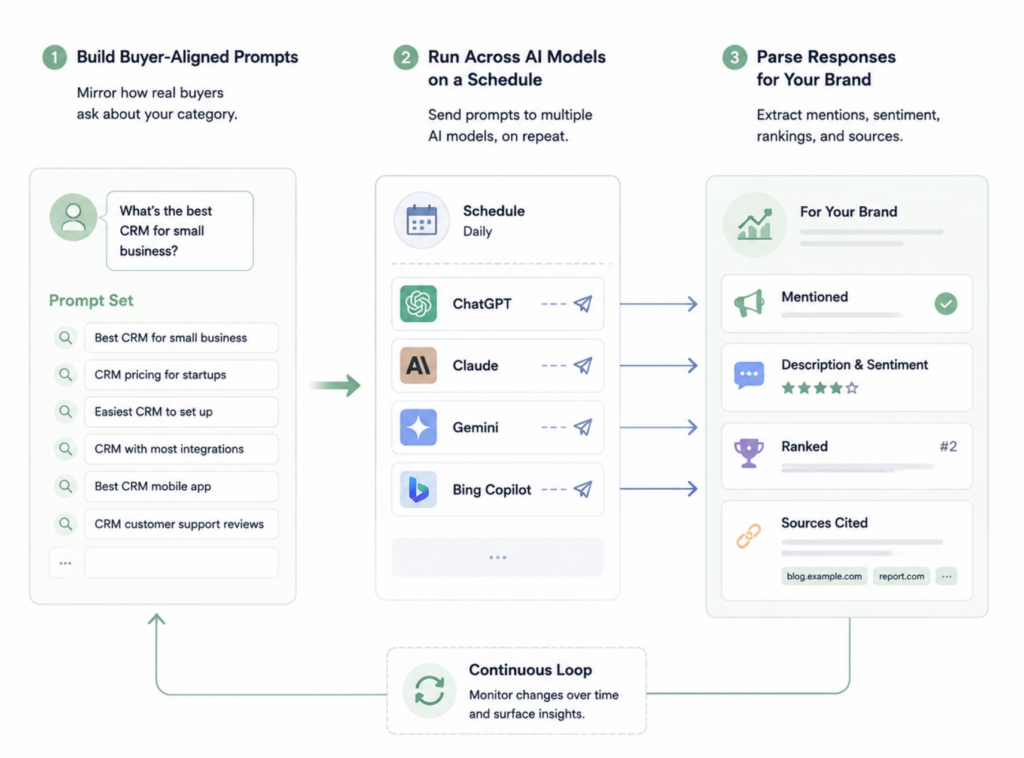
The reason you need software for this is that AI answers don’t behave like search results. There’s no fixed ranking page to scrape. Responses are conversational, personalized, and they shift as models retrain or pull new sources.
Run the same prompt twice and you can get two different verdicts. A small wording change, “best X” versus “top X for startups,” surfaces different brands entirely.
Point-in-time checks miss all of that, which is why monitoring has to be continuous.
The surface is also large enough to take seriously. ChatGPT reached roughly 900 million weekly users by early 2026, and that’s one platform among several your buyers are asking.
Why AI Reputation Is Harder to Control Than Search Rankings
The stakes come down to reach and trust. AI answers are now a primary research channel, and people act on them. 47% of consumers say AI already influences which brands they trust. In a zero-click environment, users read the model’s characterization and rarely click through to verify it.
Then there’s accuracy. AI doesn’t just relay what exists. It invents. In one study that queried ChatGPT, Perplexity, and Gemini more than 13,000 times, 93% of companies had at least one basic fact hallucinated or missing from the answers, often stated with full confidence.
A wrong price, a discontinued product listed as current, a competitor’s feature attributed to you: each error gets repeated across countless private conversations you’ll never see.
And you own what your AI says about you.
The Air Canada case made that concrete, when a tribunal held the airline liable after its chatbot invented a refund policy. The newer risk is third-party models describing you without your input. When Google’s Bard fabricated a fact in a live demo, Alphabet shed roughly $100 billion in market value. Reputation damage in the AI layer is measurable, and it’s expensive.
What to Measure: The Metrics Behind an AI Reputation Monitoring Dashboard
A useful AI reputation monitoring dashboard goes past a single visibility percentage. Reputation lives in how you’re described, not just whether you appear.
Four metrics carry most of the signal:
- Sentiment. Whether the model frames you positively, negatively, or with hedging, and which attributes it attaches to you: reliable, expensive, budget, innovative. This is the part traditional analytics never had.
- Mentions and share of voice. How often you’re named versus competitors across a prompt set. If your brand appears in 35 of 100 category prompts, your AI share of voice is 35%.
- Position. Where you land when the model lists options, first pick or afterthought.
- Sources. Which domains the model cited to form its view, so you can trace a negative characterization back to the page that caused it.
The sentiment layer is what turns visibility into reputation. It tells you not just that you were mentioned, but how you were characterized, and flags when a model describes you in a negative or hedged context.
This is where a platform like Topify fits. It tracks brand performance across major AI platforms through visibility, sentiment, position, mentions, and citation sources, scoring AI sentiment toward your brand on a 0 to 100 scale. In practice, that means you can spot a drop in ChatGPT mentions and trace it back to a source that stopped citing you, inside the same view.
Common Mistakes and a Practical Checklist for AI Reputation Monitoring
Most teams that start monitoring AI reputation make the same handful of errors.
- Tracking one platform. ChatGPT is the biggest but not the only one. Gemini and Perplexity often describe you differently and pull from different sources.
- Measuring presence, not framing. Knowing you were mentioned tells you little if the mention was “a cheaper alternative to [competitor].”
- Treating it as a one-time audit. A single check is a snapshot. Models change week to week.
- Ignoring sources. If you don’t know which pages feed the AI, you can’t fix a bad characterization.
Here’s a short checklist for setting up AI reputation monitoring that holds up over time:
- Build 30 to 50 prompts that match how buyers actually ask about your category, including comparison and problem queries.
- Run them across at least three AI models, not one.
- Track sentiment and position, not just mention rate.
- Log the cited sources for every answer.
- Re-run on a fixed cadence, weekly or monthly, and trend against competitors.
- Flag factual errors so you can correct them at the source.
Fixing what you find usually comes back to one lever: give the models better, more consistent, authoritative information to retrieve. Third-party corroboration in trusted sources tends to move the needle more than on-site tweaks.
Choosing an AI Reputation Monitoring Platform: Strategy, Examples, and Pricing
Once you move from a manual audit to an ongoing system, the platform you pick should do three things: cover the models your buyers use, measure framing rather than just presence, and connect findings to action.
Coverage comes first. A monitoring solution that only reads ChatGPT leaves most of the picture out. The budget behind AI search reflects how seriously teams take this: 89% of enterprise leaders said AI search improved their marketing in 2025, and 65% are putting at least a quarter of their 2026 budget into AI search optimization.
Then framing. The whole point of reputation monitoring is the sentiment and source layer, so a system that stops at a visibility number won’t tell you why a competitor is winning the recommendation.
This is the gap Topify is built to close. Beyond sentiment and mentions, it benchmarks your position against competitors in real time, reverse-engineers the exact domains AI platforms cite, and turns the findings into GEO strategies you can deploy. You state a goal in plain English and launch with one click instead of wiring up manual workflows.
On pricing, AI reputation monitoring tools vary widely by coverage and prompt volume. Topify’s platform starts at $99/mo on the Basic plan (100 prompts, tracking across ChatGPT, Perplexity, and Google AI Overviews), $199/mo for Pro, and from $499/mo for Enterprise, with roughly 17% off annual billing. You can see current tiers on the Topify pricing page.
The right choice depends on scale. A solo founder auditing one brand needs less than an agency reporting on twenty. But the baseline is the same: multi-platform coverage, sentiment and source analytics, and a path from insight to fix.
Conclusion
The reputation you can’t see is still a reputation. Every day, AI systems describe your brand to buyers who treat the answer as fact, and traditional SEO and ORM tools weren’t built to measure any of it.
Start by auditing what the major models say about you today, then put a monitoring system in place to catch changes and errors before they compound. The brands that learn to read the AI layer now will shape it before their competitors do.
FAQ
Q: What is AI reputation monitoring software?
A: It’s software that tracks how AI systems like ChatGPT, Gemini, and Perplexity describe, rank, and recommend your brand. It captures sentiment, mentions, position, and cited sources so you can measure and manage your reputation inside AI answers, not just on review sites.
Q: How is it different from traditional online reputation management?
A: Online reputation management monitors what people say about you across reviews, social, and news. AI reputation monitoring tracks what AI models say, which is generated on demand, varies by user, and can include confident but false claims no human ever posted.
Q: How much does AI reputation monitoring software cost?
A: Pricing depends on coverage and prompt volume. Entry plans often start around $99/mo, with mid-tier plans near $199/mo and enterprise plans from about $499/mo. Check a provider’s pricing page for current tiers.
Q: How do you measure AI reputation?
A: Run a fixed set of category prompts across multiple AI models on a schedule, then track mention rate, share of voice against competitors, position within the answer, sentiment or framing, and the sources each model cites.

