

Your team just spent a quarter earning backlinks and climbing to page one for your core terms. Then a buyer opened Google, typed a question, and never saw a single blue link. Google’s AI read a dozen pages, decided which brands mattered, and handed back one answer. Your rankings were fine. Your brand just wasn’t in the answer.
That gap between ranking well and getting chosen is the whole problem. And traditional SEO metrics weren’t built to see it.
Ranking Was the Old Game. AI Mode SEO Is About Getting Picked.
For twenty years, SEO had one job: move up the list so more people click. AI Mode SEO isn’t that. The work now is getting selected and synthesized into an answer that often replaces the list entirely.
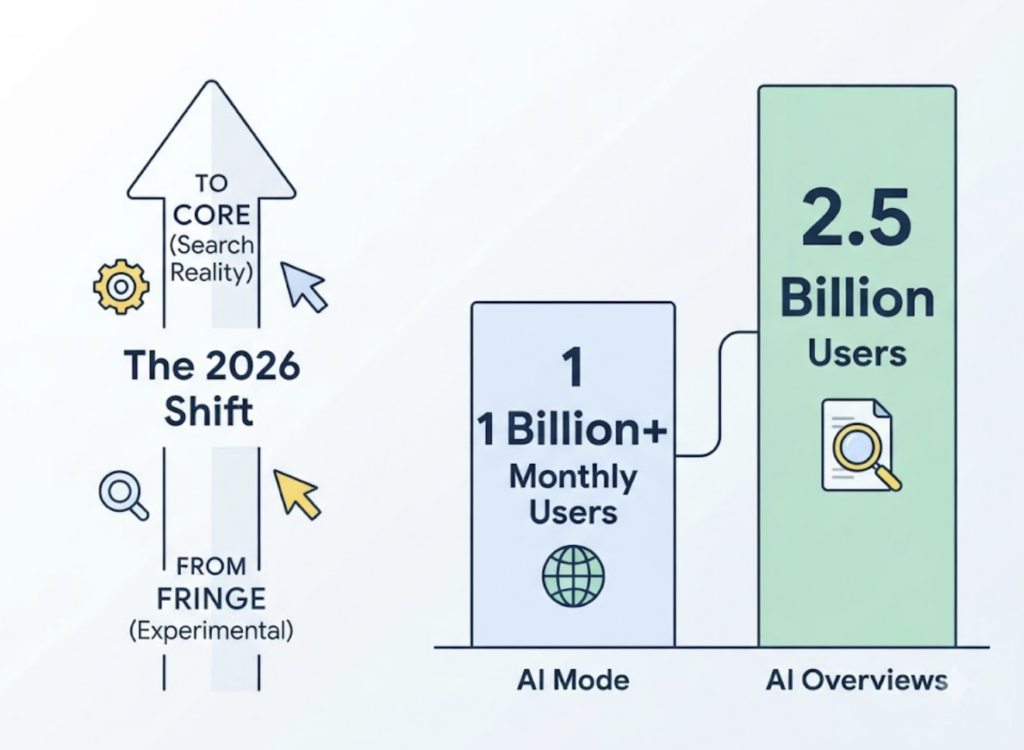
This stopped being a fringe scenario in 2026. At I/O, Google moved AI Mode from an experimental tab to a core part of Search, now powered by Gemini 3.5 Flash for every user globally. The scale is not small. AI Mode crossed one billion monthly users roughly a year after launch, with query volume more than doubling every quarter, while AI Overviews reach 2.5 billion.
Here’s the shift most SEO teams still haven’t internalized. AI Mode SEO is becoming Agent SEO: you’re no longer optimizing for a human who scans results, but for an agent that reads, reasons, and decides on the human’s behalf.
What Google’s Information Agents Actually Do
The clearest signal of this shift is a feature Google put at the center of its I/O 2026 announcement: information agents. These aren’t answer boxes. They’re background systems that run 24/7, reasoning across blogs, news, social posts, and real-time data, then alerting users when something relevant changes.
Think of Google Alerts rebuilt with a frontier model’s ability to infer and compare. Instead of a link list, the agent synthesizes multiple sources, explains why something matters, and surfaces the conclusion.
Information agents are one piece. Google also rolled out agentic booking that can call businesses on a user’s behalf and generative UI that assembles custom dashboards and mini apps on the fly. The direction is consistent across all of them. Search is moving from pointing users to websites toward making decisions for them.
That reframes the entire visibility question. The agent is your new reader. It doesn’t browse. It selects.
Why Agent SEO Breaks the Traditional SEO Playbook
The old playbook assumed a stable chain: rank high, earn the click, capture the visit. Agent SEO breaks every link in that chain, and the data now shows exactly where.
Start with the click. In early 2026, zero-click searches reached roughly 68% of Google queries per SparkToro, and when an AI Overview appears, click-through rates fall sharply. Seer Interactive’s analysis of 2.43 billion impressions found organic CTR dropping 61% on AI Overview queries, and the effect is more extreme in AI Mode, where one estimate puts the zero-click rate near 93%.
Now the part that should change how you plan. Ranking no longer predicts selection.
A Moz study of 40,000 keywords found that only 12% of AI Mode citations matched URLs in the organic top ten for the same query. Ahrefs looked at AI Overviews and found that 62% of citations now come from pages outside the top ten, up from a much tighter correlation a year earlier. Same search intent, different source list.
The reason is architectural. AI Mode uses a query fan-out technique, breaking one question into many sub-queries and pulling sources for each. Your page might win the parent query and lose every sub-query that actually fills the answer.
That’s the separation Agent SEO has to solve. Your rank can be strong while your mention rate sits near zero, and a rankings dashboard will never flag it.
How to Optimize for AI Mode SEO When the Reader Is an Agent
Optimizing for an agent means writing for a system that extracts, verifies, and cites rather than one that skims. Three shifts matter most.
Make Your Content Machine-Legible, Not Just Reader-Friendly
Agents ground their answers in passages they can retrieve and parse cleanly. Research on citation selection suggests that entity recognition can lift citation rates substantially, and that semantic match between the query and a specific passage predicts selection far better than domain authority does.
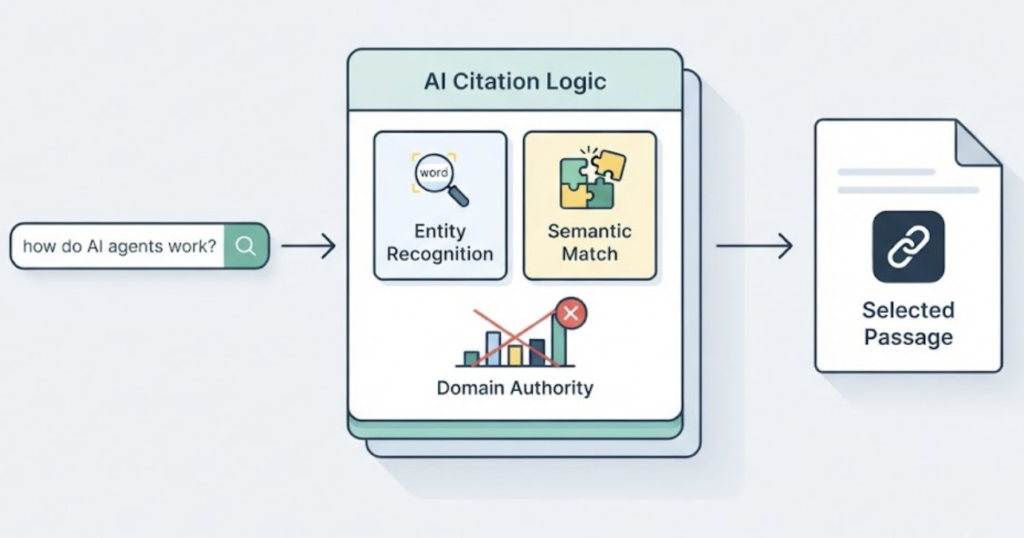
In practice, that means clear structure, direct answer-style paragraphs, defined entities, and schema markup. Pages with original research, proprietary data, and FAQ sections formatted with schema show a higher probability of being selectedas citation sources.
Build the Authority Signals Agents Actually Weigh
Backlinks still count, but they’re no longer the whole story. Google’s AI selects sources on clarity, trust, and explainability, reading author credentials, brand mentions, and topical depth alongside links.
E-E-A-T functions less like a ranking tweak and more like a pass/fail gate in the selection pipeline. Sites with consistent mentions across forums, news, and niche publications tend to get cited more often than sites with strong backlinks but a thin broader presence.
Earn Citations, Not Just Clicks
The payoff for selection is real, not symbolic. Brands cited inside AI Overviews earn roughly 35% more organic clicksthan non-cited brands on the same results page, and AI-driven visitors tend to convert far higher than traditional organic traffic.
So the goal shifts from “rank and hope they click” to “be the source the agent trusts enough to cite.” That’s the Agent SEO mandate in one line.
You Can’t Optimize What You Can’t See: Measuring Agent Visibility
Every tactic above shares one prerequisite. You have to see whether an agent is actually citing you, across platforms, at the prompt level. A rankings tool won’t show it, and AI traffic is easy to miss. Seer found that roughly 70% of AI search traffic gets misclassified as direct in standard analytics setups.
This is where a purpose-built AI visibility platform matters. Topify tracks how AI systems recommend a brand across ChatGPT, Gemini, Perplexity, and other engines, turning agent visibility into something measurable rather than a guess.
For teams adapting to Agent SEO, the useful part is the depth of the picture. Topify’s Comprehensive GEO Analytics scores brand performance across seven dimensions, including visibility, sentiment, position, mentions, and CVR. In practice, that means you can spot a drop in Gemini mentions, then trace it to a specific source that stopped citing your brand, inside one view.
Its Source Analysis feature does the reverse-engineering the query fan-out problem demands. It surfaces the exact domains and URLs AI engines cite for your topics, so you can see whether you or a competitor owns those references, and where your content gaps sit. That closes the loop between “we optimized” and “the agent noticed.”
Track it. Diagnose it. Fix the gap.
Conclusion
The buyer who never saw your blue link isn’t an edge case anymore. It’s the default path through an agent that reads for them and decides for them. AI Mode SEO has quietly become Agent SEO, and the brands that adapt are the ones treating selection, not ranking, as the metric that matters.
Start by measuring where you actually stand in AI answers, then optimize your content for how agents extract and cite. If you want a clear read on your current agent visibility before you commit to a strategy, get started with Topify and see what the AI is saying about you today.
FAQ
Q: What is AI Mode SEO?
A: AI Mode SEO is the practice of optimizing so your brand gets selected and cited inside Google’s AI Mode answers, rather than just ranking in the traditional results list. Because AI Mode replaces links with a synthesized response, the goal moves from earning clicks to earning a mention in the answer itself.
Q: How is Agent SEO different from traditional SEO?
A: Traditional SEO optimizes for a human who scans a list and clicks. Agent SEO optimizes for an AI agent that reads multiple sources, reasons across them, and decides what to cite. The signals differ too: clarity, extractable structure, entities, and broad authority often matter more than raw rank position.
Q: What are Google’s information agents?
A: Introduced at Google I/O 2026, information agents are background AI systems that monitor standing topics 24/7, synthesize updates across many sources, and notify users when something relevant changes. They represent search shifting from answering one query at a time toward acting continuously on a user’s behalf.
Q: How do I know if my brand appears in Google AI Mode?
A: Rankings tools won’t tell you, and AI traffic is frequently misattributed in standard analytics. You need an AI visibility platform that tracks mentions and citations at the prompt level across AI engines, so you can measure appearance rate rather than infer it.

