

Search “AI recommendation tracking software” and you’ll find a dozen platforms promising the same outcome: they’ll tell you whether AI recommends your brand. Put their feature pages side by side and they blur into each other. The hard part isn’t picking a tool. It’s working out which one measures something that predicts revenue, across the engines your buyers actually use.
And those engines keep moving. ChatGPT held 89% of B2B AI referrals in August 2025, then 63% eight months later, with Claude climbing from 1.4% to 18.5% in the same window. A tool that watches one platform is already watching the wrong picture.
What AI Recommendation Tracking Software Actually Tracks
AI recommendation tracking software monitors how generative engines represent your brand inside their answers. Not your URL’s position on a results page, but whether ChatGPT, Perplexity, Gemini, or Claude mention you at all, how they frame you, and whether they cite you as a source.
That’s a different measurement problem than traditional rank tracking. A Google rank is a fixed coordinate: position 3 for a given keyword. An AI answer is a paragraph, generated fresh each time, and your brand either makes it into the narrative or it doesn’t.
Because models pull from many sources to synthesize one response, visibility here gets measured as share of voice and citation share, not a numbered slot. You can rank #1 in Google and still be invisible on Perplexity for the same question.
That gap is the entire reason this category exists.
How AI Recommendation Tracking Software Works
Most platforms run a similar pipeline under the hood. The difference is in how well each step is executed.
First, prompt portfolio definition. The system runs a curated set of 50 to 100 buyer-intent prompts (“best CRM for small teams,” “alternatives to [competitor]”) across multiple AI platforms on a recurring schedule.
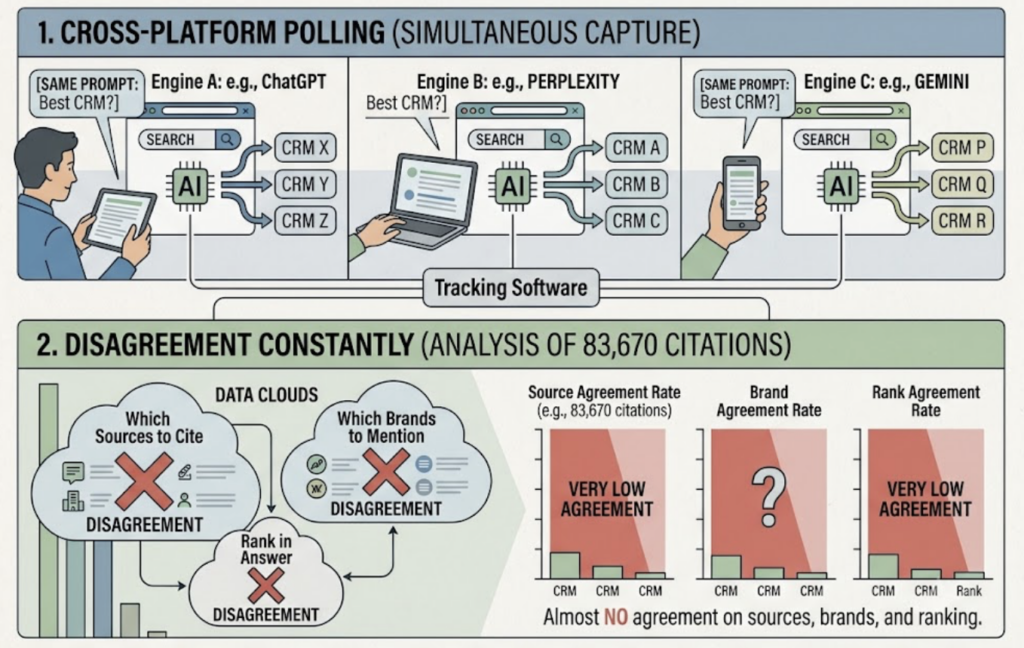
Second, cross-platform polling. Each engine uses its own retrieval setup, so the same prompt returns different answers on ChatGPT versus Perplexity versus Gemini. The software captures each response separately. This matters because the engines disagree constantly. One analysis of 83,670 AI citations across ChatGPT, Claude, and Perplexity found the engines agreed on almost nothing, including which sources to cite and which brands to mention.
Third, parsing and normalization. The raw text gets scanned for brand mentions, citation links, and sentiment, then stored as time-series data so you can see drift.
Here’s why prompt-level beats keyword-level: AI models don’t respond to keywords. They respond to intent expressed in full questions. Tracking 60 high-intent prompts gives you a cleaner read on your AI share of voice than monitoring thousands of keyword variants ever could.
The Metrics That Tell You It’s Actually Working
Plenty of tools will hand you a mention count and call it a day. Mention count is a vanity metric. These five tell you something useful.
Visibility rate (share of voice): across your category-relevant prompts, what percentage produce a brand mention?
Citation share: how often does the engine link to your domain as a source, versus a competitor’s?
Position: are you described as the lead recommendation or a footnote alternative?
Sentiment: does the AI’s framing match your positioning, or is it calling a premium product “budget-friendly”?
AI referral conversion: this is the metric that pays the bills. AI traffic is small but converts hard. Seer Interactive measured ChatGPT-referred sessions converting at 15.9% against Google organic’s 1.76%, and AI referrals to US retail ran 31% higher conversion over the 2025 holiday season. You only see it if you track that traffic as its own channel.
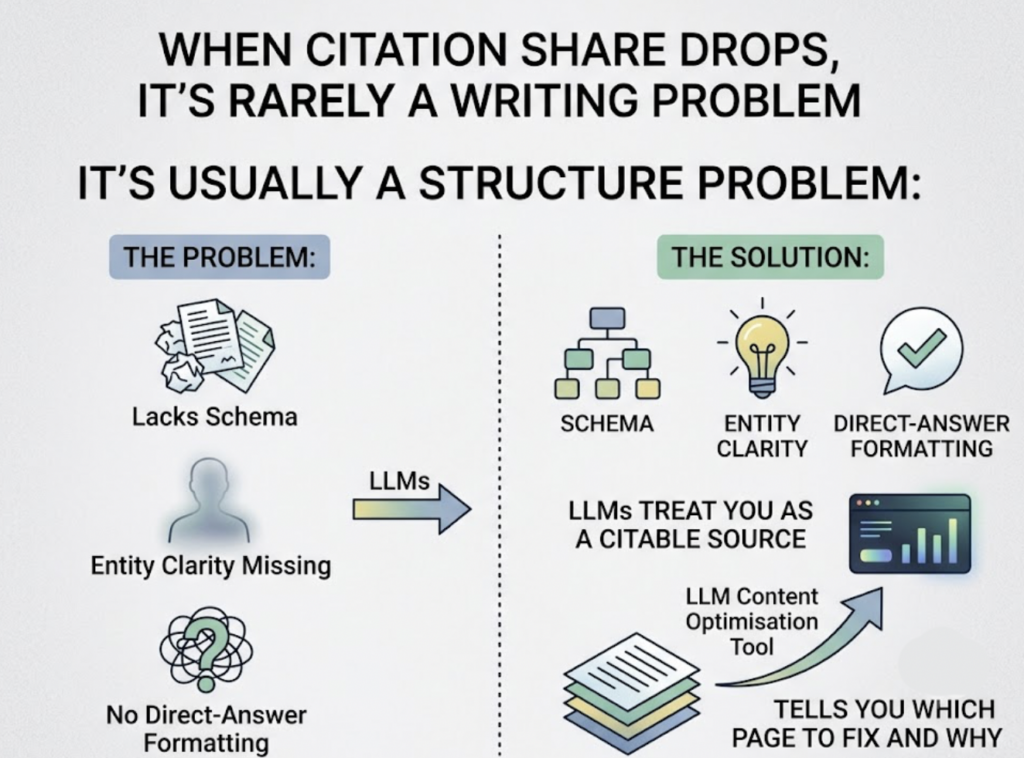
Read these together and they point somewhere specific. When citation share drops, it’s rarely a writing problem. It’s usually a structure problem: your content lacks the schema, entity clarity, or direct-answer formatting an LLM needs to treat you as a citable source. That’s why the most useful platforms double as an llm content optimisation tool, not just a dashboard. They tell you which page to fix and why.
What to Look For When You Compare Tools
When you’re comparing options, the dividing line is simple: does the tool just alert you, or does it help you act?
| Capability | Monitoring-only tools | Full GEO platforms |
|---|---|---|
| Engine coverage | Often one platform (ChatGPT only) | ChatGPT, Perplexity, Gemini, Claude |
| Granularity | Basic mention count | Prompt-level attribution and logs |
| Competitor view | None | Side-by-side share of voice |
| Source analysis | Surface mentions | The exact URLs the AI cites |
| Execution | Manual effort | Built-in content workflows |
| History | Single snapshot | Drift over weeks and months |
Coverage is the one most people underweight. Optimizing only for ChatGPT used to cover most of the market. After the fragmentation of the past year, the four leaders together hold roughly 99% of measurable AI referrals, with no single engine dominant the way ChatGPT once was. A single-engine tool now misses about a third more of the picture than it did a year ago.
Examples of AI recommendation tracking software span from lightweight mention-alert tools to full-stack GEO platforms like Topify. The right fit depends on whether you need to know what’s happening or change it.
Where Teams Go Wrong
The right software doesn’t save you from the wrong habits. Four mistakes show up again and again.
The single-platform trap. Optimizing only for ChatGPT ignores that Perplexity and Google’s AI Overviews retrieve and cite differently. AI Overviews now appear in about one in four searches, and roughly 60% of their citations come from URLs that don’t rank in the top 20 of regular search. Different surface, different rules.
Ignoring citation drift. AI sources rotate often. Content refreshed within 30 days tends to earn meaningfully more citations than stale pages. A snapshot from last quarter tells you almost nothing about today.
Chasing volume without context. A mention is not automatically good. If the sentiment is off or the source is weak, raw mention count points you in the wrong direction.
Treating the dashboard as the finish line. This is the big one.
Tracking data is an operational signal, not a report you file. When a number moves, something on your site should change: an FAQ block, a comparison page, a piece of schema. Teams that read the dashboard and do nothing get the same result as teams with no dashboard at all.
How Topify Approaches AI Recommendation Tracking
Most tools stop at telling you what happened. Topify is built to close the full loop: track, understand why, act, then measure again.
The analytics layer covers seven dimensions of AI visibility in one view: visibility, sentiment, position, volume, mentions, intent, and conversion rate. Instead of checking four engines in four tabs, you watch them in one place and catch a drop the day it happens.
High-value prompt discovery surfaces the specific buyer questions where your brand is currently missing. Those are the gaps worth closing first, because they map directly to purchase intent.
The piece most monitoring tools skip is the why. Topify’s citation analysis reverse-engineers the exact domains and URLs an engine references, so when a competitor wins a recommendation you can see which page earned it and what yours is missing. That turns a vague “we’re losing visibility” into a concrete content brief.
From there, one-click execution generates and aligns content against the prompt patterns the dashboard flags, which is where Topify works as an llm content optimisation tool rather than a passive monitor. You define the goal in plain English, review the proposed strategy, and deploy. If you’d rather see where you stand first, you can check your baseline visibility before committing to a strategy.
Pricing starts at $99/mo for Basic and $199/mo for Pro, with Enterprise from $499/mo, so a team can start small and scale prompt volume as the data proves out.
A Quick Checklist Before You Commit
Run any platform through these six questions before you sign:
- Does it track at least the big four: ChatGPT, Perplexity, Gemini, and Claude?
- Does the data turn into concrete content steps, not just charts?
- Can it show citation drift over weeks and months, not a single snapshot?
- Does it benchmark you against the competitors displacing you in AI answers?
- Does it tell you which pages the AI is citing for its summary?
- Is the pricing transparent and tied to something you control, like prompt volume or seats?
If a tool can’t answer yes to the first four, it’s a monitor, not a growth system.
Conclusion
The shift from keyword rankings to AI recommendations is already underway. AI traffic grew roughly seven times over the past year and converts at multiples of organic search, even while it’s still a small slice of total visits. Small channel, high intent, fast growth.
“Looking the same” on a features page hides real differences in how platforms handle messy, non-deterministic AI output. Judge them on coverage, citation analysis, and whether the data actually changes what your team ships next week. Get those three right, and you move from a silent participant in AI answers to the brand the engine names first.
FAQ
Q1: How does AI recommendation tracking software work?
It runs a fixed set of buyer-intent prompts across multiple AI engines on a schedule, then parses each response for brand mentions, citations, position, and sentiment. Those readings get stored over time so you can see trends and catch drift, instead of relying on a one-off manual check.
Q2: What are examples of AI recommendation tracking software?
Options range from lightweight mention-alert tools to full GEO platforms. Topify sits at the full-stack end, pairing seven-dimension analytics with citation analysis and content execution. Some general AI observability tools also touch this space, but purpose-built GEO platforms tend to fit marketing teams better.
Q3: How much does AI recommendation tracking software cost?
Pricing usually scales with prompt volume and seats. Entry tiers commonly start around $99/mo, mid tiers near $199/mo, and enterprise plans with custom prompt sets and a dedicated account manager run from roughly $499/mo upward.
Q4: How can I improve my brand’s AI recommendation visibility?
Focus on entity clarity and citable structure. Use your brand name consistently rather than pronouns, add FAQ schema, answer common questions directly in the opening lines, and attribute statistics to a named, dated source. Content with clean heading structure and direct answers tends to get cited more often.

