

Your team hit every SEO target last quarter. Domain authority climbed, three pages reached the first results page, and organic traffic held steady. Then a buyer opened ChatGPT, asked for the top option in your category, and got a clean list of five brands. Yours wasn’t on it.
The dashboard your team checks every morning had no way to explain why. It was built to measure where a URL sits in a static index, not whether an AI engine decides to bring your brand up at all. That blind spot is exactly what an AI recommendation tracking solution is built to close.
What Is an AI Recommendation Tracking Solution
An AI recommendation tracking solution is a system that monitors how large language models talk about your brand inside their generated answers. It watches whether you get mentioned, whether you get cited as a source, and whether the description matches your positioning.
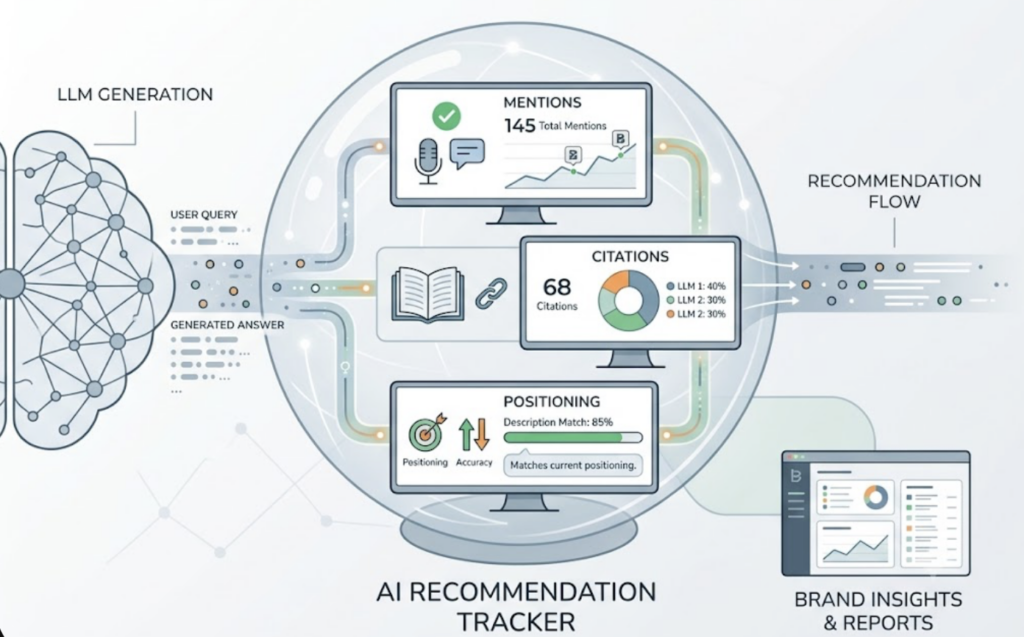
That’s a different job from a rank tracker. A rank tracker measures a URL’s position in a list. An AI recommendation tracker measures the narrative an engine synthesizes about you, which is generated fresh each time and shifts with phrasing and context.
The distinction matters more than it sounds. Traditional SEO is deterministic: the same query returns roughly the same index. AI answers are stochastic, so you can’t check a single response and call it data. You need a repeatable sample across many prompts.
The real goal is making the consideration set. When a buyer asks an AI assistant for options, you want to be one of the names it returns, before that buyer ever reaches a results page. With 94% of B2B buyers now using generative AI during their purchase process, the AI answer is increasingly the first impression your brand gets to make.
How Does an AI Recommendation Tracking Solution Work
Most working systems run a three-stage pipeline to get past the black-box problem.
First, prompt portfolio sampling. Instead of tracking thousands of keywords, you define 50 to 100 buyer-intent prompts, things like “best [category] for [use case],” then run them on a schedule to capture how answers behave over time.
Second, cross-platform polling. ChatGPT, Gemini, Perplexity, and Google AI Overviews each use different retrieval logic, and their citations barely overlap. One analysis found that ChatGPT Search swaps out 74% of its cited domains every week while Google AI Mode rotates around 56%. Polling them together is the only way to avoid a one-platform view of reality.
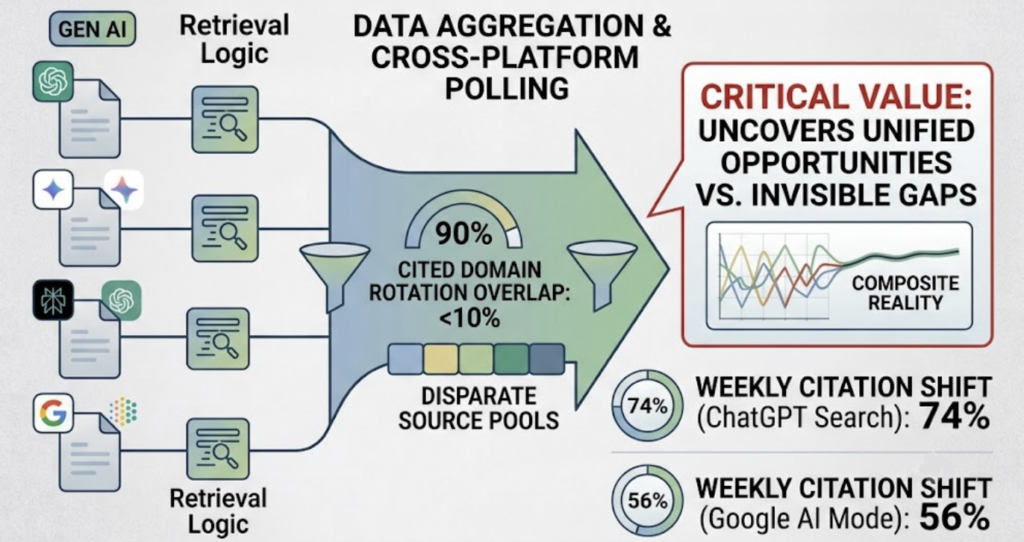
Third, parsing and normalization. The raw answer text gets read for three things: is the brand mentioned, is it cited with a link, and how is it framed. Semrush points to ChatGPT, Gemini, Claude, and AI Overviews as the platforms worth covering in most reports today.
That pipeline is the difference between guessing and knowing. Without it, “how are we doing in AI search?” stays a question nobody on the team can answer with data.
How to Measure AI Recommendation Tracking: The Metrics That Matter
Knowing how to measure an AI recommendation tracking solution starts with dropping the number most teams reach for first. Mention count is a vanity metric. Being named ten times means little if a competitor earns the citation on every high-intent prompt.
A stronger framework translates AI output into commercial signals:
| Metric | What it answers |
|---|---|
| Visibility rate | Are we in the consideration set at all? |
| Citation share | Are we earning authoritative links, or is a rival? |
| Sentiment accuracy | Does the AI describe us the way we position ourselves? |
| Share of voice | How big is our AI footprint next to competitors? |
| AI referral CVR | Are AI-driven visitors actually converting? |
Here’s the part teams miss. Semrush notes that traffic is no longer the primary KPI for AI search, because answers often satisfy a query before any click happens. Your session count can stay flat while your brand’s AI visibility climbs or collapses underneath it.
This is where a dedicated platform earns its place. Topify runs Comprehensive GEO Analytics across seven metrics: visibility, sentiment, position, volume, mentions, intent, and CVR, in one view. In practice, that means you can watch your ChatGPT mentions drop and trace it to a specific source that stopped citing you, without stitching together four separate tools.
The CVR angle deserves attention, since AI traffic tends to convert well. AI referrals converted 31% better than non-AI traffic during the 2025 holiday season, which makes a missed recommendation more expensive than it looks.
How to Improve Your AI Recommendation Visibility
Once you can measure it, the strategy for improving an AI recommendation tracking solution follows a tight loop: identify, optimize, verify.
Start by finding prompts where a competitor consistently earns the citation and you don’t. Then reverse-engineer the content the AI is pulling from. Often the difference is structural: a cleaner comparison table, an FAQ schema, original data the model can lift directly.
Authority signals tend to move the needle more than keyword density. Industry analysis points to domain authority, links from high-authority sites, and inclusion in “best of” listicles as the most consistent drivers of LLM citations.
Then there’s cadence, which is where most plans quietly fail.
AI citations decay fast. One study put the average citation half-life at 4.5 weeks, with ChatGPT closer to 3.4 weeks. Content that earns you a recommendation in March can fall out of rotation by April. Treating optimization as a one-time project is the fastest way to lose the ground you gained.
Best Tool for Search Visibility: What to Look For
Search “best tool for search visibility” and you’ll find platforms that all promise AI tracking. The differences hide in what they actually measure. A few dimensions separate a real solution from a dashboard you’ll stop opening:
| Dimension | Why it matters |
|---|---|
| Platform coverage | Single-engine data misses most of the picture |
| Citation-layer analysis | A mention and a linked citation aren’t the same thing |
| Competitor benchmarking | You need share of voice, not just your own numbers |
| Actionable feedback | Data without a next step is just a report |
| Trend drift tracking | Visibility shifts weekly as models update |
Against those, Topify covers ChatGPT, Gemini, Perplexity, DeepSeek, and other engines, separates plain mentions from linked citations, and benchmarks you against rivals on the same prompt set. Its competitor module flags emerging rivals in real time and surfaces the exact domains AI engines cite, so you can see whether you or a competitor owns the references behind an answer.
Pricing starts at $99 a month on the Basic plan, which includes prompt tracking across ChatGPT, Perplexity, and AI Overviews. That puts structured AI visibility tracking within reach for a single team, not just enterprise budgets. You can get started with Topify and run your first prompt set before committing to a plan.
Other tools fit other needs. General SEO suites that added an AI module work if you mainly want a light signal alongside your keyword data. Single-platform trackers can make sense if your audience truly lives on one engine. The trade-off, in both cases, is coverage and depth.
Common Mistakes and a Quick Checklist
A few mistakes show up again and again.
Single-engine blindness tops the list. Relying on ChatGPT data alone ignores the retrieval logic of Perplexity and AI Overviews, and the citation overlap between platforms is small.
Static snapshotting is the second. With 40 to 60% of cited sources rotating every month, a one-time audit is stale almost immediately. A 17-week study of more than 82,000 prompts confirmed just how much cited domains shift week to week.
The third is chasing vanity metrics, counting mentions without checking position, citation, or sentiment. The fourth is over-indexing on keyword density when AI engines reward structured, authoritative content instead.
A quick checklist before you commit to any approach:
- Track at least four engines, not one
- Separate plain mentions from linked citations
- Benchmark share of voice against named competitors
- Set a recurring cadence, not a single audit
- Tie a clear action to every gap you find
- Report AI metrics apart from organic traffic
Conclusion
The buyer who skipped your brand in that AI answer didn’t see a ranking problem. They saw an absence, and your old metrics couldn’t even register it. An AI recommendation tracking solution closes that gap by measuring what AI actually says about you, across the engines your audience uses, on a cadence that keeps up with how fast citations move. Pick the prompts that matter, measure visibility and citation share against your rivals, and treat optimization as an ongoing loop. The brands showing up in AI answers next quarter are the ones tracking it this quarter. You can start with Topify and map your current standing in a few minutes.
FAQ
Q: What is an AI recommendation tracking solution?
A: It’s a system that monitors how AI engines like ChatGPT, Gemini, and Perplexity mention, cite, and describe your brand in their generated answers. Unlike a rank tracker that measures a URL’s position, it measures whether you make the AI’s consideration set and how accurately you’re represented.
Q: How much does an AI recommendation tracking solution cost?
A: Pricing varies by coverage and depth. Entry-level plans tend to start around $99 a month for prompt tracking across the major engines, with higher tiers adding more prompts, seats, and competitor analysis. Topify’s Basic plan starts at $99/mo and scales from there.
Q: What are some examples of AI recommendation tracking in practice?
A: A common example is running a set of “best [category]” prompts weekly to see whether your brand appears, tracking your citation share against a named competitor, and catching sentiment drift when an engine starts describing your premium product as a “budget option.” Each is a recommendation signal a traditional SEO tool can’t capture.
Q: What’s the best tool for search visibility in AI search?
A: The best tool for search visibility depends on how many engines your audience uses and whether you need citation-level analysis. Look for multi-platform coverage, the ability to separate mentions from citations, competitor benchmarking, and an action feedback loop. Topify covers these in one platform built specifically for AI search.

