

Your CMO forwards a Slack message: a prospect said ChatGPT recommended a competitor when they asked for the best tool in your category. Now you need an answer, and your analytics stack has nothing for it. So you start shopping, and every product page promises to track AI search visibility. Some only watch ChatGPT. Others hand you a wall of numbers with no sense of whether your brand is being recommended, ignored, or quietly misdescribed. The hard part isn’t deciding to track AI recommendations. It’s figuring out which AI recommendation tracking platform measures the thing that actually moves buyers.
What an AI Recommendation Tracking Platform Actually Tracks
An AI recommendation tracking platform doesn’t measure where your page sits on a results list. It measures whether AI systems name your brand when someone asks for a recommendation, where you land in that answer, and how you’re described.
That’s a different job from rank tracking. When a buyer asks ChatGPT, Perplexity, or Gemini for the best option in your category, the model synthesizes an answer on the spot and issues a recommendation. There’s no list of ten blue links to climb. Either you’re in the consideration set or you’re not.
Inclusion is driven by topical authority and how easily your content can be extracted, not just your backlink profile. So the core question shifts from “what’s my position for this keyword” to “is the model recommending me, and why.”
Why AI Brand Recommendations Are Harder to Measure Than Rankings
Three things make AI recommendations slippery to track.
First, the outputs are probabilistic, not deterministic. Google’s index returns a fairly stable result set for a given query. LLMs don’t. The same prompt can produce different answers across sessions, platforms, and model updates, which means a single screenshot tells you almost nothing.
Second, most of the value gets consumed without a click. AI Overviews and chat answers synthesize everything a user needs inside the response, so traditional CTR and impressions decouple from real intent. Your brand can shape a buying decision and never show up in your traffic reports.
Third, the sources feeding these answers keep moving. In high-volatility categories, AI citation sources can rotate by as much as 74% week over week. A brand that’s recommended on Monday can quietly drop by Friday, with no alert in any tool built for conventional search.
That’s the gap most dashboards still can’t see.
What a Good AI Recommendation Tracking Tool Should Measure
If you’re evaluating an AI recommendation tracking tool, the feature checklist matters less than what it actually measures. A handful of metrics separate a real platform from a vanity dashboard.
| Metric | What it tells you |
|---|---|
| Visibility rate | How often you appear in the AI’s consideration set for high-intent prompts |
| Position & framing | Whether you’re cast as the category leader or a secondary alternative |
| Share of voice | How often you appear versus named competitors for the same prompts |
| Citation share | Whether the AI cites your owned content or a third party’s framing of you |
Visibility rate is the baseline. If you’re not in the answer, nothing else matters. But being mentioned isn’t the same as being recommended, which is why position and framing carry as much weight. There’s a real difference between “the category leader” and “a budget alternative worth a look.”
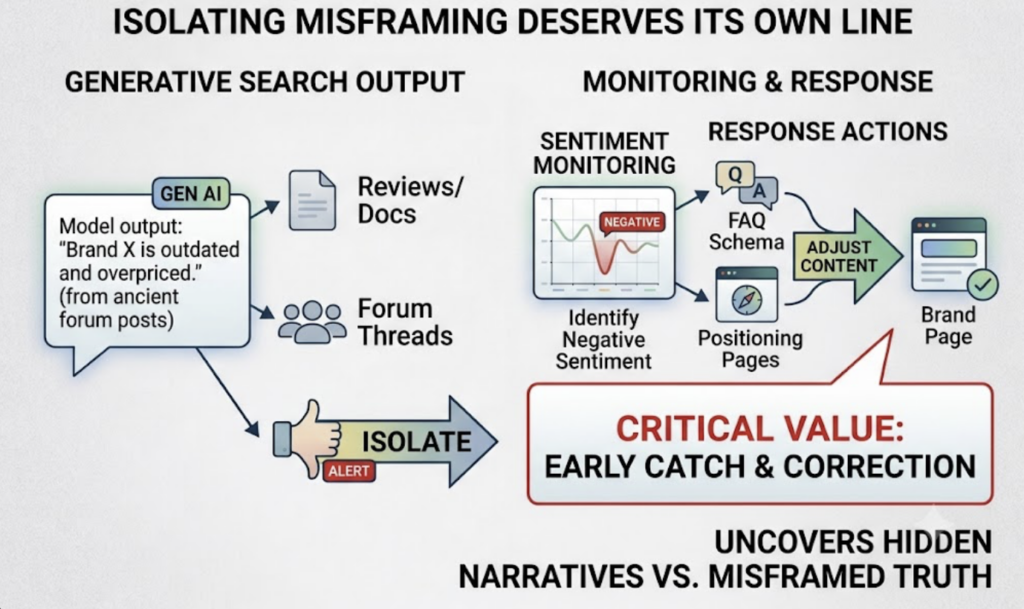
Sentiment deserves its own line. AI models compress reviews, forum threads, and old documentation into one confident-sounding paragraph. If a model ties you to a legacy flaw or an outdated pricing claim, that becomes the “truth” the buyer reads. Knowing how to monitor brand sentiment in generative search lets you catch a misframing early and respond by adjusting the content the model leans on, like FAQ schema or positioning pages. You can’t fix a narrative you can’t see.
How to Monitor Brand Presence Across Multiple AI Models
Tracking one engine is a strategic mistake, because the platforms don’t behave alike. Perplexity leans on data citations. Gemini favors the Google ecosystem. ChatGPT runs on a mix of training data and live browsing. The same prompt can put you first on one and leave you off another.
Monitoring brand presence across multiple AI models means running a consistent set of buyer-intent prompts across all of them on a schedule, so you’re measuring a portfolio instead of a single data point. That’s the only way to know whether your narrative holds up everywhere your buyers are asking.
AI Recommendation Tracking Software vs. a Static Dashboard
Plenty of products call themselves AI recommendation tracking software. Fewer earn the “software” part. The difference shows up the moment something changes.
A static dashboard shows you a number went down. It doesn’t tell you that your ChatGPT mentions dropped because a source that used to cite you stopped, or that a competitor just took your spot for three of your top prompts. You’re left to guess.
Real software closes that loop. It connects the drop to the cause, then to the action. When you can trace a visibility decline back to a specific citation source and a specific prompt, the dashboard stops being a report card and starts being a worklist.
Here’s the test: can the tool tell you what changed and why, not just that something changed.
How Topify Approaches AI Recommendation Tracking Analytics
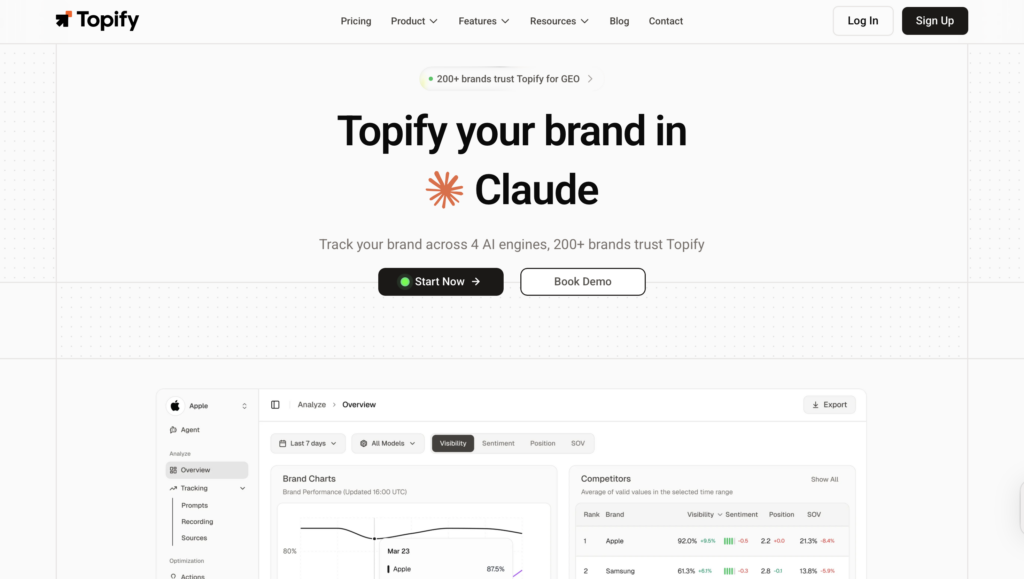
This is where AI recommendation tracking analytics gets practical. Topify is built on the idea that visibility, position, and sentiment are most useful when you read them together, in one view, rather than across four disconnected tools.
The platform’s Comprehensive GEO Analytics tracks brand performance across major AI engines on seven metrics: visibility, sentiment, position, volume, mentions, intent, and CVR, the likelihood an AI answer pushes a user toward your brand. The point isn’t the count of metrics. It’s that they’re connected.
In practice, that means you can spot a dip in ChatGPT mentions, trace it to a source domain that stopped citing you, and see which competitor moved into your position on that prompt, all inside the same dashboard.
Coverage spans ChatGPT, Gemini, Perplexity, DeepSeek, Doubao, and Qwen, so you’re monitoring presence across the models your buyers actually use, not just the one that’s easy to track. And because LLM behavior keeps shifting, the platform’s AI agent runs monitoring as an always-on loop, surfacing new high-intent prompts as recommendations evolve.
For teams that want to move from data to action, you can get started with Topify on a 30-day trial covering ChatGPT, Perplexity, and AI Overviews tracking.
Choosing the Right AI Recommendation Tracking Solution for Your Team
There’s no single right AI recommendation tracking solution. The right one depends on who you are and what you’ll do with the data.
In-house marketing teams should treat AI visibility as a product metric, not a vanity metric. Start by defining a “brand truth set,” the handful of facts about who you serve, your differentiators, and your pricing that must be correct in every AI mention. Then use the platform to catch where models hallucinate or recommend an outdated version of you.
Agencies need a system that scales across clients without multiplying manual work, so cross-account reporting and prompt management matter more than any single feature.
SaaS and product companies care most about appearing in agent workflows and recommendation lists, where citation share and position do the heavy lifting.
Whatever the use case, the selection order tends to be the same. Check multi-model coverage first, since a tool that watches one engine can’t see most of your exposure. Then check whether the system explains why a number moved. Price comes last, because a cheap dashboard that can’t tell you what to fix isn’t actually cheap.
Conclusion
The question your CMO asked, are we showing up when AI recommends tools in our category, doesn’t have a one-time answer. AI recommendations shift week to week, across platforms, often without warning. A capable AI recommendation tracking platform turns that uncertainty into something you can act on: which prompts you’re missing, why a competitor pulled ahead, and what content to fix.
Start by defining your truth set and a list of buyer-intent prompts. Then pick a platform that covers multiple models, explains the why behind each change, and connects monitoring to execution. That’s the difference between knowing you have a visibility problem and actually closing it.
FAQ
Q: How do I monitor brand presence across multiple AI models?
A: Run the same set of buyer-intent prompts across ChatGPT, Gemini, Perplexity, and others on a recurring schedule. Because citation sources can rotate quickly week to week, single-platform tracking or one-off checks miss most of the picture. A multi-model AI recommendation tracking system runs continuously so you catch shifts as they happen.
Q: How do I monitor brand sentiment in generative search?
A: Track how AI models describe your brand, not just whether they mention it. Good tools score sentiment and flag framing like “budget alternative” or outdated claims, so you can adjust the content (FAQ schema, positioning pages) that models pull from before a misframing spreads.
Q: Is an AI recommendation tracking dashboard enough on its own?
A: A dashboard that only displays numbers tells you something changed but not why. Look for a platform that ties each change to a cause, like a lost citation source or a competitor’s move, and to a next action, so the data drives content updates instead of sitting in a report.
Q: How is this different from traditional SEO software?
A: Traditional SEO software tracks rankings, impressions, and clicks on a stable index. AI recommendation tracking software measures probabilistic, no-click answers, where the model recommends brands based on topical authority and extractability rather than position alone.

