

Your domain authority is solid. Your keyword rankings are holding. But none of that tells you whether Perplexity is recommending your competitor instead of you when someone asks, “What’s the best tool in your category?”
That’s not a hypothetical. It’s what’s happening right now for most brands that haven’t thought about AI search as a separate channel. Traditional SEO dashboards can’t see it, which means you can’t fix what you don’t know is broken.
Your Rank Tracker Is Looking at the Wrong Channel
Traditional rank trackers were built for a specific job: monitor where your URLs land on a Google or Bing results page. They do that job well.
The problem is that AI engines don’t return a results page. ChatGPT, Perplexity, and Gemini generate natural language answers. There’s no position 1 through 10, no list of blue links, no URL placement to crawl. The brand that gets recommended is the one the model decides is most credible, relevant, and well-sourced for that specific query.
So when your rank tracker reports “no data,” it’s not a bug. It’s a category mismatch. The tool was never designed to look at a channel that operates on completely different logic.
What AI Engines Actually Do When Someone Searches
Traditional search is a retrieval system. AI search is a synthesis system.
When a user types a query into Google, the engine matches keywords to indexed pages and returns a ranked list. When the same user asks Perplexity or ChatGPT the same question, the model retrieves information from multiple sources, processes it through a large language model, and generates a new, unique response. Empirical research confirms that traditional search engines and AI-driven engines exhibit low source similarity. A website can rank #1 on Google for a query while having zero presence in an AI-generated answer for the exact same query.
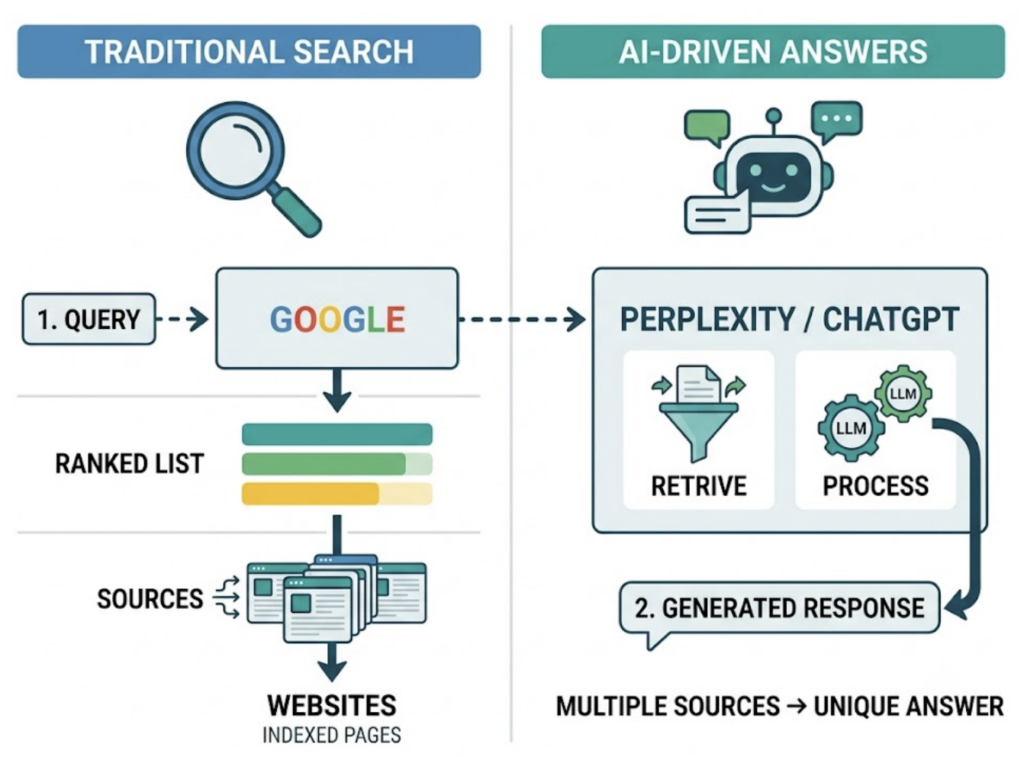
That divergence is the blind spot most marketing dashboards don’t capture.
The implication is direct: the metrics that made a brand successful on Google don’t automatically carry over. Backlink authority, crawlability, and keyword density tell AI models very little about whether to recommend you.
The Metrics Your SEO Dashboard Doesn’t Have
Here’s a side-by-side look at what traditional SEO tools track versus what AI search actually requires:
| Dimension | Traditional SEO Metrics | AI / GEO Metrics |
|---|---|---|
| Primary Goal | Traffic to URL (click-through) | Brand visibility in synthesized answers |
| Success Indicator | Keyword position (1-10) | Share of citation across AI platforms |
| Source Logic | Backlink authority (Domain Authority) | Definitional anchoring, third-party corroboration |
| Data Source | Crawl-based updates | API/query-based generation |
| Sentiment | Not tracked | How the brand is described, not just whether it appears |
The gap isn’t just technical. It’s conceptual. An AI rank checker needs to answer questions that traditional tools have never needed to ask: Does the model mention us at all? When it does, where do we appear relative to competitors? And what exactly is it saying about us?
Those are the three dimensions that matter in AI search: Presence, Position, and Perspective.
How an AI Rank Checker Actually Works
An AI rank checker doesn’t crawl a search results page. It simulates what users do.
The system sends a set of representative queries, across multiple AI platforms, and then parses the natural language responses. It extracts which brands appear, in what order, and with what framing. Run that process at scale, across hundreds of prompts and multiple AI engines, and you get a visibility baseline that traditional SEO tools can’t replicate.
As of mid-2025, weekly active users for AI search tools reached over 800 million, and AI Overviews now appear in more than 50% of representative user queries, often bypassing traditional organic links entirely. At that scale, a channel without measurement is a channel without strategy.
The operational principle is systematic prompting: you define the queries your audience is likely to ask, and the tool tells you what AI says in response. Not what Google ranks. What AI actually recommends.
What Topify Tracks That Semrush Can’t
Topify is built specifically for this layer. Where traditional SEO platforms stop at URL placement, Topify tracks seven metrics across AI platforms including ChatGPT, Gemini, Perplexity, DeepSeek, and others:
Visibility tracks how often your brand appears in AI-generated responses across a defined prompt set. Position tracks where you appear relative to competitors when the model lists multiple options. Sentiment analyzes how the model describes your brand, not just whether it mentions you.
Volume surfaces which AI search queries have the highest activity in your category. Mentions counts raw brand appearances across platforms. Intent maps which query types are driving your visibility. And CVR (Conversion Visibility Rate) estimates how likely an AI answer is to drive the user toward your brand.
Source Analysis is the feature that often surprises teams the most. It identifies which third-party domains (industry blogs, review platforms, community forums) AI engines are pulling from when they construct answers in your category. If your competitor’s G2 profile is being cited and your own isn’t, that’s where your GEO strategy needs to focus. No traditional SEO tool surfaces that.
Topify’s Basic plan covers 100 prompts with 9,000 AI answer analyses per month. The Pro plan scales to 250 prompts and 22,500 analyses. You can get started at app.topify.ai.
Three Signs You Already Need an AI Rank Checker
Your SEO traffic is stable but pipeline quality has shifted. Traditional rankings look fine, but fewer leads are arriving with strong purchase intent. AI search is increasingly handling the middle of the funnel: consumers use LLMs to synthesize reviews, compare products, and perform brand discovery before clicking a single link. If AI isn’t mentioning you in that phase, you’re losing deals before they start.
A competitor you’ve outranked on Google is gaining share in your category. They might not have better backlinks or higher DA. They might have better AI visibility. If you can’t check, you can’t know.
You can’t answer the question your leadership team is starting to ask. “What’s our presence in ChatGPT?” is becoming a standard executive ask. If the honest answer is “we don’t have data on that,” the gap between what you measure and what matters is already visible to the people who fund your team.
Conclusion
An AI rank checker isn’t a replacement for your SEO stack. It’s the layer your SEO stack was never built to cover.
Traditional tools track Google visibility. GEO tools track AI visibility. Both channels are real, both are growing, and they operate on completely different logic. The brands that figure that out now, while most of their competitors are still looking at keyword positions, are the ones that will be embedded in AI recommendations when their category reaches full maturity.
Topify tracks the metrics that matter in AI search, across every major platform, at the prompt level. If you don’t know what AI is saying about your brand right now, that’s the place to start.
FAQ
Q: What is an AI rank checker?
A: An AI rank checker is a tool that tracks how and whether your brand appears in AI-generated answers from platforms like ChatGPT, Perplexity, and Gemini. Unlike traditional rank trackers that monitor URL positions in Google search results, an AI rank checker measures brand mentions, position relative to competitors, and sentiment within synthesized AI responses.
Q: Can Semrush or Ahrefs track AI search visibility?
A: No. Tools like Semrush and Ahrefs are built to monitor URL placement in traditional search engine results pages. They can’t parse natural language AI responses or measure whether your brand appears in ChatGPT or Perplexity answers, because AI engines don’t return a ranked list of URLs. You need a separate tool designed specifically for AI visibility tracking.
Q: How do I check if my brand appears in AI search answers?
A: The most systematic approach is to use an AI visibility platform that sends representative queries to multiple AI engines and analyzes the responses for brand mentions, position, and framing. Manual spot-checks (typing queries directly into ChatGPT or Perplexity) can give you a rough sense, but they don’t scale across enough prompts or platforms to be reliable for strategy decisions.
Q: What’s the difference between SEO ranking and AI visibility?
A: SEO ranking refers to your URL’s position in a Google or Bing results page, determined by factors like backlink authority, keyword matching, and technical performance. AI visibility refers to whether your brand gets mentioned in AI-generated answers, where it appears relative to competitors, and how it’s described. The two metrics correlate poorly: high SEO rankings don’t guarantee AI visibility, and brands with strong AI presence sometimes have modest traditional rankings.

