

Your keyword rankings are solid. Domain authority sits in the 70s, the monthly SERP report is mostly green, and your rank tracker refreshes positions every 24 hours like clockwork. Then someone on the leadership team asks what ChatGPT says when a buyer requests recommendations in your category, and there’s no row in the spreadsheet for that.
Here’s the uncomfortable part: the data you need isn’t a missing column in your current tool. It’s a different measurement system entirely. Rank trackers and AI rank checkers sound like siblings. They measure different universes, and knowing where one stops and the other starts is what separates teams that adapt from teams that keep reporting stale wins.
Your Rank Tracker Says #1. ChatGPT Has Never Heard of You.
The core problem is that a #1 Google position and an AI recommendation are produced by two systems that barely agree. When Ahrefs compared ChatGPT’s citations against search results, the links generated by ChatGPT’s fan-out queries matched only 6.82% of Google’s top 10 results. Your page can dominate the SERP and still never surface when an AI assistant composes its answer.
Meanwhile, the SERP itself is sending fewer people your way. In the first four months of 2026, 68.01% of US Google searches ended without a single click, up from 60.45% in 2024. More of the buying journey now happens inside generated answers, on Google and off it.
That’s the gap a traditional rank tracker was never built to see.
What a Traditional Rank Tracker Actually Measures
A rank tracker answers one question with precision: for a fixed keyword, where does a specific URL sit on the results page? The output is a deterministic position from 1 to 100, refreshed on a schedule, comparable week over week.
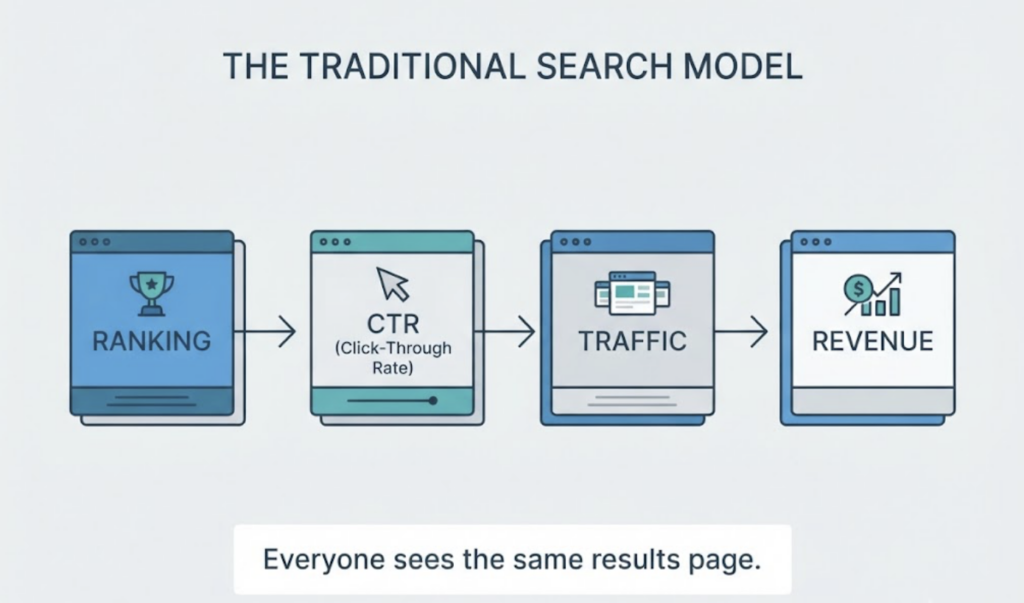
That model rests on an assumption that held for two decades. Everyone searching “best CRM software” saw roughly the same results page, so a single tracked position represented what your audience actually saw. Rankings mapped to click-through rates, CTR mapped to traffic, and traffic mapped to revenue.
None of that is wrong today. Google still drives the majority of referral traffic for most sites, and SERP positions still matter for the queries that produce clicks. The limitation is scope, not accuracy. A rank tracker tells you nothing about whether Perplexity mentions your brand, what position you hold inside a ChatGPT answer, or which sources the models trust instead of you.
What an AI Rank Checker Measures Instead
An AI rank checker tracks how AI platforms answer real prompts, and whether your brand shows up when they do. The measurement unit shifts from URL positions to brand-level signals: presence, position within the generated answer, sentiment, and the sources cited to justify the recommendation.
There’s a second structural difference that trips up most SEO teams. AI answers are probabilistic. Ask the same question in two sessions and you’ll often get two different brand lists, which means a single spot-check tells you almost nothing. A useful AI rank checker samples the same prompt repeatedly over time and reports rates, not one-off screenshots.
Here’s how the two tool categories compare side by side:
| Dimension | Traditional Rank Tracker | AI Rank Checker |
|---|---|---|
| Measurement object | Fixed keyword, SERP position | Prompt-level mention, citation, sentiment |
| Data unit | URL rank 1-100 | Presence rate, answer position, share of voice |
| Result stability | Consistent between crawls | Volatile by session, requires sampling |
| Competitive view | Who outranks you on a keyword | Which brands AI recommends before yours |
| Optimization lever | Backlinks, on-page SEO, CTR | Citations, entity clarity, third-party sources |
The strategic difference sits in the last row. Traditional rank tracking optimizes for clicks. AI rank checking optimizes for influence, meaning whether the model trusts your brand enough to name it when nobody clicks anything at all.
Why the Two Datasets Diverge: Rankings vs Mentions
AI engines don’t rank pages. They retrieve information, filter it through their own selection layer, and synthesize an answer. That extra processing is where your #1 position gets lost.
The research on this is consistent and blunt. A 2026 academic study found that GPT-4o’s cited domains overlap with Google’s top 10 by a mean of just 4.0%, with a median of 0%. For more than half of the queries tested, not a single domain appeared in both lists.
The divergence doesn’t stop between Google and AI. It runs between the AI platforms themselves. A study of 127,198 citations across five engines found they agreed on only 2.7% of sources, with 71% of cited sources appearing on just one platform. ZipTie’s analysis shows the flavor of that split: ChatGPT leans heavily on Wikipedia while Perplexity pulls 46.7% of its top citations from Reddit, and only 11% of domains get cited by both for the same query.
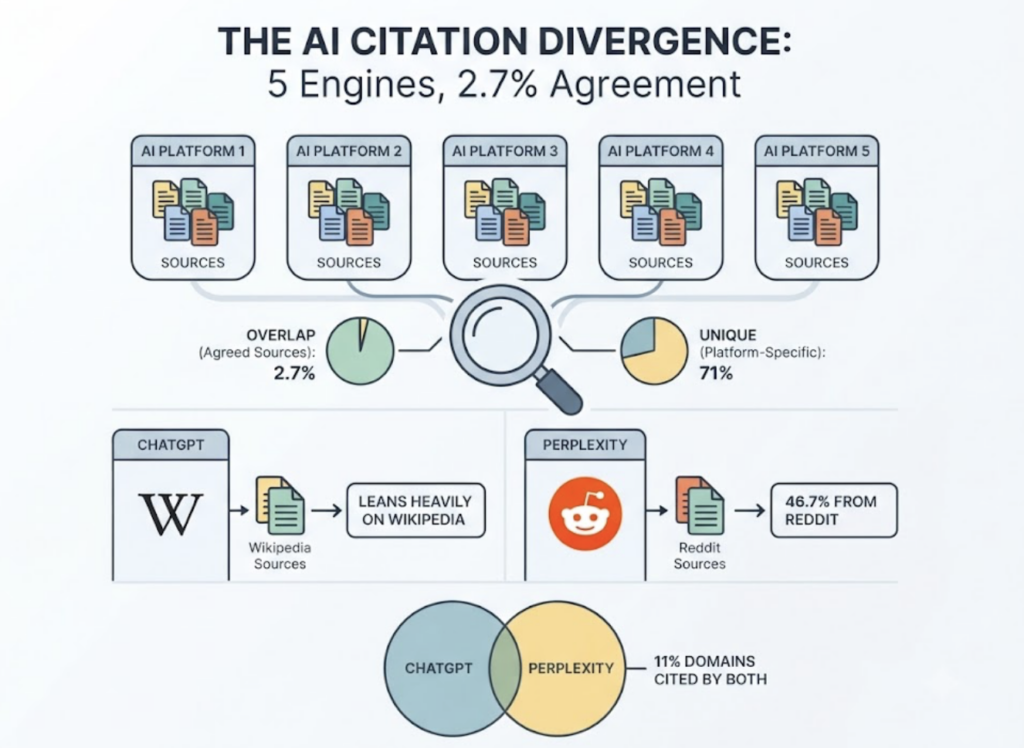
The takeaway: being visible on one AI platform predicts almost nothing about the others. Any tool that checks a single engine, or checks each prompt once, is measuring noise.
Running an AI Rank Checker in Practice: What Topify Tracks
Given the volatility and platform fragmentation above, a working AI rank checker needs three things: prompt-level tracking at scale, coverage across multiple AI engines, and a competitive baseline so a “yes, you’re mentioned” actually means something relative to rivals.
Topify is built around exactly that model. Its Position Tracking monitors where your brand lands inside AI answers relative to competitors, which is the closest analog to a traditional “rank” in the AI context. That sits within a broader set of seven metrics covering visibility, sentiment, position, volume, mentions, intent, and CVR, so a position drop can be read alongside sentiment shifts or citation changes rather than in isolation.
Coverage matters because of the 2.7% cross-engine agreement problem. Topify tracks brand performance across ChatGPT, Gemini, Perplexity, DeepSeek, and other major AI platforms, which lets you see the model-specific gaps a single-engine checker would hide.
In practice, the workflow looks like this: you notice your Perplexity position slipping on a high-intent prompt like “best project management tool for agencies.” Topify’s citation analysis shows which domains Perplexity started citing instead, and you trace the drop to a comparison site that stopped listing your product. That’s an actionable fix, not just a red number on a dashboard.
Pricing starts at $99/month for the Basic plan, which includes 100 tracked prompts and around 9,000 AI answer analyses per month, enough to run statistically meaningful sampling on a focused prompt set. If you want to test the water before committing to monitoring, there’s a free GEO tools reference that covers no-cost checkers for baseline audits.
Other tools exist in this category, and some do single-platform tracking well. The evaluation question is whether a tool samples repeatedly, covers the engines your buyers use, and connects position data to the citations driving it.
You Still Need Both. Here’s How the Stack Fits Together.
This isn’t a replacement decision. It’s a stack decision.
Traffic still overwhelmingly flows through Google, and your rank tracker plus Search Console remain the right instruments for it. But the traffic arriving from AI platforms behaves differently: Seer Interactive’s case study measured ChatGPT-referred traffic converting at 15.9% against 1.76% for Google organic. Small volume, disproportionate value. Ignoring the layer that produces it means ignoring your highest-intent channel.
A practical dual-stack setup takes an afternoon:
- Baseline. List your top 20 high-intent prompts, the “best [category] software” and “[problem] solution” questions your buyers actually ask AI.
- Trace. Run them through an AI rank checker and record presence rate, average position, and which competitors appear ahead of you. Get started with Topify to automate the sampling instead of screenshotting sessions manually.
- Optimize and re-measure. Where you’re absent, audit the citations the AI does trust, strengthen your presence on those third-party sources, tighten your semantic HTML, and check whether your presence rate moves over the next 30 days.
Keep your GA4 channel groupings updated to isolate AI referrals, and report both datasets side by side. SERP position tells you about clicks. AI position tells you about recommendations. Your leadership team needs both numbers.
Conclusion
A #1 Google position answers half the visibility question, and the half it answers is shrinking as zero-click behavior climbs and buyers delegate research to AI assistants. The other half, whether models mention, trust, and recommend your brand, requires an AI rank checker because the two systems agree on sources in the low single digits.
The pragmatic move isn’t panic or a platform migration. It’s a baseline: pick 20 prompts, measure your presence across the major AI engines this week, and decide where to invest based on what the data shows. Teams that establish that baseline now will be optimizing while their competitors are still explaining to leadership why the green SERP report doesn’t match reality.
FAQ
Q: What is an AI rank checker?
A: An AI rank checker is a tool that tracks whether and where your brand appears in AI-generated answers across platforms like ChatGPT, Perplexity, and Gemini. Instead of URL positions on a results page, it measures prompt-level presence, answer position, sentiment, and the sources AI engines cite.
Q: Can my existing rank tracker check AI rankings?
A: Generally no. Traditional rank trackers query search engine results pages, which are deterministic and URL-based. AI answers are probabilistic and brand-based, so they require repeated sampling of the same prompts across multiple engines, a fundamentally different data collection method.
Q: How do I check my brand ranking in ChatGPT?
A: Manually, you can ask ChatGPT your target prompts in fresh sessions and record whether your brand appears. But answers vary between sessions, so a reliable read requires sampling each prompt many times. Dedicated tools like Topify automate this and report presence rates and positions over time.
Q: How often should I track rankings in AI answers?
A: Continuously, or at least weekly. AI citation patterns shift as models update their retrieval sources, and studies show cross-session answer variance is high. Monthly spot-checks tend to miss both drops and wins, so ongoing sampling is the only way to see real trends.

