

Your rank tracker shows you sitting at #2 for your money keyword. Then your VP asks where you land when a buyer asks ChatGPT for a recommendation in your category, and you have nothing. You open the dashboard you’ve used for years, and there’s no column for it. That tool was built to watch Google’s ten blue links. AI search doesn’t work that way, and the distance between what your tracker measures and what buyers actually do is widening every quarter.
Why Your Rank Tracker Can’t See AI Search
Traditional rank tracking assumes a stable, ordered list of URLs. You rank #3 today, maybe #2 next week, and the tool logs the movement. That logic falls apart the moment an answer gets generated instead of listed.
AI search engines use Retrieval-Augmented Generation. Instead of returning ranked pages, they pull information chunks from multiple sources and synthesize a single answer. Google ranks entire pages on authority and backlinks. AI models rank pieces of information on semantic relevance and citation confidence. Different unit, different game.
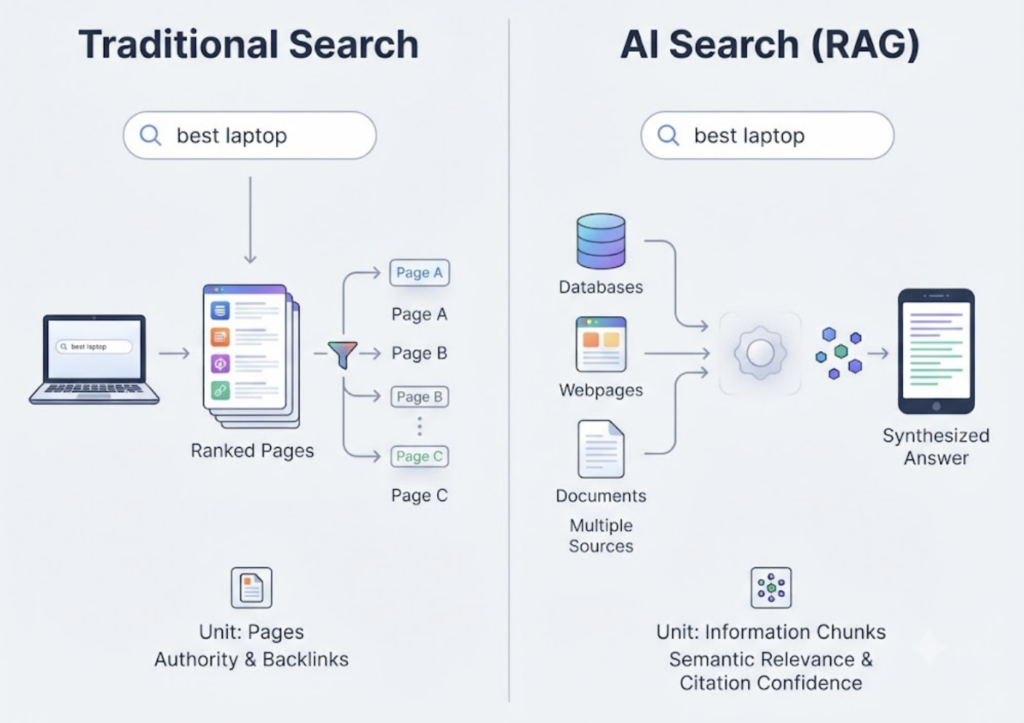
There’s also the zero-click problem. When the answer appears inside the interface, nobody clicks through, so “position #1” stops correlating with traffic or revenue.
And the output isn’t even stable. Ask the same question twice and you can get different citations, depending on the model’s settings, the conversation history, or a fresh index pull. A conventional AI rank checker built on fixed positions has nothing to hold onto.
That’s the gap most SEO teams still can’t see.
What “Rank” Even Means in ChatGPT, Perplexity, and AI Overviews
In AI search, rank isn’t a number from 1 to 10. It’s a measure of influence, and it shows up in three tiers.
The strongest is direct citation, where your brand is named and linked as a source. Below that is entity association, where the AI recommends your product as a solution without a link. The baseline is topic authority, where the model reliably pulls your data or perspective when the subject comes up. A useful AI rank checker has to account for all three, not just whether a blue hyperlink appeared.
The selection mechanics matter here. AI engines run a multi-stage pipeline: they parse a conversational query (often 20-plus words), retrieve candidates using both vector similarity and keyword matching, then run an L3 re-ranking pass that scores those candidates on factual density and answer completeness before writing the response. The technical breakdown from Mersel.ai maps this out in detail. The takeaway for anyone checking their AI rank: you’re not competing for a position, you’re competing to be the chunk the model trusts enough to quote.
The three platforms also behave differently. ChatGPT leans generative and synthesizes across sources. Perplexity is citation-first and shows its references openly. Google AI Overviews sits on top of search and pulls from a mix. Checking one and assuming the others match is a fast way to get a wrong read.
How to Check Your AI Rank Manually (Step-by-Step)
You can get a real baseline by hand before you automate anything. Here’s the process.
Step 1: Build a Prompt List That Mirrors Real Buyer Questions
Don’t start with keywords. Start with the questions your buyers actually type. Pull them from sales call transcripts and support tickets, then build a taxonomy of 50 to 100 core prompts. These should sound conversational and task-oriented (“what’s the best tool for tracking brand mentions in AI answers”), not like short-tail search terms. The prompt list is the foundation of every AI rank check that follows, so it’s worth doing carefully.
Step 2: Run the Same Prompts Across ChatGPT, Perplexity, and AI Overviews
Take each prompt and run it, unchanged, on all three engines. Same wording, same session-clean conditions where possible. You’re looking to compare apples to apples, because the point is to see how your ChatGPT ranking differs from your Perplexity ranking for the identical question. Run each prompt more than once. A single pass tells you almost nothing given how much the output moves.
Step 3: Log Whether You’re Mentioned, Where, and Who Beats You
For every result, record three things. Were you mentioned at all? Where did you land in the sequence of citations or recommendations? And who showed up ahead of you? Note the tone too: positive, neutral, or a comparison that frames a competitor as the safer pick. That last column is where the real intelligence lives. Being mentioned fifth behind two rivals is a different problem than not being mentioned at all.
Why Manual Checks Break Down Fast
The manual method works for a baseline. It doesn’t survive contact with the real pace of AI search.
The freshness demand alone is brutal. AuthorityTech’s 2026 citation research found that 88% of Google AI citations come from pages outside the traditional organic top 10, and separate analysis showed 76.4% of the pages Perplexity cited heavily had been updated within the previous 30 days. Manual spot-checks can’t keep up with a system that rewards content refreshed weeks ago.
Then there’s randomness. Models rotate citations to avoid repeating themselves, so a one-off check gives you a snapshot, never a trend line. You need repeated sampling over time to separate signal from noise.
And the workload compounds. Fifty prompts, three platforms, multiple runs each, logged and tallied by hand, every week. By the time you finish, the data’s already stale.
Using an AI Rank Checker to Automate the Whole Thing
Once the manual method proves the concept, the job becomes turning a one-time audit into a running measurement. That’s where a purpose-built AI rank checker earns its place.
For teams tracking rank across multiple engines, Topify approaches this by running your prompt set continuously across ChatGPT, Gemini, Perplexity, Google AI Overviews, and other major platforms, then rolling the results into one view. In practice, its Position Tracking tells you where you sit relative to competitors in AI answers, Visibility Tracking shows how often you’re mentioned at all, and Source Analysis reverse-engineers which domains and URLs the AI actually cited. So when your ranking drops, you can trace it to a specific source that stopped referencing your brand, inside the same dashboard.
That last point closes the loop the manual method leaves open. A hand-logged spreadsheet can tell you that you slipped. It rarely tells you why. Pairing Position data with Source data answers both in one place.
The measurement also spans the full definition of rank. Rather than checking a single hyperlink, the platform tracks visibility, sentiment, position, and citation sources together, which is closer to how AI search actually distributes influence. If you want to test the surface of this before committing, Topify’s free GEO tools reference is a reasonable place to start, and you can run a full trial to see your own prompt set scored across engines.
Common Mistakes When Checking AI Rank
A few errors show up over and over, and each one quietly corrupts the data.
Checking one platform and generalizing is the most common. ChatGPT, Perplexity, and AI Overviews cite differently, so a strong Perplexity showing tells you little about ChatGPT.
Running each prompt once is the second. Non-deterministic output means a single pass is closer to a coin flip than a measurement.
Tracking position while ignoring mention is the third, and the most expensive. If your brand never enters the answer, there’s no rank to improve. Visibility comes before position, always.
The last one is subtle: testing with your own brand name instead of the buyer’s real question. Searching “is [your brand] good” almost guarantees a mention. It also has nothing to do with how an actual prospect discovers you.
Conclusion
The uncomfortable truth is that your Google rank and your AI rank are now two separate things, and only one of them shows up in your current tracker. That gap won’t close on its own. AI search keeps growing, citation patterns shift by the week, and every quarter you wait is a quarter of missing baseline data. Start with a manual audit to see where you stand across ChatGPT, Perplexity, and AI Overviews. Then move to continuous tracking before the volatility outpaces your ability to measure it by hand. The brands that establish an AI rank baseline now will be the ones who can prove movement later.
FAQ
Q: Is there a free AI rank checker?
A: You can run a basic manual check for free by polling ChatGPT, Perplexity, and AI Overviews with your own prompt list and logging the results. Some platforms also offer free entry-level GEO tools to test visibility on a small scale before you commit to full tracking.
Q: Does AI search actually have rankings like Google?
A: Not in the same way. Google returns an ordered list of URLs. AI search synthesizes answers and “ranks” you by whether you’re cited, where you appear in the sequence, and how favorably you’re framed. It’s better understood as citation probability than position.
Q: How often does AI ranking change?
A: Frequently, and for two reasons. Models rotate citations to avoid repetition, so results shift between runs, and they favor recently updated content, with a large share of cited pages refreshed within the prior month. This is why a single check is unreliable and repeated sampling matters.
Q: ChatGPT vs Perplexity: is the ranking the same?
A: No. Perplexity is citation-first and surfaces its sources openly, while ChatGPT leans generative and synthesizes across references. The same prompt can rank you well on one and omit you entirely on the other, which is why cross-engine checking is essential.

