

You run your category prompt through ChatGPT and a competitor shows up in the answer. Six months ago, that meant one thing: the model’s retrieval layer picked them organically. Now it might mean something else entirely. They could have paid for that placement. Your traditional rank tracker has one column for “position.” AI search just split into two ranking systems, paid and organic, and most tools can’t tell you which one you’re looking at. That’s the gap an ai rank checker has to close in 2026.
Two AI Platforms Just Split the Definition of Ranking
In the span of five weeks, the two most-watched AI search companies took opposite bets on the same question: should answers carry ads?
OpenAI moved first. The company announced ChatGPT advertising on January 16, 2026, with the US rollout starting in early February for users on the Free and $8/month Go tiers. Plus, Pro, Team, and Enterprise subscribers stay ad-free. Sponsored units appear alongside responses, matched to conversation context rather than keyword bids.
Perplexity went the other way. On February 18, 2026, the company abandoned advertising entirely and committed to a subscription-only model. This wasn’t a company that never tried ads. Perplexity was among the first to test sponsored placements back in 2024, then spent a year phasing them out. One executive put the reasoning bluntly: “the challenge with ads is that a user would just start doubting everything.”
The result is a structural fork. “Ranking” in ChatGPT now means two different things depending on whether money changed hands. Ranking in Perplexity means exactly one thing: the retrieval system judged your brand worth citing.
Your measurement stack has to handle both realities at once.
Inside ChatGPT’s Ad Machine and What an AI Rank Checker Sees
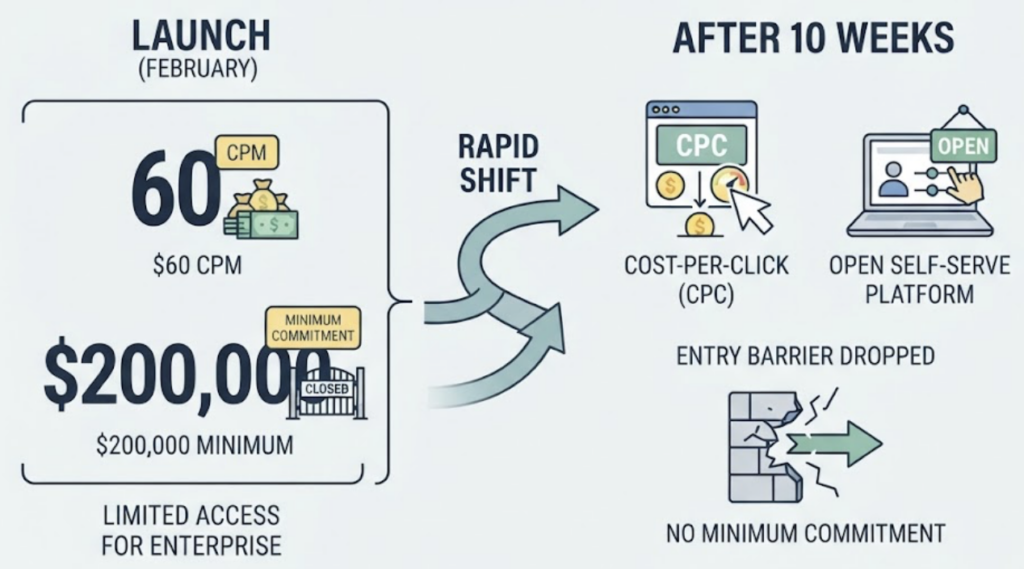
The speed of ChatGPT’s ad expansion caught most marketing teams flat-footed. The February launch started at $60 CPM with a $200,000 minimum commitment, pricing that limited buyers to a narrow set of enterprise brands. Within ten weeks, OpenAI shifted to cost-per-click bidding, opened a self-serve platform, and dropped the entry barrier entirely.
Penetration followed. By late May 2026, monitoring data put ads in 49.1% of US ChatGPT responses, with CPCs running $3 to $5 for general categories and $8 to $18 for software and finance. For comparison, that US ad rate is roughly 24 times Google’s classic SERP rate.
Here’s what this means for anyone checking AI rankings. The same prompt now produces different visible results depending on who’s asking. A free-tier user sees sponsored units a paid subscriber never encounters. A brand that “appears in ChatGPT” might be renting that presence week to week, while its organic mention rate sits at zero.
OpenAI maintains that ads don’t influence the actual answers. Take that at face value, and the implication is still sharp: paid slots and organic mentions are separate inventory, governed by separate rules.
Why Paid Placement Isn’t the Ranking You Should Track
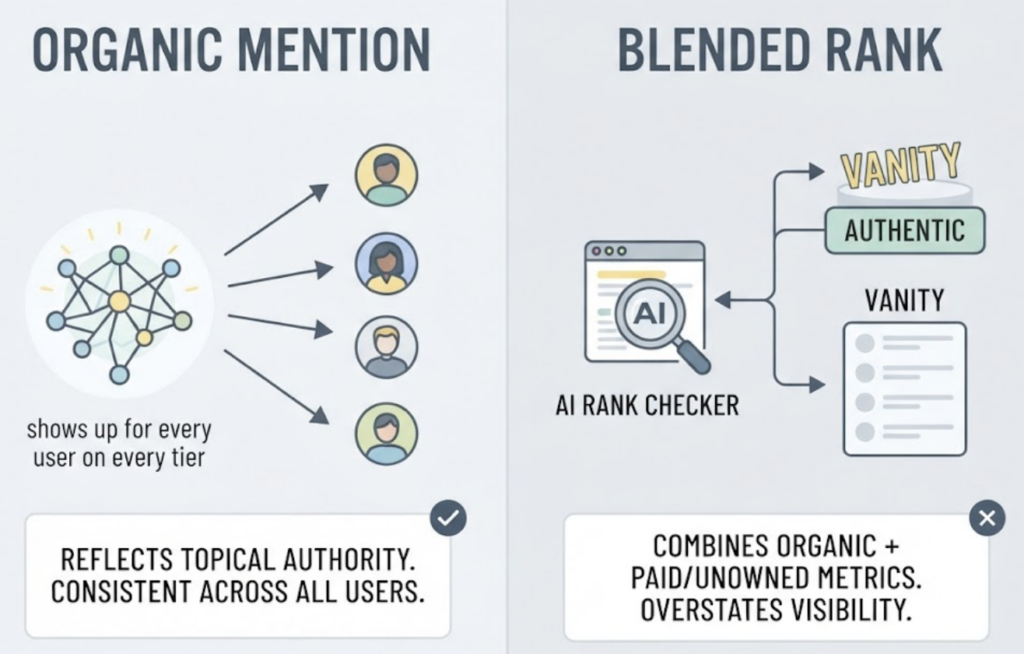
A paid slot is a lease. It lasts as long as the budget does, it’s visible to only part of the user base, and it disappears the moment a competitor outbids you.
An organic mention is different. It reflects what the model’s retrieval and synthesis layers concluded about your topical authority, and it shows up for every user on every tier. When an ai rank checker reports your position, the number only means something if it’s measuring this second category. Blending the two produces a vanity metric that overstates visibility you don’t actually own.
Perplexity’s Zero-Ad Bet Makes Organic Rank the Only Rank
Perplexity’s retreat looks less risky once you see the numbers behind it. Advertising never became meaningful revenue for the company; the business runs on subscriptions ranging from $20 to $200 per month, and leadership has said usage-based subscriptions represent the right long-term model for AI.
That subscriber base skews toward exactly the audience B2B marketers struggle to reach: professionals in finance, legal, healthcare, and consulting who pay for accuracy. There is no sponsored path in front of them. Every brand that appears in a Perplexity answer earned the citation through content the engine deemed authoritative.
On a zero-ad platform, citation share is the entire game.
This changes what tracking should measure. Position still matters, but the deeper signal is which domains and URLs Perplexity pulls into its synthesis, how often your brand appears across a prompt set, and whether the surrounding sentiment helps or hurts. A negative citation on a trust-first platform can do more damage than absence.
How to Rebuild Your AI Rank Checking Stack for a Split Market
Traditional rank trackers were built for deterministic results: one query, one ordered list, one position per domain. Generative answers break every one of those assumptions, and the ad split breaks them further. A stack built for 2026 needs four capabilities.
Platform-specific tracking. ChatGPT and Perplexity now run on different commercial logic, so their numbers can’t be averaged into one score. You need separate baselines per engine, plus visibility into how ad-supported and ad-free ChatGPT tiers differ.
Paid versus organic segregation. Any tool that can’t tell a sponsored unit from an organic mention will inflate your visibility data. This distinction should be a first-class field in every report, not a footnote.
Citation intelligence. The focus shifts from “what position” to “which sources.” Knowing that Perplexity cites a competitor’s comparison page in 40% of category prompts tells you exactly what content to build.
Sentiment and context. Presence without favorable framing is a liability. Tracking has to capture how the model describes you, not just whether it does.
For teams putting this into practice, Topify covers all four layers in one platform. Its Position Tracking monitors where your brand lands in AI answers relative to competitors, measured on the organic side rather than the rented one. Visibility Tracking runs the same prompt sets across ChatGPT, Perplexity, Gemini, and other engines so the platform-by-platform divergence becomes visible instead of averaged away. Source Analysis reverse-engineers the exact domains AI platforms cite, which is the practical answer to winning Perplexity’s zero-ad environment. And Competitor Monitoring shows whether a rival’s sudden ChatGPT presence comes from earned authority or an ad budget, which determines whether you should respond with content or with spend.
If you want to gauge the problem before committing to a platform, a set of free GEO tools can establish a quick baseline of where your brand currently stands.
What This Split Means for Your 2026 Visibility Budget
The temptation is to treat ChatGPT ads as the fast lane and skip the slower organic work. The economics argue against that as a standalone strategy.
AI referral traffic is still a small slice of total web traffic, but industry benchmark studies through 2026 have measured conversion rates around 14.2% for IT and B2B services from AI referrals, versus roughly 2.8% from traditional Google organic. High intent, small volume, outsized value per visit. Paid slots capture some of that intent, but only on one platform, only for ad-tier users, and only while you keep paying.
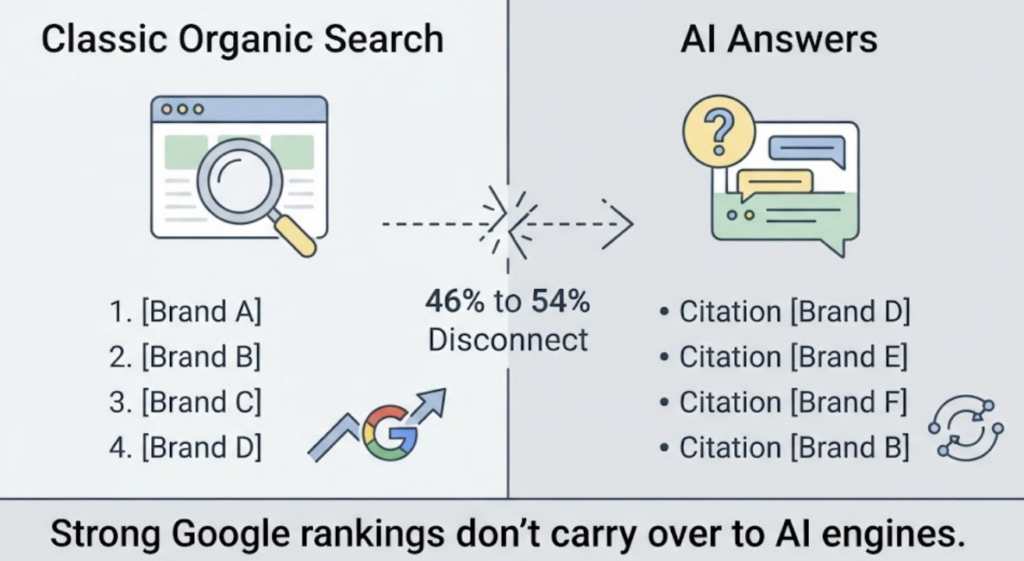
Meanwhile, the same benchmark research points to a 46% to 54% disconnect between brands cited in classic organic search and brands cited in AI answers for identical queries. Strong Google rankings don’t carry over. AI engines tend to favor structured, extractable content: question-based headers, schema markup, self-contained comparisons.
So the rational budget is a dual strategy. Use paid ChatGPT placements tactically for a handful of high-intent prompts where immediate presence justifies the CPC. Put the durable investment into GEO, the content and authority work that earns organic citations across every engine, including the ones where visibility can’t be bought.
The more ad inventory floods ChatGPT, the more scarce and valuable the organic slot becomes.
Conclusion
The ChatGPT-Perplexity split isn’t a temporary divergence. It’s two viable business models pulling AI search in opposite directions, and it permanently forked the meaning of “ranking.” From here on, an AI visibility number without a paid-or-organic label is incomplete data.
The practical first step costs nothing: baseline your current organic presence across both platforms, per prompt, before spending a dollar on placements. Start with a free visibility check, identify where competitors are earning citations you’re not, and let that gap set your content priorities for the next quarter.
FAQ
Q: What does an ai rank checker track in ChatGPT versus Perplexity?
A: In ChatGPT, it should track organic mentions and positions separately from sponsored units, since roughly half of US responses now carry ads. In Perplexity, where no ads exist, it tracks citation frequency, position relative to competitors, and the source URLs the engine pulls from.
Q: Do ChatGPT ads affect the organic recommendations in answers?
A: OpenAI states that sponsored units don’t influence the answer content itself. Ads appear as labeled units alongside responses. Organic mentions are still determined by the model’s retrieval and synthesis process, which is why the two need separate measurement.
Q: How do I check my brand’s AI search ranking for free?
A: Start with manual spot checks across your top 10 to 20 category prompts on both platforms, then use free GEO tools to establish a baseline before investing in continuous monitoring. Manual checks miss volatility, so treat them as a snapshot rather than a tracking system.
Q: Is a Perplexity ranking more valuable now that the platform has no ads?
A: For high-intent professional audiences, often yes. Perplexity’s subscribers pay $20 to $200 monthly for accuracy, and every brand appearance is organically earned. A consistent citation there signals topical authority that no budget can replicate.

