

Your rank tracker says everything is fine. Fifty cities, solid local pack positions, map grids mostly green. Then a regional manager forwards you a screenshot: someone asked ChatGPT for “the best urgent care in Denver,” and your clinic, the one holding position 2 in the local pack there, isn’t in the answer. You check three more cities. You’re in one, missing from two, and described as “a budget option” in the third. Your reporting stack has no column for any of this. The tools that track your rankings were built to watch a results page, not to read an answer. What you need now is a different kind of rank checking, one that looks inside AI responses, city by city.
Your Local Pack Rankings Don’t Predict What ChatGPT Recommends
The gap between traditional local visibility and AI visibility is not a rounding error. SOCi’s 2026 Local Visibility Index analyzed nearly 350,000 locations across 2,751 multi-location brands and found that ChatGPT recommended only 1.2% of locations, Gemini 11%, and Perplexity 7.4%. Those same brands appeared in Google’s local 3-pack 35.9% of the time.
In other words, AI visibility can be up to 30 times harder to earn than a local pack spot.
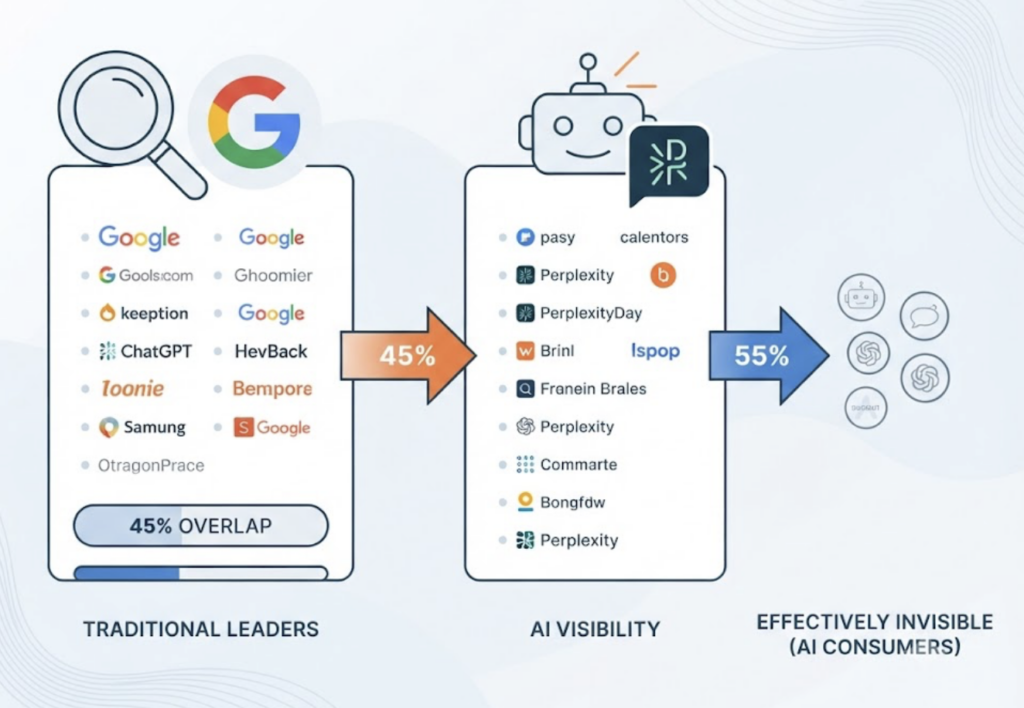
Strong traditional performance doesn’t carry over, either. In retail, only 45% of brands leading in traditional local search also ranked among the most recommended in AI results. More than half of the winners on Google are effectively invisible to consumers who ask an AI assistant instead.
And those consumers are no longer an edge case. AI-referred sessions grew 527% year over year, and Semrush found that AI search visitors convert at 4.4x the rate of traditional organic visitors. The channel is small in absolute terms, but it’s the highest-intent traffic most local brands aren’t measuring.
What an AI Rank Checker Actually Measures
An AI rank checker monitors how AI assistants answer buying-intent questions about your category, then records whether your brand appears, where it sits in the recommendation list, and how it’s described. That’s a different job from checking a SERP.
The core difference: AI answers are probabilistic. As Rand Fishkin’s research made clear, asking an AI tool the same question 100 times can produce 100 different answers. So an AI rank checker doesn’t report a single fixed position. It samples repeatedly and reports frequency: how often you’re mentioned, and your average position when you are.
| Dimension | Traditional local rank tracker | AI rank checker |
|---|---|---|
| What it queries | Google SERP / local pack / map grid | Prompts sent to ChatGPT, Gemini, Perplexity |
| Result format | Ranked list of links | Synthesized answer with 3-5 recommendations |
| Position metric | Fixed rank (1, 2, 3…) | Mention rate (%) + average position across samples |
| Competitive view | Same 10 results for everyone | Competitor set shifts per prompt and city |
| Descriptive layer | None | Sentiment and framing (“premium” vs “budget”) |
For local and multi-location brands, one more dimension matters: every metric above has to be tracked per location. A brand-level mention rate hides exactly the failures you need to find.
Why Location Changes Everything in AI Answers
Swap the city name in a prompt and the AI’s recommendation set can change completely. Each market has its own review density, local press coverage, and community discussion, so the trust signals AI models weigh are rebuilt from scratch for every geography.
The spread between winners and everyone else is stark. In the restaurant category, SOCi found visibility concentrated among a handful of leaders: Culver’s reached AI recommendation rates of 30.0% on ChatGPT and 45.8% on Gemini, while most competitors barely registered. A brand can be the default answer in one metro and absent in the next, with no signal in its SEO dashboard explaining why.
Now do the math on manual checking. A 60-location brand tracking 10 prompt variants across 3 AI platforms needs 1,800 query checks for a single snapshot, and because answers vary run to run, each check should be sampled multiple times. Weekly.
That’s not a spreadsheet task. That’s a monitoring system.
How to Check AI Rankings Across Every Location
The workflow that works in practice has four steps, and each one maps to a tooling requirement.
Step 1: Build a location-modified prompt library. Start from your highest-value buying questions (“best [category] in [city],” “affordable [service] near [neighborhood]”) and generate variants for every market you operate in. This is where prompt discovery beats guesswork: the phrasings customers actually use rarely match your keyword list.
Step 2: Run the prompts across platforms on a schedule. Each AI engine weighs sources differently, so ChatGPT, Gemini, and Perplexity results diverge. One platform is not a proxy for the others.
Step 3: Record position per city, not just mentions. Being listed fifth behind four competitors is a different business outcome than being the first name the AI offers.
Step 4: Track change over time and trace it to sources. A position drop usually has a cause you can act on, typically a source that stopped citing you or started citing a competitor.
This is the use case Topify is built around. Its Position Tracking monitors where your brand ranks inside AI answers relative to competitors, prompt by prompt, across ChatGPT, Gemini, Perplexity, and other major engines. High-Value Prompt Discovery surfaces the location-modified queries with real AI search volume, so a 60-location brand isn’t guessing which of its 1,800 prompt-city combinations deserve monitoring budget. Competitor Monitoring auto-detects who you’re actually up against in each market, which matters because your rival in Phoenix often isn’t your rival in Seattle. In practice, this means you can spot your Austin locations sliding from position 2 to position 5 on ChatGPT, then trace it back to a local listicle that dropped you, all in one view.
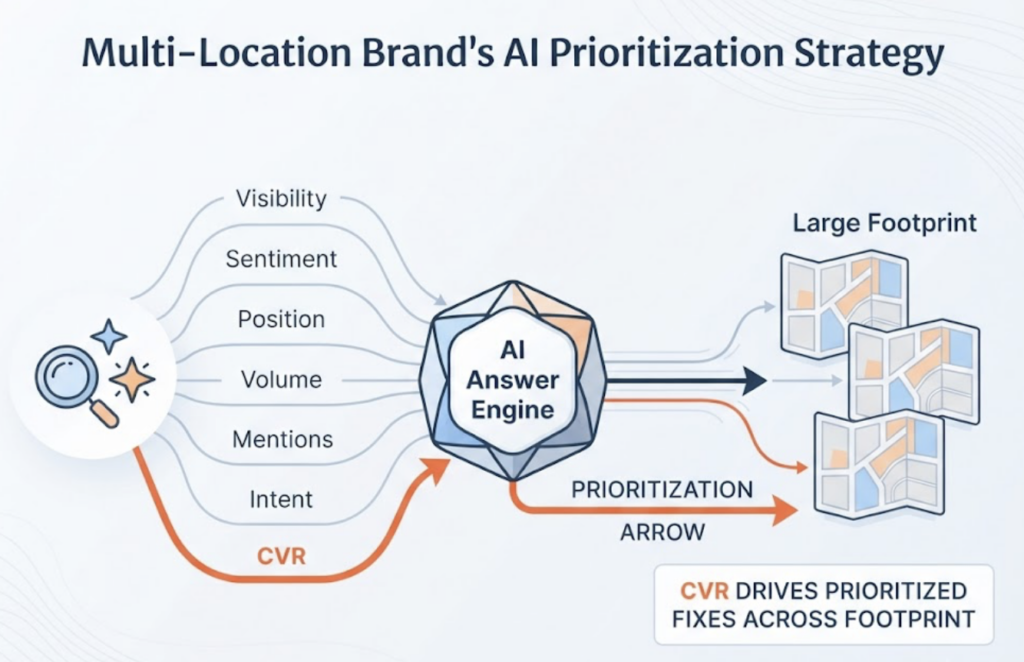
The platform tracks seven metrics per prompt: visibility, sentiment, position, volume, mentions, intent, and CVR. For a multi-location brand, that last one estimates which cities’ AI answers are most likely to drive actual customer action, which is how you prioritize fixes across a large footprint.
If you’d rather validate the gap before committing, run a handful of your own city prompts through a free trial and compare the results against your local pack report. Topify also maintains a reference list of free GEO tools if you want to benchmark with lighter-weight checks first.
The Sources AI Trusts for Local Recommendations
Checking your AI rank tells you where you stand. Improving it requires knowing which sources the models lean on, and the data here is specific.
Review signals set a hard floor. Locations recommended by ChatGPT averaged 4.3 stars, while brands near 3.4 stars with review response rates below 5% were effectively invisible in AI recommendations. In traditional local search, a middling location can still rank on proximity. In AI answers, it typically gets excluded outright.
Community platforms carry outsized weight. Semrush’s research found Quora is the most commonly cited website in Google AI Overviews, with Reddit in second place, because AI systems treat forum threads as a proxy for genuine human consensus. If nobody on Reddit has ever recommended your Portland location, that silence is a ranking signal.
Data accuracy is quietly leaking visibility too. SOCi found business profile information was only about 68% accurate on ChatGPT and Perplexity, compared with 100% on Gemini, which grounds its answers in Google Maps. Wrong hours or an outdated address at even a few locations reads as risk to a model, and models handle risk by leaving you out.
This is where citation-level analysis earns its keep. Topify’s Source Analysis reverse-engineers the exact domains and URLs each AI platform cites for your category prompts, per market. Instead of a generic “get more reviews” plan, you get a target list: the two local publications, one Reddit community, and one aggregator that actually feed the answers in each city.
Common Mistakes Multi-Location Brands Make in AI Search
Auditing only flagship cities. The markets where you’re strongest are the least informative. AI visibility failures cluster in mid-tier locations with thinner review and citation footprints, exactly where nobody checks.
Treating one AI platform as representative. Gemini’s grounding in Google Maps makes it the friendliest engine for brands with clean GBP data, which is why it recommended 11% of locations while ChatGPT recommended 1.2%. Reading only Gemini results tends to overstate your real coverage.
Assuming GBP optimization covers AI. Listings hygiene is necessary but not sufficient. Models synthesize your entire footprint, including reviews, forums, and press, so a perfect profile with a weak citation footprint still loses.
Ignoring prompt phrasing variants. “Best,” “cheapest,” and “most reliable” pull different recommendation sets. Tracking one phrasing per city undercounts both your wins and your losses.
Reporting brand averages to stakeholders. A 40% overall mention rate can hide ten cities at zero. Location-level reporting is the whole point.
Conclusion
The definition of rank checking has changed underneath local brands. Your local pack positions still matter, but they no longer predict whether an AI assistant will name you when a customer asks, and the 1.2% ChatGPT recommendation rate for multi-location brands says most are losing that moment by default.
The fix starts smaller than it sounds. Pick your 10 highest-value location prompts, run them across three AI platforms, and record where you stand. That baseline, tracked weekly with an AI rank checker that measures position and mention rate per city, turns an invisible problem into an ordinary reporting line. The brands doing this now are setting the defaults everyone else will be trying to displace.
FAQ
Q: What is an AI rank checker?
A: An AI rank checker is a tool that monitors AI-generated answers from platforms like ChatGPT, Gemini, and Perplexity to see whether a brand appears, what position it holds in the recommendation list, and how it’s described. Because AI answers vary between runs, it reports mention frequency and average position rather than a single fixed rank.
Q: How do I check my brand’s ranking in ChatGPT for a specific city?
A: Manually, you’d ask ChatGPT a buying-intent prompt with the city name (“best [category] in Austin”) multiple times and log whether and where your brand appears. At multi-location scale, a platform like Topify automates this by running location-modified prompts on a schedule and tracking position per market.
Q: How is AI rank checking different from local rank tracking?
A: Local rank trackers monitor fixed positions in Google’s SERP and local pack. AI rank checking monitors synthesized answers where results are probabilistic, competitor sets change by city, and visibility is measured as recommendation frequency plus position. Strong local pack rankings often coexist with zero AI visibility.
Q: How many prompts should a multi-location brand track?
A: Start with 5-10 core buying-intent prompts per priority market, covering your main category terms and at least two phrasing variants (such as “best” and “affordable”). Expand based on prompt discovery data showing which queries carry real AI search volume in each city.

