

Your keyword rankings look fine. Your domain authority hasn’t moved. But when a buyer asks ChatGPT for recommendations in your category, you have no idea whether your brand shows up, where it lands, or how the AI describes you. That blind spot is getting expensive: as of 2026, over 60% of information-seeking queries resolve inside the AI interface without a single click. The dashboards you’ve relied on for a decade weren’t built to measure any of this.
What an AI Query Tracking Solution Actually Tracks
An AI query tracking solution is a system that audits how your brand appears inside the generative outputs of AI platforms like ChatGPT, Perplexity, Gemini, and Google AI Overviews. Instead of monitoring where a URL ranks on a results page, it monitors whether your brand gets mentioned, recommended, or cited when someone asks an AI a buying question.
The distinction matters because the two systems behave differently. Traditional rank tracking watches a deterministic list: your page either holds position #4 or it doesn’t. AI answers are probabilistic. Models use temperature settings and contextual awareness, so the same prompt can return different brand recommendations across consecutive sessions.
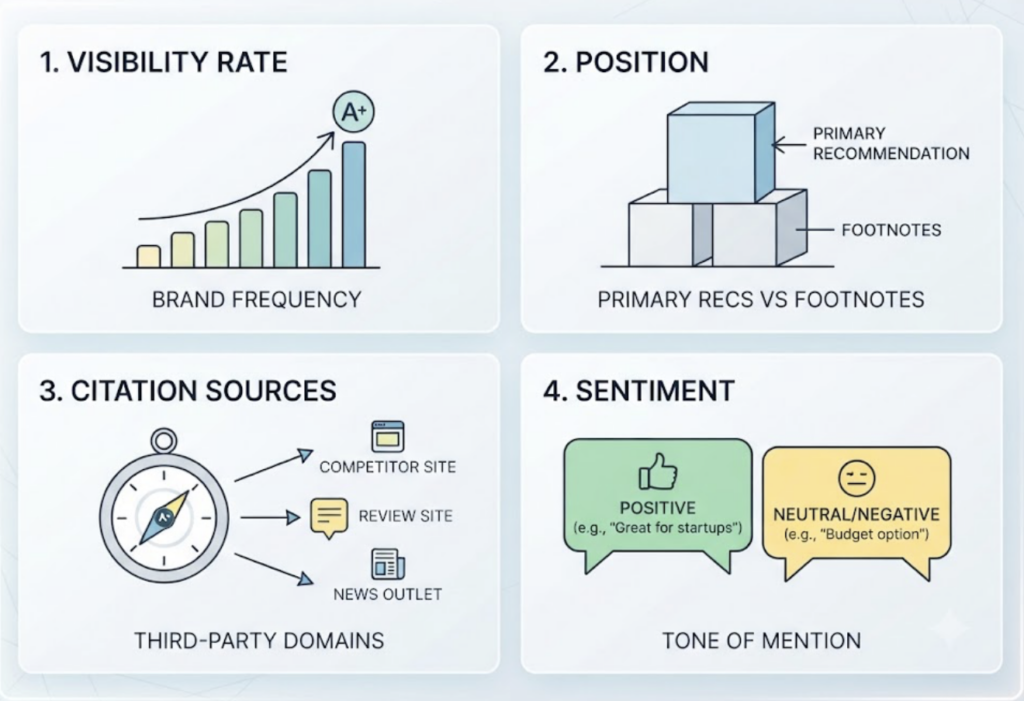
In practice, a solid tracking setup measures four things: how often your brand appears for a given prompt (visibility rate), whether you’re the primary recommendation or a footnote (position), which third-party domains the AI cites as evidence (citation sources), and the tone of the mention (sentiment). “Great for startups” and “a budget option” are both mentions. They’re not the same outcome.
Rank Trackers Told You Where You Stood. AI Answers Don’t Work That Way.
Tools built for the SERP era have started bolting on AI features. A rank ranger AI Overviews tracker, for example, treats Google’s AI Overviews as another SERP feature to monitor, similar to a featured snippet or an image pack. That’s genuinely useful if your goal is defending Google click-through.
It’s also where the coverage stops.
The SERP-first approach runs into three walls. First, platform blindness: it ignores conversational engines like Perplexity and ChatGPT, where the discovery journey starts and ends outside of Google entirely. Second, it detects whether a link exists but not what the answer says. It can’t tell you if the AI calls your product “expensive” or “premium,” and that semantic difference shapes buyer perception more than the link itself. Third, it assumes stability. SERP positions hold steady for days; AI visibility shifts between sessions, which means a single snapshot is closer to a coin flip than a measurement.
None of this makes SERP trackers obsolete. It makes them incomplete. They answer “where do I rank on Google” while the newer question is “what does AI say about me everywhere.”
How an AI Query Tracking Solution Works, Step by Step
Most professional systems follow the same four-step cycle, repeated on a schedule.
Step 1: Build a prompt library. Tracking starts with queries that mirror real buyer journeys, like “best [product] for [industry]” or “alternatives to [competitor].” Generic prompts produce generic data. Decision-stage prompts produce data you can act on.
Step 2: Sample across engines. The system runs those prompts on ChatGPT, Perplexity, Gemini, and AI Overviews on a daily or weekly cadence. Because outputs vary, one pass means nothing. Repeated sampling across platforms reveals where the engines agree about your category and where they diverge.
Step 3: Parse the responses. NLP-based analysis converts raw answer text into structured data: mentions, position, sentiment, and the specific sources cited. This is the step that separates a tracking solution from someone manually pasting prompts into a chat window.
Step 4: Attribute the gaps. When visibility is zero, the system should tell you why. Sometimes the cause is weak topical authority on your own site. More often, it’s absence from the third-party platforms the AI actually trusts, like review sites, forums, or trade publications.
Platforms like Topify run this cycle across seven metrics (visibility, sentiment, position, volume, mentions, intent, and CVR), which means a drop in ChatGPT mentions can be traced back to a specific source that stopped citing your brand, inside the same dashboard.
How to Measure Whether Your AI Query Tracking Is Working
Raw answer data becomes useful when it’s compressed into a few KPIs your team can review weekly. Four have emerged as the industry standard:
Mention rate is the existence metric. If a prompt triggers your category and your brand isn’t in the answer, you have an inclusion gap, and nothing else matters until it’s closed.
Average position measures salience. Being recommended first versus fifth changes both perception and the probability a user acts on it.
Citation share tracks how often your owned or earned assets appear as the evidence behind an AI’s claim. This is the metric SERP tools skip entirely.
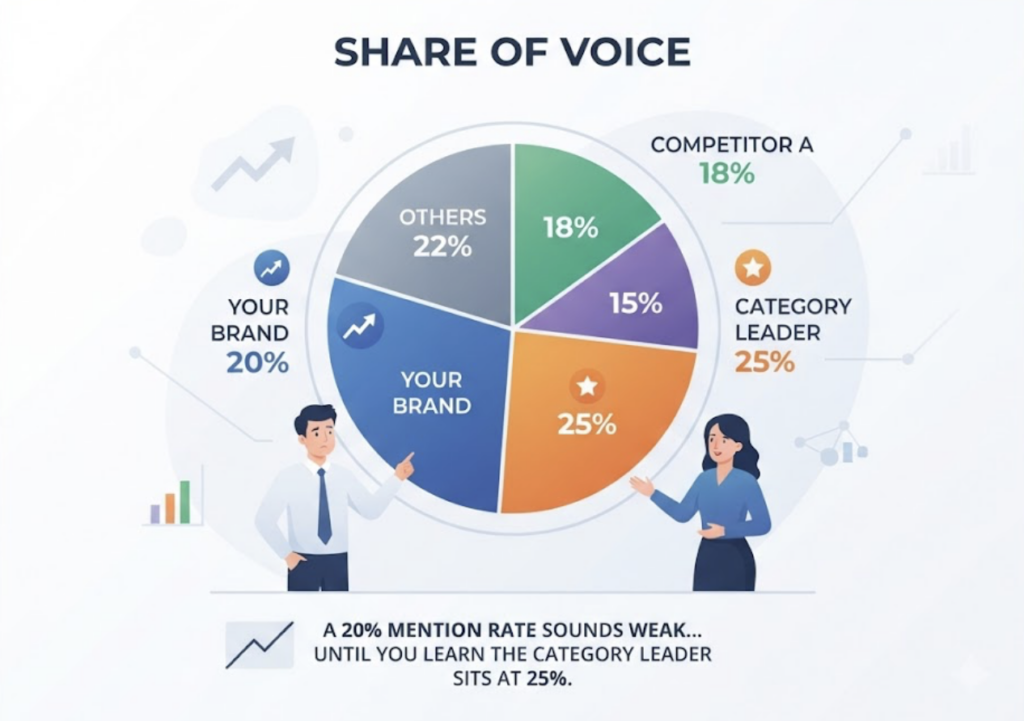
Share of voice puts your presence in context against competitors within the same prompt cluster. A 20% mention rate sounds weak until you learn the category leader sits at 25%.
Measure all four against a baseline, then review the trend over a rolling window rather than reacting to any single day’s output.
Best Tools for an AI Query Tracking Solution in 2026
The market splits into two camps: SERP-first tools that added AI features, and AI-first platforms that treat the LLM as the primary surface.
| Tool | Focus | Pricing | Best For |
|---|---|---|---|
| Topify | Cross-platform AI visibility, citation analysis, execution | From $99/mo | Brands needing prompt-level insights and citation gap analysis |
| Rank Ranger AI Overviews tracker | Google SERP + AIO monitoring | Tiered | Teams optimizing primarily for Google SERP features |
| General SERP suites with AI add-ons | Rank tracking with partial AIO data | Varies | Teams not yet ready to track conversational platforms |
Topify is the strongest fit for teams that want the full loop rather than another report. It tracks brand mentions at the prompt level across ChatGPT, Gemini, Perplexity, DeepSeek, and other major engines, then layers on the citation analysis piece: reverse-engineering the exact domains and URLs each platform cites when answering questions in your category.
That citation layer is where it pulls ahead in day-to-day use. If a competitor keeps getting validated by G2 or a niche trade journal and your brand doesn’t appear there, Topify maps that specific missing link, effectively telling your team where to aim PR and content effort to teach the AI your brand is an authority. Tracking tells you the score. Source gaps tell you the next move.
Pricing starts at $99/mo on the Basic plan, which covers ChatGPT, Perplexity, and AI Overviews tracking with 100 prompts and 9,000 AI answer analyses, enough to run the “Core 50” strategy below with room to spare. Plans scale by usage rather than enterprise bundles, so you can start small and expand as the data proves out.
The rank ranger AI Overviews tracker approach still makes sense as a complement if Google remains your dominant channel. Just don’t mistake AIO coverage for AI coverage.
Common Mistakes That Undermine an AI Query Tracking Solution
Trusting a single sample. Running one manual query and treating the answer as truth is the most common failure. AI outputs vary by session. Use a rolling average, typically a 30-day window, before drawing conclusions.
Ignoring the citation supply chain. Teams optimize their own site while the AI pulls its evidence from third-party review platforms. If you’re invisible on the sources the AI trusts, you’ll stay invisible in the answer, no matter how good your on-site content gets.
Writing for keyword density. LLMs parse intent, not keyword counts. Content stuffed with “SEO-ese” reads as low-trust. Clear definitions, concise headings, and authoritative data tables perform better because they’re easier for models to extract and cite.
Freezing the prompt set. Buyer language shifts, and so do the prompts that matter. A tracking setup that never adds new queries slowly measures yesterday’s market.
A quick checklist before you trust your data: 50+ decision-stage prompts, at least three platforms sampled, weekly cadence minimum, citation sources logged, and a competitor set defined for share of voice.
Conclusion
The gap between “my rankings are fine” and “AI never mentions my brand” is the defining measurement problem of this search era, and it won’t show up in any dashboard built for blue links. The fix is straightforward to start. Define your Core 50 high-intent prompts. Sample them across ChatGPT, Perplexity, and AI Overviews for 30 days to establish a baseline. Then audit the sources AI cites for your competitors and close the gaps one by one. If you’d rather not build that pipeline manually, you can get started with Topify and have baseline data within the first week.
FAQ
Q: What is an AI query tracking solution?
A: It’s a system that monitors how a brand appears in AI-generated answers across platforms like ChatGPT, Perplexity, and Google AI Overviews. It measures mention rate, position, sentiment, and citation sources at the individual prompt level, rather than tracking URL rankings on a results page.
Q: How much does an AI query tracking solution cost?
A: Entry pricing typically starts around $99/mo for prompt-level tracking across major platforms, with usage-based tiers as prompt volume grows. SERP-first tools with AI Overviews add-ons use tiered pricing that varies by plan, but they generally don’t cover conversational platforms.
Q: Is a rank ranger AI Overviews tracker enough for AI search monitoring?
A: It covers one surface: AI Overviews inside Google. It won’t show how ChatGPT or Perplexity describe your brand, and it detects link presence rather than sentiment or salience. Most teams pair SERP tracking with an AI-first platform for full coverage.
Q: How often should you sample AI answers?
A: Weekly at minimum, daily for competitive categories. Because AI outputs are probabilistic, judge trends on a rolling 30-day average rather than any single query result.

