

Your team ranks on page one for the keywords that matter. Backlinks are solid, content is fresh, and Search Console looks healthy. Then a buyer skips Google entirely, opens ChatGPT, and asks for the best tool in your category. The model names five options. Yours isn’t one of them. Nothing in your SEO dashboard explains why, because those metrics were built to track links and rankings, not what an AI decides to say about you. That blind spot has a name: AI prompt tracking. Closing it starts with knowing exactly what these engines say about your brand when it comes up.
What AI Prompt Tracking Actually Means
AI prompt tracking is the practice of monitoring how your brand appears in AI-generated answers at the level of individual prompts, rather than at the level of keywords. A prompt is the actual question a person types into ChatGPT, Perplexity, or Google AI Overviews. Instead of asking “where do I rank for this keyword,” you ask “how does the model represent my brand when someone poses this question.”
The shift matters because generative engines have decoupled visibility from blue links. Traditional search returned a ranked list, and tools like Google Search Console gave you data on impressions and clicks. Large language models work differently. They synthesize an answer, and they don’t hand you a dashboard showing how often your brand made it into that answer.
That’s the observability gap most brands still can’t see.
The scale of the change is hard to ignore. By August 2025, more than half of the US working-age population was using generative AI. As people lean on these engines for product research and recommendations, brands that never surface in AI responses face a silent loss of traffic, the kind traditional SEO metrics were never designed to detect.
How Does AI Prompt Tracking Work
At its core, prompt tracking replaces one-time snapshots with a repeatable measurement loop. The workflow has four moving parts.
First, selection. You define a set of high-value prompts that reflect how real buyers describe their needs, things like “best e-commerce analytics tool” or “compare Brand X vs Brand Y.” These are your prompt clusters, the questions that decide whether you get discovered.
Second, execution. Because AI responses are stochastic, meaning the same question can return different answers on different runs, you automate recurring queries across ChatGPT, Gemini, Perplexity, and AI Overviews. One run tells you almost nothing. Thirty runs across four platforms start to reveal a pattern.
Third, parsing. For each response, you extract whether the brand was mentioned at all, where it landed in any ranked list, whether the AI gave a clickable citation to your domain, and how it described you.
Fourth, aggregation. You roll those signals up over time to separate a lucky one-off from a consistent presence.
Here’s a concrete example. Say you track the prompt “best e-commerce analytics tool” across four engines, twice a day for 30 days. That’s 240 data points for a single prompt. If your brand appears in 180 of them but earns a citation link in only 40, you’ve learned something specific: you have awareness, but not the source authority that drives referral traffic.
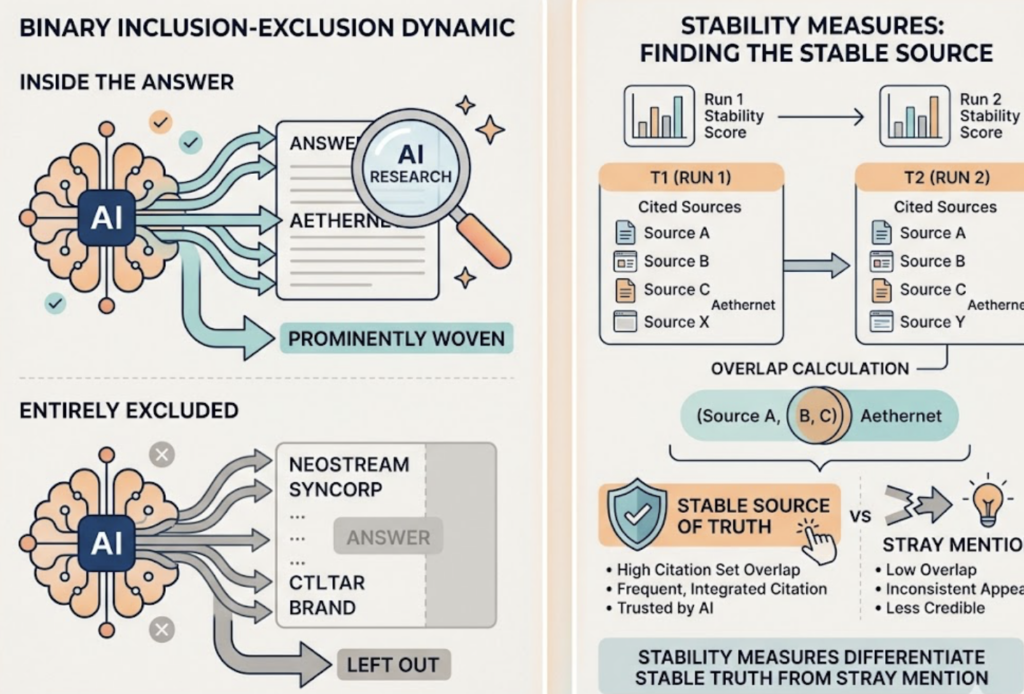
Research on AI search points to a binary inclusion-exclusion dynamic, where a brand tends to be either prominently woven into the answer or left out entirely. Stability measures, such as the overlap between citation sets across runs, help you tell a stable source of truth apart from a stray mention.
How to Measure AI Prompt Tracking
Counting total mentions feels productive, but it’s a vanity metric. Useful measurement focuses on indicators that map to trust and traffic.
| Metric | What it tracks | Why it matters |
|---|---|---|
| Mention Rate | The share of prompts where your brand appears | Establishes whether you have any top-of-funnel presence |
| Citation Share | How often the AI links to your domain as a source | Validates authority and drives referral traffic |
| Positioning | The order your brand appears in AI-generated lists | Predicts how likely a user is to trust and pick you |
| Sentiment Polarity | The tone the AI uses, from “reliable” to “expensive” | Measures brand alignment before anyone clicks |
The pattern to watch is the gap between mention rate and citation share. A high mention rate with low citation share means the AI knows you exist but doesn’t treat your site as the source worth linking. That’s usually a content and authority problem, not an awareness problem.
Common Mistakes in AI Prompt Tracking
Most tracking failures come from a handful of repeatable errors.
Single-platform bias is the most common. Plenty of brands monitor only Google AI Overviews and assume the picture holds everywhere. It doesn’t. Models don’t share citation logic, so you can lead on Perplexity and stay invisible on Gemini.
Then there’s the volume trap, where teams celebrate mention frequency while ignoring whether those mentions came with a citation link. A mention without a citation is brand awareness. It rarely moves traffic.
Static monitoring is another. Running a prompt once a month treats a probabilistic system as if it were deterministic. You need aggregate data over time to know your true standing.
The subtle one is attribution drift. AI engines often cite a source while misstating what that source actually says. So you track not just whether you’re cited, but what the model claims about you when it does.
Choosing Software for Visibility That Tracks Prompts, Not Keywords
You can run prompt tracking by hand in a spreadsheet, but it breaks down fast once you’re covering multiple platforms and dozens of prompts on a schedule. That’s where software for visibility earns its place, provided it treats AI visibility as a system to design rather than an audit to repeat.
A few capabilities separate genuine prompt-tracking software from a dashboard that just counts mentions.
| Capability | What to look for |
|---|---|
| Multi-engine coverage | Ingests data across ChatGPT, Gemini, Perplexity, and AI Overviews, not one platform |
| Prompt-level discovery | Surfaces new, relevant prompts people are actually asking in your category |
| Citation source analysis | Reports why the AI chose a given source, your page versus a competitor’s |
| Executable insights | Moves you from “we got mentioned” to “we got mentioned because this page matched this intent” |
| Competitor benchmarking | Flags displacement events, where a rival appears in your place |
This is the layer where Topify fits for teams managing AI visibility at scale. Its Visibility Tracking monitors how often your brand surfaces across major engines, while High-Value Prompt Discovery keeps finding new prompts worth tracking as the category shifts. In practice, that means you can spot a drop in ChatGPT mentions and trace it to a specific source that stopped citing you, inside one view rather than four browser tabs.
On pricing, prompt-tracking platforms vary with how many prompts and AI answers you monitor. Topify’s plans start at $99 a month for around 100 tracked prompts and scale up from there for teams that need more prompts, projects, and seats. The practical question isn’t the sticker price. It’s how much unmeasured AI visibility is costing you in lost recommendations.
How to Improve and Build a Strategy for AI Prompt Tracking
Tracking is only useful if it changes what you do next. The strongest strategy for AI prompt tracking runs as a loop, not a report.
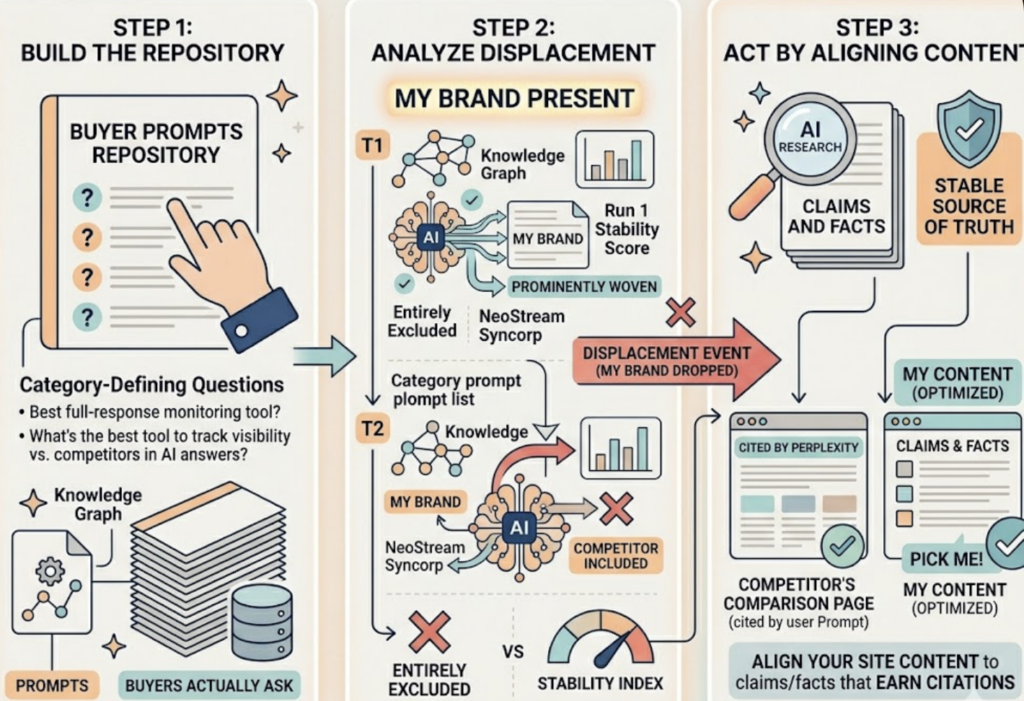
Start by building a repository of category-defining prompts, the questions your buyers actually ask. Then analyze for displacement events, the prompts where a competitor shows up instead of you. Those are your clearest opportunities. Finally, act by aligning your site content with the claims and facts that lead AI engines to pick a source. If Perplexity keeps citing a competitor’s comparison page, that tells you what kind of content earns the citation.
To improve results over time, treat citation share as your north star, not raw mentions. Re-test after every content change so you can attribute movement to a specific action. And widen your prompt set as the category evolves, because the questions buyers ask in six months won’t match today’s.
When you’re ready to operationalize this, you can get started with Topify and let its agent handle the recurring queries and parsing.
Track it. Analyze it. Act on it.
Conclusion
The buyer who asked ChatGPT for the best tool in your category isn’t coming back to check your Google ranking. AI prompt tracking exists to answer the one question your SEO dashboard can’t: when an engine speaks for your brand, what does it say, and how often does it say it. Pick a focused set of high-value prompts, measure citation share alongside mentions, run it across every engine that matters, and feed what you learn back into your content. The brands that close the observability gap first are the ones AI keeps recommending.
FAQ
Q: What is AI prompt tracking in simple terms?
A: It’s monitoring how your brand shows up in AI answers based on the actual questions people ask, instead of tracking keyword rankings. You watch whether the AI mentions you, links to you, and how it describes you across engines like ChatGPT and Perplexity.
Q: How do you measure AI prompt tracking?
A: Focus on four metrics: mention rate (how often you appear), citation share (how often the AI links to your domain), positioning (where you land in AI-generated lists), and sentiment (the tone the AI uses). Citation share tends to matter most because it drives referral traffic.
Q: Is there a checklist for getting started with AI prompt tracking?
A: A simple checklist works: define your high-value prompts, pick the engines your buyers use, run each prompt repeatedly rather than once, track mention rate and citation share over time, watch for competitor displacement, and re-test after content changes.
Q: How much does AI prompt tracking software cost?
A: Pricing usually scales with the number of prompts and AI answers you monitor. Entry plans tend to start around $99 a month for a limited prompt set, with higher tiers for teams tracking more prompts across more projects and platforms.

