

Your team spent the last quarter publishing content, earning links, and climbing Google rankings. Then a buyer in your category opened ChatGPT and asked which tool to use. The answer named five options. Yours wasn’t one of them, and nothing in your analytics flagged it.
That’s the blind spot. Google reports organize the world by keywords and pages. AI assistants organize it by prompts: the actual questions people type. When the two don’t line up, you can rank well and still go unmentioned where buying decisions now start. Closing that gap is the job of AI prompt tracking analytics.
What Is AI Prompt Tracking Analytics?
AI prompt tracking analytics is the practice of monitoring how a brand gets mentioned, cited, or recommended in AI-generated answers when people ask category-relevant questions.
The shift in logic matters more than the definition. Traditional SEO tracks keywords, which are static search strings tied to a page. Prompt tracking follows prompts, which are full natural-language questions that span the buyer’s journey, from “what is X” to “which X should I buy.”
There’s a structural reason the old model breaks. AI engines don’t return a fixed ranked list. They run a query fan-out, splitting one prompt into several retrieval tasks and synthesizing an answer from many sources at once. So the question stops being “where do I rank” and becomes “how often does the model include me, and in what light.”
That’s a probability, not a position. And probability is exactly what analytics is good at measuring.
How AI Prompt Tracking Analytics Works
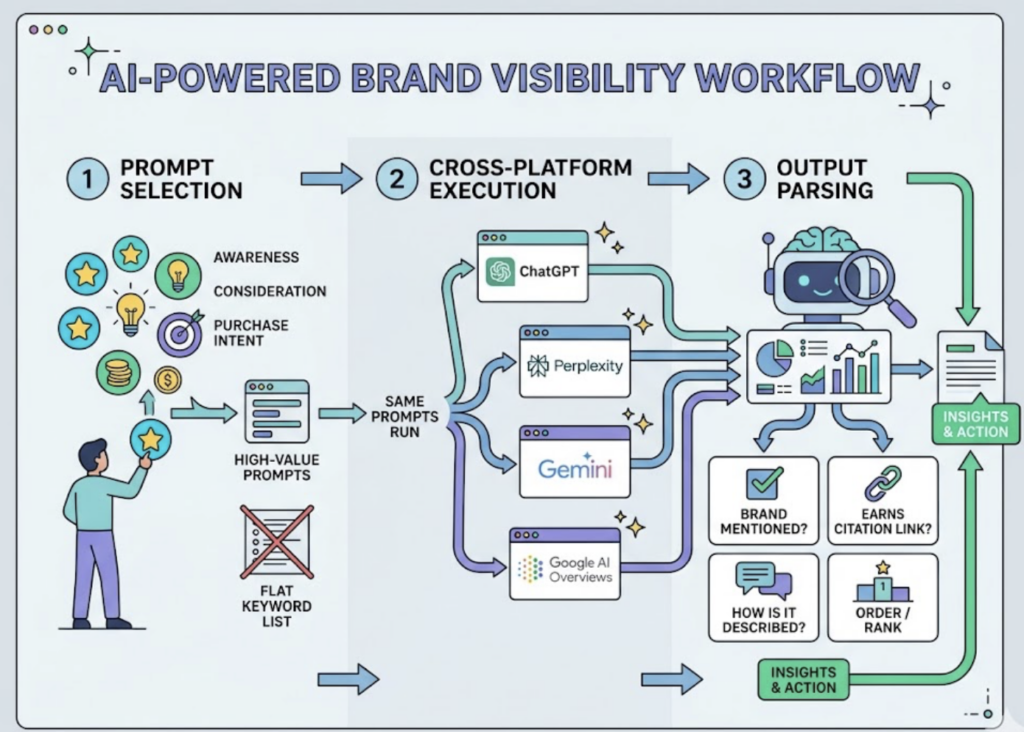
Prompt tracking doesn’t work like a crawler checking a ranking. It works through structured probing: a repeatable, automated routine that treats each AI answer as a data point.
Three steps run on a loop.
First, prompt selection. You curate a set of high-value prompts mapped to awareness, consideration, and purchase intent, instead of a flat keyword list. Second, cross-platform execution. The same prompts run across ChatGPT, Perplexity, Gemini, and Google AI Overviews, because each model has its own bias about who to name. Third, output parsing. An AI layer reads each response and pulls out whether your brand is mentioned, whether it earns a citation link, how it’s described, and where it sits in the order.
Here’s the part most teams underestimate: consistency.
AI answers are probabilistic, so the same prompt can return a different lineup on the next run. In one analysis of repeated queries, only 35% of domains showed up again across runs, meaning two-thirds dropped out between identical searches. The drift goes deeper than sources. A separate study found that AI recommendation lists repeat less than 1% of the timewhen you ask twice.
So a single check tells you almost nothing. A reliable AI prompt tracking system measures presence across dozens of runs over 30+ days, and treats stable presence, not a lucky snapshot, as the real signal of authority.
How to Measure AI Prompt Tracking Analytics: The Metrics That Matter
Standard analytics suites have no built-in metric for AI visibility. Teams that report to executives tend to settle on a small, consistent framework instead.
| Metric | The business question it answers |
|---|---|
| Share of Answers | Do we have a baseline visibility problem in our category? |
| Third-Party Mention Rate | Are we recommended by name in AI-generated lists? |
| Citation Share | Are we earning “source of truth” status that drives traffic? |
| Sentiment Polarity | Does AI position us as a leader or a legacy option? |
| Recommendation Ranking | Do we land in the top three of the response? |
The trade-off with any single metric is that it answers half the question. Share of Answers tells you if you show up. It says nothing about whether the model frames you as the category leader or a budget afterthought.
This is where a unified view earns its keep. Topify tracks brand performance across major AI platforms through seven dimensions at once: visibility, sentiment, position, volume, mentions, intent, and CVR. Pulling sentiment and position into the same frame as raw mentions is what separates “we got named” from “we got named, ranked second, and described as premium.” The CVR layer goes one step further, estimating how likely an AI answer is to push a user toward real brand interaction, which connects visibility to revenue rather than vanity counts.
Where Teams Use It: Examples of AI Prompt Tracking Analytics in Practice
The clearest examples of AI prompt tracking analytics show up in three recurring jobs.
The first is executive reporting. When a leadership team asks “are we showing up in ChatGPT,” a prompt-level dashboard turns a vague worry into a number trended over time. The second is competitor monitoring. Topify’s competitor benchmarking shows which rivals the models recommend, tracks your position against them, and flags new entrants the moment they start getting named. The third is content diagnosis.
That last one is where prompt data gets genuinely actionable.
Reverse-engineering AI citations means looking at the exact domains and URLs a model pulls from, then asking why a competitor’s page got cited and yours didn’t. Topify’s source analysis maps those references at scale, so a drop in Perplexity mentions can be traced back to a specific source that stopped citing you, all inside one view.
Choosing an AI Prompt Tracking Tool, Platform, or Dashboard
Search “AI prompt tracking tool” and you’ll find software that all promises AI visibility. The differences hide in three places, and they’re worth a short framework before you commit.
Platform coverage comes first. A tool that only watches ChatGPT misses Perplexity, Gemini, and AI Overviews, where your buyers may be getting a completely different answer. Attribution depth comes second: does the platform explain why a citation moved, or just chart that it did. Execution comes third. Some solutions stop at reporting; others let you act on the finding without exporting to a separate workflow.
On all three, Topify tends to stand out by covering global AI engines and pairing the data with one-click execution. You state a goal in plain English, review the proposed strategy, and deploy it from the same place you spotted the problem. For teams drowning in dashboards that report and never resolve, that closes the loop. You can get started with Topify on a single project before scaling across a brand portfolio.
Plenty of category tools handle one slice of this well. The question isn’t which one is loudest, but which one matches how your team actually works.
What Separates a Dashboard from a Real AI Prompt Tracking System
A reporting dashboard shows you where you stand. A visibility system tells you why and what to do next. That distinction decides whether an AI prompt tracking dashboard is useful or just decorative.
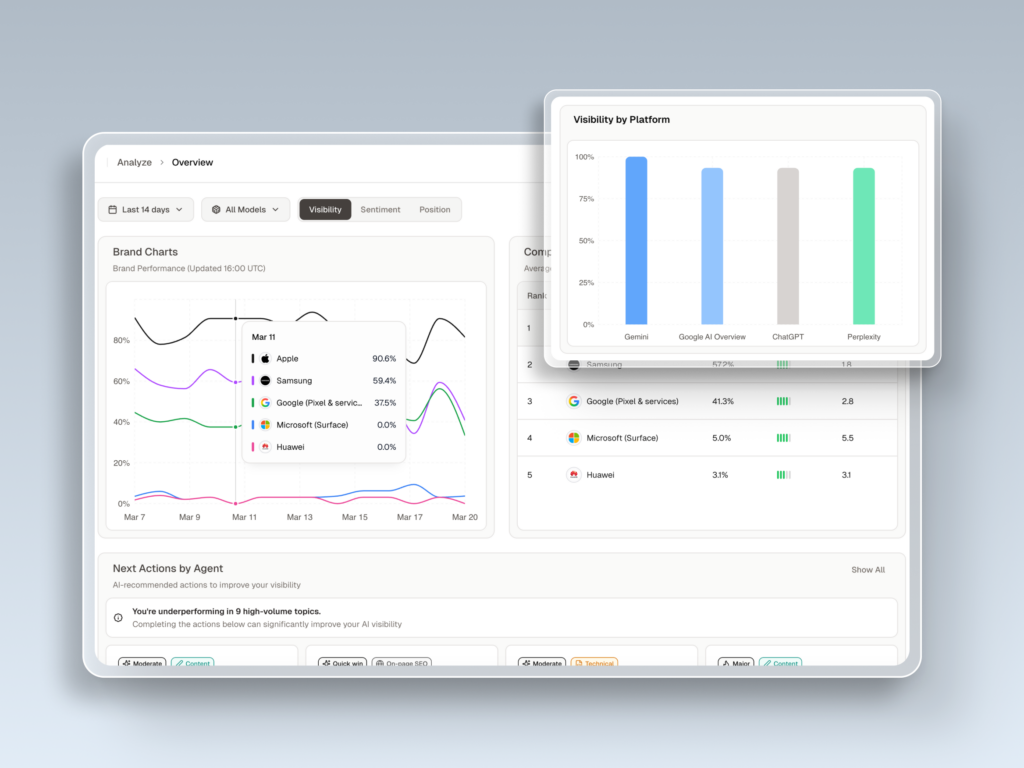
Dashboards hand you a number: “mentioned five times this week.” Systems and solutions hand you attribution: a competitor got cited because their landing-page schema matched the prompt’s intent, and here’s the gap to close. One describes the weather. The other tells you to bring an umbrella.
How to Improve Your AI Prompt Tracking Analytics
Improving prompt tracking is less about more data and more about avoiding the mistakes that quietly distort it.
Four show up constantly. The volume trap is treating prompts like keywords and chasing mention frequency while ignoring citation authority. Single-model bias is assuming strong ChatGPT presence guarantees Perplexity or AI Overviews coverage; it doesn’t. Snapshot reliance is running a prompt once and trusting it, despite the volatility covered earlier. Siloed execution is the quiet one: treating generative engine optimization as separate from SEO, when AI models lean on the same trust signals, E-E-A-T, clean structure, technical health, that good SEO already builds.
A workable strategy for AI prompt tracking analytics fits on a short checklist.
- Map your prompts. Take your top 20 to 40 high-intent keywords and rewrite them as natural-language questions a buyer would actually ask.
- Establish a baseline. Track those prompts across at least three models for 30 days before drawing any conclusion.
- Audit source gaps. When a competitor gets cited, study their page structure, schema, and how directly they answer the question.
- Iterate content. Structure yours answer-first, with clear headers and factual summaries a model can lift cleanly.
Run that loop, and the analytics stop being a report card and start being a roadmap.
Conclusion
The gap between what your Google reports show and what AI assistants tell buyers isn’t closing on its own. As generative AI adoption climbs past 20% inside enterprises, the brands that win won’t be the ones ranking for the most keywords. They’ll be the ones AI engines treat as the preferred source of truth.
Start small. Pick a focused set of high-intent prompts, baseline them across the major models for a month, and watch where you appear and where you vanish. That single habit turns AI visibility from a thing you worry about into a channel you can measure and move.
FAQ
Q: What is AI prompt tracking analytics?
A: It’s the systematic monitoring of how a brand is mentioned, cited, or recommended in AI-generated answers across platforms like ChatGPT, Perplexity, and Google AI Overviews. Unlike keyword tracking, it follows the full natural-language prompts people actually ask and measures the probability of brand inclusion rather than a fixed ranking.
Q: How much does AI prompt tracking analytics cost?
A: Pricing varies by coverage and prompt volume. Topify’s platform starts at $99 per month for the Basic plan with 100 tracked prompts, moves to $199 per month for Pro at 250 prompts, and offers Enterprise plans from $499 per month for teams that need dedicated support and higher limits.
Q: What are the most common mistakes in AI prompt tracking analytics?
A: The frequent ones are chasing mention volume over citation authority, assuming one platform represents all of them, relying on a single snapshot despite AI answer volatility, and treating GEO as separate from SEO instead of building on the same trust signals.
Q: How do I build a strategy for AI prompt tracking analytics?
A: Convert your highest-intent keywords into natural-language prompts, baseline them across at least three AI models for 30 days, audit why competitors get cited when you don’t, and restructure your content to be answer-first so models can extract it easily.

