

Your keyword rankings held steady all quarter. Domain authority’s up. Organic traffic looks fine on the dashboard. Then a prospect types “best tool for my category” into ChatGPT, reads the three names it recommends, and yours isn’t one of them. Nothing in your SEO stack flagged it, because rank trackers were built to watch a results page, not the inside of an AI answer. That blind spot is where a different kind of tracking comes in, one that measures what models actually say about you when nobody’s watching the SERP.
What an AI Prompt Tracking Tool Actually Tracks
An AI prompt tracking tool monitors how a brand shows up inside AI-generated answers, measured at the level of individual prompts. A prompt is the real question a user asks an assistant, like “what’s the best CRM for a small sales team.” The tool watches whether your brand appears in the response to that prompt, where it lands, and how it’s described.
That’s a different unit of measurement than traditional SEO. A keyword rank tracker tells you your page sits at position 4 for a search term. It says nothing about whether ChatGPT names you when someone asks for a recommendation. The link and the answer are separate worlds now.
The shift is big enough to matter. AI-driven search jumped from under 10% of interactions in 2023 to roughly 30% by 2026. And according to Similarweb, searches ending without a click rose from 56% to 69% once AI answers started landing at the top of results. When the answer is the destination, being named inside it is the new front page.
So at the prompt level, these tools typically track four things: how often you’re mentioned, where you sit in the answer, how the model frames you, and which sources it cites to back the claim. Put simply, it answers a question your SEO reports can’t. When AI talks about your category, does it mention you, and what does it say?
How an AI Prompt Tracking Tool Works Under the Hood
Under the hood, prompt tracking runs a loop. It starts with a prompt library, a curated set of questions that mirror how real buyers research. These aren’t keywords. They’re full questions like “X vs Y” or “best solution for this use case,” because that’s how people actually talk to assistants.
Next, the tool runs those prompts across multiple engines on a schedule. ChatGPT, Perplexity, Gemini, and Copilot each retrieve and rank information differently, so checking one tells you almost nothing about the others. The fragmentation is real. ChatGPT’s share of B2B AI referrals fell from 89% to about 63% in roughly eight months as Gemini, Claude, and Perplexity absorbed the rest.
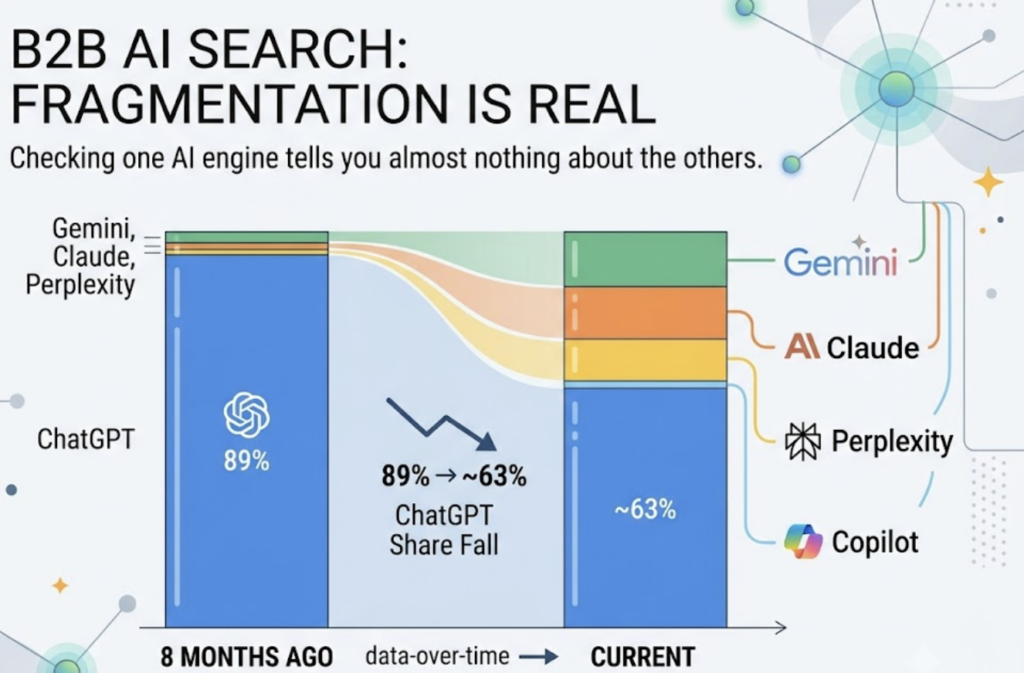
Track one platform and you’re measuring a third of the picture.
Then it parses the output. Using language processing, the tool pulls out brand mentions and, just as important, the citation chain, the source URLs the model leaned on to build its answer. Those citations are the closest thing GEO has to a backlink graph.
Here’s the part that trips people up. AI answers aren’t deterministic. The same prompt can return different results across sessions because of model updates, memory features, and randomness in how text gets generated. A single check is a snapshot of noise. So a decent tool computes a rolling average over 7 to 30 days, which is what turns scattered readings into a trend you can act on.
The Metrics That Tell You If You’re Visible or Invisible
Raw mentions feel satisfying, but one number rarely tells the truth. Knowing how to measure AI search performance means watching a few metrics together.
Visibility rate is the starting point: the percentage of your tracked prompts where the brand shows up at all. Share of voice puts that in context by comparing your presence against direct competitors for the same prompts. You can be mentioned 40% of the time and still be losing if a rival hits 70%.
Position matters too, and it’s where the idea of an ai visibility rank tracker becomes literal. Being named last in a list of eight, or buried under a “you might also consider” aside, isn’t the same as being the first recommendation. Salience inside the answer is the new ranking.
Then there’s sentiment, or framing. A model can mention you accurately and still cast you as the budget option when you sell premium. And citation strength tells you which sources the AI trusts to talk about you, because fixing those sources is often how you move the other numbers.
The trap is measuring any one of these alone. A visibility spike means little if sentiment is sliding or a competitor’s share of voice is climbing faster. Read them as a set.
What Most Teams Get Wrong When They Start Tracking
Most early GEO programs fail in predictable ways.
The first is treating prompts like keywords. Teams port their old keyword list straight into the prompt library, either too broad (“CRM”) or too granular to match how anyone actually asks an assistant. Prompts are conversations, not search strings.
The second is single-platform bias. Monitoring only ChatGPT ignores the citation-first behavior that drives Perplexity and the integrated answers inside Gemini and Google AI Overviews, which now surface on a large share of informational queries. Different engines, different rules.
Third is static monitoring. Checking once a month feels efficient and produces garbage data, because models update and citation patterns drift on a scale of weeks, not quarters.
And fourth is the attribution gap. Plenty of teams watch AI visibility rise and never connect it to branded search volume or organic traffic, so the work never earns its budget. Roughly 25% of B2B buyers now use generative AI for vendor research before they build a shortlist. If you can’t tie visibility to that pipeline, you can’t defend the spend.
Best AI Prompt Tracking Tools and What Separates Them
Search “AI prompt tracking tool” and you’ll find two broad types, and they’re not interchangeable. Before comparing names, it helps to know what actually separates them: engine coverage, whether the tool finds high-value prompts for you or makes you guess them, depth of citation analysis, and whether it stops at a dashboard or helps you act.
That last point is the real divide. Lightweight monitors tell you what happened. Comprehensive platforms tell you what to do next.
| Approach | Engine coverage | What it surfaces | Workflow |
|---|---|---|---|
| Monitoring-only tools | Often one or two engines | Mention and visibility snapshots | Reporting stops at the dashboard |
| Comprehensive GEO platforms, like Topify | ChatGPT, Gemini, Perplexity, and more | Prompts, citations, competitor gaps | Monitor, analyze, then act |
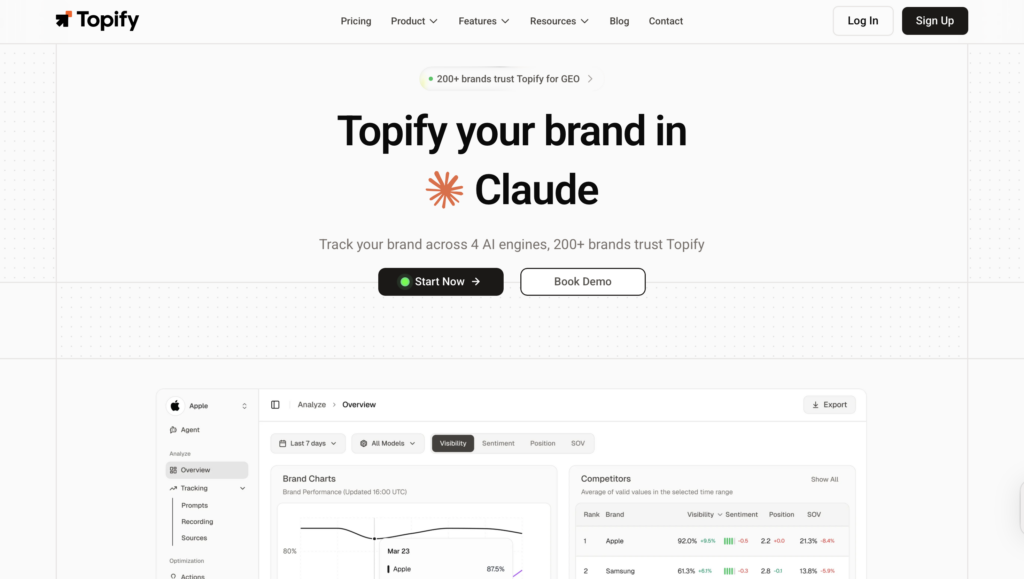
Topify sits in the second group. It tracks brand performance across major engines through seven metrics, visibility, sentiment, position, volume, mentions, intent, and CVR, so you’re not stitching separate readings together. Its prompt discovery surfaces the high-volume questions worth tracking instead of leaving you to guess them. And its source analysis reverse-engineers the exact domains and URLs an engine cites, so when your visibility drops you can trace it to a specific citation that stopped pointing your way, then fix the content or earn the mention. For a sense of the free diagnostics available for this kind of work, Topify keeps a public reference of GEO free tools.
Other monitoring tools cover the basics well and can be the right call for a small team testing the water. The difference shows up when you need to move a number, not just watch it.
A Checklist for Choosing and Improving Your Setup
If you’re setting this up from scratch, a simple sequence keeps it useful.
- Build a prompt library of 50 to 100 questions that mirror the buyer journey: comparisons, pain-point queries, and category research. Map them to how people actually ask, not to your keyword sheet.
- Set a baseline. Track visibility and share of voice for 30 days across ChatGPT, Perplexity, and Google AI Overviews before you judge any movement.
- Audit citations. Find the authority domains, review sites, forums, industry publications, that engines lean on for your top prompts. These are your targets.
- Close the gaps. Use the tool’s gap analysis to restructure landing pages so a model can parse them as the definitive source, not a maybe.
- Watch the competition. Track your top three rivals so you can see how their framing differs from yours and where they’re winning prompts you aren’t.
Improving the numbers follows from the audit. If a competitor owns a prompt because three review sites cite them and none cite you, the strategy is earning those citations, not rewriting your homepage for the tenth time. When you’re ready to run this as a live loop rather than a one-off check, you can get started with a tracked prompt set and expand from there.
What an AI Prompt Tracking Tool Costs
Pricing in this category follows the work the tool does, not a flat rate. Most vendors meter on prompt volume, tracked engines, seats, and analysis depth, which is why two tools with similar dashboards can sit a tier apart.
Across a survey of 34 AI search visibility tools, entry plans cluster around a $79 median while the top public tier lands near $400, and prompt volume is the single biggest reason a plan steps up. Pure monitoring tools tend to run cheaper than platforms that also handle execution. A separate analysis of 20 tools puts the practical range for most teams at $79 to $149 a month, with sticker prices stretching from $20 to several thousand at the enterprise end.
For reference, Topify’s Basic plan runs $99 a month and covers ChatGPT, Perplexity, and AI Overviews tracking with 100 prompts and a 30-day trial, while Pro at $199 lifts that to 250 prompts. Full tiers sit on the Topify pricing page. The sensible approach is the one buyers use across the category: start small, confirm that visibility moves real traffic, then scale the prompt count as the value shows up.
Conclusion
Traditional rank trackers still do their job. They just can’t see the layer where more and more buying decisions now start, inside an AI answer where your brand is either named or invisible. An AI prompt tracking tool fills that gap by measuring what models say about you, across engines, over time.
The practical first step is small. Pick 50 prompts that match how your buyers ask, track them for a month across the engines they use, and see where you actually stand. You can’t improve a number you’ve never measured.
FAQ
Q: What is an AI prompt tracking tool, in plain terms?
A: It’s an analytics tool that checks whether AI assistants mention and recommend your brand when users ask real questions. Instead of measuring where your link ranks on Google, it measures how you show up inside the answer ChatGPT, Perplexity, or Gemini generates.
Q: How is an AI prompt tracking tool different from an SEO rank tracker?
A: A rank tracker watches your position on a search results page. A prompt tracker watches your presence inside an AI-generated response: whether you’re mentioned, where you sit in the answer, how you’re framed, and which sources the model cites. One looks at the list of links, the other looks at what replaced the list.
Q: How do you measure success with one?
A: Watch a few metrics together rather than chasing a single count. Visibility rate shows how often you appear, share of voice compares you to competitors, position shows where you land in the answer, and sentiment shows how you’re described. A rise in one means little if another is falling.
Q: How much does an AI prompt tracking tool cost?
A: Most teams land in the $79 to $149 a month range, with entry plans commonly near a $79 median and enterprise tiers running several hundred and up. Pricing usually scales with prompt volume and engine coverage, so a small tracked set costs far less than monitoring hundreds of prompts across every platform.

