

Your AI visibility dashboard shows a score of 62. Last month it was 58. That looks like progress, until you realize the number can’t tell you which customer questions actually surface your brand and which ones hand the answer to a competitor. A single score averages away the one thing that moves pipeline: presence at the prompt level. Most teams end up watching a metric rise and fall without ever knowing why, or what to fix.
That’s the gap an AI prompt tracking service is built to close.
What an AI Prompt Tracking Service Is
An AI prompt tracking service is a platform that monitors how AI engines like ChatGPT, Perplexity, and Gemini represent your brand when real users type natural-language questions. Traditional SEO watches keyword positions on a results page. Prompt tracking watches the synthesized answer the model actually generates.
The difference is granularity. A “total visibility score” rolls everything into one figure. Prompt-level tracking shows you exactly which questions trigger a mention and which ones leave you out.
That distinction matters more than it sounds. You can rank high on Google yet still be absent from AI-generated answerswhere competitors appear. With 37% of people now starting searches with AI and Gartner projecting a 25% drop in traditional search volume by 2026, the prompt layer is no longer optional to measure.
This is why the category is sometimes called an AI prompt tracking tool, software, or solution. The labels vary. The job is the same: tell you where your brand stands inside AI answers, prompt by prompt.
How an AI Prompt Tracking Service Works
A prompt tracking system treats each AI model as a black box that has to be probed on purpose. The workflow comes down to three moves.
First, build a prompt repository: a curated set of high-intent questions your buyers actually ask, like “what’s the best CRM for small business?” Second, run those prompts repeatedly across sessions and platforms. Third, parse each full response to extract mentions, citation links, position, and sentiment.
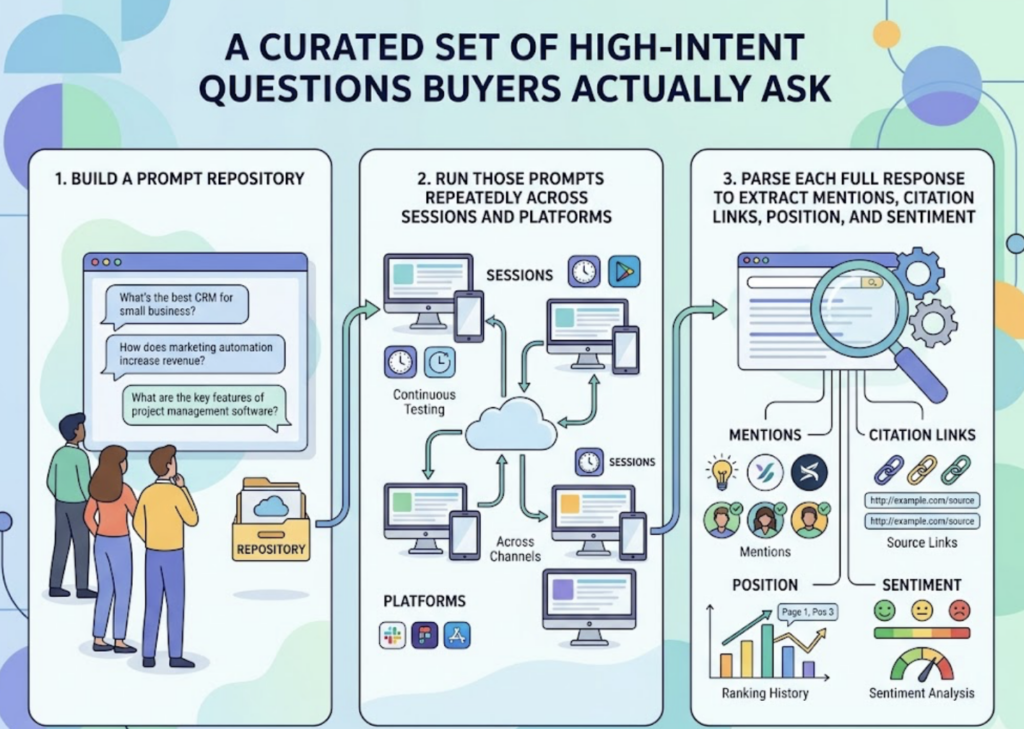
The repeated part isn’t optional. AI systems give probabilistic responses that change even when users enter the same prompt, so a single check tells you almost nothing.
One snapshot is noise. A distribution is signal.
Only aggregate data over time can confirm whether you’ve reached authority status in a prompt category or just got lucky on one run. A platform that samples once a month is reporting a coin flip. A real tracking solution samples often enough to build a stable picture per prompt, per platform.
Why Prompt-Level Tracking Beats a Single Visibility Score
Here’s the thing about aggregate scores: they hide the cases you most need to act on. Your score can hold steady at 62 while you quietly lose every comparison prompt in your category to one competitor.
Semrush frames the prompt set as a portfolio organized by business impact, not vanity visibility, covering revenue, reputation, competitor, and gap prompts. Each type maps to a different growth signal. Lump them into one number and you lose the ability to tell a reputation problem from a revenue one.
The strongest case for prompt-level data is the displacement event: a question where a rival shows up in the answer and you don’t. That single insight is worth more than a month of trend lines, because it points to a specific content gap you can fix.
A dashboard that only shows movement can’t show you that. A prompt-level view can.
How to Measure an AI Prompt Tracking Service
Useful measurement moves past raw mention counts. The working set of dimensions most teams settle on looks like this.
| Metric | What It Tells You |
|---|---|
| Visibility Rate | The share of tracked prompts where your brand is named. Your baseline for existence. |
| Citation Share | The share of AI answers that link to your site. Your “source of truth” authority. |
| Average Position | Where you land in recommendation lists. Users rarely read past the first three. |
| Sentiment | The context of the mention. Top choice, or legacy alternative? |
| Share of Voice | Your frequency versus direct competitors in the same prompt cluster. |
Two of these deserve a closer look. AI Share of Voice is the AI-era version of market presence, showing how often you appear relative to rivals across prompts and platforms. Prompt coverage, the percentage of your tracked set where you show up at all, exposes structural gaps that a high score on one narrow cluster will mask.
A good AI prompt tracking dashboard puts these side by side so a drop in one is traceable to a cause, not just a lower number.
What to Look for in an AI Prompt Tracking Tool
Once you understand the metrics, choosing a platform gets simpler. Three capabilities separate a real tracking solution from a glorified spreadsheet.
The first is high-value prompt discovery. You shouldn’t have to guess your prompt set. The platform should surface the questions buyers are actually asking in your category, since that’s where visibility converts to revenue.
The second is source and position analysis. Knowing you lost a prompt is half the answer. Knowing why, usually because a competitor’s content is more machine-readable, is what lets you respond.
The third is cross-platform coverage. ChatGPT presence doesn’t predict Perplexity or Gemini presence. Each engine surfaces different brands for identical questions, so single-platform tracking gives you a false read.
This is where a platform like Topify fits the brief. It runs a seven-dimension analysis (visibility, position, sentiment, citation share, volume, mentions, and intent) and pairs it with High-Value Prompt Discovery, so you’re not just monitoring a fixed list but continuously finding new prompts as AI recommendations shift.
In practice, that means you can catch a displacement event the week it happens: a competitor enters the answer for a high-intent prompt, Topify flags it, and its Competitor Monitoring and Source Analysis show you which domains the model now cites instead of yours. Coverage spans ChatGPT, Gemini, Perplexity, DeepSeek, and other major engines, so the read holds across the platforms your audience actually uses.
Common Mistakes and a Strategy That Works
Most teams don’t fail at prompt tracking because the tooling is hard. They fail because of a few repeatable mistakes.
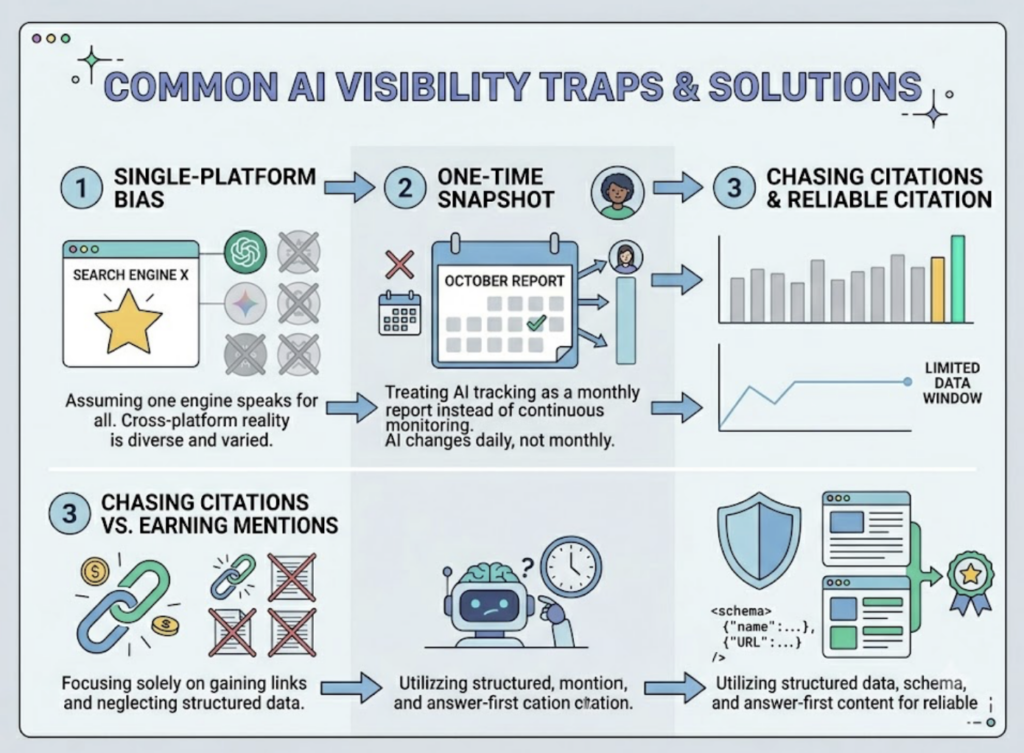
The dashboard trap comes first. Obsessing over a single visibility score while ignoring the prompt data underneath. Entrepreneur put it bluntly: many teams track GEO performance with dashboard numbers that don’t connect to anything real.
The next three are just as common. Single-platform bias, assuming one engine speaks for all. The one-time snapshot, treating tracking as a monthly report instead of continuous monitoring. And chasing citations instead of earning mentions, while neglecting the structured data, schema, and answer-first content that lets AI cite you reliably.
Going quiet after launch is the quietest killer of all.
A workable strategy reverses each mistake. Build a repository of at least 20 to 50 high-value questions. Run baseline probes across all your primary platforms to establish your visibility rate. Use the data to spot source gaps, then treat the prompts you’re missing as content targets and audit your page structure to answer them directly. Then re-measure. The cycle is the point: track, find the gap, fix the source, re-test.
What an AI Prompt Tracking Service Costs
Pricing for most prompt tracking software scales on two things: how many prompts you track and how many platforms you cover. Sampling frequency and depth of source analysis push it up from there.
Typical starting tiers run from around $99 a month for entry plans to $499 and up for enterprise coverage. Topify follows that shape, with a Basic plan at $99/month, Pro at $199, and Enterprise from $499, scaling on tracked prompts, AI answer analyses, projects, and seats rather than locked into inflated bundles.
The math worth running isn’t the subscription. It’s the cost of a competitor owning every comparison prompt in your category while you can’t see it happening. You can start tracking your own prompt set and get a baseline visibility rate before committing to a paid tier.
Conclusion
An AI prompt tracking service exists to answer one question a visibility score can’t: which buyer prompts surface your brand, and which ones hand the answer to someone else. The teams getting value from it aren’t the ones with the highest score. They’re the ones who built a focused prompt set, measured across every platform that matters, and turned the gaps into content targets.
Start small. Pick 20 high-intent prompts, run a baseline across ChatGPT, Perplexity, and Gemini, and see where you actually stand. The number on the dashboard will make a lot more sense once you can see the prompts behind it.
FAQ
Q: What is an AI prompt tracking service, in one sentence?
A: It’s a platform that monitors how AI engines mention, cite, and rank your brand when users ask natural-language questions, measured at the level of individual prompts rather than a single aggregate score.
Q: How do I improve my AI prompt tracking results?
A: Find the high-intent prompts where competitors appear but you don’t, then make your content the most machine-readable answer to those exact questions using clear structure, schema, and answer-first formatting. Re-measure after each change to confirm the prompt now surfaces your brand.
Q: What’s a quick checklist for evaluating an AI prompt tracking tool?
A: Look for four things: automatic high-value prompt discovery, repeated sampling across sessions, coverage of multiple AI platforms, and source or citation analysis that explains why a competitor was chosen. A tool missing any one of these gives you an incomplete read.
Q: Is a prompt tracking system different from a visibility dashboard?
A: They overlap, but a dashboard often shows only an aggregate score, while a prompt tracking system preserves the underlying per-prompt data. The dashboard tells you the number changed. The prompt-level system tells you which question caused it.

