

You’ve got solid rankings. Your domain authority is respectable. But when you search your own category on Google, an AI Overview appears at the top, summarizing the “best options” in your space, and your brand isn’t in it. Your current SEO tools show nothing unusual. That’s the gap.
AI Overviews now trigger on roughly 48% of queries globally, climbing to 88% in healthcare and 82% in B2B tech. For those categories, AI-generated summaries aren’t a side feature. They’re the first thing users see. And traditional rank trackers don’t measure what happens inside them.
The question isn’t whether you need an AI overview tracker. It’s whether the one you’re looking at actually tells you what matters.
Your Rankings Don’t Predict Whether You’re Cited
Before getting into what a tracker should show, it’s worth understanding why existing tools miss this entirely.
Only 38% of AI-cited URLs hold a top-10 organic rank, down from 76% just a year earlier. That means most brands earning AI Overview citations aren’t winning them through traditional SEO. AI models are prioritizing topical authority, structured content, and “answer-first” formatting over conventional SERP position.
That’s a complete decoupling of ranking and visibility. A tracker that only shows you organic positions can’t tell you why you’re absent from AI responses, because the two signals no longer move together.
#1: Whether Your Brand Actually Shows Up in AI Overview Answers
The most basic thing an AI overview tracker must tell you is presence. Not keyword rank. Not impressions. Whether your brand is being cited in the actual AI-generated response for the queries that matter to your business.
This sounds obvious, but most tools don’t measure it at the prompt level. They track SERP features in the aggregate, not which specific prompts trigger your brand’s inclusion or exclusion.
A well-built tracker monitors your brand across a curated set of high-value prompts, covering both informational and transactional intent. The output is a Presence Rate: across the 100+ prompts in your category, what percentage actually surfaces your brand? That number tells you whether you’re in the AI’s “trusted knowledge base” or not.
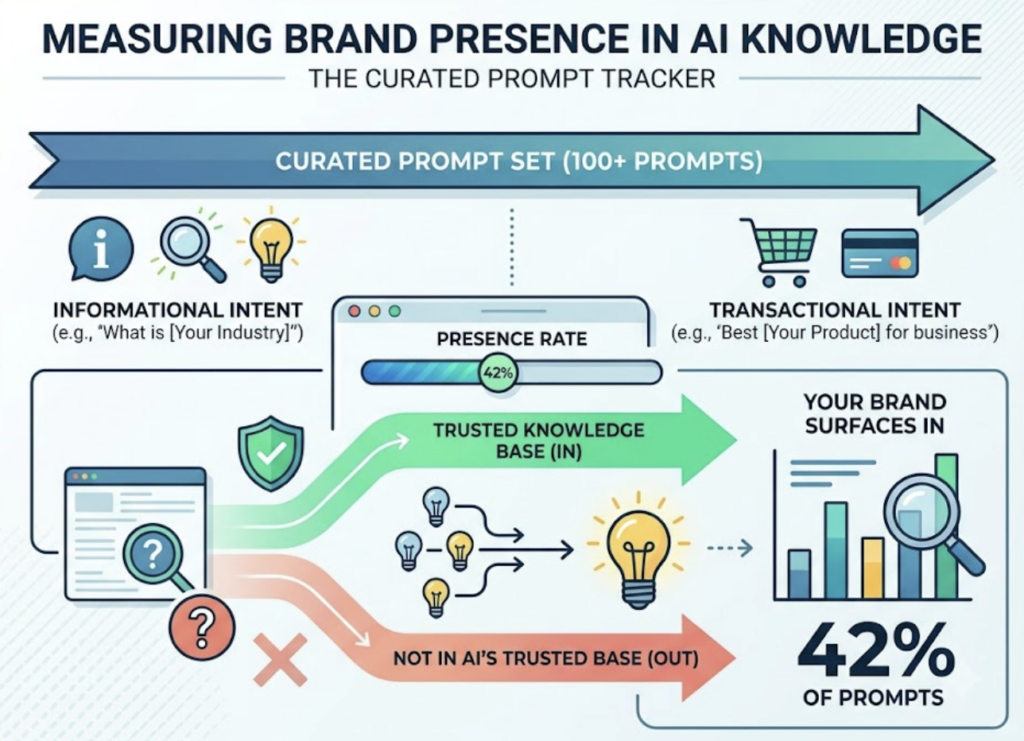
Topify‘s Visibility Tracking maps brand presence at the prompt level, across ChatGPT, Perplexity, Gemini, and Google AI Overviews. You don’t get a single aggregate score. You see which prompts include you, and which don’t.
#2: Where You Rank Inside the AI Answer
Presence alone isn’t enough. Being mentioned in an AI Overview and being mentioned first are very different things.
AI responses for “best X for Y” queries typically follow a list format with internal ordering. The first two or three brands named carry meaningfully higher attention and conversion weight than those mentioned further down or as footnote alternatives. Being listed as “a budget option” near the end of a summary is visibility, technically. It’s also a positioning problem.
An AI overview tracker should show you your Position Within the Answer, not just whether you appeared. This means tracking where in the synthesized response your brand appears, and how that placement compares to competitors.
Topify‘s Position Tracking and Competitor Monitoring do this in tandem. You can see that Competitor A is consistently named first in “enterprise solution for [category]” prompts while your brand appears third. That’s an actionable gap, not just a visibility metric.
#3: Which Sources the AI Is Pulling to Build Its Answer
This one is where most AI overview trackers stop short, and where the real optimization leverage lives.
AI Overviews aren’t generated from thin air. They cite specific domains, URLs, and content formats. Knowing you weren’t included is one thing. Knowing which domains were cited instead of yours tells you exactly what content structure, format, or authority signals you’re missing.
By identifying which domains AI engines trust for specific query types, you can reverse-engineer the content formats required to earn future citations. Whether that means more listicles, better structured data, FAQ schema, or video embeds depends on what the AI is actually pulling today.
This is Source Attribution Analysis. An AI overview tracker without it gives you a scoreboard with no replay footage.
Topify’s Source Analysis tracks the exact domains and URLs that AI platforms cite for your tracked prompts. You can see if a competitor’s blog is the primary source for queries where you should be winning, and build content strategy around that gap, rather than guessing.
Also worth noting: AI search isn’t confined to Google. Perplexity converts at rates up to 11x higher than traditional organic traffic. A tracker that only watches Google AI Overviews is leaving significant cross-platform signal on the table.
#4: How AI Describes Your Brand’s Sentiment
Showing up in an AI Overview with the wrong framing can be worse than not showing up at all.
AI models categorize brands. “Budget-friendly.” “Market leader.” “Best for small teams.” “A solid alternative to X.” Each of these phrasings shapes how users perceive your brand before they’ve even clicked a link. If you’ve spent years positioning your product as enterprise-grade and AI consistently describes it as “great for startups,” that’s a brand narrative problem you can’t fix without first detecting it.
Sentiment tracking scored 0–100 helps brands detect whether AI framing aligns with their desired market positioning. This isn’t just qualitative monitoring. 58% of consumers find brands cited in AI responses more trustworthy, which means the way you’re cited carries real downstream weight on purchase decisions.
Topify’s Sentiment Analysis scores AI-generated descriptions of your brand across platforms, flagging neutral or misaligned framing before it compounds. You see the actual language AI is using, not just a presence/absence binary.
#5: Which Prompts Drive Meaningful AI Visibility
Not all AI Overview appearances are worth the same. A citation in a low-intent informational query moves a different needle than a citation in a high-commercial-intent “best tool for X” query.
The missing link between AI visibility data and actual business outcomes is intent mapping. You need to know which of your tracked prompts carry genuine conversion weight, and whether your brand is appearing in those specifically.
That’s what Conversion Visibility Rate (CVR) addresses. By correlating AI visibility with branded search volume or direct conversion events, you can quantify the ROI of your AI Overview strategy instead of chasing vanity presence metrics. High prompt volume with no commercial intent is noise. High-intent prompts where competitors outrank you are the actual priority.
Topify’s AI Volume Analytics and High-Value Prompt Discovery surface which prompts in your category are worth tracking in the first place, and continuously update as AI recommendation patterns shift. You’re not managing a static keyword list. You’re working with a living signal set.
Getting All Five Signals in One Place
The five things above aren’t separate reports from separate tools. They’re interconnected: where you rank matters more if you know which sources got cited instead of you; sentiment matters more once you’re present at a meaningful position; CVR only makes sense once you’ve identified which prompts have commercial intent.
Topify is built around this integrated view. The platform monitors brand performance across ChatGPT, Gemini, Perplexity, DeepSeek, and Google AI Overviews using seven core metrics: visibility, sentiment, position, volume, mentions, intent, and CVR. All five signals described above are tracked in a single dashboard, updated as AI responses evolve.
For teams currently flying blind on AI Overviews or piecing together data from disconnected sources, the Basic plan starts at $99/month and includes tracking across 100 prompts and 9,000 AI answer analyses. Get started at app.topify.ai.
Conclusion
AI Overviews have changed what “being visible in search” actually means. Organic ranking and AI Overview citation are now two separate signals that require two separate measurement systems. A tracker that only covers one isn’t enough.
The five things above, presence rate, position within the answer, source attribution, sentiment framing, and intent-weighted CVR, are what separate a useful AI overview tracker from a dashboard that looks good but doesn’t help you act. Start there when evaluating what your current setup is actually telling you.
FAQ
Q: What’s the difference between an AI overview tracker and a traditional SEO rank tracker?
A: A traditional SEO rank tracker measures where your URLs appear in organic search results, typically positions 1 through 100. An AI overview tracker measures whether your brand is cited in AI-generated summaries, where in those summaries it appears, how it’s described, and which sources the AI pulls. The two systems track fundamentally different signals, and since only 38% of AI-cited URLs hold a top-10 organic rank, you can’t infer one from the other.
Q: How often should I check my AI overview visibility?
A: AI models update their citation patterns more frequently than traditional search rankings, especially in fast-moving categories. For most brands, weekly monitoring is the minimum. If you’re in a vertical where AI Overviews trigger on 80%+ of queries (healthcare, B2B tech), daily or near-real-time tracking is more appropriate. The key is consistency, not frequency. Tracking at irregular intervals makes it hard to attribute changes to specific content or strategy actions.
Q: Can an AI overview tracker help with Google AI Overviews specifically?
A: Yes, but the better trackers cover Google AI Overviews as one platform among several. Consumer behavior increasingly spans ChatGPT, Perplexity, and Google interchangeably for brand discovery. A tool that only watches Google misses Perplexity, which converts at significantly higher rates than traditional organic traffic. If you’re evaluating trackers, cross-platform coverage is one of the first things to check.
Q: Do I need a separate tool for each AI platform?
A: Ideally, no. Managing separate trackers for ChatGPT, Perplexity, and Google AI Overviews creates fragmented data and makes it nearly impossible to see your overall AI Search Share of Voice. Integrated platforms that aggregate signals across engines into a single view give you both the individual platform breakdowns and the unified picture. That unified view is where the most actionable patterns tend to emerge.

