

Your domain authority is solid. Your content ranks in the top 10. You’ve done everything right by traditional SEO standards. Then organic CTR drops, and Search Console gives you nothing useful to explain it.
Here’s what’s likely happening: Google AI Overviews are answering your customers’ queries before they ever reach your listing. Your brand might be mentioned in that summary, or a competitor might be. Either way, you have no visibility into which one is true. That’s the gap an ai overview tracker is built to close.
Google AI Overviews Changed Search. Your Analytics Didn’t.
AI Overviews now appear in approximately 20% of all Google searches, with trigger rates climbing above 60% for health-related queries. For categories where users are actively researching solutions, that number is much higher than it looks in aggregate.
The traffic signal this sends is brutal: 83% of AI-integrated searches don’t result in a traditional organic click. Users get their answer from the summary and stop scrolling. Brands that appear in the overview benefit from the attention. Brands that don’t are invisible to that session entirely.
What makes this particularly disorienting for SEO teams is that Google Search Console doesn’t surface this. GSC now includes “AI Mode” filters, but they only reflect post-click traffic data. They can’t tell you whether your brand was mentioned in an AI Overview, how it was described, or who else appeared alongside it.
You’re flying blind on a channel that already influences a significant slice of your audience.
Only 38% of AI Citations Come from Top-10 Pages
This is the number that should concern any team still treating SEO rankings as a proxy for AI visibility.
Only 38% of AI citations now originate from top-10 ranking pages, a 50% relative decline from mid-2025. Google’s query fan-out mechanism pulls sources from across the broader SERP, not just the top results. A page ranking at position 15 can get cited in an AI Overview while the position-1 result gets skipped entirely.
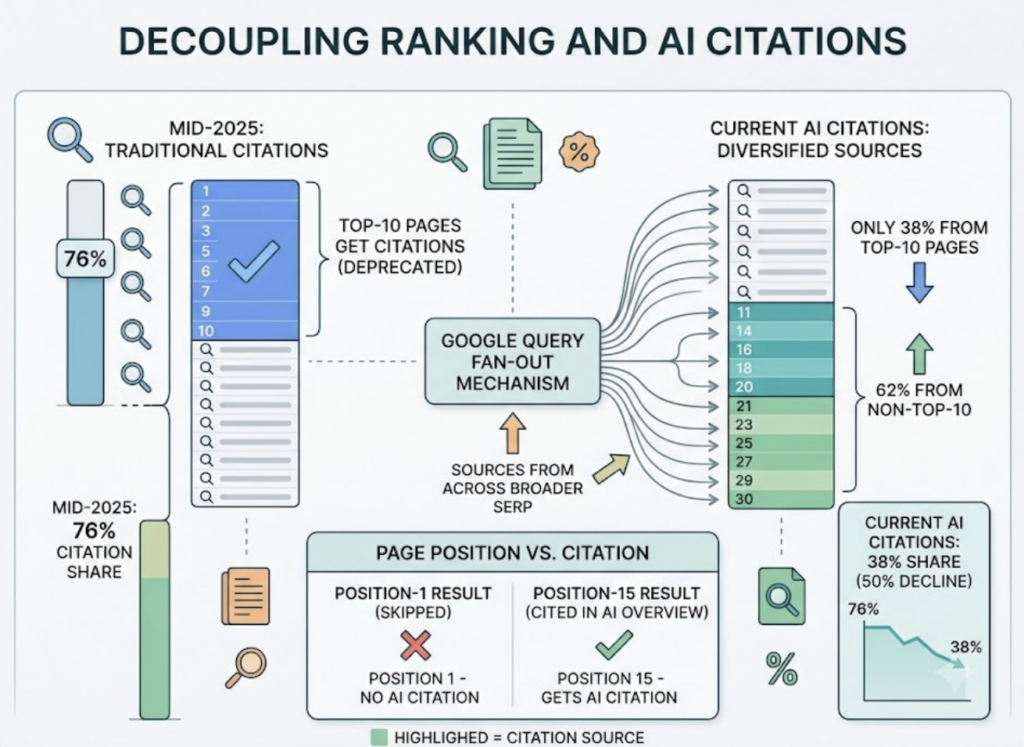
That’s a structural decoupling. Traditional rank tracking tells you where you appear on the list. It says nothing about whether AI selected your content as a trusted source.
The implication: brands that want AI visibility need to measure AI visibility directly. Rankings are a different metric now.
What an AI Overview Tracker Actually Measures
An ai overview tracker doesn’t work like a rank checker. It runs a curated set of prompts through AI search engines, captures the generated responses, and extracts four types of signals:
Visibility Rate: How often does your brand appear in responses to relevant queries? Tracked across a defined prompt set, this gives you a frequency baseline and lets you spot changes over time.
Sentiment and Framing: When your brand appears, how is it described? There’s a meaningful difference between “industry leader,” “affordable option,” and “budget alternative.” AI Overview citation tracking that stops at mention detection misses this entirely.
Source and Citation Integrity: Which specific URLs is the AI pulling from? This matters for content strategy. If a page you’ve optimized for traditional SEO isn’t getting cited, that’s a content structure problem, not a ranking problem.
Competitive Co-occurrence: Who else appears when you do? Understanding the AI’s mental model of your competitive landscape helps teams anticipate which positioning moves will have downstream effects on citation patterns.
These four layers are what separate a real ai overview tracker from a simple keyword alert tool.
How Topify Tracks Your Brand Across AI Overviews
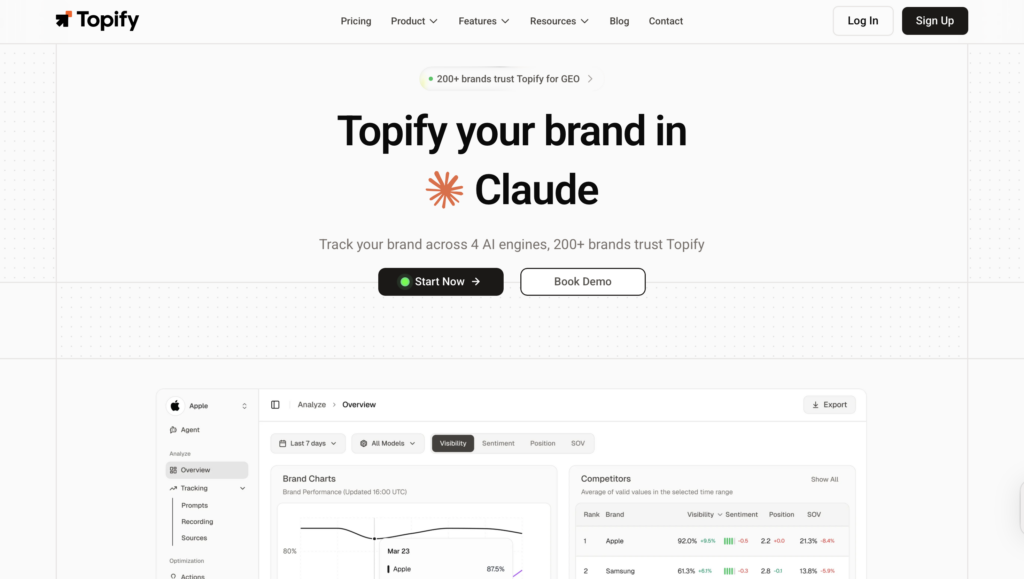
Topify tracks brand visibility across ChatGPT, Perplexity, and Google AI Overviews within a single platform. The workflow starts with prompt definition: you input the queries your target audience is likely asking, and Topify runs those prompts repeatedly to capture AI-generated responses at scale.
The Basic plan supports up to 100 prompts and 9,000 AI answer analyses per month, which covers a meaningful chunk of a brand’s high-priority query set. For teams managing larger prompt libraries, the Pro plan scales to 250 prompts and 22,500 analyses.
What Topify surfaces across those analyses:
- Visibility score: Frequency of brand mention across your full prompt set
- Sentiment score: 0-100 rating of how AI engines describe your brand
- Position tracking: Where your brand ranks relative to competitors in AI answers
- Source analysis: Which domains and URLs are being cited, and whether your content is among them
- CVR (Conversion Visibility Rate): An estimate of how likely AI citations are to drive downstream brand interactions
The source analysis layer is particularly useful for AI Overview citation tracking. If Topify shows that a competitor’s blog is being cited consistently for a query your team has been targeting, that’s an actionable content gap, not an abstract concern.
Get started with Topify to run your first AI Overview visibility audit.
Why Google AI Overviews Tracking Can’t Live in a Silo
Google AI Overviews represent one part of how your customers are getting AI-generated answers. ChatGPT handles an estimated 250–500 million weekly queries, while Perplexity serves around 50 million weekly. These platforms don’t share data with GSC.
The conversion dynamics across platforms also differ significantly. Perplexity citations convert at rates approximately 11x higher than standard organic traffic, driven by the platform’s inline citation format that makes source visits feel natural rather than promotional. A brand invisible in Perplexity but visible in Google AIO is missing a high-intent channel entirely.
Platform-specific tracking creates blind spots. A team that monitors only Google AI Overviews will see a partial picture of their AI search share of voice. The more useful question isn’t “do we appear in Google AI Overviews?” but “across the AI engines our customers actually use, how often and how well are we being described?”
That’s the question a cross-platform AI overview tracker answers.
The CTR Recovery Story: What It Means for Brands That Track
Organic CTR for cited brands recovered from a floor of 1.3% in late 2025 to 2.4% by early 2026, according to Seer Interactive’s tracking data. That’s not a dramatic rebound, but it indicates a stabilization pattern.
The brands driving that recovery share a common characteristic: they know they’re being cited. They’ve invested in ai overview tracking, identified which content gets pulled, and optimized those pages for AI-friendly formatting, structured data, and clear answer-first structure.
Brands without tracking infrastructure are largely excluded from that recovery. You can’t optimize for a channel you can’t see.
Conclusion
The traffic you’re losing to AI Overviews isn’t recoverable through better rankings alone. The citation logic has changed. Sources are being pulled from positions 11-30 as often as from the top results, and the framing of those citations shapes how your brand is perceived before a single click happens.
An ai overview tracker gives you the measurement layer to work with instead of guessing. Track which prompts trigger your brand, see how you’re being described, and identify the content gaps that are handing citations to competitors. Topifycovers this across Google AI Overviews, ChatGPT, and Perplexity from a single dashboard. Start your first audit before your next quarterly review.
FAQ
Q: What is an AI overview tracker? A: An AI overview tracker is a tool that monitors how often and how a brand appears in AI-generated search results, including Google AI Overviews, ChatGPT responses, and Perplexity answers. It captures visibility frequency, sentiment framing, cited sources, and competitive positioning across a defined set of prompts.
Q: Can Google Search Console track AI Overviews appearances? A: Not directly. GSC added “AI Mode” filters in 2025, but these only reflect traffic data after a user clicks through. They don’t show whether your brand was mentioned in an AI Overview, how it was described, or which competitors appeared alongside you. A dedicated AI overview tracker fills this gap.
Q: How often should I check my brand’s AI Overview visibility? A: Weekly monitoring is a reasonable baseline for most brands. Citation patterns in AI search can shift faster than traditional rankings, particularly when Google updates its query fan-out logic or when a competitor publishes content that gets picked up as a source. Monthly snapshots will miss these shifts.
Q: Does appearing in AI Overviews increase website traffic? A: It depends on whether your brand is cited as a source. Brands cited in AI Overviews saw organic CTR recover to roughly 2.4% in early 2026, up from a 1.3% floor in late 2025. Traffic impact is also platform-dependent: Perplexity citations currently convert at significantly higher rates than standard AI Overview mentions due to the platform’s inline citation format.

