

You live in Search Console. So when Google shipped its generative AI performance report in June, you opened it expecting an answer to the question your team keeps asking: how are we doing in AI Mode? What you got was a single impression count with AI Mode, AI Overviews, and Discover folded into one line, no clicks, no queries, and no history before mid-May. You can tell something’s happening. You just can’t tell what, where, or whether it’s worth anything.
That’s the gap AI Mode SEO runs into. And Search Console alone won’t close it.
Why Search Console Still Can’t Tell You How You’re Doing in AI Mode
For two years, the honest answer to “are we showing up in AI Mode?” was a shrug. That changed on June 3, 2026, when Google added dedicated Search Generative AI performance reports that isolate impressions inside AI Overviews, AI Mode, and Discover. It’s real progress. It’s also narrower than it looks.
Three limits keep it from answering the question you actually have.
First, the surfaces are blended. AI Overviews, AI Mode, and Discover’s generative features all get counted in the same combined view, so you can’t pull AI Mode out on its own. A spike could be Discover. A dip could be AI Overviews. You’re reading a merged signal and guessing which surface moved.
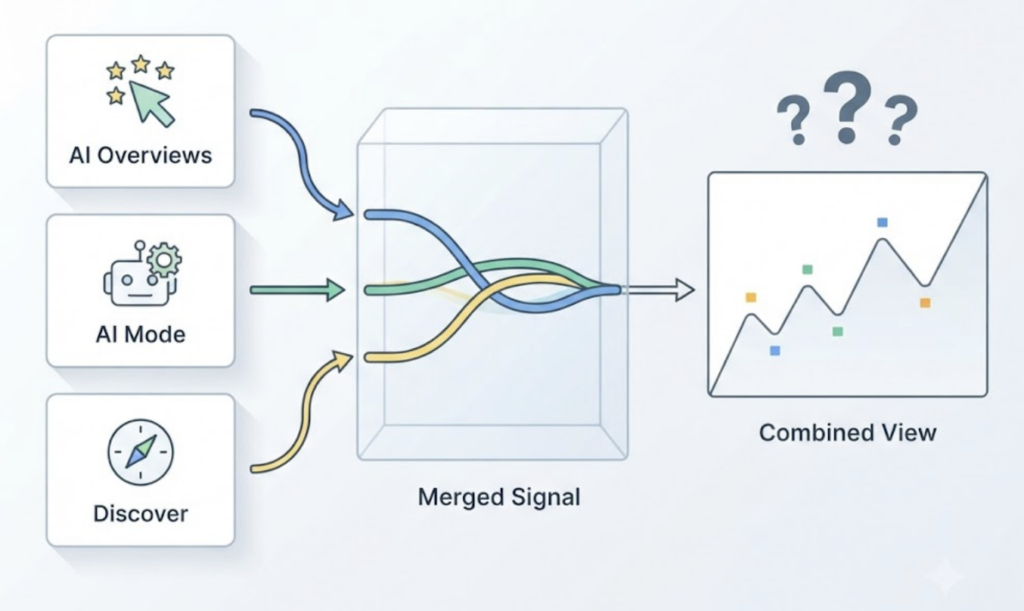
Second, it’s impressions only. The current report shows no click, CTR, or query data, so you learn how often you appeared but nothing about what that appearance was worth. Visibility without value is a vanity metric wearing a lab coat.
Third, there’s no history and limited access. Early observers report the data only reaches back to around mid-May 2026, with no backfill, and Google is rolling it out to a subset of sites in the UK first while US properties wait. If you’re not in the rollout, you have nothing at all.
And none of this touches the AI platforms outside Google. The report covers no data for ChatGPT, Gemini, or Perplexity, which is where a growing share of your buyers now start.
What AI Mode SEO Visibility Actually Means
AI Mode isn’t a ranked page. It’s a synthesized answer built through what Google calls query fan-out, where one question gets split into many sub-queries that run in parallel, then the results get stitched into a single response with citations.
The scale of that is easy to underestimate. One analysis found AI search queries average 70 to 80 words versus 3 to 4 for traditional search, with Google firing hundreds of searches behind a single complex prompt. Your brand isn’t competing for one keyword anymore. It’s competing to be pulled into dozens of sub-answers you never see.
So AI Mode SEO visibility means something different from ranking. It’s whether your content gets retrieved, cited, and surfaced as a supporting source inside that generated answer.
That also makes AI Mode and AI Overviews different targets, not two names for the same thing. AI Overviews sit on top of a classic results page and shape click behavior there. AI Mode is a longer, conversational surface where users ask follow-ups and stay to explore, with sessions averaging around 49 seconds against 21 for AI Overviews, per adoption data from Google’s 2026 I/O. Optimizing for one doesn’t automatically win you the other.
A 3-Step Method to Measure AI Mode Visibility Without Waiting on Search Console
You don’t have to wait for Google to add clicks and query breakdowns. You can measure AI Mode visibility directly by treating it like the conversational surface it is.
Step 1: Build a Prompt Set That Mirrors Real AI Mode Queries
Start with the questions your buyers actually ask, not the short keywords you tracked for classic SEO. Because AI Mode queries run roughly three times longer than traditional searches, your tracking set should be full-sentence, intent-rich prompts: comparisons, “best tool for X,” “how do I,” and the follow-ups a real user would type next.
Aim for coverage of your category’s sub-intents, not just your branded terms. The fan-out process rewards content that answers adjacent questions, so your prompt set should map the neighborhood around your core topic.
Step 2: Track Mentions, Citations, and Position Across Those Prompts
Run each prompt on a fixed cadence and record three things: whether you’re mentioned, whether you’re cited as a source, and where you land relative to competitors. Mentions tell you presence. Citations tell you Google trusted you enough to link. Position tells you whether you’re the first name in the answer or the afterthought at the bottom.
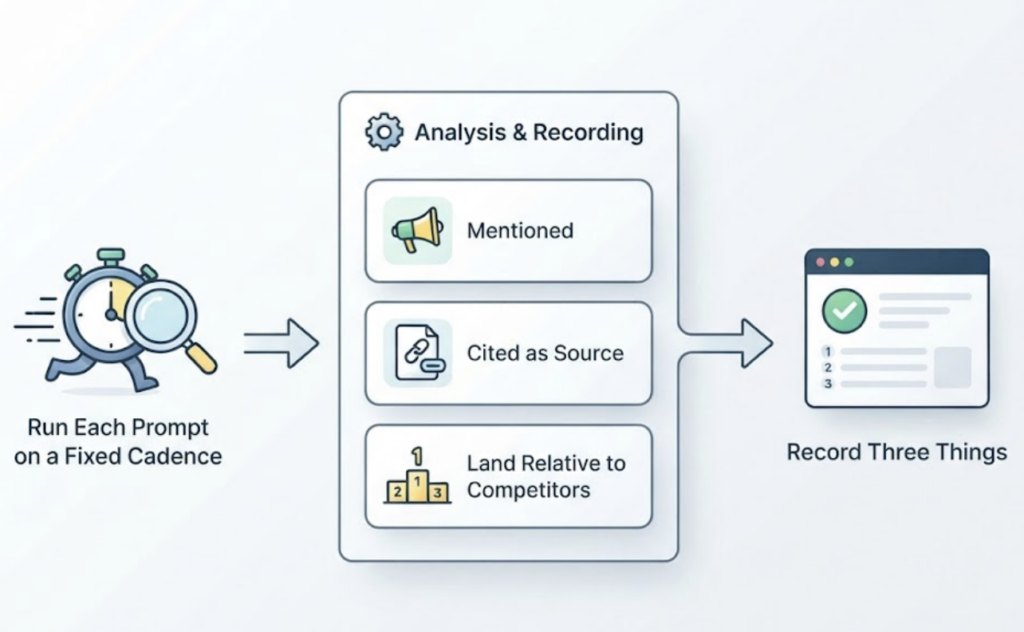
This is the layer Search Console skips entirely. Impressions confirm you appeared somewhere in a blended surface. Prompt-level tracking tells you the actual sentence you showed up in and who beat you to it.
Step 3: Pair Visibility Signals With Downstream Analytics
Visibility only matters if it moves something. Search Console shows presence but not value, which is why pairing impression data with session and conversion data from analytics is the only way to know what AI Mode exposure is genuinely worth.
That connection matters more in AI Mode than anywhere else, because 92 to 94% of AI Mode sessions end without a click to an external site. If you judge success by traffic alone, you’ll write off a surface that’s shaping demand well before the click ever happens.
The AI Mode SEO Metrics That Matter Beyond Impressions
Impressions are the floor, not the picture. A useful AI Mode SEO measurement model tracks what a blended impression count can’t.
| Metric | Question it answers | In GSC today? |
|---|---|---|
| Impressions | Did I appear at all? | Yes, but surfaces are blended |
| Mentions | How often is my brand named in answers? | No |
| Citations / sources | Which of my URLs does AI actually link? | No |
| Position | Am I first or buried among competitors? | No |
| Share of voice | How do I compare to rivals on the same prompts? | No |
| Sentiment | How does AI describe my brand? | No |
Read that column on the right and the takeaway is blunt.
Search Console tells you that you exist. It doesn’t tell you whether you’re winning.
Common Mistakes When Measuring AI Mode Visibility
The teams that misread AI Mode tend to make the same handful of errors.
They treat impressions as value. A high impression count in a blended report feels like progress, but with no clicks or queries attached, it can’t tell you whether those appearances drove anything.
They ignore the citation layer. Being mentioned and being cited aren’t the same. A citation means your page was pulled in as evidence, which is the closest thing AI Mode has to a ranked position, and it’s exactly what impression counts obscure.
They measure only Google. AI Mode matters, but your buyers also live in ChatGPT and Perplexity, and the Search Console report says nothing about either. Measuring one engine and calling it AI visibility is measuring one room and calling it the house.
And they skip the baseline. With no backfill before mid-May, every week you don’t capture data is a week you can’t reconstruct later. Start tracking before you feel ready, because the history you skip is gone for good.
Building a Repeatable AI Mode SEO Measurement Workflow
Doing this by hand across dozens of prompts and multiple engines gets unmanageable fast. That’s the point where a purpose-built platform earns its place, less for the dashboard and more for the layers Search Console leaves out.
This is where a tool like Topify fits into an AI Mode SEO workflow. Instead of a single blended impression line, it tracks visibility at the prompt level across major AI platforms, so you can see which specific questions surface your brand and which hand the answer to a competitor. In practice, that means a drop in mentions isn’t a mystery. You can trace it to the prompt that changed.
The part that maps most directly to AI Mode is citation analysis. Topify reverse-engineers the exact domains and URLs AI systems cite, which turns the invisible fan-out process into something you can actually audit: is it your page getting pulled into answers, or your rival’s? Pair that with competitor benchmarking and position tracking, and you get the share-of-voice view the Search Console report structurally can’t produce.
Coverage is the other half. Because AI Mode is one surface among many, tracking that spans ChatGPT, Gemini, Perplexity, and Google’s AI features keeps you from optimizing for one engine while going dark on the rest. When you’re ready to set a baseline, you can get started and begin capturing prompt-level data before more history slips away.
Track the prompts. Watch the citations. Tie it to outcomes.
Conclusion
The June update was a real step, but it answered “did I appear?” and left “where, and was it worth it?” wide open. AI Mode SEO measurement has to fill that gap on its own: a prompt set that mirrors real conversational queries, tracking that captures mentions, citations, and position, and a link back to sessions and conversions so visibility connects to value. Start building the baseline now. The surfaces will keep shifting, and the teams that measure early are the ones who’ll know what changed when it does.
FAQ
Q: Does Google Search Console show AI Mode visibility separately?
A: Not on its own. The June 2026 generative AI report isolates AI features from classic Search, but it blends AI Mode, AI Overviews, and Discover into one impression view, and it shows no clicks, CTR, or query data yet.
Q: What’s the difference between AI Mode and AI Overviews for SEO?
A: They’re separate optimization targets. AI Overviews sit above classic results and shape click behavior on the page, while AI Mode is a longer, conversational surface built through query fan-out where users ask follow-ups and explore. Appearing in one doesn’t guarantee the other.
Q: How can I measure AI Mode visibility if Search Console data is limited?
A: Build a set of full-sentence prompts that mirror real AI Mode queries, track mentions, citations, and position across them on a fixed schedule, then pair those signals with your analytics to connect visibility to conversions.
Q: Why do impressions alone fail as an AI Mode SEO metric?
A: Because impressions confirm you appeared in a blended surface but say nothing about whether AI cited your page, where you ranked against competitors, or whether the appearance drove any action. Citations and position carry the signal impressions hide.

