

Over the past year, plenty of teams added an llms.txt file, broke their pages into bite-sized chunks, and rewrote perfectly good content “so the AI could read it.” The advice came from a wave of GEO and AEO vendors promising a separate playbook for AI Mode. Then Google published its first official guidance on the subject, and the message was blunt: for Google Search, none of those tactics do anything. Not chunking. Not llms.txt. Not rewriting for machines.
If you’ve been treating AI Mode as a new game with new rules, the guide is worth reading closely, because it says close to the opposite of what most of the internet has been selling.
What Google Actually Put on the Record About AI Mode SEO
Google Search Central published the guide on May 15, 2026, announced by John Mueller and filed under a new “Generative AI fundamentals” section of the documentation. It’s titled “Optimizing your website for generative AI features on Google Search,” and it covers both AI Overviews and AI Mode from a site owner’s point of view.
Most of what’s in there isn’t new. Google staff had said similar things at conferences and in interviews for over a year. What changed is that the position now sits in official documentation you can cite, rather than in scattered tweets and conference recaps.
That matters for one practical reason. When a client or a colleague asks whether AI Mode needs its own strategy, you now have an on-record answer instead of a vendor’s pitch deck.
There’s No Separate AI Mode Index. It Pulls From the Same Ranking
The central claim of the guide is short: SEO still matters because Google’s generative AI features are rooted in its core Search ranking and quality systems. There’s no separate “AI index” and no separate “AI ranking algorithm.”
Two techniques do the work. Retrieval-augmented generation, which Google also calls grounding, pulls relevant, up-to-date pages from the Search index and uses them to build a response with clickable supporting links. Query fan-out sends out several related queries at once. Ask “how to fix a lawn that’s full of weeds,” and the model may also run “best herbicides for lawns” and “how to prevent weeds in lawn” behind the scenes.
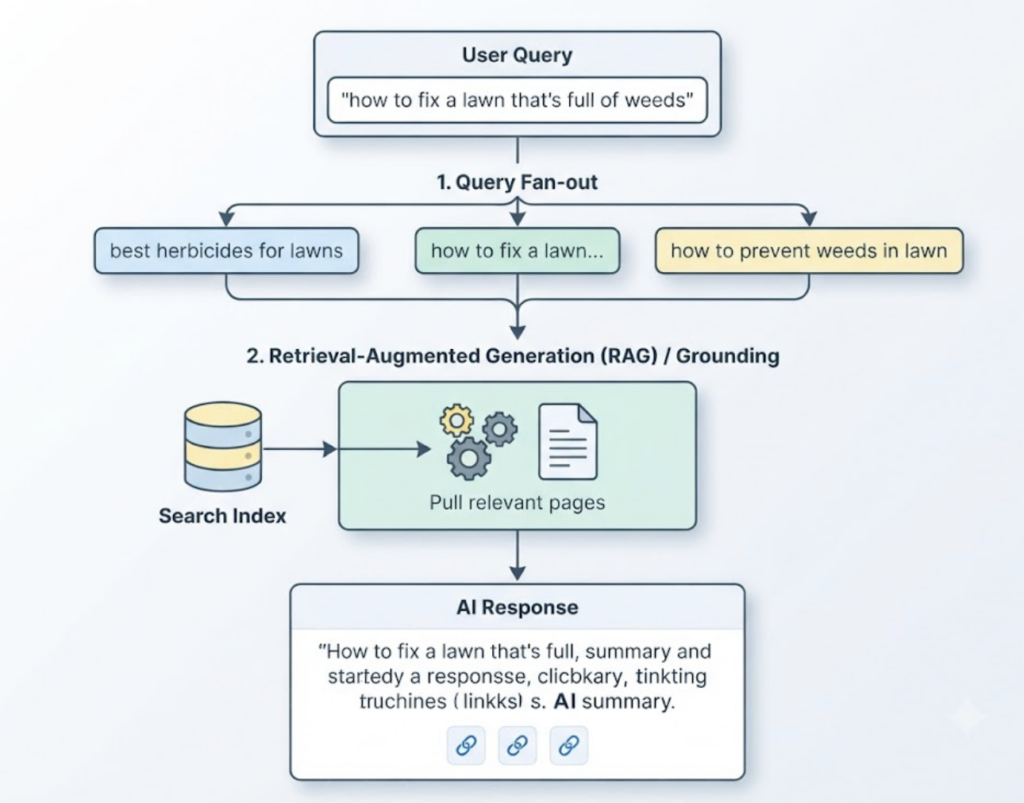
Both techniques read from the same index that powers classic Search.
The eligibility rule follows from that. To appear in AI Overviews or AI Mode, a page has to be indexed, eligible to show with a snippet, and meeting Google’s technical requirements. If your page can’t earn a normal snippet, it can’t surface in an AI answer either.
Google Says “GEO” and “AEO” Are Still Just SEO
The guide addresses the acronyms head-on. From Google’s perspective, optimizing for generative AI search is optimizing for the search experience, and that’s still SEO. The document names AEO and GEO directly and points readers toward its guidance on evaluating third-party advice.
This lines up with what Googlers Gary Illyes and Cherry Prommawin told Search Central Live audiences: AI search doesn’t need a separate framework. The difference now is that it’s written down.
Here’s the nuance a lot of the coverage skipped. This is a statement about Google’s own surfaces. It tells you the label “GEO” doesn’t unlock a hidden algorithm inside Google. It does not say anything about what happens outside Google, which turns out to be the more interesting half of the story.
The Mythbusting Section: AI Mode SEO Tactics Google Says to Drop
The guide includes a section called “Mythbusting generative AI search,” listing tactics you can ignore for Google Search. It’s the most direct Google has been about the AI optimization industry.
| Tactic making the rounds | What Google says |
|---|---|
| llms.txt and other “special” markup | Google Search doesn’t use these files. Keeping one won’t help or hurt your rankings. |
| Chunking content into tiny blocks | Not required. Google’s systems read nuance across a full page and show the relevant part. |
| Rewriting content just for AI | Unnecessary. The systems handle synonyms and intent without you chasing every keyword variant. |
| Chasing inauthentic “mentions” | Ineffective. Core ranking rewards quality content while other systems filter spam. |
| Overfocusing on structured data | Not required for AI answers, though still worth using for rich results. |
One caveat is worth keeping straight. “Ineffective for Google Search” is not the same as “ineffective everywhere.” Some of these tactics may still matter for other AI systems that do read files like llms.txt. The guide only speaks for Google.
What the Guide Tells You to Do Instead
Strip out the myths and the positive advice reads like a refresher on fundamentals.
First, create non-commodity content. Google draws a line between common-knowledge posts like “7 Tips for First-Time Homebuyers” and something built on real experience, like a first-hand account of waiving an inspection and what it cost. A unique point of view, drawn from what you actually know, tends to influence long-term visibility more than any technical tweak in the guide.
Second, keep a clean technical structure. Make pages crawlable and indexable, follow JavaScript SEO basics if your site relies on frameworks, provide a good page experience, and reduce duplicate content. Semantic HTML helps, but Google says not to obsess over perfect code.
Third, handle local and ecommerce details where they apply. Merchant Center feeds and Google Business Profiles feed the product and local information that can appear in AI responses.
Fourth, keep an eye on agentic experiences. Browser agents may read your site through screenshots, the DOM, and the accessibility tree, and emerging protocols like the Universal Commerce Protocol point to where this is heading.
None of that is a new discipline. It’s the SEO you already know, reframed for a new surface.
The Blind Spot: Google’s Guide Only Covers Google
Read the guide twice and the gap becomes hard to miss. Every line is about Google’s own AI Overviews and AI Mode. Even the recommended measurement tool, the Generative AI performance report in Search Console, only reports on Google surfaces.
Meanwhile, a large share of AI search now happens somewhere Google can’t see. ChatGPT holds the majority of AI-assistant usage, Gemini and Copilot split much of the rest, and Perplexity has grown into tens of millions of monthly users. By early 2026, AI platforms were taking an estimated 15 to 20 percent of informational query volume. Zero-click behavior has climbed too, with about 43 percent of Google searches ending without a click, rising sharply when AI Mode is active.
Google’s guide says nothing about any of it. That’s not an oversight. Google can only document its own product.
The guide also warns you to be wary of third-party tools that claim access to “internal” Google metrics, and it’s right to. No outside tool sees Google’s ranking systems. The honest read is narrower than the skeptics suggest: a good third-party tool shouldn’t pretend to hold Google’s internal data. It should measure the platforms Google’s own report leaves out.
That’s the gap Topify is built for. Instead of guessing at Google internals, it tracks how your brand shows up across ChatGPT, Gemini, Perplexity, DeepSeek, and other engines, then reports visibility, sentiment, and position in one view. In practice, that means you can see a drop in ChatGPT mentions and trace it to a source that stopped citing you, which is the kind of movement Search Console will never show.
Citation data explains why the source layer matters. Research suggests 40 to 55 percent of ChatGPT and Perplexity citations flow to fewer than 1,000 domains. Topify’s source analysis maps which domains those engines cite for your topics, so you can find the pages worth earning a mention on. When you’re ready to check where you stand, you can get started with Topify and pull a cross-platform baseline in a few minutes.
Conclusion
Google’s first official guide doesn’t hand you a secret AI Mode SEO playbook. It does two quieter things. It confirms that solid SEO is what earns visibility inside Google’s AI features, and it tells you most of the “AI optimization” industry is selling tactics Google doesn’t use.
So the plan splits cleanly. For Google surfaces, do the fundamentals well and lean on the Generative AI performance report to track them. For everything outside Google, where a growing slice of AI search now lives, build a separate measurement layer, because Google’s tools were never designed to look there. Read the guide for what it says. Then plan for what it doesn’t.
FAQ
Does AI Mode need separate SEO from regular Google Search?
No. Google’s guide states that AI Overviews and AI Mode run on its core Search ranking systems, so the same SEO fundamentals apply. There are no extra requirements to appear in AI Mode beyond being indexed and eligible for a snippet.
Are GEO and AEO different from SEO according to Google?
Not for Google Search. The guide says optimizing for generative AI search is optimizing for the search experience, which is still SEO. The acronyms describe the same work, not a separate algorithm inside Google.
Do I need an llms.txt file to show up in AI Mode?
No. Google Search doesn’t read llms.txt or other special markup, and keeping one won’t help or hurt your Google rankings. It may still matter for other AI systems, but the guide only speaks for Google.
How do I measure my visibility in AI Mode and other AI search engines?
Use the Generative AI performance report in Search Console for Google’s own surfaces. For ChatGPT, Perplexity, Gemini, and other engines, you’ll need a cross-platform tracker, since Search Console doesn’t report on anything outside Google.

