

Your top three keywords all sit in position one. Domain authority keeps climbing. Then you open Google’s AI Mode, ask it to recommend a tool in your category, and read a clean, confident answer that cites five sources. None of them are you.
That gap isn’t a fluke. Recent studies show only 14% of the URLs cited in AI Mode also rank in Google’s organic top 10. AI Mode SEO turns out to run on different rules than the SEO you’ve been doing for a decade, and traditional metrics can’t explain the miss, because they were never built to measure what an AI decides to say.
The Data: Ranking #1 on Google Barely Overlaps With AI Mode
Start with the overlap numbers, because they’re the whole story in miniature.
SEO Ranking’s analysis found that AI Mode citations match Google’s organic top 10 at just 14% at the URL level and 21.9% at the domain level. Semrush ran a separate study and measured AI Mode’s overlap with the top 10 at roughly 35% of URLs and 54% of domains, which it described as looser, more independent retrieval than either AI Overviews or Perplexity showed. Different methods, same direction: ranking predicts far less than most teams assume.
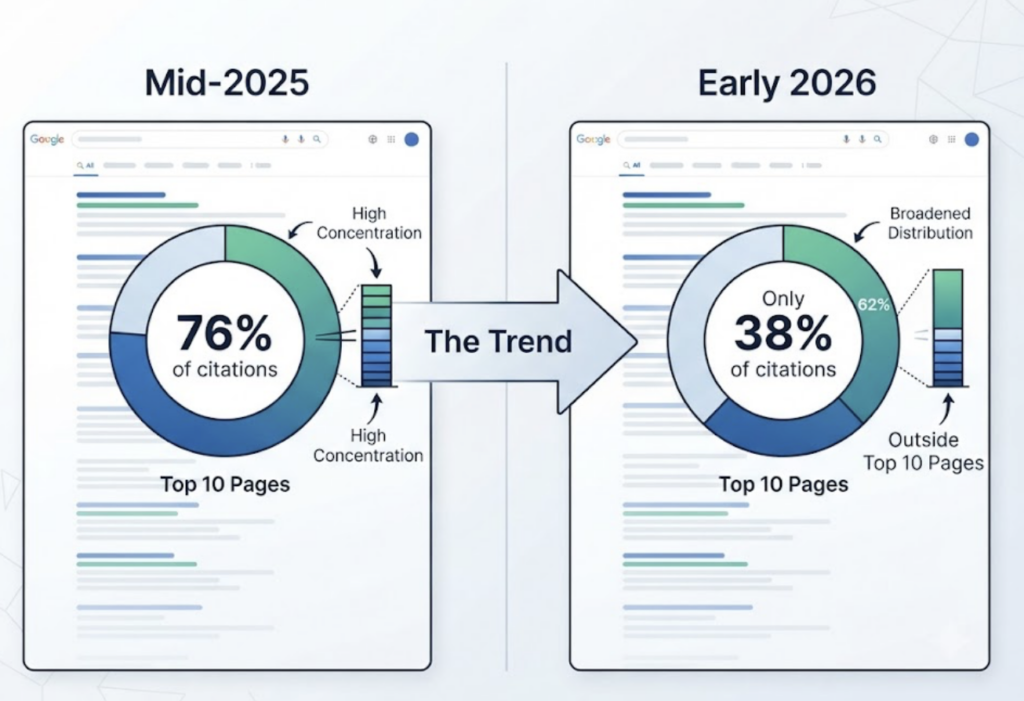
The trend is also moving fast. In mid-2025, about 76% of AI Overview citations came from pages ranking in the top 10. By early 2026 that had fallen to roughly 38%, with a separate cross-methodology read putting it near 17%. Roughly five out of six citations now come from pages that don’t hold a top-10 spot at all.
One more distinction worth internalizing: AI Mode and AI Overviews aren’t the same surface. Ahrefs found they cite the same URLs only 13.7% of the time. Optimizing for one doesn’t hand you the other.
Ranking still functions as an upstream filter. It just stopped being the thing that decides who gets pulled into the answer.
Why AI Mode SEO Doesn’t Work Like Traditional SEO
The mechanism explains the numbers.
AI Mode is a dedicated conversational surface powered by Gemini, and it uses a technique called query fan-out. One question like “best CRM for a 10-person agency under $50 a seat” gets decomposed into four to eight background sub-queries covering pricing, use cases, integrations, and reviews. Then the model synthesizes an answer from whatever passages best fit each fragment.
That changes the unit of competition. Traditional SEO optimizes a page to rank for a query. AI Mode SEO is closer to optimizing passages to be extracted for sub-queries you’re not even tracking.
Placement inside the page matters too. Roughly 44.2% of LLM citations come from the first 30% of a page, which rewards answering the question up front instead of burying it under context.
That’s the shift most SEO teams still can’t see.
Your rank for a head term can be perfect while the specific passage the model needed sits three scrolls down, wrapped in setup, and never gets picked. Page-level authority and passage-level extraction are two different games.
What Actually Gets You Cited in Google AI Mode
If ranking isn’t the lever, what is?
Three inputs tend to carry weight. First, structured, extractable passages: concise, self-contained answers in the featured-snippet mold that a model can lift without rewriting. Second, information consistency across sources, where the same product claims show up the same way across Reddit, review platforms, and independent publications, so the model finds agreement when it grounds its answer. Third, topical coverage across formats rather than a single well-ranked page, since fan-out rewards breadth over a lone position.
There’s also a volatility problem that traditional SEO never had to face. SE Ranking found that in AI Mode, over 60% of domains and 80% of URLs change between runs, even for the same user, city, and query. A citation you earn today may not reappear tomorrow.
That instability is exactly why single-snapshot checks mislead you. Appearing once tells you almost nothing about whether you’re reliably present.
Your Rank Tracker Is Blind to AI Mode Visibility
Here’s the uncomfortable part. Most teams are measuring the wrong surface entirely.
Only about 14% of marketers currently track AI search performance at all. The rest are watching rank dashboards that, by the data above, explain a shrinking share of what actually drives discovery.
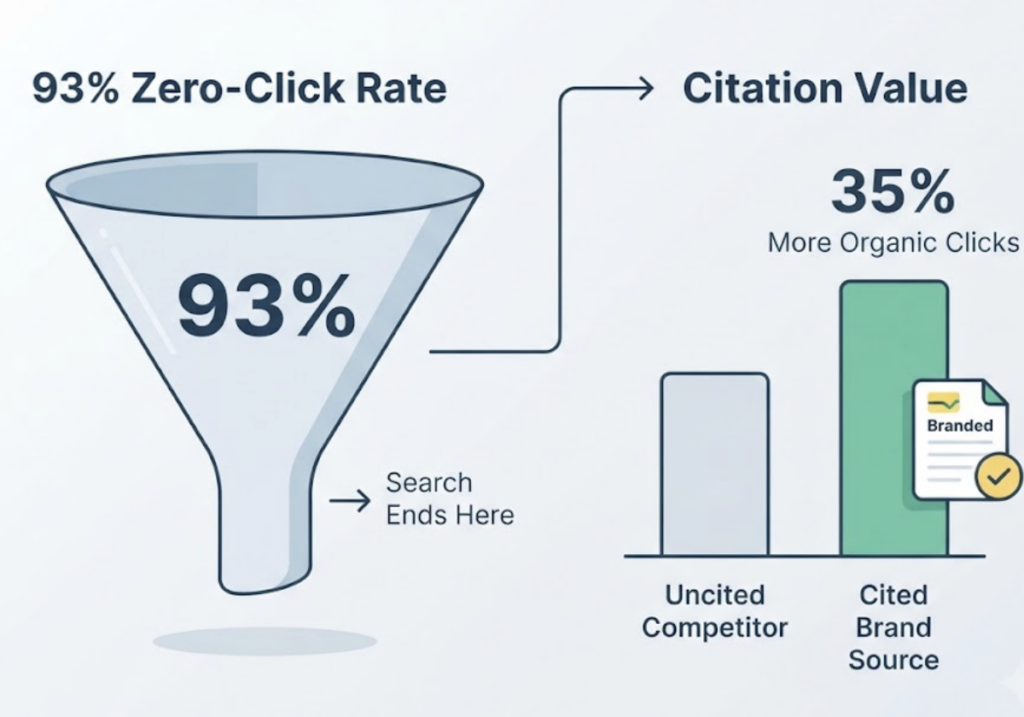
Meanwhile the stakes on these queries are real. AI Mode runs at roughly a 93% zero-click rate, meaning the answer usually ends the search. And when your brand is the cited source, that citation is worth about 35% more organic clicksthan being an uncited competitor on the same query. Being in the answer is the position now.
A rank tracker can tell you you’re number one. It can’t tell you whether Gemini mentioned you, what it said, or which competitor it recommended instead. Those are different questions, and AI Mode SEO lives entirely in the second set.
Building an AI Mode SEO Strategy You Can Actually Measure
Closing the gap starts with measuring the right thing, then acting on it.
You need three capabilities that a keyword tool doesn’t provide: visibility tracking that watches whether AI systems mention you across their answers, citation analysis that shows which domains and URLs those systems actually pull from, and competitor benchmarking so you can see who’s getting recommended in your place.
This is where Topify fits for teams making the move from SEO to GEO. Its Comprehensive GEO Analytics tracks brand performance across major AI platforms, including Google AI Overviews, ChatGPT, Gemini, and Perplexity, through metrics like visibility, sentiment, position, and mention frequency. Instead of a single spot-check, you get repeated sampling, which matters given how volatile AI Mode citations are between runs.
The citation piece tends to be the most useful for answering “why not me.” Topify’s source analysis reverse-engineers the exact domains and URLs AI platforms cite, so you can see whether a competitor owns the references a model leans on and where your content is missing from the grounding set. Pair that with position tracking and you can watch your standing relative to rivals shift in something close to real time.
In practice, that turns a vague worry (“are we in AI answers?”) into a specific, trackable metric your team can move. You can get started with Topify and benchmark your current AI Mode visibility before deciding where to invest.
The point isn’t to abandon SEO. Strong rankings still help you get crawled, indexed, and considered. The point is to stop assuming the rank carries over, and to start measuring the surface where the decision now happens.
Conclusion
Ranking #1 on Google and appearing in AI Mode used to be close to the same exercise. The data says they’ve come apart: 14% URL overlap, a top-10 citation share that fell from 76% to under 40% in months, and a surface that ends 93% of searches without a click. Treat AI Mode SEO as its own discipline with its own scoreboard. Audit whether AI systems actually cite you, find the sources they trust instead, and rebuild your content around passages a model can extract. The teams that win the next few years aren’t the ones that only rank. They’re the ones that rank and get cited.
FAQ
Does ranking #1 on Google help you appear in AI Mode?
It helps as an upstream signal but no longer determines the outcome. Only about 14% of AI Mode citations come from URLs in Google’s organic top 10, and the broader top-10 citation overlap has dropped sharply since mid-2025. Ranking supports indexability; passage structure and source consistency drive citation.
Is AI Mode SEO the same as optimizing for AI Overviews?
No. AI Mode and AI Overviews are separate surfaces that share infrastructure but behave differently, citing the same URLs only about 13.7% of the time. You need to track and optimize for each one rather than treating them as a single target.
Why isn’t my brand showing up in AI Mode?
Usually because your content isn’t structured for passage-level extraction, your claims aren’t consistent across the sources models trust, or competitors own the citations the model grounds its answer on. AI Mode’s query fan-out also evaluates sub-queries you may not be tracking, so single-keyword optimization leaves gaps.
How do I track my brand’s AI Mode visibility?
Rank trackers can’t see it. You need a GEO tool that monitors whether AI systems mention you, analyzes which sources they cite, and benchmarks you against competitors across repeated samples, since AI Mode citations are volatile between runs.

