

Your keyword rankings are holding. Your domain authority looks healthy. Then a prospect opens Perplexity, types your category, and gets back three named tools. None of them is yours. Your SEO stack tracked everything except the one thing that just decided the deal: whether an AI model names your brand when someone asks. That signal doesn’t live in a rank tracker. It lives inside the answers themselves, across engines that rewrite their reasoning every few weeks. The tools built to catch it are new, uneven, and easy to pick wrong.
Why Most “SEO Tools for Perplexity” Miss the Mention Layer
Traditional SEO tools were built for a web of indexed links and fixed SERP positions. AI engines don’t work that way. They run on retrieval-augmented generation, pulling sources into a reasoning chain and synthesizing one answer. If your brand isn’t part of that reasoning, you’re absent, no matter how strong your backlink profile is.
The numbers explain the urgency. 64.82% of Google searches now end without a click, up from 50% in 2019. In Google’s AI Mode, one analysis of 25.1 million impressions found 93% of queries produce zero outbound clicks. For B2B, AI Overviews now trigger on 82% of tech queries, up from 36% a year earlier.
Clicks stopped being a reliable proxy for visibility.
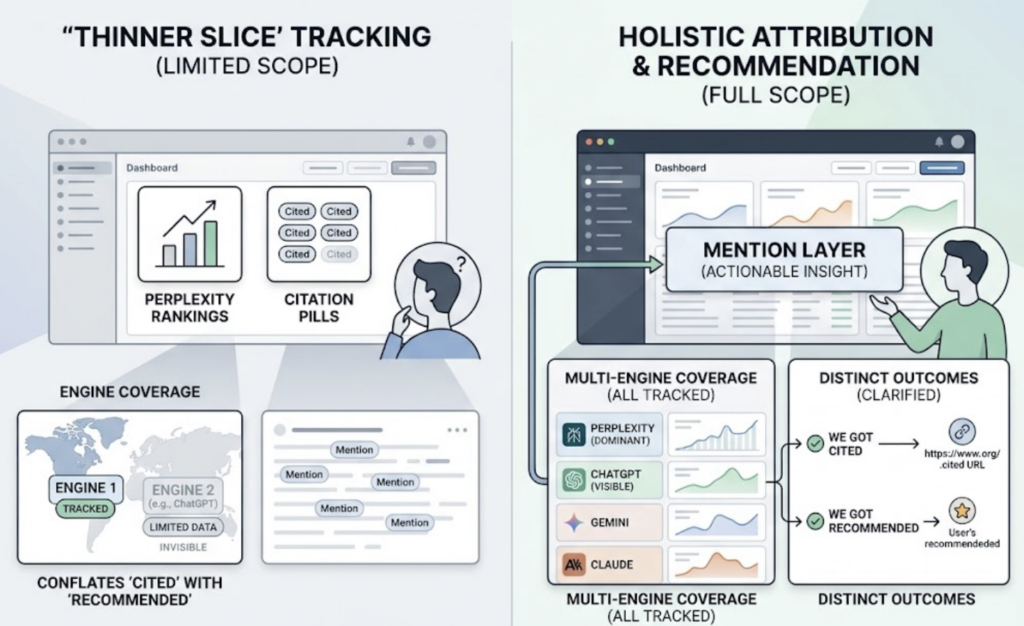
So a tool that only reports Perplexity rankings or citation pills is tracking a thinner slice than it admits. Two gaps show up again and again. First, most platforms cover one engine well and the rest poorly, when a brand can be dominant in Perplexity and invisible in ChatGPT. Second, they conflate “we got cited” with “we got recommended,” which are different outcomes. The mention layer, the actual sentence where an AI names you, is what a dashboard has to capture.
What an AI Mention Tracking Dashboard Should Actually Measure
An AI mention tracking dashboard earns its place when it turns raw answers into something you can act on, not a wall of numbers. Five metrics separate a useful one from a vanity panel.
Brand Presence. Does your brand appear in the answer at all, and how often across a set of tracked prompts. This is the category-relevance baseline.
Citation Share. What percentage of the sources an AI pulls from point to you versus your competitive set. It’s the closest proxy for how much authority a model assigns your content.
Visibility Depth. Whether the AI mentions you in passing or builds you into its recommended solution. A mention and a recommendation are not the same, and a good dashboard tells them apart.
Entity Stability. How consistently AI engines recognize and describe your brand correctly over time. Drift here is an early warning for hallucination and narrative slip.
AI Referral Traffic. The clicks that do come through from AI platforms. Small in volume, but they tend to convert well, since the user already read a summary before clicking. One dataset found AI search visitors convert at 23x the rate of traditional search visitors.
The trade-off is coverage versus depth. Some tools track many engines shallowly. Others go deep on one. The right pick depends on where your buyers actually ask.
The 7 Tools, Ranked at a Glance
Here’s how the field compares on the dimensions that decide whether a dashboard is worth the seat cost.
| Tool | AI engines covered | Mention-level tracking | Source / citation analysis | Competitor benchmarking | Starting price |
|---|---|---|---|---|---|
| 1. Topify | ChatGPT, Gemini, Perplexity, DeepSeek, and more | Yes, prompt-level | Yes, domain and URL level | Yes, automatic | $99/mo |
| 2. Profound | ChatGPT, Perplexity, others | Yes | Partial | Yes | Custom / enterprise |
| 3. Peec AI | ChatGPT, Perplexity, Gemini | Yes | Limited | Yes | Mid-tier |
| 4. Otterly.AI | ChatGPT, Perplexity, Google AIO | Yes | Basic | Basic | Lower tier |
| 5. Semrush AI toolkit | AI Overviews, ChatGPT | Partial | Partial | Yes | Bundled with suite |
| 6. Ahrefs Brand Radar | AI Overviews, ChatGPT | Mention-focused | Partial | Limited | Bundled with suite |
| 7. Daydream | Multi-engine | Yes | Limited | Yes | Custom |
The table flattens a lot of nuance, so the sections below add the context the columns can’t.
#1 Topify: Cross-Engine Brand Visibility in ChatGPT and Perplexity
Topify lands at the top for a specific reason: it treats the mention as the unit of measurement, then connects it back to the source that produced it, across engines, in one view. That’s the combination most other tools split apart.
In practice, it works like this. Topify monitors a set of high-intent prompts at the prompt level across ChatGPT, Gemini, Perplexity, DeepSeek, and other major engines. Its Visibility Tracking shows where your brand surfaces and how often. When a ChatGPT mention drops, Source Analysis lets you trace it to the exact domain or URL that stopped citing you, so you know what content to fix rather than guessing.
That source visibility matters because AI engines often favor third-party pages over your own. If a competitor’s blog post is the model’s preferred reasoning node, you can see it and decide whether to match the topic, outpublish it, or earn the citation at the source.
For teams that need ai seo tools for brand visibility in chatgpt without stitching three subscriptions together, the appeal is the single workflow. Competitor Monitoring flags who the AI recommends alongside or instead of you, Position Tracking shows your order relative to rivals in the answer, and Sentiment Analysis scores how the model describes you on a 0 to 100 scale. CVR, the conversion visibility rate, estimates how likely an answer is to push a reader toward you.
Pricing starts at $99/mo on the Basic plan, which covers ChatGPT, Perplexity, and AI Overviews tracking with 100 prompts and four projects. That’s a meaningful gap below the enterprise pricing common among AI-only visibility platforms, and it makes the tool reachable for in-house teams and agencies running several client brands.
The trade-off is honest to name. Topify is built for ongoing GEO operations, not a one-time audit, so the value compounds over weeks of tracked data rather than a single report. You can get started with Topify on a trial before committing.
How Topify Tracks Brand Visibility in ChatGPT and Perplexity
The mechanics are straightforward. You define 20 to 50 customer prompts, the kind real buyers type, and Topify runs them across engines on a schedule. Because AI answers are non-deterministic, repeated synthetic prompting builds a trend line instead of a single snapshot. The merged view means you stop tab-switching between a Perplexity tool and a ChatGPT tool, and you start seeing one brand picture.
#2 to #7: Where the Other Tools Fit
The rest of the field is capable, with sharper edges in specific use cases.
Profound is strong on enterprise-grade answer analytics and custom prompt tracking, and it’s a common pick for large teams. Pricing tends to sit at the enterprise level, which prices out smaller operators.
Peec AI focuses on multi-engine visibility reporting with clean dashboards, and it suits teams that want fast setup. Source-level attribution is lighter than a citation-first tool.
Otterly.AI is approachable and budget-friendly, covering ChatGPT, Perplexity, and Google AI Overviews. It’s a reasonable entry point, though competitor and source depth are basic.
Semrush’s AI toolkit wins when you already live in Semrush and want AI visibility folded into an existing SEO workflow. Engine coverage is narrower than dedicated GEO tools.
Ahrefs Brand Radar leans into brand-mention detection inside AI answers and AI Overviews, useful if Ahrefs is your home base. Competitor benchmarking is limited.
Daydream offers multi-engine tracking with an automation bent, fitting teams that want monitoring plus workflow. Citation analysis is less developed.
None of these is wrong. They’re tuned for different priorities.
How to Choose the Best SEO Tools for Perplexity and ChatGPT
Picking the best seo tools for perplexity and ChatGPT comes down to three questions, not a feature checklist.
First, how many engines do your buyers use. If your audience splits across Perplexity, ChatGPT, and Gemini, single-engine coverage leaves blind spots, so favor a tool that merges them.
Second, do you need to know why, not just what. If you only need a presence score, a lighter tool works. If you need to trace a drop to a source and fix it, you need citation-level analysis.
Third, who’s paying and how often you’ll look. Agencies and in-house teams checking weekly get more from a per-seat subscription with competitor benchmarking than from an enterprise contract built for a quarterly report.
Match the tool to the answer you need to give your boss or your client. That’s the filter.
Conclusion
The gap that opened this piece, a prospect getting three AI recommendations and none of them yours, is now measurable. The brands that close it aren’t tracking more keywords. They’re tracking prompts, across engines, at the mention level, and tracing each result back to a source they can influence. Start by listing the 20 to 50 prompts your buyers actually ask, decide which engines matter for your market, then choose a dashboard that covers both presence and the reason behind it. The reporting follows from there.
FAQ
Q: What is an AI mention tracking dashboard?
A: It’s a tool that monitors how often and how AI engines like ChatGPT, Perplexity, and Gemini name your brand in their answers, then reports presence, citation share, sentiment, and competitive position in one view. Unlike a rank tracker, it measures the answer itself, not a SERP position.
Q: What are the best SEO tools for Perplexity in 2026?
A: Tools that cover Perplexity well alongside other engines, track mentions at the prompt level, and attribute citations to source domains. Single-engine tools tend to undercount, since a brand visible in Perplexity can be absent in ChatGPT.
Q: How do I track brand visibility in ChatGPT?
A: Define a set of high-intent prompts, run them across ChatGPT on a schedule using synthetic prompting, and log how often your brand appears, in what position, and which sources the model cites. Repeating this over time turns volatile single answers into a usable trend.
Q: Are AI SEO tools for ChatGPT visibility worth it in 2026?
A: With AI Overviews triggering on 82% of B2B tech queries and most AI searches ending without a click, traditional click metrics now miss most of your exposure. For teams whose buyers research through AI, a visibility dashboard captures performance that rank trackers can’t see. A free tool audit is a low-risk way to start; see this list of free GEO tools.

