

You opened ChatGPT last week, typed your category, and checked whether your brand came up. It did, so you moved on. Then a colleague ran the same prompt from a different city and got a different answer, with a competitor in the top slot and your brand missing entirely. That’s the catch with checking AI by hand. A single query tells you almost nothing, because the answer one person sees is rarely the answer everyone sees. An AI brand monitoring strategy replaces that scattered guesswork with a system you can measure, repeat, and actually report on.
Why Spot-Checking ChatGPT Isn’t a Strategy
Manual checking feels productive. It isn’t.
The first problem is volatility. AI models are non-deterministic, so the same prompt returns different answers depending on browser history, location, and the model’s own randomness settings. Check once and you’ve captured a single roll of the dice.
The second is platform fragmentation. Watching only Google AI Overviews while ignoring ChatGPT, Claude, Perplexity, and regional engines gives you a false sense of safety. Your brand might dominate one and vanish on another.
Then there’s the baseline problem. Without systematic logging, you can’t tell whether your presence in AI answers is climbing or sliding. You just have a feeling.
The last issue is the one that hurts at work: manual checks don’t produce data anyone can audit. There’s nothing to put in a deck, nothing to integrate into your marketing stack, and nothing leadership can hold you to.
What an AI Brand Monitoring Strategy Actually Tracks
A real strategy starts by deciding what to watch, and the honest answer is more than “are we mentioned.”
Think of it as a monitoring system with five moving parts: whether you appear, where you appear, how you’re described, what sources the AI trusts to back you up, and how you stack against competitors in the same answer. Each one tells a different part of the story. A brand can be highly visible but described poorly, or cited often but ranked below a rival every single time.
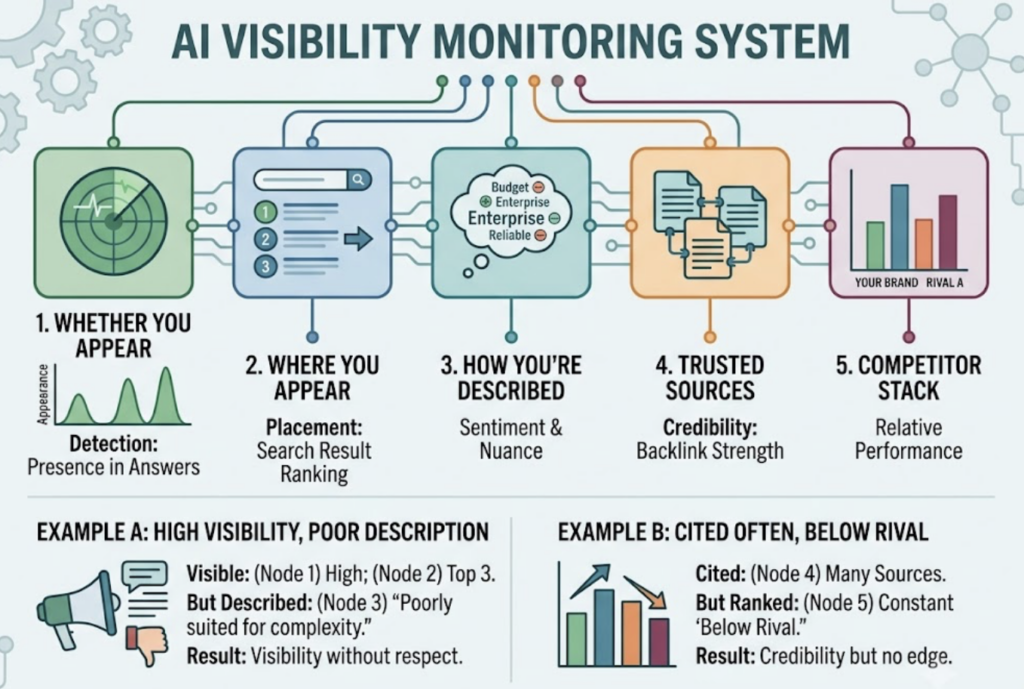
The shift here is from rankings to influence. Traditional SEO asks where you sit on a results page. AI monitoring asks whether the model chooses to mention you at all, and in what light. That’s a different question, and it needs a different system to answer it.
The Metrics That Make or Break Your Monitoring System
Once you know what to watch, you need numbers to watch it with. Vague impressions don’t survive a quarterly review.
Here’s the metric set most enterprise teams converge on:
| Metric | What it tells you |
|---|---|
| Visibility rate | The share of relevant prompts where your brand shows up at all |
| Position | How prominently you sit in the AI’s list of recommendations |
| Sentiment | Whether you’re framed positively, neutrally, or negatively |
| Citation source | Which external URLs the AI trusts to vouch for you |
| Share of voice | Your presence versus direct competitors in the same prompt cluster |
| Intent alignment | How well the answer matches what the user actually wanted |
| Conversion rate | The last-mile signal: whether AI recommendations turn into traffic |
No single number runs the show. Visibility without sentiment can mean you’re mentioned as the cautionary example. Position without share of voice hides whether a competitor is quietly winning the same answers. A monitoring system earns its name when it holds all seven together in one view, not when it reports one of them well.
Picking an AI Brand Monitoring Tool That Fits Your Strategy
Strategy and tooling are different things, but a strategy you can’t execute is just a document. The AI brand monitoring tool you choose either makes the system run or quietly stalls it.
Four dimensions separate a usable tool from a dashboard that looks busy and changes nothing.
Engine coverage comes first. Any solution worth paying for has to watch both general-purpose models like ChatGPT, Claude, and Gemini and search-focused engines like Perplexity, Google AI Overviews, and DeepSeek. Coverage gaps are blind spots, and blind spots are where competitors win.
Entity-level parsing comes next. Good software moves past keyword matching to recognize your brand, its parent company, and its product lines as distinct entities. That’s how it tells the difference between a mention of your company and a mention of a product you discontinued.
Source attribution is the third. The platform should reverse-engineer why the AI cited what it cited, pointing to the specific pages acting as trust signals rather than leaving you to guess.
Actionability is the one that’s easy to skip and expensive to miss. The real test of any AI brand monitoring solution is the bridge between the dashboard and the work: does it tell you what to change, or just what’s wrong?
From Dashboard to Action: Where Most Strategies Stall
Most AI brand monitoring strategies don’t fail at the data stage. They fail right after it.
A team stands up a dashboard, watches the visibility line for a month, and then nothing. The numbers are interesting, but nobody knows which page to edit, which source to pursue, or which prompt to prioritize. The strategy quietly becomes wallpaper.
That gap between knowing and doing is where the strategy lives or dies. A dashboard that reports a problem is useful. A system that also hands you the fix, and lets you ship it, is what actually moves the visibility rate.
How Topify Turns the Strategy Into a Running System
This is where a purpose-built platform earns its place. Topify was built around the gap most monitoring setups leave open, pairing visibility data with the workflow to act on it.
Its Comprehensive GEO Analytics tracks the full metric set across a broad spread of AI platforms, from ChatGPT, Gemini, and Perplexity to DeepSeek, Doubao, and Qwen. That coverage matters for any team whose audience searches across more than one market or one engine.
The part that addresses the action gap is One-Click Execution. Instead of exporting a report and routing it to a content team weeks later, you can deploy updates directly to the pages the AI is failing to cite. The loop from “we’re not being mentioned here” to “we fixed it” closes inside one platform.
Competitor benchmarking goes a step further with what amounts to citation gap analysis. It shows you specifically what a rival’s content is doing, a pricing table, a comparison page, a case study, that’s winning the citation your brand keeps losing. You stop guessing why the AI prefers them.
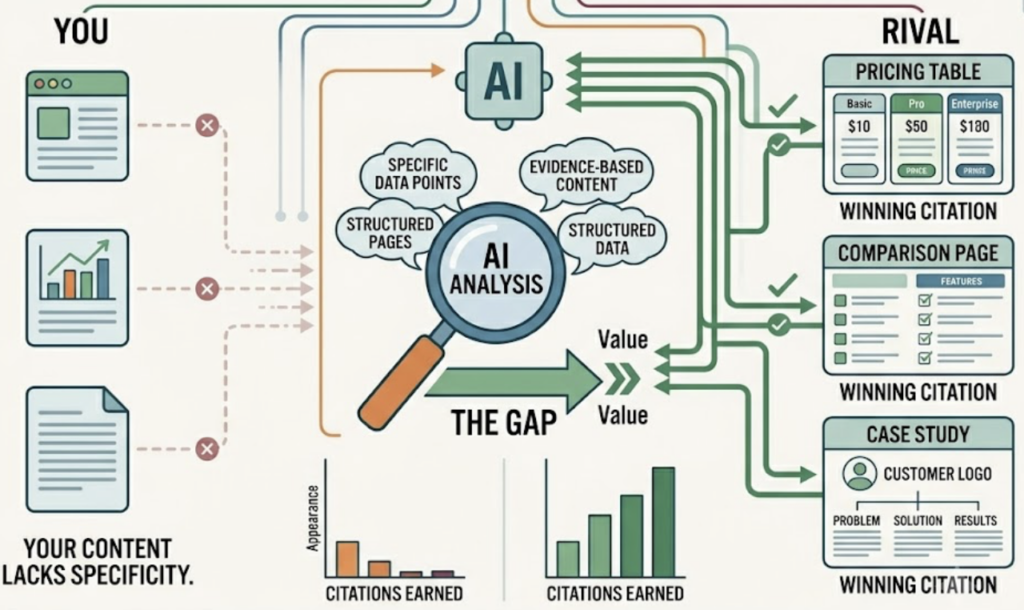
There’s also the reporting angle, which enterprise teams tend to underrate until a QBR lands. Topify works as a central system of record for GEO, so visibility trends get reported with the same rigor as traditional SEO metrics. Stakeholders get a number they trust, tracked the same way every month.
For a team formalizing its first AI brand monitoring strategy, the value isn’t any single feature. It’s that monitoring, competitive analysis, and execution sit in one system instead of three disconnected ones. You can get started and run a baseline scan before committing to a full rollout.
Knowing Whether the Strategy Is Working
A strategy without a review rhythm drifts. The fix is a cadence, not a one-time setup.
Start by curating a golden prompt set, ideally 200 or more queries that map the buyer’s journey from research to purchase. Run a cross-platform baseline to find your zero-mention gaps, the prompts where you simply don’t exist yet. Those gaps are your roadmap.
From there the signals to watch are plain: visibility rate climbing, position moving up, sentiment improving, and citation frequency rising on the sources that matter. Review the general strategy monthly. For mission-critical prompts, check weekly, since model updates can reshuffle answers with no warning.
Conclusion
The brand manager who opens ChatGPT once a week isn’t wrong to look. They’re just looking at one frame of a film that never stops running. A single check can’t capture an answer that changes by location, by session, and by model update.
An AI brand monitoring strategy is the move from that single frame to the full reel: a defined prompt set, a fixed metric framework, broad platform coverage, and a way to act on what you find. Start with a baseline scan, pick the metrics you’ll report on, and build the review cadence before anything else. The brands that show up in AI answers next year are the ones treating this as a system today, not a search.
FAQ
Q1: What were the recent Answer Engine Optimization milestones in 2025?
In 2025, Answer Engine Optimization moved away from keyword stuffing toward entity authority. LLMs began favoring brands with consistent, structured, and verifiable data patterns across the web, rewarding clear entity signals over raw keyword density.
Q2: How do enterprise marketers review Answer Engine Optimization approaches?
Enterprise marketers now fold Answer Engine Optimization into broader brand governance, putting AI visibility metrics into quarterly business reviews next to traditional SEO. Reviews tend to focus on visibility rate, share of voice, and citation trends rather than one-off mentions.
Q3: How often should an AI brand monitoring strategy be updated?
Monthly for the general strategy, weekly for mission-critical prompt sets. The faster cadence accounts for model updates, which can reshuffle answers between checks.
Q4: Do I need a separate AI brand monitoring platform, or can existing SEO tools handle it?
Traditional SEO tools are built for static search results on Google and Bing. They can’t simulate how an LLM synthesizes an answer, so a purpose-built AI brand monitoring platform is needed for accurate tracking.

