

Search “AI mention tracking system” and you’ll find a dozen products that all promise the same thing: they’ll tell you when your brand shows up in AI answers. Look closer and they diverge fast. Some only watch ChatGPT. Some report raw mention counts with no context. And the citation patterns they’re tracking shift every few weeks, so last month’s report is already half-stale. The hard part isn’t finding a tracker. It’s figuring out which one measures what actually moves your brand’s standing in AI search, across every engine your buyers are using.
What an AI Mention Tracking System Actually Does
An AI mention tracking system does more than scan the web for your brand name. It periodically queries AI engines with the same high-intent questions your customers ask, then records whether your brand shows up, how it’s described, and which sources the model leaned on to build its answer.
That method has a name: synthetic prompting. Instead of scraping public APIs the way legacy social listening tools do, the system runs category-specific prompts against ChatGPT, Perplexity, Gemini, and Google AI Overviews, then logs three things. Presence frequency, or how often you’re mentioned. Narrative framing, or whether the AI casts you as a leader, a challenger, or a budget option. And citation authority, or whether the model treats your domain as a primary source.
Here’s why that matters now. With over 64% of informational queries ending in zero-click interactions, page rankings and organic traffic no longer tell you whether your brand is winning the moment a buyer asks an AI for a recommendation. A page ranking first in Google can be ignored by an LLM, while a lower-ranked but well-structured page gets cited as the authority.
That’s the gap most dashboards still can’t see.
Why a Single-Platform AI Mention Tracking Tool Falls Short
Most teams start with a single-platform AI mention tracking tool, usually one that watches ChatGPT and nothing else. It feels like enough until you realize each engine builds answers differently.
Different models use different retrieval-augmented generation patterns. Your brand might dominate Google AI Overviews and stay completely absent from Perplexity, because the two pull from different source pools and weight authority differently. You can’t extrapolate one platform’s results to another. A strong ChatGPT presence tells you almost nothing about how you’re doing in Perplexity.
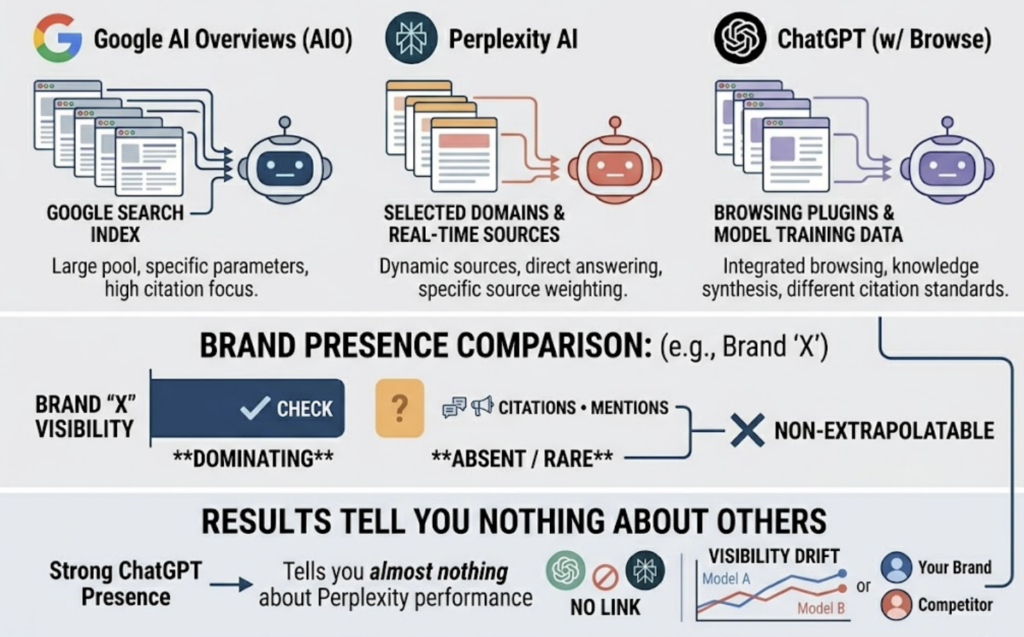
Single-platform tools share two other blind spots. They report that you were mentioned without explaining why the AI picked the sources it did. And they rarely connect mention data to anything downstream, so you’re left with a vanity count instead of a signal you can act on.
Knowing an AI cited a competitor because of a third-party review site, not a better product page, is the kind of context that actually changes what you do next.
AI Mention Tracking Software vs a Real Tracking Platform
The words get used interchangeably, but there’s a practical difference between AI mention tracking software and a full tracking platform. Software tends to do one job well: detect and count mentions. A platform integrates that detection with attribution, competitor benchmarking, and a path to action.
The split looks like this in practice.
| Dimension | Single-point software | Full tracking platform |
|---|---|---|
| Platform coverage | One engine, usually ChatGPT | ChatGPT, Perplexity, Gemini, AI Overviews |
| Attribution | Mention count only | Shows why a source was cited |
| Competitor view | None or manual | Automated benchmarking against rivals |
| Business correlation | Vanity counts | Ties visibility to branded search and assisted conversions |
| Workflow | Export and DIY | Connects to content and SEO actions |
The trade-off is real. Point software is cheaper and faster to set up. A platform costs more but answers the question that point tools can’t: not just whether your mentions changed, but what to fix when they drop.
What to Look for in an AI Mention Tracking Solution
If you’re evaluating an AI mention tracking solution for 2026, five criteria separate the useful from the merely busy. Each one maps to a question you can ask a vendor in a demo.
| Criterion | What to ask |
|---|---|
| Model breadth | Do you track Google AI Overviews, ChatGPT, Perplexity, and Claude natively? |
| Source attribution | Can you show why the AI selected a given source, not just that it did? |
| Comparative intelligence | Do you benchmark my brand against my top three to five competitors automatically? |
| Sentiment and accuracy | Will you alert me to hallucinated claims or a negative shift in how I’m described? |
| Actionable workflow | Does the data connect to my content planning or SEO process? |
Model breadth is the one teams underweight most. The whole point of a system, as opposed to a tool, is that it watches every engine your audience uses, not the one that was easiest to integrate. If a vendor covers a single platform, you’re buying back the blind spot you were trying to close.
Source attribution is the second filter. A mention count tells you the score. Attribution tells you how the game is being played, which is the only thing that helps you change the outcome.
The AI Mention Tracking Dashboard and Analytics That Matter
A crowded AI mention tracking dashboard can hide more than it shows. The job of good AI mention tracking analytics is to answer “why did this change,” not just “how much did it change.” A few metrics carry most of that weight, and they line up with the AI visibility metrics practitioners now treat as core.
Citation Share is the first. It’s your percentage of the sources an AI cites in your category, measured against the competitive set. It reframes visibility as a contest for the evidence pool, not a raw tally.
Position Index measures prominence. Being named first in an answer carries more weight than appearing as a footnote, and a dashboard that flattens both into “1 mention” is lying to you by omission.
Then there’s Drift, or volatility. AI descriptions of your brand change as models retrain and content refreshes, and tracking how often that framing shifts tells you whether your narrative is stable or quietly eroding. Entity Salience rounds it out: the degree to which an AI links your brand to your core category terms, which is the closest thing to topical authority in the generative era.
Vanity dashboards stop at mention counts. The analytics that matter explain the movement.
Bringing Mention Tracking Together with Topify
For teams that want all of this in one view rather than stitched across five tabs, Topify is built around exactly the layers above. Its Visibility Tracking watches how often your brand surfaces across ChatGPT, Gemini, Perplexity, and other engines, so you’re measuring mentions where your buyers actually search rather than on a single platform.
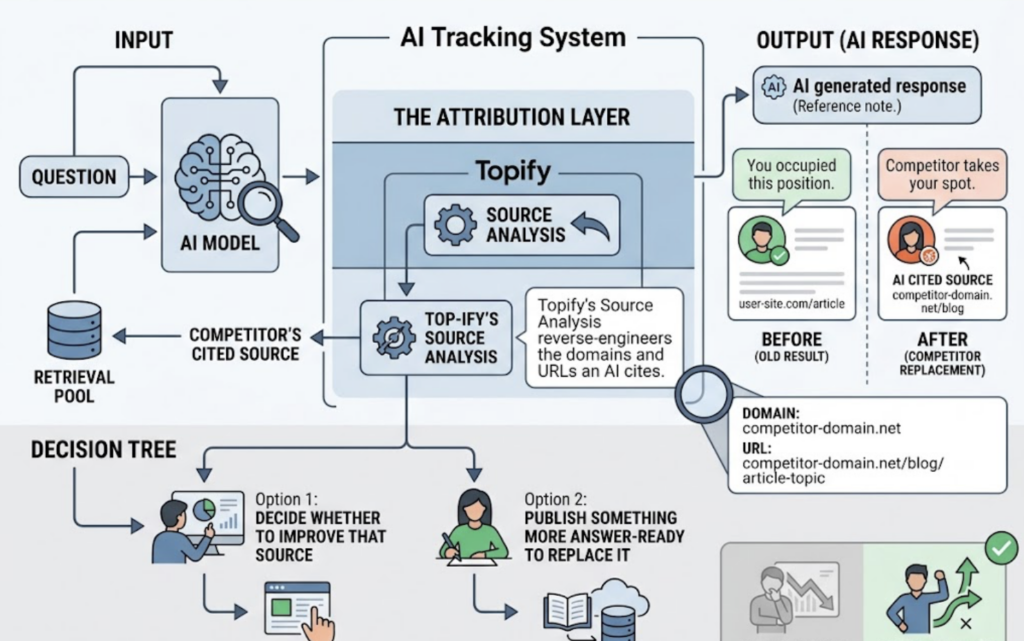
The attribution layer is where a tracking system earns its keep. Topify’s Source Analysis reverse-engineers the domains and URLs an AI cites, so when a competitor takes your spot you can see the exact reference behind it and decide whether to improve that source or publish something more answer-ready to replace it in the retrieval pool. That’s the difference between knowing you slipped and knowing what to do about it.
Competitor Monitoring handles the benchmarking criterion automatically, tracking your Citation Share and Position against rivals and flagging new challengers as they emerge. Sentiment scoring catches narrative drift before it hardens, and CVR estimates how likely an AI answer is to push a reader toward a brand interaction, which connects visibility to something closer to revenue than a mention count ever could.
You can start tracking across platforms and see where your brand stands within a few minutes. Plans begin at $99 per month, so you can validate the data before committing to a wider rollout.
Conclusion
The question was never whether to track AI mentions. It’s which system gives you signal instead of noise. Start with the five criteria: model breadth, source attribution, competitor benchmarking, sentiment alerting, and a workflow you’ll actually use. Then weight coverage heavily, because a tracker that only watches one engine reproduces the blind spot you’re paying to remove. Pick the system that explains why your mentions move, not just that they did, and you’ll spend your time fixing the source instead of refreshing a dashboard.
FAQ
Q: What’s the best Perplexity mention tracker? A: The strongest option is one that tracks Perplexity alongside ChatGPT, Gemini, and AI Overviews in the same view, because Perplexity uses its own retrieval pattern and your results there won’t match other engines. Look for source attribution specifically, since Perplexity surfaces citations openly and a good tracker should tell you which domains it pulled from.
Q: What’s the best ChatGPT mentions tool? A: A ChatGPT mentions tool is most useful when it pairs presence tracking with framing and citation data, so you learn not just that you were named but how you were described and why. A standalone ChatGPT-only tool leaves you blind to the other engines your buyers use, so a multi-platform system is generally the safer pick.
Q: How is AI mention tracking different from traditional brand monitoring? A: Traditional brand monitoring scans published content and social posts for your name. AI mention tracking uses synthetic prompting to query AI engines directly, measuring how you appear inside generated answers. The first watches what people say. The second watches what the AI says, which is increasingly what buyers see first.
Q: Does an AI mention tracking system update in real time? A: Most systems run on a scheduled cadence rather than true real time, since synthetic prompting means actively querying engines on an interval. Weekly prompt audits are a common rhythm, often enough to catch competitive shifts while keeping query costs reasonable. The right interval depends on how fast your category’s AI narratives change.

