

Your boss asks a simple question in Monday standup: “Are we showing up when people ask ChatGPT about our category?” You’ve got Google rankings, a traffic dashboard, and a content calendar. None of them answer her. That blank space is the actual problem. Search has quietly moved from a list of blue links to a synthesized answer, and most teams have no way to see what that answer says about them, whether it cites them, or whether it recommends a competitor instead.
So before you can fix your position in AI search, you need to see it. That’s what AI mention tracking is for.
What AI Mention Tracking Actually Measures
AI mention tracking is the practice of monitoring how your brand, product, or service gets referenced, cited, or recommended inside the answers that large language models generate. It’s not social listening. Social listening scrapes public feeds. AI mention tracking interrogates the synthesized output of a model that never shows its work.
The reason teams get confused early is that “mention” isn’t one thing. It’s three.
A brand mention is a raw textual reference to your name, with or without a link. It builds recall and tells the model your brand is a real entity in the category. A summarization presence is when your brand gets woven into the narrative of the answer itself, which signals topical authority. A citation is an explicit link the AI provides back to your domain, which is the strongest signal of all because it treats your content as a verifiable source.
Tracking only one of these gives you a distorted view. A brand mentioned often but never cited has recall without authority. A brand cited often but described inaccurately has authority working against it.
How AI Mention Tracking Works Behind the Scenes
Generative engines don’t pull up a ranked page the way classic search does. They run Retrieval-Augmented Generation, or RAG. The system retrieves snippets from a large indexed corpus, filters them using signals like site authority, content structure, and recency, then rewrites the result into a single direct answer.
That mechanism is why keyword rank tracking falls apart here. AI responses are variable, shifting with session context, location, and how the prompt is phrased. They’re also synthetic. The model doesn’t rank your page in isolation, it extracts and recombines fragments from many sources.
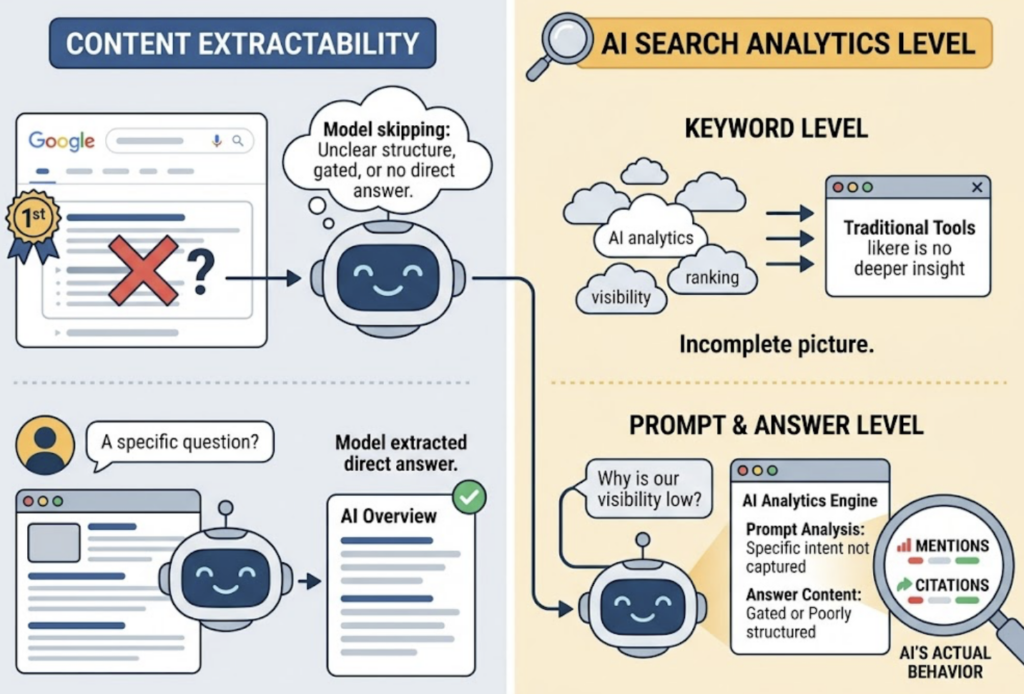
The practical consequence is blunt. If your content isn’t extractable, because it’s poorly structured, gated, or never directly answers a specific question, the model will skip it even when you rank first on Google. Good AI search analytics work at the prompt and answer level, not the keyword level, because that’s the only layer where the model’s actual behavior shows up.
Why AI Mention Tracking Matters More Than Your Google Rank
Around 64% of informational queries now end without a click. The answer is the destination. When the AI summarizes your category and your brand isn’t in that summary, you don’t lose a ranking position, you lose the entire impression before the user ever reaches a search results page.
This is the gap that breaks legacy reporting. Domain authority, keyword positions, and organic sessions all measure a world where users click through to read. AI search visibility measures a world where they often don’t. A brand can hold the number one organic spot for a term and still be invisible in the AI answer that now sits above it.
Page rank tells you where you stand in a list. It says nothing about whether the AI knows you exist.
How to Measure AI Mention Tracking the Right Way
Measuring this well means moving past a single vanity number. “We got mentioned 12 times” is meaningless without context: out of how many relevant prompts, on which platforms, framed how, and against whom. A useful measurement framework tracks a handful of metrics together.
| Metric | What It Measures | Why It Matters |
|---|---|---|
| Share of Voice | Percentage of category-relevant AI answers that mention your brand | Relative mindshare against competitors |
| Citation Inclusion Rate | How often your domain is cited as a source | Technical and content authority |
| Sentiment Framing | The descriptive tone the AI uses about you | Catches narrative drift and brand damage |
| Position Index | Where you appear in the answer, first mention versus footnote | Drives user trust and prominence |
| Hallucination Rate | How often the AI states wrong facts about you | Brand integrity and risk |
Here’s a concrete example of what this looks like in practice. You run the prompt “best project management tool for remote teams” across three engines daily for 30 days. Your share of voice is 18% on Perplexity but 3% on ChatGPT, your sentiment is positive everywhere except one engine that still lists a discontinued pricing tier, and a competitor holds the first-mention position in 70% of answers. That single view tells you exactly where to act, which is what good AI search intelligence should deliver.
The Mistakes That Make Mention Data Useless
Most teams stumble because they apply old SEO instincts to a new system. Four mistakes show up again and again.
The first is platform monoculture. Tracking only Google AI Overviews while ignoring ChatGPT and Perplexity hides most of your exposure, since each engine uses a different retrieval mechanism and cites different sources. The second is the keyword trap, fixating on search volume instead of how customers actually ask. People type conversational prompts like “what’s a good X for a small team,” and if you aren’t tracking prompt-level behavior, your data describes a search world that no longer exists.
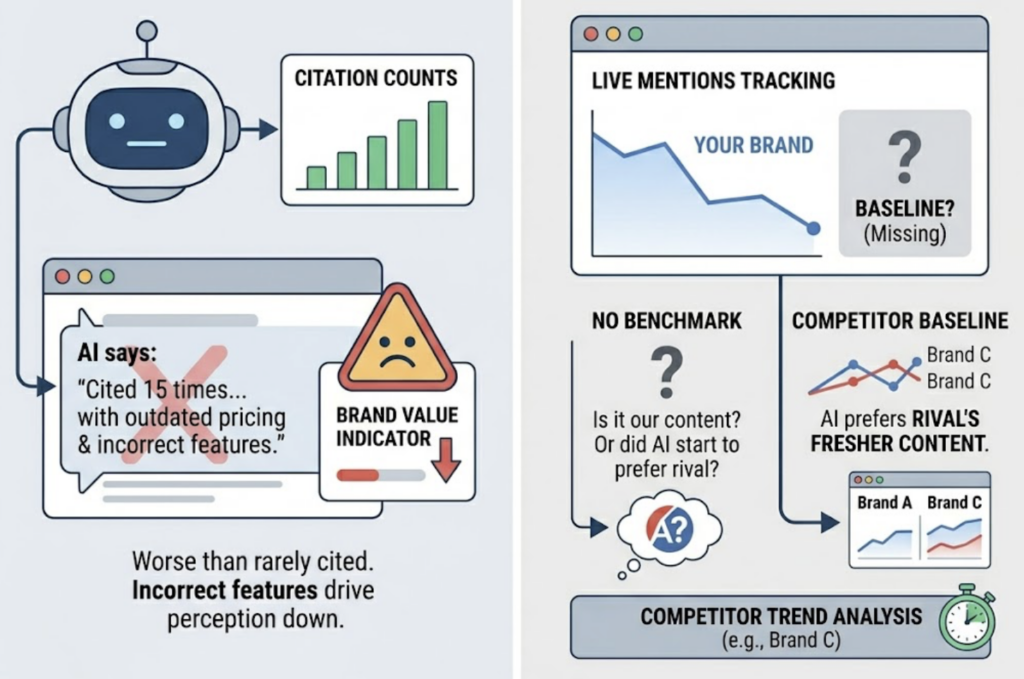
The third is neglecting sentiment. Teams obsess over citation counts while ignoring what the AI says. A brand cited often with outdated pricing or wrong features is in worse shape than one rarely cited at all. The fourth is skipping a competitor baseline. If your mentions drop and you have no benchmark, you can’t tell whether something broke on your end or the AI simply started preferring a rival’s fresher content.
Counting mentions without context isn’t measurement. It’s noise with a number attached.
Turning Mention Data Into a Visibility Strategy
Tracking is a diagnostic, not the cure. The point is to feed what you find back into a strategy that changes the AI’s answer next month. A workable Generative Engine Optimization loop has four moves.
Start with prompt-level mapping, a curated set of 20 to 40 high-intent prompts spanning informational, comparative, and instructional questions, run consistently so you see trends rather than snapshots. Then work on structural optimization for extractability, using clear headings, direct question-and-answer formats, and schema so models can ingest your content. Build third-party authority next, since AI engines weigh reviews, industry coverage, and community discussion heavily, often more than on-page tweaks. Finally, treat inaccurate descriptions like a PR issue and publish authoritative content that directly overwrites the claim the AI keeps repeating.
Running this loop by hand across three or four engines, dozens of prompts, and a rotating set of competitors gets unmanageable fast. This is where a dedicated AI visibility platform earns its place. Topify is built for exactly this workflow: its Visibility Tracking watches how often your brand surfaces across ChatGPT, Gemini, Perplexity, and AI Overviews, Source Analysis reverse-engineers which domains the engines cite so you can see who’s being read instead of you, and Competitor Monitoring keeps a live baseline so a drop in mentions reads as signal, not mystery. In practice that means you can spot a fall in ChatGPT mentions, trace it to a third-party page that stopped citing you, and know what to fix, all in one view. For AI SEO and broader AI search optimization, having mention data, sentiment, and citation sources in a single dashboard is what turns reporting into action.
Your AI Mention Tracking Checklist
If you’re starting from zero, keep the first pass simple and run these five steps in order.
- Audit. Write down the top 20 questions your customers ask during their research phase, in their words, not your keywords.
- Baseline. Run those prompts across ChatGPT, Perplexity, and Google AI Overviews and record who gets mentioned and cited.
- Analyze. Identify which sources the AI cites instead of you, and where competitors hold the first-mention spot.
- Optimize. Update your content, or the third-party source being cited, to be more concise, factual, and answer-shaped.
- Monitor. Set a recheck cadence and watch how the AI’s description of your brand shifts as your content changes.
You can run a rough version of steps two and three manually before committing to any tool. A set of free GEO toolscovers the basic audit, and when you’re ready to track continuously rather than spot-check, you can get started with Topifyon a single project.
Conclusion
The question your boss asked, whether you show up in AI answers, isn’t going away, and Google rank won’t answer it. AI mention tracking gives you the visibility layer that legacy SEO metrics were never built to capture: who the AI mentions, who it cites, and how it frames you against competitors. Start with 20 real customer prompts and a baseline across three engines. Once you can see the answer the AI is giving, you can start changing it.
FAQ
Q: What are the best tools for AI mention tracking?
A: The strongest options track multiple engines at once, measure share of voice and citations rather than raw mention counts, include sentiment, and maintain a competitor baseline. Single-platform trackers and keyword-volume tools tend to miss most of your real exposure. Look for a platform that covers ChatGPT, Perplexity, Gemini, and AI Overviews together.
Q: How can I improve my AI mention tracking results?
A: Improve the inputs, not just the dashboard. Map 20 to 40 high-intent prompts, make your content extractable with clear Q&A structure and schema, build third-party authority through reviews and industry coverage, and publish content that directly corrects any inaccurate claims the AI keeps repeating about you.
Q: What does AI mention tracking pricing usually look like?
A: Pricing typically scales with how many prompts, projects, and AI platforms you monitor, plus how often you refresh the data. Entry plans tend to start around the cost of a standard SEO tool, with higher tiers adding more prompts, seats, and content credits. You can compare tiers on the Topify pricing page.
Q: Can you give an example of AI mention tracking in action?
A: Say you track “best CRM for small teams” daily across three engines for a month. You learn your share of voice is 20% on Perplexity but 4% on ChatGPT, one engine still cites a competitor’s outdated comparison page, and you hold a first mention in only 1 of 10 answers. That tells you precisely which engine and which source to target next.

