

You typed your category into ChatGPT last week, watched it recommend five vendors, and noticed your brand wasn’t one of them. So you checked again the next day, and the answer had shifted. Now you’re not sure if that first result was a fluke or a pattern, and you have no way to tell. A single check is a snapshot, and snapshots lie. What B2B teams need isn’t another manual look. It’s a repeatable AI mention tracking strategy that shows what AI says about them, week after week.
Why AI Brand Mentions Need a Strategy, Not Just a Spot Check
The gap is wider than most teams realize. Research puts B2B AI adoption at 73% of buyers now using tools like ChatGPT and Perplexity during research and procurement, while only 22% of marketing teams track AI visibility at all.
That’s a 51-point gap between where buyers are looking and where brands are watching.
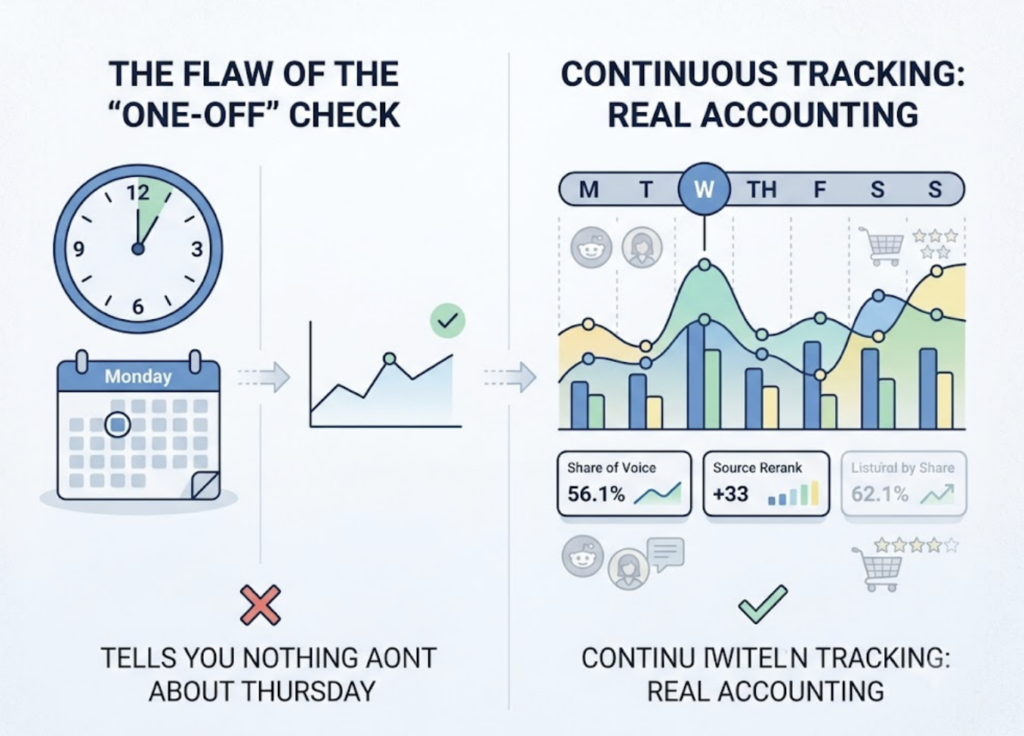
A one-off check can’t close it. AI brand mentions move constantly as models re-rank their sources, so the answer you saw on Monday tells you nothing about Thursday. Treating mention tracking as an occasional habit is like checking your bank balance once a quarter and calling it accounting.
The cost of staying blind isn’t abstract. AI-referred traffic has been measured converting at up to 5.1x the rate of traditional organic, which means the channel you’re not tracking is often the one closing deals.
What “Track Brand Mentions in AI” Actually Means to Measure
Before you track anything, you need to know what counts. A mention in an AI answer isn’t a backlink. It’s a recommendation signal, and it has more than one dimension.
Four metrics matter most when you track brand mentions in AI:
- Mention Inclusion Rate: the share of high-intent prompts (like “best [category] software”) where your brand actually appears.
- Share of Citation: how much of an answer’s supporting evidence traces back to your brand’s sources.
- Cited-Source Diversity: the number of independent domains (G2, analyst sites, Reddit, reputable media) that validate you.
- Competitor Displacement Rate: how often you replace a rival in comparison-style answers over time.
Here’s the part that trips up SEO teams: ranking and mention are barely related. Ahrefs research found roughly 80% of AI citations don’t rank in the Google top 10 for the same query, and the correlation between Google position and AI visibility sits near zero, around 0.034. Your domain authority can be excellent while your mention rate is flat.
Google rewards single-source authority. AI models reward entity consistency and topical breadth. Those are different games, and you can’t measure the second one with the scoreboard from the first.
Step 1: Map the Prompts Where Your Brand Should Appear
You can’t track mentions without first defining where mentions should happen. That starts with a prompt set, often called a golden set, that mirrors how a buyer actually moves through a decision.
A working set covers three query types:
- Problem queries: “How do I solve [X] without [Y]?”
- Comparison queries: “[Competitor] vs. your brand”
- Category queries: “Best software for [industry use case]”
The point is coverage, not volume. Thirty prompts that map cleanly to your buyer’s journey beat three hundred random ones. Once that set exists, every mention you measure has context: you know which buying moment it belongs to.
Step 2: Track Brand Mentions Across ChatGPT, Perplexity, and AI Overviews
Single-platform tracking is the most common blind spot. AI search isn’t one channel, and the engines disagree with each other more than people expect.
Researchers at the University of St. Gallen found that cited-source overlap between consecutive days runs only 34% to 42% across AI engines. BrightEdge’s work on “sourcing personalities” adds the why: Gemini leans conservative and institutional, favoring .gov and .edu domains. Perplexity weights community sources like Reddit and forums heavily. ChatGPT leans on established commercial listings and review platforms.
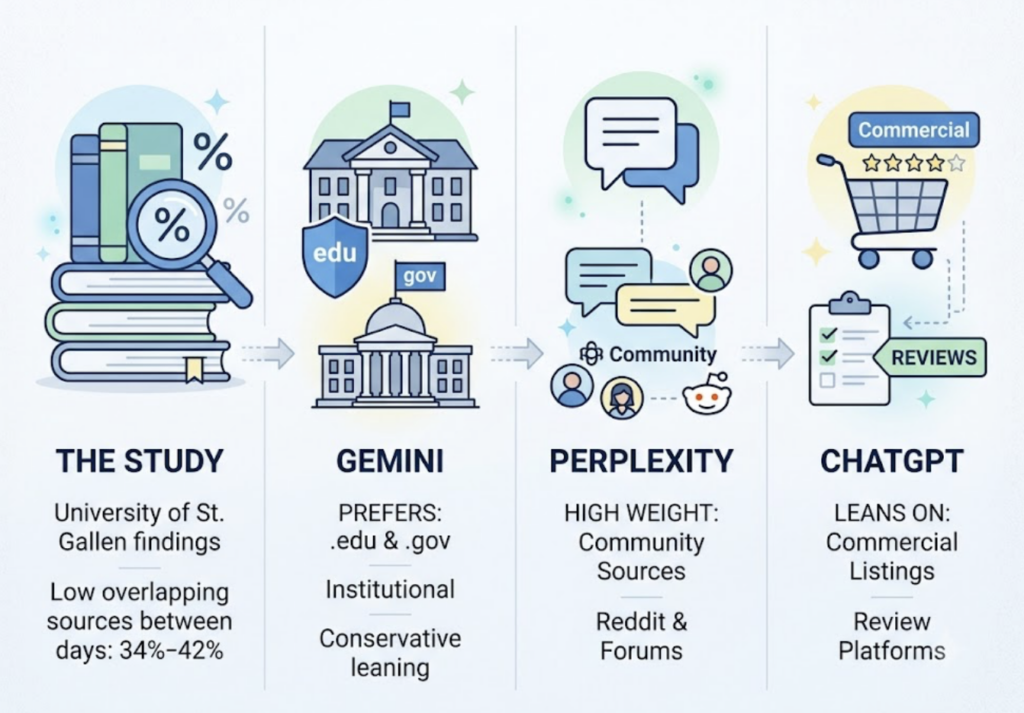
The practical takeaway is blunt. You can dominate ChatGPT and be invisible on Perplexity, and a tool that only watches one engine will never tell you.
This is where a cross-platform monitor earns its place. Topify tracks brand mentions across ChatGPT, Gemini, Perplexity, Google AI Overviews, and others in a single view, so the question shifts from “did I get mentioned” to “where, how often, and against whom.” For teams searching for the best tool to track brand mentions on ChatGPT, the more useful frame is software that tracks mentions in AI responses everywhere your buyers ask, not just the one engine you happened to check first.
If you want to start narrow, how to track AI search visibility and rankings in ChatGPT walks through a single-engine setup before you scale to the full stack.
Step 3: Turn Mention Data Into Predictive Alerts and Benchmarks
Data you don’t act on is just a prettier spot check. A real strategy closes the loop: when something moves, someone gets told.
Competitive B2B categories show 15% to 30% weekly citation fluctuation, which is too fast for a human to catch by hand. That’s the case for automated, continuous monitoring rather than calendar reminders.
The alert layer is what separates monitoring from strategy.
When your brand drops out of a high-intent comparison query, the system should flag it the same week, while you can still respond by refreshing third-party documentation, updating a comparison page, or seeding new reviews. Topify’s AI agent handles the monitoring and surfaces what changed, then proposes the strategy to fix it, which is closer to what teams want from predictive AI alerts than a static dashboard that only reports yesterday’s numbers. Pair that with competitor benchmarking and you can watch your Competitor Displacement Rate move in real time instead of reconstructing it after the quarter ends.
Choosing Software to Track Brand Mentions in AI Search
Once the strategy is set, the tooling decision gets simpler, because you already know what you need it to do. The mistake B2B teams make is buying on dashboard polish instead of on whether the tool covers the four metrics across multiple engines.
Here’s a practical requirements checklist for tools for tracking brand mentions in AI answers:
| Requirement | Why it matters | Topify |
|---|---|---|
| Multi-platform coverage | Engines disagree 58-66% of the time | ChatGPT, Gemini, Perplexity, AI Overviews, DeepSeek, and more |
| Sentiment tracking | “Enterprise-grade” vs “budget option” changes buying | Sentiment scoring across answers |
| Competitor share of voice | Displacement is the real KPI | Dynamic competitor benchmarking |
| Predictive alerts | 15-30% weekly drift outpaces manual checks | AI agent monitors and flags changes |
| Prompt-level tracking | Mentions need buyer-journey context | High-value prompt discovery |
For most teams evaluating software to track brand mentions in AI search, B2B fit comes down to two things: does it watch every engine your buyers use, and does it tell you what to do when a number moves. Topify’s plans start at $99/mo for ChatGPT, Perplexity, and AI Overviews tracking with 100 prompts, which is enough to run a full golden set without an enterprise contract. You can get started and have a baseline mention rate within a few minutes.
Conclusion
That shifting ChatGPT answer from the intro wasn’t a glitch. It’s the normal behavior of a channel that 73% of your buyers already use and most of your competitors aren’t watching. A mention tracking strategy turns that volatility from a source of anxiety into a measurable signal. Define your golden set of prompts, track the four metrics across every engine, and wire up alerts so a drop becomes an action instead of a surprise. Start with a baseline this week. The brands that show up in AI answers next quarter are the ones measuring it this one.
FAQ
Q: How do I track brand mentions in ChatGPT specifically?
A: Build a set of high-intent prompts in your category, run them against ChatGPT on a regular cadence, and log whether your brand appears, in what position, and with what sentiment. Manual checks work for a handful of prompts, but most teams move to automated software to track brand mentions in AI responses once the prompt set grows past a dozen.
Q: Do brand mentions really differ across AI platforms?
A: Yes, and more than most expect. Daily cited-source overlap between engines runs only 34% to 42%, and each platform favors different source types. A brand strong on ChatGPT can be missing from Perplexity, which is why cross-platform tracking is the baseline, not an upgrade.
Q: How often should I re-check AI mention data?
A: Weekly at minimum for competitive B2B categories, where citation patterns shift 15% to 30% week over week. Daily continuous monitoring is better if the category moves fast. One-off checks are statistically close to meaningless.
Q: Do I need B2B-specific software to track brand mentions in AI search?
A: You need software that covers the engines your buyers use, scores sentiment, tracks competitor share of voice, and sends predictive alerts. B2B fit is less about a separate product category and more about prompt-level tracking that maps to a real buying journey, which general-purpose tools and predictive AI alerts brand mentions providers handle to very different degrees.

