

Search “AI mention tracking service” and you’ll get a dozen platforms that all promise the same thing: they’ll tell you when ChatGPT or Perplexity talks about your brand. Sign up for two of them, run the same set of prompts, and the numbers won’t match. One counts a mention only when your exact brand name shows up. Another counts it when the AI describes your product without naming you at all.
For a single brand, that’s just confusing. For an agency comparing presence across five client accounts, it makes the data almost impossible to trust.
Why “Mention Tracking” Means Something Different at Every Service
There’s no shared definition of what an “AI mention” actually is. That sounds like a technicality. It’s the single biggest reason two services report wildly different visibility for the same brand.
The first split is exact match versus semantic mapping. Exact-match tracking is keyword-based: it only registers a hit when your literal brand name appears. That misses a lot. AI answers often recommend a product by category, paraphrase the name, or imply an entity without spelling it out, which produces a high rate of false negatives.
Semantic mapping uses LLM-based parsing to read intent and context. It catches the moment an AI recommends you even when the phrasing shifts. The gap between the two approaches isn’t cosmetic. It’s the difference between thinking you’re invisible and knowing you’re being recommended under a description you never tracked.
The second split is engine-specific logic. Search-grounded engines like Perplexity and Google AI Overviews lean on citations, so a service has to separate a “mention” in the answer text from a “cited source” in the footer. Conversational models like ChatGPT and Claude lean on framing, so the job becomes capturing how you’re positioned: market leader, niche alternative, or a name dropped in passing.
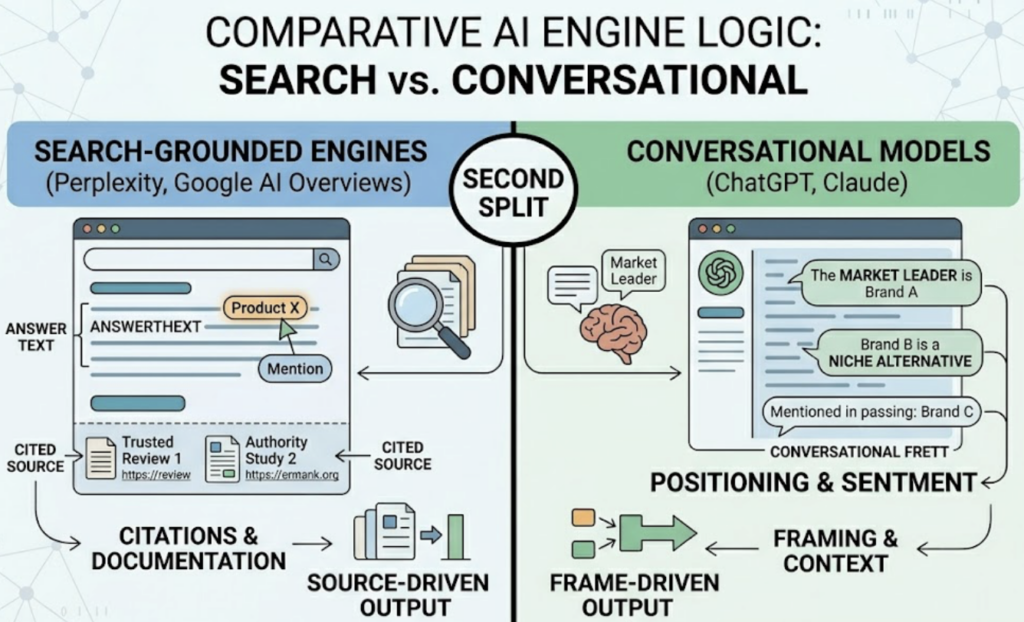
A service that treats all engines the same is averaging away the thing you most need to see.
Five Things That Separate a Real Service From a Pretty Dashboard
A dashboard hands you raw counts. A service hands you causal intelligence, the why behind the numbers. When you evaluate options, these five pillars tend to separate the two.
Engine coverage. The platform should run your prompts across ChatGPT, Gemini, Perplexity, Claude, and Google AI Overviews at the same time. Each model answers the same question with different logic, and single-engine tools hide that variance.
Prompt intent segmentation. Flat keyword lists tell you little. Prompts grouped by buyer stage (discovery, evaluation, decision) tell you where in the journey you go missing.
Competitor benchmarking. This is where brand AI search presence comparison actually lives. A visibility score means nothing without context on how often rivals surface in the same “best-of” or “vs.” queries. Side-by-side share of voice turns a lonely number into a standing.
Source attribution. Knowing you were mentioned is step one. Knowing which third-party domains (G2, industry blogs, news sites) pushed the model to recommend you is what you act on.
Multi-project management. For agencies and enterprise teams, the platform has to keep separate brands in separate knowledge footprints, with project-level tracking and no data bleed between accounts.
Miss any one of these and you’re buying a report, not a service.
Comparing the Main AI Mention Tracking Services
Most options on the market fall into two camps. The first is the basic dashboard: cheap, fast to set up, and limited to telling you whether a mention happened. The second is the holistic platform built for ongoing GEO work. The table below maps the practical difference.
| Capability | Basic Dashboards | Holistic AI Platforms |
|---|---|---|
| Tracking depth | Raw mention count, yes or no | Semantic sentiment, positioning, and framing |
| Competitor insight | Static reports | Dynamic share of voice benchmarks |
| Source analysis | None | Domain-level citation auditing |
| Actionability | Observation only | Linked to GEO-focused optimization |
| Scalability | Single brand | Multi-project and multi-seat support |
The pattern is consistent. Basic dashboards answer “did it happen.” Holistic platforms answer “why, against whom, and what to do next.” If your goal is a monthly screenshot, the first camp is fine. If your goal is moving the number, it isn’t.
How Topify Tracks Mentions Across AI Platforms
Topify sits in the second camp, and its core design choice is to treat tracking as the start of the work rather than the end of it.
The measurement runs on seven metrics instead of a single count. Visibility tracks how often you land in the top recommended slots. Sentiment reads the tone and context of each mention. Position shows how early you appear in the synthesized answer. Volume totals your occurrences across engines. Share of voice measures your presence against named competitors. Intent alignment checks whether you show up on high-value buying prompts. And a conversion-rate signal links AI-driven discovery back to downstream engagement on your site.
Seven angles on the same mention. That’s the difference between a count and a diagnosis.
For brand AI search presence comparison, the competitor monitoring layer matters most. Topify detects who AI engines recommend alongside you, tracks your position relative to them in real time, and surfaces the queries where a rival is winning the slot you want. You’re not staring at your own number in isolation. You’re seeing the leaderboard the AI is effectively running.
The source analysis layer answers the follow-up question. Topify reverse-engineers the exact domains and URLs that AI platforms cite, so you can see whether your pages or your competitor’s pages dominate the references a model trusts. That’s the bridge from “we aren’t showing up” to “here’s the content gap to fix.”
Then there’s the part agencies care about. Topify’s plans are built around projects and seats, so separate client brands stay in separate workspaces. The Basic plan covers four projects and four seats with prompt-level tracking across ChatGPT, Perplexity, and AI Overviews. The Pro plan scales to eight projects and ten seats. You can get started on a single brand and expand as the account load grows, with full plan details on the pricing page.
The piece that ties it together is one-click execution. Most tools stop at the data. Topify lets you state a goal in plain English, review the proposed GEO strategy, and deploy it, which closes the loop between spotting a visibility gap and actually fixing it.
Matching the Service to How You Actually Work
The right service depends less on feature lists and more on who’s using it.
A single in-house brand team usually needs depth over breadth. One project, strong competitor benchmarking, and clear source attribution will do more than a sprawling multi-account setup they’ll never fill.
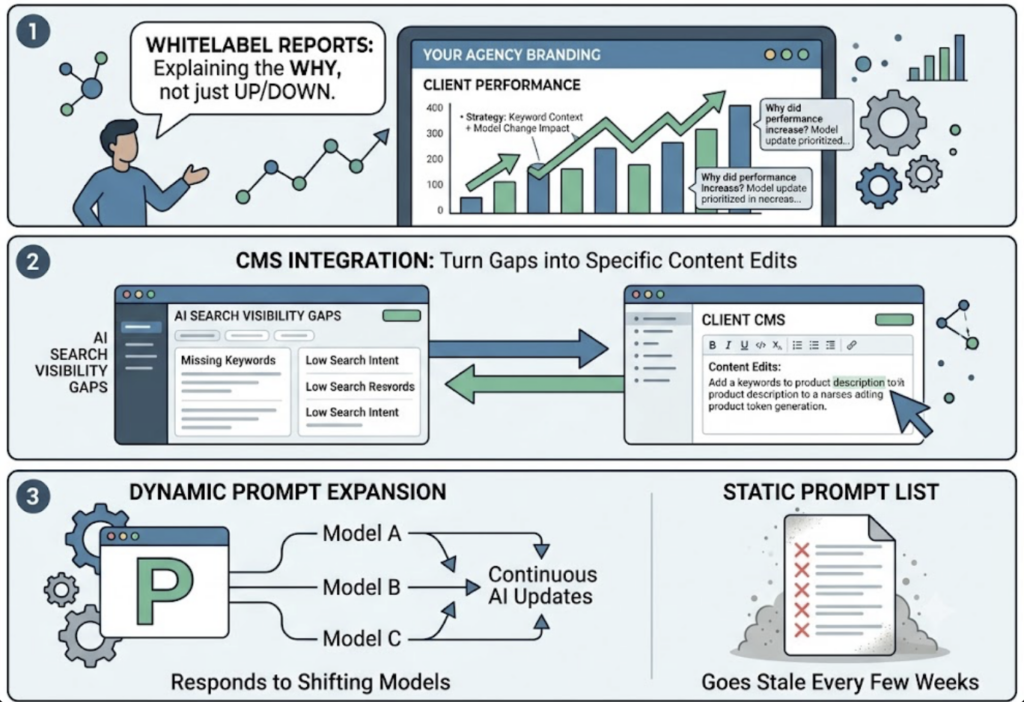
Agencies are the harder case. When you’re evaluating multi brand AI search management platforms, the deal-breakers are rarely the headline metrics. They’re the operational details: can the platform white-label reports that explain the why to a client instead of just showing an arrow going up or down? Can it integrate with the CMS so visibility gaps turn into specific content edits? Does it expand prompts dynamically as models shift, or are you stuck maintaining a static list that goes stale every few weeks?
Enterprise teams add governance on top: seat management, project isolation, and reporting that survives a handoff between people.
Here’s the throughline. The service has to fit your workflow, not the other way around. A platform that produces beautiful charts nobody can act on is a cost, not an investment.
Conclusion
The hard part of choosing an AI mention tracking service isn’t finding one. It’s seeing past the shared vocabulary to what each platform actually measures and whether it connects to action.
A practical sequence keeps you honest. Audit first: run a small set of high-intent prompts across the top engines to find where you go missing. Compare next: benchmark that visibility against your top three competitors so the number has context. Optimize last: chase source authority by getting your high-value pages cited by the domains the models already trust. Start with a free visibility check, then commit to a service once you know which gaps are real.
FAQ
What’s the difference between an AI mention tracking service and a rank tracker?
A rank tracker monitors your position on a search results page. An AI mention tracking service monitors whether and how AI answer engines reference your brand in their generated responses, which has no fixed “page” to rank on. The metrics, the queries, and the underlying logic are different.
How is brand AI search presence comparison measured?
Through share of voice. The service runs the same prompts for you and your named competitors, then reports how often each brand surfaces, in what position, and with what framing. A raw mention count without this comparison can’t tell you whether you’re winning or losing.
What should agencies look for in multi brand AI search management platforms?
Project isolation so client data never mixes, white-label reporting that explains the why rather than just the trend, seat management for team access, and dynamic prompt expansion so tracking keeps pace as AI models change. Headline metrics matter less than these workflow details.
How often should AI mention data be refreshed?
More often than traditional SEO data. AI engines shift their citation and recommendation patterns within weeks, so monthly snapshots often describe a state that no longer exists. Continuous or near-continuous tracking is the safer default.

