

Your CEO asks a simple question in the Monday standup: are we showing up when people ask ChatGPT for a recommendation in our category? So you open a few AI tools and start typing the prompts a customer might use. The first answer mentions you. The second one, same prompt, doesn’t. Run it on Perplexity and a competitor sits in the top slot instead. Twenty minutes later you’ve got a folder of screenshots that contradict each other and no way to turn them into a number anyone can report on.
That’s the gap most teams hit the moment they try to measure AI visibility by hand. AI mention tracking monitoring exists to close it, by turning scattered spot-checks into a repeatable signal you can actually defend.
What AI Mention Tracking and Monitoring Actually Means
The terms get used interchangeably, but they describe two different jobs.
AI mention tracking is the what. It’s the systematic capture of every time your brand, your product, or a competitor shows up inside an AI-generated answer, across engines and across prompts. Think of it as an inventory of your presence.
AI monitoring is the how and the why. It watches those mentions shift over time, following changes in sentiment, source attribution, and how you’re framed against rivals. Monitoring is what tells you a drop happened because a source stopped citing you, not because of random noise.
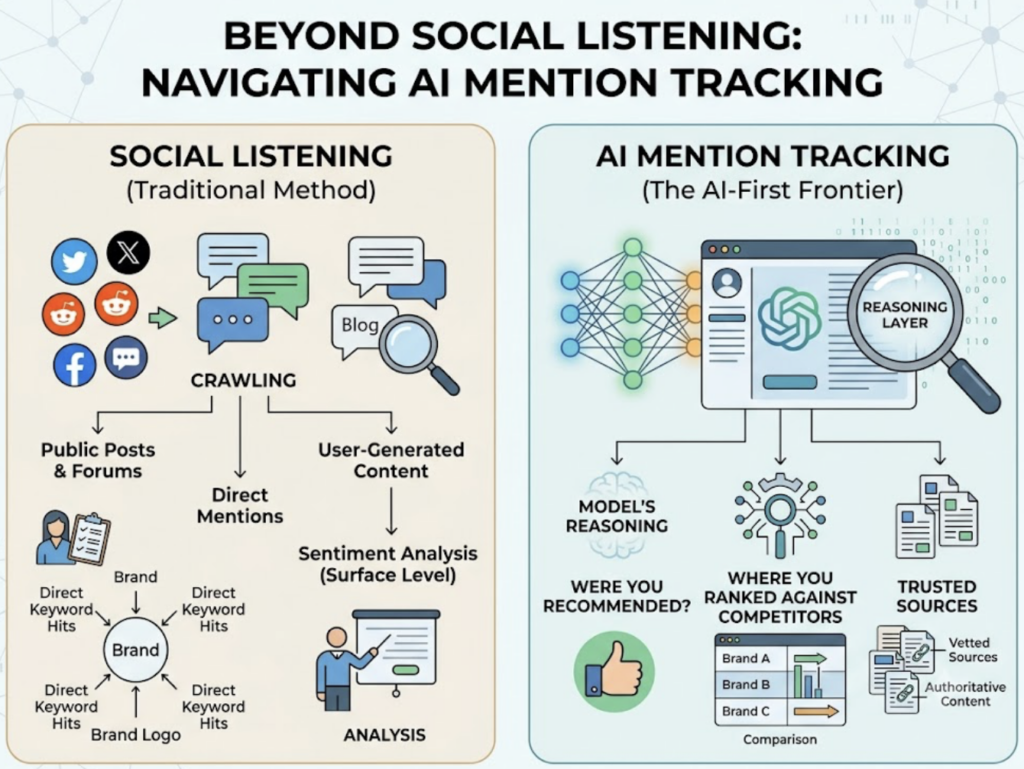
Here’s the part that trips up teams coming from social listening. Social listening crawls public posts and forums for direct mentions. AI mention tracking monitoring targets synthesized output instead. It looks inside the model’s reasoning: not just whether you were named, but whether you were recommended, where you ranked against competitors, and which sources the AI trusted to back up its answer.
Why an AI Mention Tracking Tool Beats Manual Spot-Checks
Manual checking feels rigorous. It isn’t, and the reasons are baked into how these models work.
First, the output is non-deterministic. LLMs run on controlled randomness and live retrieval, so the same prompt asked twice, even two minutes apart by the same person, can return different answers. One screenshot proves nothing.
Second, answers are context-sensitive. Models build responses from the conversation flow, and small changes in phrasing or prior history trigger different fan-out queries to external sources. Your brand can appear or vanish based on context you can’t see.
Third, the scale is unworkable by hand. With millions of query variations, human sampling captures less than 0.5% of the actual discovery journey. That’s not a sample, it’s an anecdote.
An AI mention tracking tool solves the part people can’t: consistency at volume. Good AI mention tracking software runs the same prompt sets on a schedule and applies an LLM-as-a-judge approach, measuring variance with statistical methods like the intraclass correlation coefficient instead of eyeballing a handful of results. The point isn’t more screenshots. It’s a number you can trust and repeat.
What Separates a Real AI Mention Tracking Platform from a Dashboard
A lot of products in this space are really just dashboards. They show you a count of mentions and a line going up or down.
The trouble with a counting dashboard is that it answers the easy question and skips the useful one. Knowing your mention rate fell 12% last week doesn’t help if you can’t see that it fell because a high-authority source dropped your citation, while a competitor picked up the top slot in “best X” prompts.
A real AI mention tracking platform works at the prompt level. It ties each mention to the specific intent that triggered it, attributes the sources the model cited, and tracks your position relative to competitors inside the same answer.
That’s the line between a dashboard and a platform. One reports what changed. The other explains why.
Core Capabilities Every AI Mention Tracking Solution Should Have
Before you compare vendors, lock down what the category actually requires. Any AI mention tracking solution worth paying for should cover five capabilities.
| Capability | Why it matters |
|---|---|
| Prompt-level tracking | Shows how specific personas and intents trigger your mentions, not just an aggregate count |
| Cross-engine benchmarking | Compares visibility across ChatGPT, Perplexity, Gemini, and Google AI Overviews in one view |
| Source and citation analysis | Identifies which of your web properties the AI actually trusts and cites |
| Sentiment and context | Measures whether the tone around your brand is favorable or corrective, not just present |
| Change alerting | Flags the moment your visibility drops or a competitor takes top-slot share |
A system that handles the first three but skips alerting will leave you finding out about a visibility drop a month after it cost you pipeline. Treat this as your scorecard, not a wish list.
How to Monitor Visibility in Perplexity and Other Engines
Perplexity deserves its own line in your plan. As of mid-2026 it processes hundreds of millions of monthly queries and works as an answer engine, which means it leans hard on source citations and structured, scannable content. A brand that gets cited there earns visibility a brand that’s merely mentioned doesn’t.
That citation-first behavior is also why tools to monitor visibility in perplexity have to look at more than mention frequency. You want to see which of your pages get cited, where you sit in the source list, and how that stacks up against the competitor Perplexity pulls in alongside you.
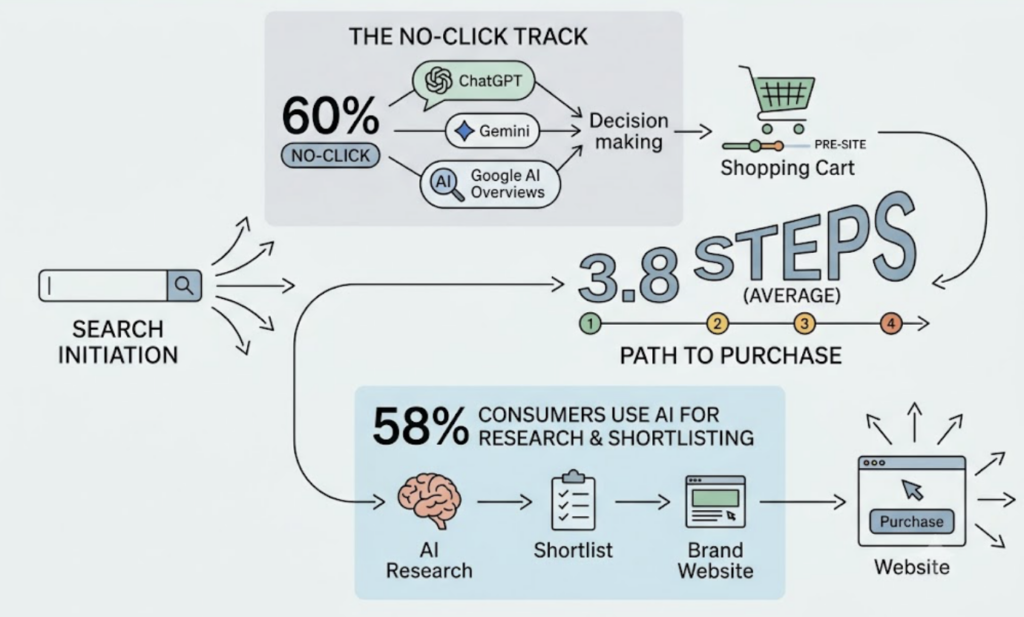
But single-engine tracking is its own trap. Roughly 60% of search interactions now resolve without a click, and that high-intent behavior is spread across ChatGPT, Gemini, and Google AI Overviews too. The path to purchase has stretched from 1.6 steps to 3.8 steps on average, with 58% of consumers using AI tools for product research and building shortlists before they ever reach your site.
Watch one engine and you’re optimizing for a fraction of the journey. Cross-engine coverage is the baseline, not a premium feature.
Turning an AI Mention Tracking System into Action
Tracking is the floor. The teams that win treat AI mention tracking monitoring as the input to a feedback loop, not the output.
That loop has three moves. Make your content retrieval-ready, so FAQs, specs, and white papers are easy for AI crawlers to parse. Build topical authority, the persistent knowledge footprint models treat as reliable source material. Then measure the GEO metrics that map to revenue: visibility share in the top-three recommended positions, citation rate back to your domain, and how you rank against competitors in compare-and-vs prompts.
This is where an integrated system earns its place over a stack of single-purpose tools. Topify is built around that loop. Instead of a standalone dashboard, it monitors brand performance across major AI platforms through seven metrics: visibility, sentiment, position, volume, mentions, intent, and CVR.
In practice, that means you can catch a dip in your ChatGPT mention rate, trace it to a source that stopped citing you, and see which competitor moved into your slot, all inside one view. Its competitor benchmarking surfaces who the engines recommend and where you sit relative to them, and its source analysis reverse-engineers the exact domains and URLs the models cite. Coverage runs across ChatGPT, Gemini, Perplexity, and other major engines, so the cross-engine baseline is handled rather than stitched together.
When you’re ready to move from spot-checks to a repeatable signal, you can get started with Topify and define your prompt sets in plain language.
Conclusion
The shift is already underway. Around 60% of searches end without a click, and the decision is forming inside the AI answer before anyone reaches your site. Measuring that by hand was never going to scale.
The teams that stay visible are the ones that treat AI mention tracking and monitoring as a standing system: consistent prompt sets, cross-engine coverage, source-level detail, and alerts when something moves. Start with the five-capability scorecard, pick a solution that explains why your numbers change rather than just counting them, and wire the output back into how you build content. That’s how you turn a folder of contradictory screenshots into a number you can stand behind.
FAQ
Q: What’s the difference between AI mention tracking and AI monitoring?
A: Tracking is the capture step, recording every time your brand or a competitor appears in an AI answer across engines and prompts. Monitoring is the ongoing layer that watches how those mentions shift over time in frequency, sentiment, and source attribution. You need both: tracking gives you the inventory, monitoring tells you why it’s changing.
Q: How do I monitor brand mentions in ChatGPT and Perplexity at the same time?
A: Use an AI mention tracking platform with cross-engine coverage rather than checking each tool separately. Run a consistent set of customer-style prompts on a schedule across both engines, then compare mention frequency, citation share, and competitor position in a single view. Perplexity needs extra attention on which of your pages get cited, since it’s citation-first by design.
Q: Why can’t I just check AI answers manually every week?
A: Because LLM output is non-deterministic and context-sensitive, so the same prompt can return different answers minutes apart. Manual sampling also captures less than 0.5% of real query variations, which makes any single check an anecdote rather than a measurement.
Q: What should an AI mention tracking dashboard show beyond a mention count?
A: A count alone tells you something moved, not why. A useful AI mention tracking dashboard adds prompt-level detail, source and citation attribution, sentiment, competitor position, and alerts when visibility drops, so you can act before the change costs you pipeline.

