

Your team watches keyword rankings every week. You know exactly where you sit on page one for your top terms. Then a buyer opens ChatGPT, types “best software for my category,” and reads a five-name shortlist before ever touching Google. Your brand isn’t on it, and nothing in your current reporting explains why. Rank trackers were built to measure links. They can’t see what a model chooses to say about you, and that gap is exactly where buying decisions now happen.
That blind spot has a fix, but it starts with measuring the right thing.
What AI Mention Tracking Is (and Why It’s Not Rank Tracking)
AI mention tracking monitors whether, how often, and in what context your brand shows up inside AI-generated answers across ChatGPT, Perplexity, Gemini, and Google’s AI Overviews. It measures brand presence inside conversational output, not link position on a results page.
That distinction matters more than it sounds. Traditional SEO rank tracking measures access: getting a user to click through to your site. AI mention tracking measures influence: whether the model names you as the answer in the first place.
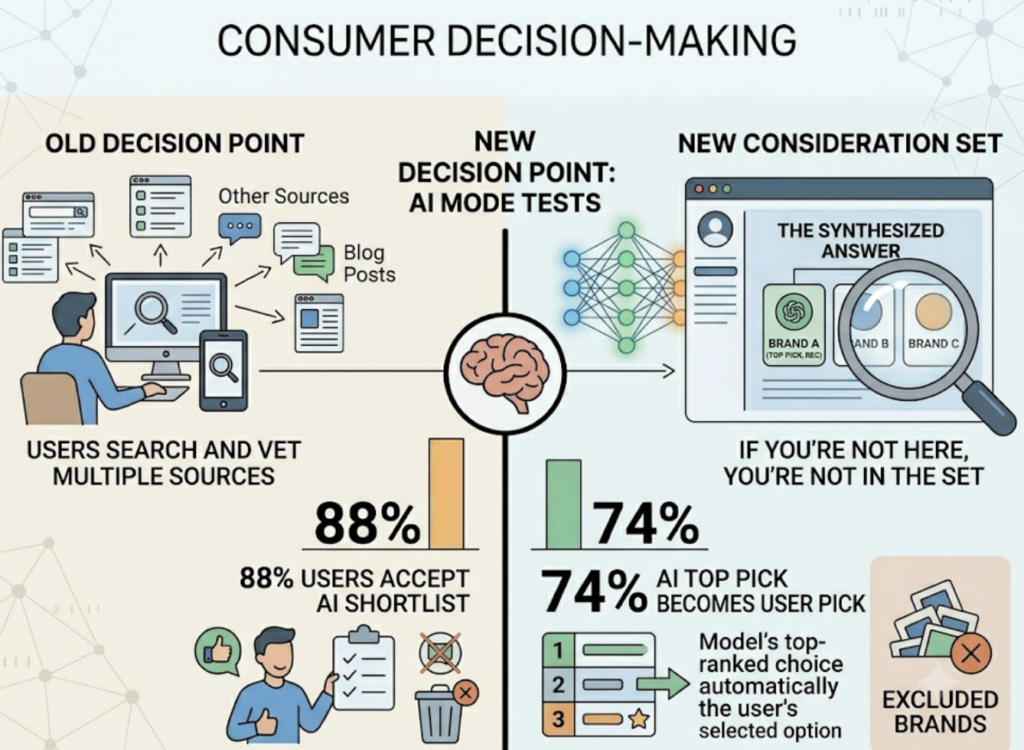
The decision point has moved. In recent AI Mode tests, 88% of users accepted the AI’s shortlist without checking other sources, and the model’s top pick became the user’s pick 74% of the time. If you’re not in that synthesized answer, you’re not in the consideration set.
This is why an AI mention tracking platform looks nothing like a rank tracker under the hood. One indexes URLs. The other parses unstructured language for brand entities, sentiment, and position.
How AI Mention Tracking Works
Instead of crawling static pages, AI mention tracking software runs through a process closer to systematic querying than indexing.
It starts with prompt clustering. High-intent queries like “best tool for X” or “alternatives to Y” get grouped into structured prompt sets that mirror how real buyers ask questions. Those prompts then run across multiple engines at once, since OpenAI, Anthropic, Google, and Perplexity each generate answers differently.
The output gets parsed for three things: is your brand mentioned, is it cited from a real source, and how is it framed. Most systems use an LLM-as-a-judge approach to score sentiment as positive, neutral, or negative.
The last step is normalization. Perplexity leans hard on explicit citations, while ChatGPT favors conversational flow, so a tracking system has to reconcile those formats into one comparable visibility metric.
Here’s the part most teams underestimate: AI answers aren’t stable. AI Overview content changes for the same queryabout 70% of the time, swapping out nearly half its citations when it does. A static keyword list checked once a month won’t catch that movement, which is why mention tracking has to run continuously.
What to Measure: The Metrics Behind AI Mention Tracking
A mention count alone is a vanity number. A useful AI mention tracking system turns raw presence into strategic signal across a handful of metrics.
Mention frequency is the raw count of AI responses that name your brand. It’s the baseline, not the whole picture.
Share of voice is how often you appear relative to named competitors in the same prompt category. This one is gaining weight fast. After an October update, ChatGPT cut its brand mentions per answer from roughly six or seven down to three or four. Fewer slots means share of voice, not raw count, decides who’s actually visible.
Contextual sentiment captures framing. Being called a “market leader” and being called a “niche option” are both mentions, but they don’t carry the same value.
Positioning tracks whether you show up in the opening summary or buried deep in citations. Citation authority tracks whether the model is pulling your name from high-trust domains or low-authority blogs.
There’s a real payoff to getting cited well. When a brand is referenced in an AI Overview, its organic click-through runs about 35% higher than when it isn’t.
Mention Frequency vs. Share of Voice
It’s easy to confuse these two. Frequency tells you how loud you are. Share of voice tells you how loud you are next to everyone else competing for the same answer.
A brand can hold steady frequency while its share of voice drops, simply because a competitor started showing up more often. Tracking both is what separates a dashboard that reports activity from one that explains your standing.
How to Improve Your AI Mention Rate
Once you can measure mentions, the next question is how to move them. Three levers do most of the work.
Source authority comes first. Models pull brand information from domains they trust, and brands are 6.5x more likely to be cited through third-party sources than through their own site. Getting featured on high-authority review platforms and industry coverage tends to move mention rates more than polishing your own pages.
Structured content is the second lever. Clear schema markup and concise, answer-shaped content make it easier for a model to extract and verify what your brand does. The third is correction cycles: catching the moments an AI describes your product wrong and fixing the underlying sources feeding that description.
This is the point where measurement and action need to live in one place. Topify approaches this by pairing visibility data with source analysis, so when your mention rate dips you can trace it to the specific domains that stopped citing you, then prioritize which sources to win back. Its high-value prompt discovery keeps surfacing new queries worth tracking as buyer language shifts, which addresses the stale-prompt problem directly.
The strategy isn’t complicated. Find where you’re invisible, find who’s getting cited instead, and close the source gap.
Choosing an AI Mention Tracking Tool: Software, Platform, or Full Solution
Not every AI mention tracking solution does the same job, and the labels blur together. The practical difference is whether a tool tells you “the what” or also “the why.”
Run any candidate through four questions:
- Multi-engine coverage. Does it track Perplexity, Gemini, ChatGPT, and Google AI Overviews, or just one?
- Prompt granularity. Can it separate visibility by intent, like transactional versus informational queries?
- Competitor benchmarking. Does it show side-by-side share of voice, not just your own numbers?
- Actionable feedback. Does it link mentions back to specific sources you can optimize?
Here’s how the common options stack up:
| Solution type | What it’s good at | Where it falls short |
|---|---|---|
| Manual spot-checks | Quick qualitative read | Doesn’t scale, biased, not reproducible |
| Basic dashboard | Raw mention counts | No context, sentiment, or cause |
| Full AI platform | End-to-end GEO analytics | Higher commitment, far more strategic value |
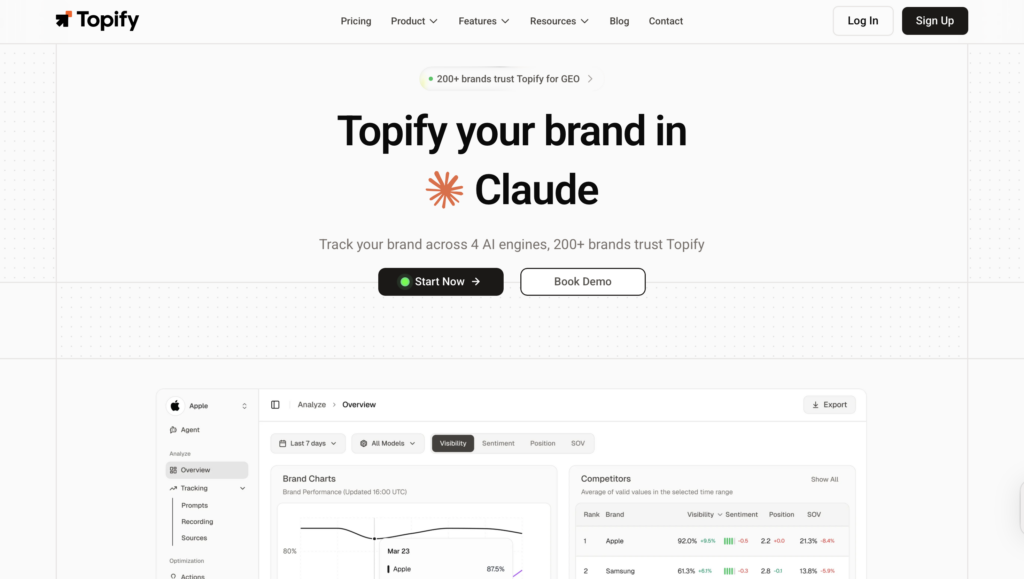
A full AI mention tracking platform like Topify sits in that third row. It monitors brand performance across major AI engines through seven metrics: visibility, sentiment, position, volume, mentions, intent, and conversion visibility rate. Competitor benchmarking surfaces who the engines recommend and how you rank against them in real time, and citation analysis reverse-engineers the exact domains AI platforms cite so you can see whether you or a rival owns those references.
The pricing question comes up early, so to be direct: professional-grade tracking generally starts around the $99/month range for mid-market teams, with Topify’s plans following that structure. The trade-off worth weighing isn’t tool cost. It’s the cost of not knowing where you stand while buyers make decisions inside answers you can’t see.
Common Mistakes in AI Mention Tracking
Most teams that start tracking make the same handful of errors.
The silo trap is the most common: monitoring only ChatGPT while ignoring the different citation logic of Perplexity and AI Overviews. Context neglect is close behind, where teams count mentions but skip sentiment. A negative mention can do more damage than no mention at all.
Prompt stagnation is subtler. A static keyword list goes stale as buyer language drifts toward longer, conversational queries, so the prompt set has to stay dynamic.
The last mistake is treating this as SEO with a new coat of paint. Stuffing SEO keywords into prompts doesn’t work, because models favor topical authority over keyword density. It shows up in the numbers, too: just 16% of brandssystematically track their AI search performance today, which means most are still measuring the old channel while the decision moves to the new one.
Conclusion
AI mention tracking isn’t an extension of SEO. It’s a separate discipline built for a moment when the answer, not the link, is what buyers act on. The brands that win here stop reading AI responses as search results and start treating them as influence engines worth measuring.
Start with the basics: decide which prompts and platforms matter for your category, then pick a tool that explains why your mentions move, not just that they did. Get started with Topify if you want that measurement and the source-level context in one view.
FAQ
Q: What is AI mention tracking?
A: It’s the practice of monitoring whether and how your brand appears inside AI-generated answers across engines like ChatGPT, Perplexity, Gemini, and Google AI Overviews. Unlike rank tracking, which measures link position, it measures brand presence, sentiment, and prominence within conversational output.
Q: How do you measure AI mention tracking?
A: Through metrics that go past raw counts: mention frequency, share of voice against competitors, contextual sentiment, position within the answer, and the authority of the sources the AI cites. Tracking share of voice alongside frequency tells you not just how visible you are, but how visible you are relative to rivals.
Q: What are common mistakes in AI mention tracking?
A: Monitoring only one engine, counting mentions without checking sentiment, using a static prompt list that goes stale, and treating it like keyword-based SEO. Each one leaves gaps in what you can actually see and act on.
Q: How much does an AI mention tracking tool cost?
A: Professional platforms generally start around $99/month for mid-market teams, scaling up with the number of prompts, projects, and engines tracked. The relevant comparison is that cost against the lost visibility of not knowing where your brand stands in AI answers.

