

Your brand monitoring dashboard tracks every tweet, every mention on Reddit, every press hit across 50 media outlets. It cost six figures to set up and runs 24/7. But here’s what it can’t tell you: when a potential customer asked ChatGPT, “What’s the best product in your category?”, your brand wasn’t in the answer. That conversation happened 2.5 billion times yesterday across ChatGPT alone, and your monitoring stack didn’t catch a single one.
The gap isn’t a minor blind spot. It’s an entire channel where brand narratives are being written, repeated, and trusted, without any input from the brands themselves.
What AI Brand Monitoring Actually Measures (and What Legacy Tools Miss)
AI brand monitoring is the systematic tracking of how brands appear inside conversational AI platforms: ChatGPT, Gemini, Perplexity, DeepSeek, and others. It measures visibility, sentiment, recommendation position, and citation sources across these engines in real time.
That’s a fundamentally different architecture from legacy brand monitoring. Tools like Brandwatch and Mention scrape static HTML, index RSS feeds, and query social APIs to count keyword mentions. They estimate “Share of Voice” based on potential impressions. None of that works in conversational AI, because there’s no static page to scrape. Every response is generated dynamically, session by session, prompt by prompt.
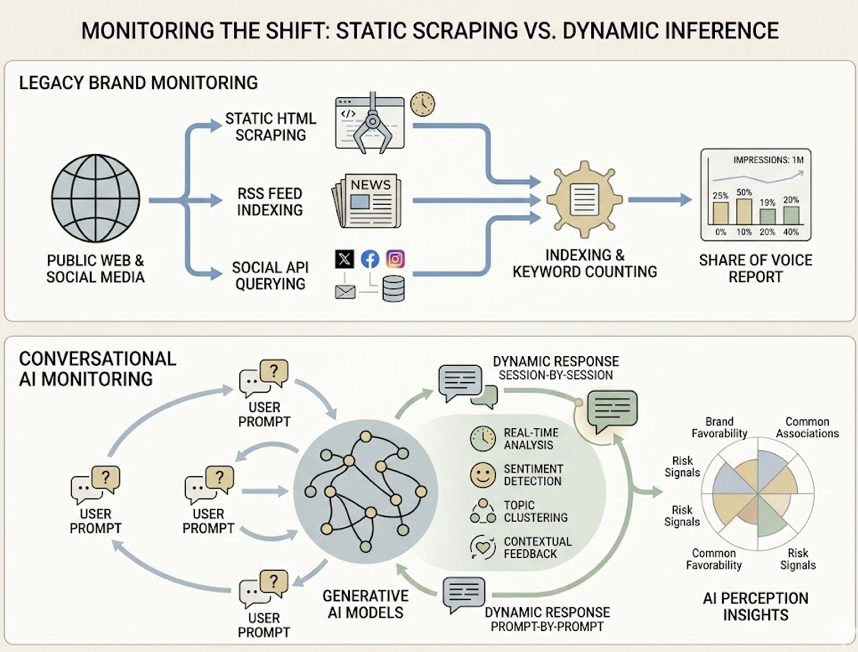
The gap shows up in four core metrics that legacy tools simply can’t capture:
Mention Frequency (AI Visibility): How often a brand surfaces per 1,000 relevant category queries across major LLMs. The average enterprise brand sits at an AI visibility score of just 0.3%. Top performers hit 12%.
Platform-Level Sentiment: Legacy tools classify sentiment as positive, negative, or neutral. AI brand monitoring scores it on a granular spectrum from -100 to +100, catching cases where one platform describes a brand positively while another frames it critically.
Recommendation Position: Conversational interfaces rank options hierarchically. Being listed first vs. fourth isn’t a cosmetic difference. User trust and click-through rates are heavily weighted toward the initial recommendation.
Citation Sources: This maps the exact domains and URLs that LLMs pull from to ground their answers, revealing the authority signals feeding the AI’s knowledge graph.
| Dimension | Legacy Tools (Brandwatch, Mention) | AI Brand Monitoring (Topify) |
|---|---|---|
| Data Capture | Scraping public pages, RSS, social APIs | Real-time prompting of LLM APIs, parsing RAG outputs |
| Sentiment | Keyword matching (Pos / Neg / Neutral) | NLP scoring (-100 to +100), hallucination detection |
| Output Visibility | Share of Voice by potential reach | Mention frequency, recommendation hierarchy, citation placement |
| Core Action | PR response, social engagement | GEO content optimization, schema structuring, digital PR seeding |
Why AI Brand Monitoring Matters More in 2026 Than a Year Ago
The numbers have shifted fast. ChatGPT now reaches 900 million weekly active users, processing roughly 2.5 billion prompts per day. Perplexity handles over 1.2 billion monthly queries, with projections pointing toward 1.5 billion monthly sessions by mid-2026. And 78% of Americans now report using AI-powered tools regularly.
The behavioral shift is sharpest in high-income demographics. In households earning over $150,000 annually, AI engines have officially overtaken traditional Google search as the first point of discovery for local businesses and services. In the $150,000 to $175,000 bracket, AI-first discovery leads traditional search 53% to 49%. Above $175,000, the gap widens to 61% versus 57%.
Google itself has accelerated the transition. AI Overviews now trigger on 25.11% of all search queries as of Q1 2026, up from 13.14% in early 2025. That integration has driven a 42% decline in organic click-through rates for top-ranking results. Roughly 93% of AI search sessions end without a click to an external website.
That’s the new reality: zero-click is the default.
Consumer trust adds another layer. While 74% of AI users rate their trust in generative recommendations at 4 or 5 out of 5, over 93% still verify before purchasing. After receiving an AI recommendation, 62% cross-check on a search engine, 58% visit the brand’s website directly, and 52% click through to embedded citations. The implication is clear: AI recommendations drive the consideration set, and traditional channels close the sale.
Here’s where platform strategy splits. ChatGPT commands 87.4% of all AI-driven search referrals but cites external sources at just 0.7% per query. Perplexity cites at 13.8% per query, a 20-fold difference. Perplexity-referred users also spend 57% more per transaction. So ChatGPT is your awareness channel, Perplexity is your acquisition channel, and you need different strategies for each.
The cost of doing nothing is steep. 70% of enterprise brands fail to detect sentiment decay in AI models until it has already eroded their sales pipeline. Silent invisibility, competitor dominance, model distortion: these risks compound daily without dedicated monitoring.
Innovative AI Brand Monitoring Companies Worth Watching
The market has matured quickly. Here’s where the key players stand in 2026.
Topify: The Full-Stack GEO Platform
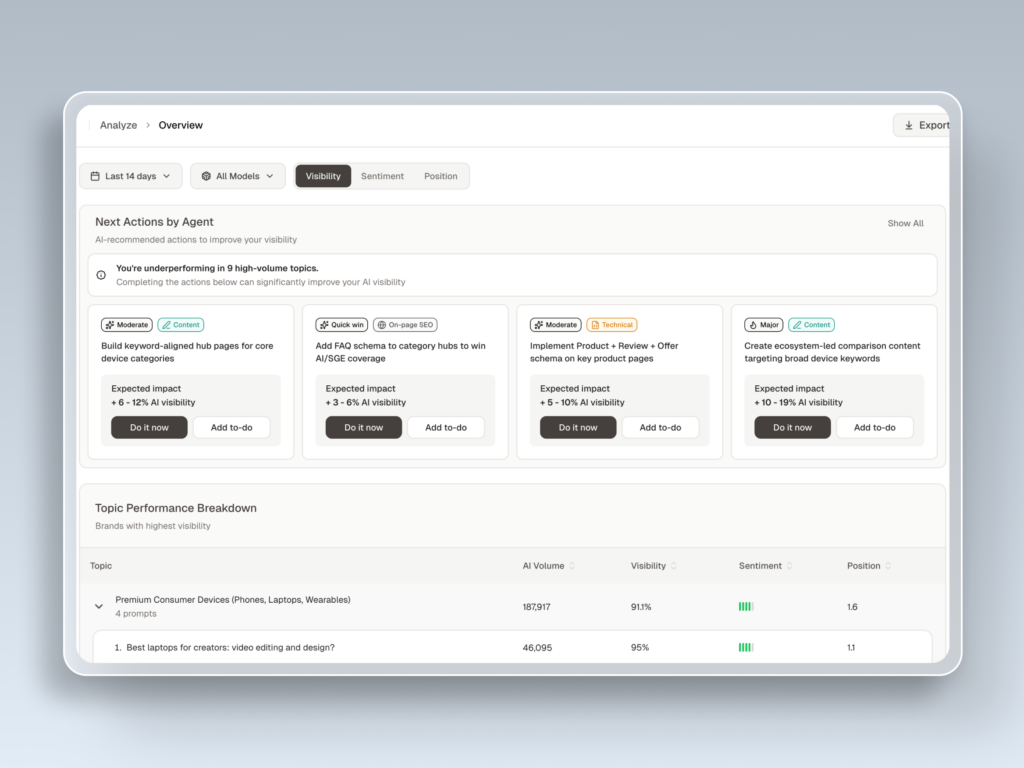
Topify has positioned itself as the industry standard for Generative Engine Optimization and AI brand visibility analytics. The platform monitors ChatGPT, Gemini, Perplexity, Claude, and Google AI Overviews from a single dashboard, tracking seven core metrics: visibility, sentiment, position, volume, mentions, intent, and CVR (Conversion Visibility Rate).
What separates Topify from passive reporting tools is execution. The platform’s AI Visibility Gap Detection identifies high-value prompts where competitors get recommended but the target brand doesn’t appear. Its integrated GEO Content Generation engine then drafts citation-ready content blocks designed to satisfy model retrieval logic.
In practice, this means a brand manager can spot a visibility drop on a critical query, trace it to a missing authority signal, and deploy a fix, all within the same interface. Topify’s one-click execution and plain-English goal setting make it accessible to non-technical marketing teams, while the depth of its analytics (NLP sentiment scoring from -100 to +100, source-level citation mapping) satisfies data-driven strategists. Plans start at $99/month.
Other Notable Players
Profound targets Fortune 500 enterprises, tracking across ten AI engines and mapping citations directly to revenue. Its Agent Analytics tool monitors crawler activity, but complexity is high and pricing starts at $499/month.
Omnia specializes in localized, multi-country monitoring across four core AI engines starting at €79/month. Its citation intelligence reverse-engineers competitor source URLs, though model coverage is narrower.
Nightwatch offers dual-layer tracking (LLM outputs plus the underlying web searches AI bots execute) at just $32/month. It’s cost-effective for teams that need basic AI tracking integrated with traditional SEO rank monitoring.
Ranketta focuses specifically on e-commerce, tracking product-level visibility within ChatGPT Shopping and AI shopping recommendations at the SKU level.
| Platform | AI Platforms Covered | Execution Support | Starting Price |
|---|---|---|---|
| Topify | ChatGPT, Gemini, Perplexity, Claude, AI Overviews | High: one-click GEO content generation | $99/mo |
| Profound | 10 engines (incl. Meta AI, Copilot) | Moderate: automated workflows, setup specialists required | $499/mo |
| Omnia | ChatGPT, Perplexity, Gemini, AI Overviews | High: automated content briefs | €79/mo |
| Nightwatch | ChatGPT, Claude, Perplexity, AI Overviews | Low: tracking only, no content generation | $32/mo |
| Ranketta | ChatGPT, Perplexity, AI Overviews (more on Enterprise) | High: schema markup and copy generation | Custom |
AI Brand Monitoring Integration Tools That Fit Your Existing Stack
The MarTech landscape now exceeds 15,384 distinct solutions, with global revenues projected to reach $1.03 trillion by late 2026. B2B marketing teams typically operate 12 to 20 disconnected tools, and enterprise stacks frequently exceed 120 applications. CFOs and RevOps leaders are rejecting standalone software that creates data silos.
AI brand monitoring has to plug into that stack, not sit beside it.
Topify addresses this with REST APIs and webhook integrations that feed real-time AI visibility metrics directly into existing data infrastructure. Here’s what that unlocks across four common integration scenarios:
CRM and Revenue Attribution: Funneling LLM brand-mention events into HubSpot or Salesforce lets teams attribute pipeline growth to generative search visibility. AI-referred visitors convert at 4.4x the rate of traditional organic traffic. Programmatic tracking surfaces the exact Customer Acquisition Cost and Lifetime Value of these leads.
BI Dashboarding: JSON exports from Topify feed into Tableau, Looker Studio, or Power BI. Teams build unified dashboards combining generative Share of Voice, traditional search rankings, and paid media spend in one view.
CMS Optimization Loops: Connecting AI monitoring to Shopify, WordPress, or Webflow creates closed-loop workflows. When the system detects sentiment drift or a new visibility gap, it triggers alerts prompting content teams to refresh product descriptions or inject schema markups.
Digital PR Alignment: When Topify’s Source Analysis shows a specific media outlet being cited by Perplexity or ChatGPT, PR teams can prioritize that domain for outreach, building earned media assets that organically feed the AI’s training loop.
The ROI is quantifiable. Integrated marketing automation yields an average return of $5.44 for every $1 invested. Top-performing programs reach $8.71 per dollar. Mature integrations deliver 25-30% decreases in operational expenses, boost sales productivity by 14.5%, and save marketing practitioners an average of 6.2 hours per week.
What “Easy to Use” Actually Looks Like in AI Brand Monitoring Tools
Software complexity is a real problem. Configuration abandonment rates hit 70% when interfaces introduce unnecessary friction or fail to deliver immediate value. In MarTech, data-heavy dashboards that don’t translate into action lead to steady user disengagement.
Evaluating AI brand monitoring tools’ ease of use comes down to three dimensions:
Onboarding velocity. Marketing ops teams can’t wait weeks for an integration cycle. A usable tool must establish tracking baselines automatically, identifying the brand’s keyword universe and competitor landscape programmatically.
Data readability. Conversational AI outputs are unstructured. Usable platforms organize thousands of diverse prompts into thematic clusters, separating transactional shopping intent from informational research, rather than dumping raw query logs into spreadsheets.
Output actionability. This is where most tools fall short. Showing a visibility gap is one thing. Generating the content changes needed to close it is another.
Topify’s setup requires entering the brand’s primary URL. The platform’s crawler then auto-identifies relevant category prompts, competitive entities, and baseline metrics. If a brand’s recommendation position drops on a high-intent query, Topify’s one-click mechanism pinpoints the missing authority signal and generates the exact citable copy block or schema markup to recover. That turns AI brand monitoring from a passive reporting task into an active growth channel.
How to Start AI Brand Monitoring in Under 30 Minutes
Step 1: Map your target AI platforms. Focus on the engines that cover 99%+ of generative search volume: ChatGPT for high-volume brand awareness, Perplexity for direct click-through attribution, and Google AI Overviews plus Gemini to defend existing search traffic.
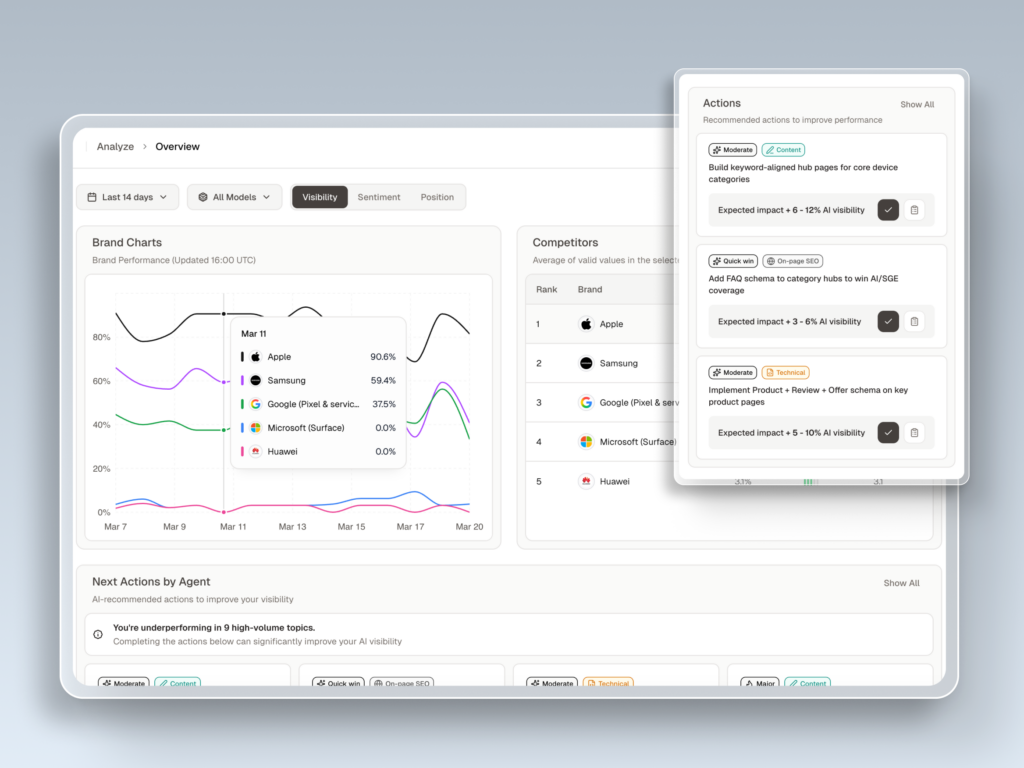
Step 2: Establish your Day 0 baseline. Enter your brand’s primary domain into the Topify dashboard. Configure NLP rules to isolate your brand from similarly-named entities. Add your top three competitors to establish baseline Share of Voice, sentiment, and recommendation rankings across all monitored engines.
Step 3: Act on the first visibility report. Navigate to the AI Visibility Gap Detection panel. Identify queries where competitors are recommended but your brand is missing. Use Topify’s GEO Content Generation tool to draft citation-ready content blocks, publish them with proper schema markup, and set up Sentiment and Hallucination Alerts for ongoing monitoring.
The whole process, from account setup to first actionable insight, takes less than 30 minutes.
Conclusion
Brand equity in 2026 isn’t just defined by media coverage or organic rankings. It’s increasingly determined by the probability of a brand being synthesized into an LLM’s response. The 900 million weekly users on ChatGPT, the 1.2 billion monthly queries on Perplexity, the 25% of Google searches now triggering AI Overviews: these channels are where brand narratives are forming.
AI-referred visitors convert at 4.4x the rate of standard organic traffic. Leaving that channel unmonitored means handing high-intent prospects to competitors. The brands that start tracking, measuring, and optimizing their generative footprint now will own the recommendation layer. The ones that wait will spend the next two years trying to catch up.
FAQ
Q: What is AI brand monitoring?
A: AI brand monitoring is the programmatic tracking of brand visibility, recommendation position, sentiment, and citations across conversational search platforms like ChatGPT, Gemini, and Perplexity. It simulates real user prompts to monitor how AI engines synthesize brand information, rather than scraping static web pages.
Q: How is AI brand monitoring different from social media monitoring?
A: Social media monitoring crawls public pages and APIs to count static keyword mentions. AI brand monitoring prompts conversational models directly, tracking how brands are synthesized, ranked, and cited inside dynamic AI responses. The data architecture, the metrics, and the optimization levers are entirely different.
Q: Are AI brand monitoring tools easy to use for non-technical teams?
A: Yes. Modern platforms are built with AI brand monitoring tools’ ease of use as a core design principle. Topify, for example, requires only a brand URL to start, auto-discovers relevant prompts and competitors, and provides plain-English dashboards with one-click content generation to resolve visibility gaps, no technical setup required.
Q: Which AI platforms should I monitor for brand mentions?
A: Focus on ChatGPT (87.4% of AI search referrals), Perplexity (high-intent, high-citation traffic), Google AI Overviews (25.11% of all search queries), and Gemini. Together, these cover the vast majority of consumer AI search volume and handle the bulk of transactional discovery.

