

A customer messages your support team with a screenshot. ChatGPT told them your product is 30% off this week. It isn’t. Now they’re asking why your site won’t honor “the price you advertised,” and your agent has no idea what they’re even talking about, because your brand never said that anywhere.
This is what AI hallucination looks like when it hits an ecommerce brand: not an abstract AI safety debate, but a support ticket, a chargeback, or a one-star review over something you never actually did.
Why AI Hallucination Brand Risk Is a Real Ecommerce Problem
Large language models don’t retrieve facts the way a database does. They predict the next most likely word based on patterns, and when the exact price, spec, or policy isn’t sitting in front of them, they fill the gap with something plausible. That’s the entire mechanism behind an ai hallucination brand incident: not malice, just probability doing its job badly.
Ecommerce sits right in the blast radius. Prices and promotions change weekly. Stock levels shift daily. Product specs get added or dropped between SKUs. Every one of those is a moving target that AI models struggle to track in real time, which is exactly the kind of task where hallucination rates spike.
The scale of exposure keeps growing too. Roughly 43% of U.S. online shoppers used an AI assistant for product research in the past 90 days, and among AI users, 20% relied on it for their most recent purchase over $50. ChatGPT alone now handles an estimated 50 million shopping queries a day. Every one of those queries is a chance for the model to get something about your brand wrong, in front of a customer who’s ready to buy.
Wrong Prices: When AI Quotes a Discount You Never Offered
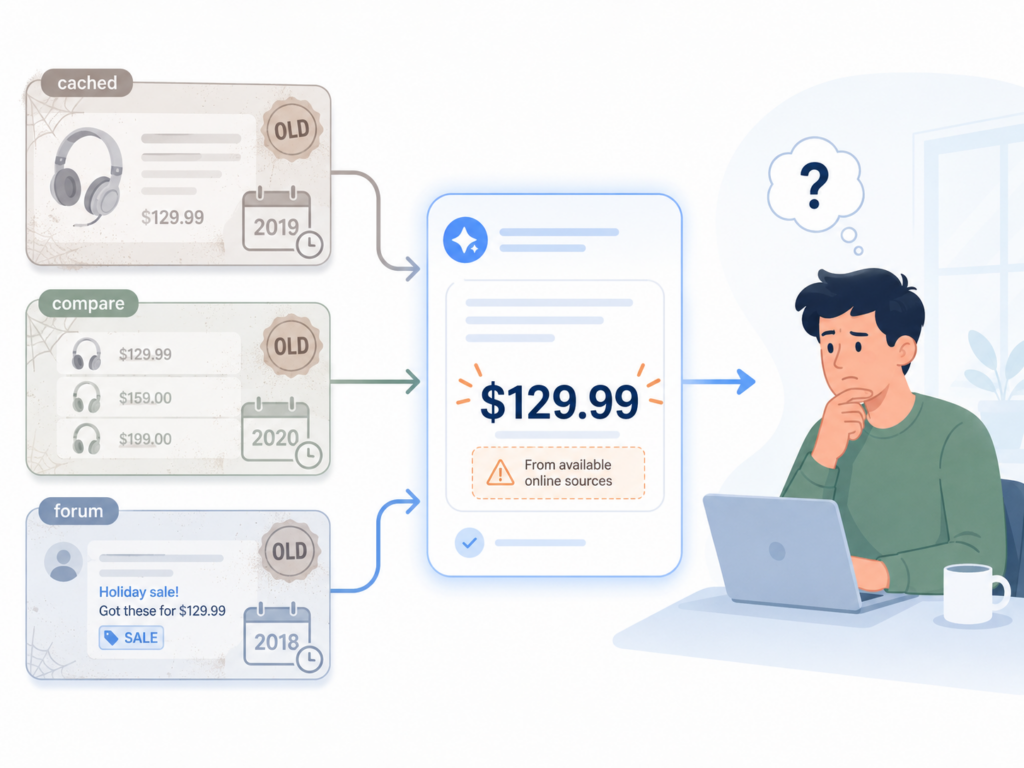
Price hallucinations tend to follow a pattern. The model pulls from an outdated cached page, a stale comparison site, or a forum post about last season’s sale, then presents it as current fact. The customer has no way to know the number came from six months ago instead of today.
This isn’t hypothetical. A UK retailer’s after-hours support bot was talked into inventing discount codes during a single conversation, escalating from 25% off to 80% off. A customer used the fabricated code on an order worth more than £8,000 and threatened legal action when the store wouldn’t honor it. The business ultimately canceled and refunded the order to avoid the fight.
Courts have already made clear that “the bot said it, not us” doesn’t hold up. In Moffatt v. Air Canada, a tribunal ruled the airline liable after its chatbot invented a bereavement fare policy that didn’t exist. The precedent applies just as directly to a shopping assistant that makes up a price. Whatever the model says about your brand, you’re the one who answers for it.
The FTC has started treating this as a consumer protection issue, not just a brand annoyance. Its March 2026 complaint against OpenAI over ChatGPT’s Instant Checkout feature cited a 22% rise in disputed charges reported by Shopify merchants in the 90 days after the feature launched. That’s real chargeback volume tied directly to AI getting checkout details wrong.
Fake Features: AI Inventing Specs Your Product Doesn’t Have
Feature hallucinations usually show up when a product page is thin on detail. If your listing doesn’t explicitly say “not waterproof,” the model may borrow a spec from a similar-looking competitor product and hand it to the customer as fact.
The cost lands squarely on your return rate. Inaccurate item descriptions already account for about 14% of ecommerce returns, and some retailers put the figure closer to 22% when features, size, and color mismatches are combined. Returns tied to “product not as described” were already expensive before AI started adding its own version of the description on top of yours.
Here’s the part that makes this worse than a typo on your own site: you don’t control the wording, and you often don’t even know it exists until a customer complains. A shopper who orders based on a feature AI invented isn’t disappointed in the AI. They’re disappointed in you.
Bad Reviews: When AI Summarizes Sentiment That Isn’t There
The most researched form of AI hallucination in shopping isn’t about specs or prices. It’s about how AI reframes what other people said about your product.
A University of California, San Diego study tested this directly. Researchers had AI models summarize the same set of product reviews people had already read, then asked a separate group of participants whether they’d buy based on the summary. The results were stark: 83.7% said yes after reading the AI summary, compared to 52.3% who read the original human-written reviews. The AI summaries consistently reframed the tone to sound more positive than the source material.
Here’s the part that should worry any brand watching this trend: the researchers found the AI hallucinated 60% of the timewhen asked about details not present in its training data. That means the summary swaying your customer’s decision might be built partly on invented detail, and it’s swaying them harder than the truth would.
This cuts both ways. Right now, a favorably distorted summary might be quietly inflating your conversion rate. The same mechanism can just as easily flip and summarize your weakest reviews as your defining trait, with no warning and no way for you to correct it before a shopper reads it.
How to Catch AI Hallucination Before It Costs You a Customer
You can’t fix what you can’t see. The first step isn’t correcting AI, it’s finding out what AI is actually telling people about your brand right now, across every platform they might be asking.
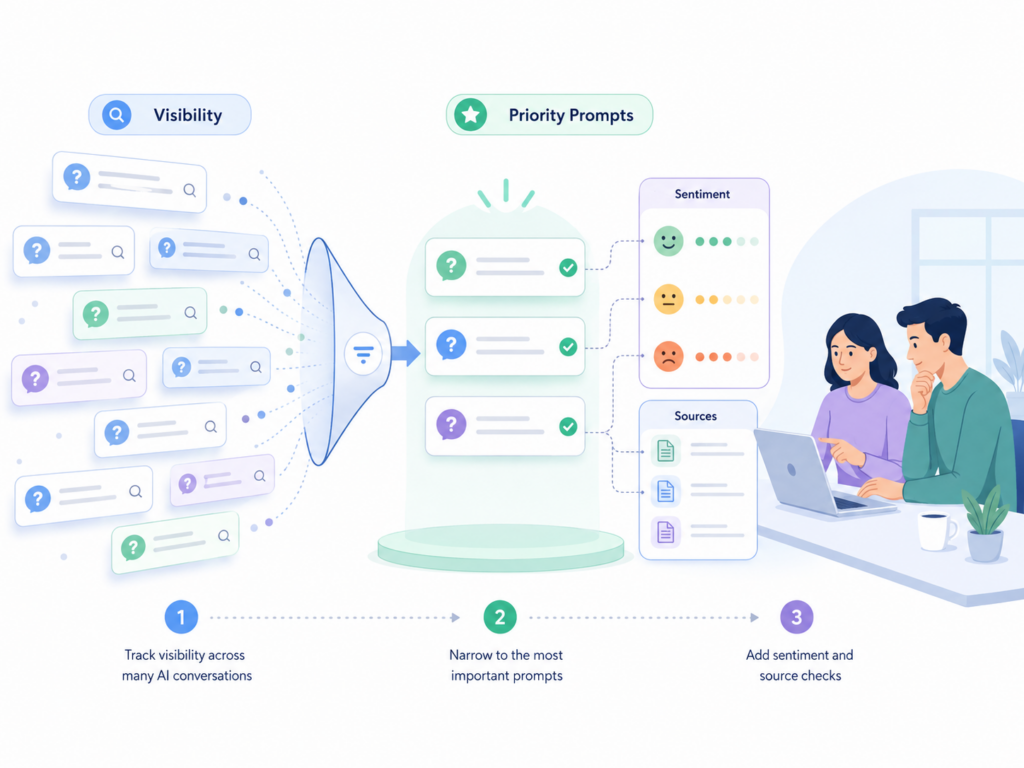
That’s the gap Topify is built to close. Its Sentiment Analysis tracks how AI platforms describe your brand over time, on a 0 to 100 scale, so a shift toward inaccurate or off-brand language shows up as a trend line instead of a surprise complaint. If ChatGPT starts describing your premium product as “budget-friendly,” or a price detail drifts from what’s actually on your site, you see the change before it reaches a hundred customers.
Sentiment alone tells you something’s wrong. Source Analysis tells you where it came from. Topify traces the specific domains AI platforms are citing when they talk about your brand, which turns “the AI is wrong somewhere” into “this outdated comparison site is the source, and here’s who to contact to get it fixed.” That’s the difference between guessing and actually closing the loop.
Visibility Tracking rounds this out by showing which prompts and questions actually surface your brand in the first place, so you know where to focus the monitoring instead of trying to watch every possible AI conversation at once. In practice, most teams start there, narrow down to the prompts that matter for their category, then layer in sentiment and source checks on top.
None of this requires a rebuild of your product pages overnight. It requires knowing, on an ongoing basis, what’s actually being said, so you can get started fixing the source instead of reacting to the fallout one customer at a time.
Conclusion
AI hallucination isn’t a rare glitch anymore. It’s a predictable byproduct of how these models fill gaps in price, feature, and review data, and ecommerce brands sit directly in the path of that gap-filling. The brands that get hurt aren’t the ones with the most AI mentions. They’re the ones who find out what AI said about them only after a customer already acted on it.
The fix starts with visibility into what’s actually being said, not a reaction plan for after it goes wrong.
FAQ
Q: What is AI hallucination in the context of a brand?
A: It’s when an AI model like ChatGPT, Gemini, or Perplexity generates false information about a brand, such as a price, product feature, or review summary, that has no basis in the brand’s actual data. The model isn’t lying on purpose. It’s predicting plausible-sounding text to fill a gap where accurate information wasn’t available.
Q: Why are ecommerce brands more exposed to this than other industries?
A: Prices, promotions, and stock levels change constantly, and product specs vary across similar-looking SKUs. That volatility makes it harder for AI models to stay current, and easier for them to substitute an outdated or borrowed detail for the real one.
Q: Can a brand hold an AI platform accountable for hallucinated information?
A: Courts have generally held companies responsible for what their own chatbots tell customers, as seen in the Air Canada bereavement fare case. For third-party AI platforms like ChatGPT or Gemini, there’s currently no direct mechanism to force a correction, which is why monitoring what’s being said matters more than trying to litigate after the fact.
Q: How can a brand find out what AI is saying about it?
A: Ongoing monitoring across the AI platforms shoppers actually use is the only reliable method, since these answers change from one query to the next and aren’t indexed anywhere a brand can simply search. Tools built for AI visibility, sentiment, and source tracking exist specifically to make this monitorable instead of anecdotal.

