

A brand manager types their own product name into ChatGPT this month and gets back a pricing tier that hasn’t existed since 2024. It’s not a rare glitch. It’s the kind of error that shows up when you actually go looking for it.
That’s the tension behind the headline question. Model-level benchmarks keep improving. Brand-level accuracy tells a messier story.
Why “Better or Worse” Is the Wrong First Question
Most people assume hallucination is a single number that goes up or down over time. It isn’t.
A model can post record-low error rates on a math benchmark and still invent a founding date for a mid-size SaaS company. The two numbers don’t move together, because they’re measuring completely different failure modes.
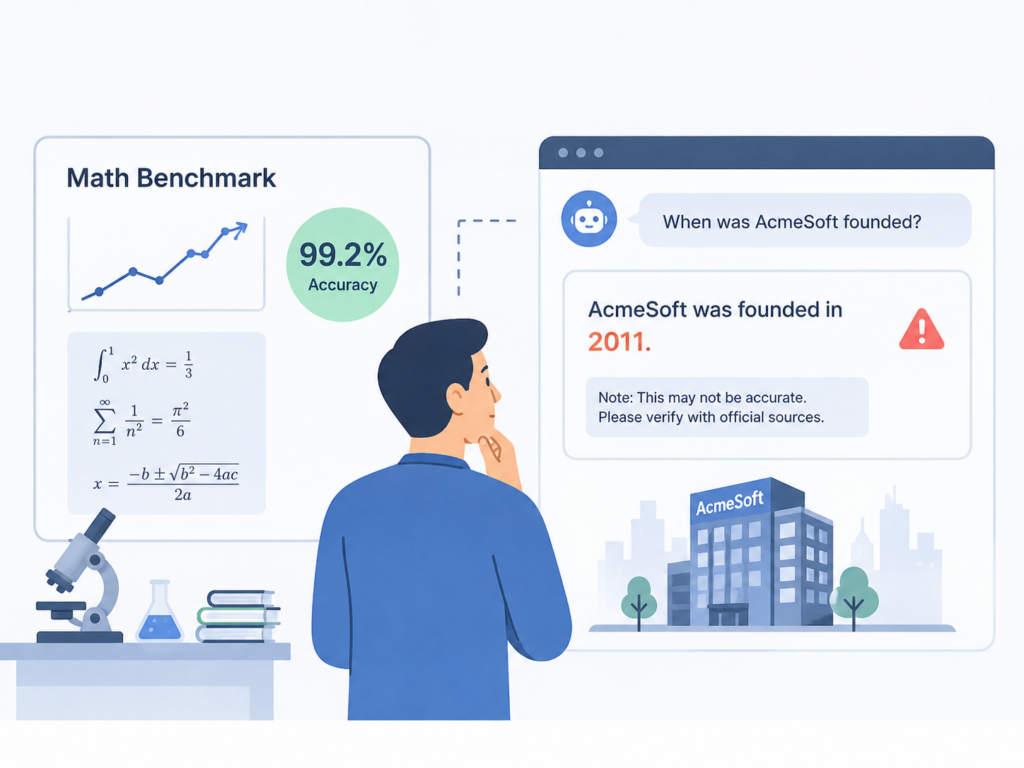
Hallucination is not evenly distributed. It concentrates wherever training data is thin, conflicting, or stale, and brand information happens to sit exactly in that zone.
So the real question isn’t “is AI hallucination getting better or worse.” It’s “better or worse for what, and for whose brand.”
What the 2026 Benchmarks Actually Show
On the numbers that get quoted most often, 2026 looks like a genuine win. Grounded summarization tasks measured by Vectara’s HHEM leaderboard fell from a 2.5% to 8.5% range in 2024 down to roughly 1% for top models this year, a drop of about 95%.
That’s the good news. The catch is in the task type.
The Stanford HAI 2026 AI Index Report tested 26 top models on a harder scenario: does the model hold its answer steady when a false claim is framed as something the user personally believes, rather than something a third party believes. Under that framing, GPT-4o’s accuracy dropped from 98.2% to 64.4%. DeepSeek R1 fell from over 90% to 14.4%.
Here’s the pattern that matters for brands. The tasks that improved most (structured summarization with a source document right in front of the model) look nothing like the tasks people run when they ask an AI assistant “what does this company do” from memory.
| Task type | 2024 rate | 2026 rate | Source |
|---|---|---|---|
| Grounded summarization (source document provided) | 2.5% to 8.5% | ~1% | Vectara HHEM |
| Open-ended factual recall, no source provided | Not standardized | 3% to 19% depending on task | HHEM and 2026 benchmark aggregates |
| User-belief framed false claims | Not tested at scale | 22% to 94% across 26 models | Stanford HAI 2026 AI Index |
Brand queries fall almost entirely into that second and third row. Nobody hands an AI assistant a source document before asking it to describe a competitor’s pricing.
Why Brands Are a Structurally Hard Case for AI Accuracy
A model doesn’t fail on brand facts because it’s careless. It fails because brand information behaves differently from the encyclopedic facts these systems were built to handle.
Pricing changes quarterly. Product tiers get renamed. A company that pivoted its positioning last year still has three-year-old blog posts outranking its current homepage.
An AI visibility report from Metricus found that 72% of brands it audited had at least one factual error surface in AI-generated responses. The errors weren’t ambiguous. They were wrong founding dates, discontinued products listed as current, and features attributed to the wrong pricing tier.
The same report traced the errors to three root causes: conflicting information across indexed sources, information gaps the model fills with plausible-sounding guesses, and stale training data reflecting the brand as it used to be.
That’s less about model quality and more about how messy a brand’s own footprint is across the web.
The Small Brand Penalty
Scale changes the odds. Research from Muck Rack found that AI models strongly favor content published in the past 12 months. When a brand has no recent coverage, older sources fill the void by default.
A large enterprise typically has a steady stream of press mentions, review updates, and fresh content refreshing what the model sees. A smaller or newer brand often doesn’t. When the model needs to answer a question and finds a gap instead of a source, it doesn’t say “I don’t know.” It generates something plausible instead.
That’s the small brand penalty. Not more errors because the model dislikes small brands, but more errors because there’s less recent, consistent material to anchor the answer.
How to Tell If You’re Being Misrepresented, Not Just Mentioned
Two very different risks get lumped under “AI visibility” and they need separate answers.
The first is absence: your brand doesn’t come up when it should. That’s frustrating, but it’s a visibility gap, not a hallucination.
The second is misrepresentation: your brand comes up, and what’s said about it is wrong. This one is more dangerous because it looks like the AI is doing its job. Nobody double-checks an answer that arrives with total confidence.
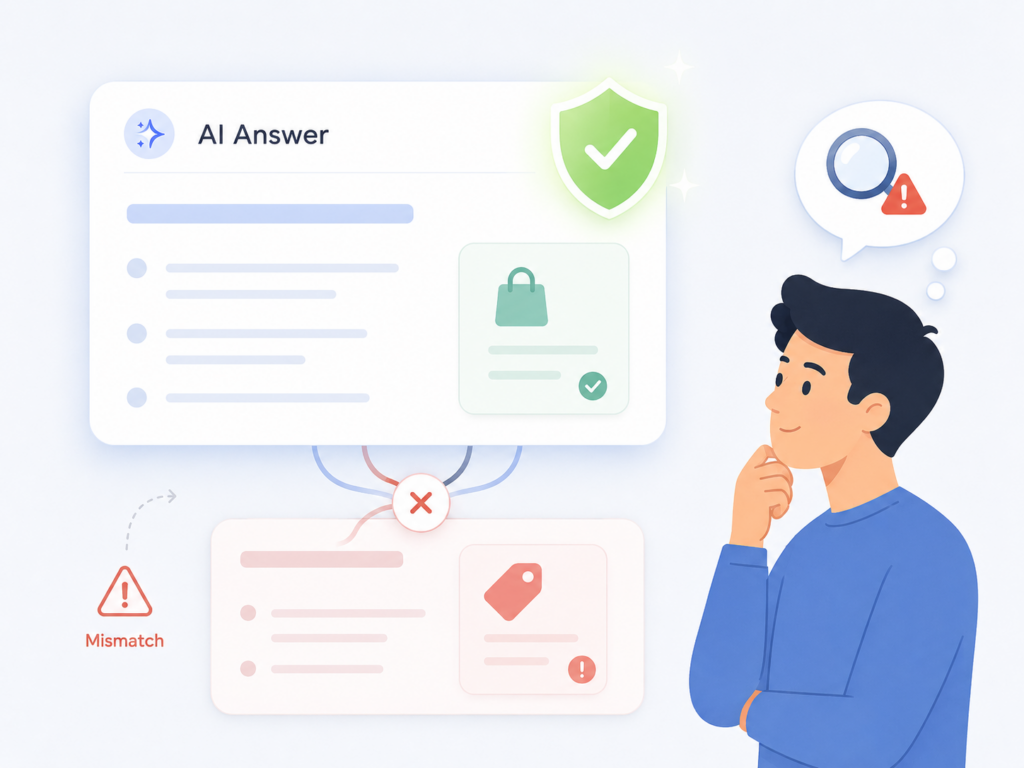
Legal precedent is starting to catch up with this distinction. In the widely cited Air Canada case, a tribunal ruled the airline liable for its chatbot’s fabricated refund policy, treating the bot’s output as an extension of the company’s own voice. The airline had to honor the incorrect policy and later pulled the chatbot altogether.
Regulation is moving the same direction. The EU AI Act’s Article 50 transparency requirements, enforceable from August 2, 2026, require AI-generated content to be labeled appropriately, a sign that accuracy accountability for AI outputs is becoming a compliance question, not just a reputational one.
Consumers already feel the risk. Forbes and Gartner research cited by Firney found that over 70% of consumers are worried about AI-generated misinformation, well before most of them can name a specific incident.
Manually testing this is possible but limited. Typing a handful of prompts into ChatGPT once a month tells you what happened in that moment, on that platform, with that exact phrasing. It won’t tell you whether the error is a one-off or a pattern, and it definitely won’t tell you which source is feeding the mistake.
Turning AI Accuracy Into a Trackable Metric
If misrepresentation is the risk that matters most, the fix has to work at the same scale as the problem. That means moving past occasional spot checks toward something closer to continuous measurement.
Topify approaches this through two connected functions. Sentiment Analysis scores how AI platforms describe a brand on a 0-100 scale, catching not just whether the tone is positive or negative but whether the description has drifted from what’s actually true. Source Analysis goes one layer deeper, tracing exactly which domains an AI model pulled its answer from, so a brand can see whether the error originated from an outdated review site, a stale Wikipedia entry, or a competitor’s comparison page.
That combination changes what a correction looks like in practice. Instead of “we noticed ChatGPT said something wrong,” it becomes “this specific outdated page is the source, here’s the correction path, and here’s the sentiment score before and after the fix goes live.”
For a multi-product SaaS brand with pricing tiers that shift often, that means catching a stale price point before it costs a lead. For a newer brand still building its content footprint, it means knowing exactly where the information gaps are before an AI model fills them on its own.
Either way, the goal isn’t chasing a lower hallucination percentage in the abstract. It’s knowing, with actual data, whether your brand specifically is being described accurately this month compared to last month.
Conclusion
The honest answer to the headline question is: it depends which brand you are. Model-level hallucination on structured, source-grounded tasks has genuinely improved, dropping by something like 95% since 2024 on the benchmarks that measure it best. But brand-level accuracy, especially for smaller companies or fast-changing product lines, hasn’t moved nearly as much, because the underlying problem isn’t model capability. It’s messy, inconsistent, and stale source material.
Guessing which category your brand falls into isn’t a great strategy. Building a baseline is. Once you know how your brand is actually being described across AI platforms this quarter, you have something to compare against next quarter, and a source to point to when something needs fixing.
FAQ
Is the AI hallucination rate actually improving in 2026?
On grounded, source-provided tasks, yes, with reported drops of roughly 95% since 2024 according to Vectara’s leaderboard. On open-ended factual recall, the kind of query most brand-related questions fall into, rates still run between 3% and 19% depending on the benchmark and task.
How do I check if ChatGPT is wrong about my brand?
Manual prompting across ChatGPT, Perplexity, and Gemini can surface obvious errors, but it only captures a single moment and phrasing. A recurring audit that tracks sentiment and traces citation sources over time catches patterns that one-off checks miss.
Why does AI make up false information about smaller or newer brands more often?
AI models favor recently published, consistent content. Larger brands tend to generate a steadier stream of that material. When a smaller brand has content gaps, the model fills them with plausible-sounding guesses instead of leaving the answer blank.
Can a brand be held legally responsible for what an AI says about it?
Precedent is still developing, but the Air Canada ruling established that a company can be held liable for its own chatbot’s fabricated claims, on the reasoning that the AI’s output counts as the company’s voice. Regulatory frameworks like the EU AI Act are adding separate transparency obligations on top of that.

