

A customer asks ChatGPT about your pricing before they ever land on your site. The answer sounds specific and confident: a number, a feature comparison, a claim about what you offer. It’s also wrong. Nobody at your company said it, and nobody caught it before that customer read it as fact.
That’s the part most people get wrong about AI hallucination and brand information. They assume a mistake this visible would get flagged fast. It doesn’t. AI-generated answers carry an authority that ads and search snippets never had, and consumers extend that authority to information the model simply invented.
Where AI Hallucinations About Brands Actually Come From
Large language models don’t look up your website every time someone asks about you. They generate an answer based on patterns learned during training, then fill any gaps with whatever sounds statistically plausible. Sometimes that means outdated facts. Sometimes it means details that never existed at all.
The scale of this is bigger than most brand teams assume. NP Digital’s February 2026 accuracy report tested 600 prompts across six major models and found ChatGPT topped the field with only 59.7% fully correct responses. Grok came in last at 39.6%.
That’s not a rare glitch in an obscure model. That’s the best-performing AI assistant getting roughly two out of every five brand-related answers wrong.
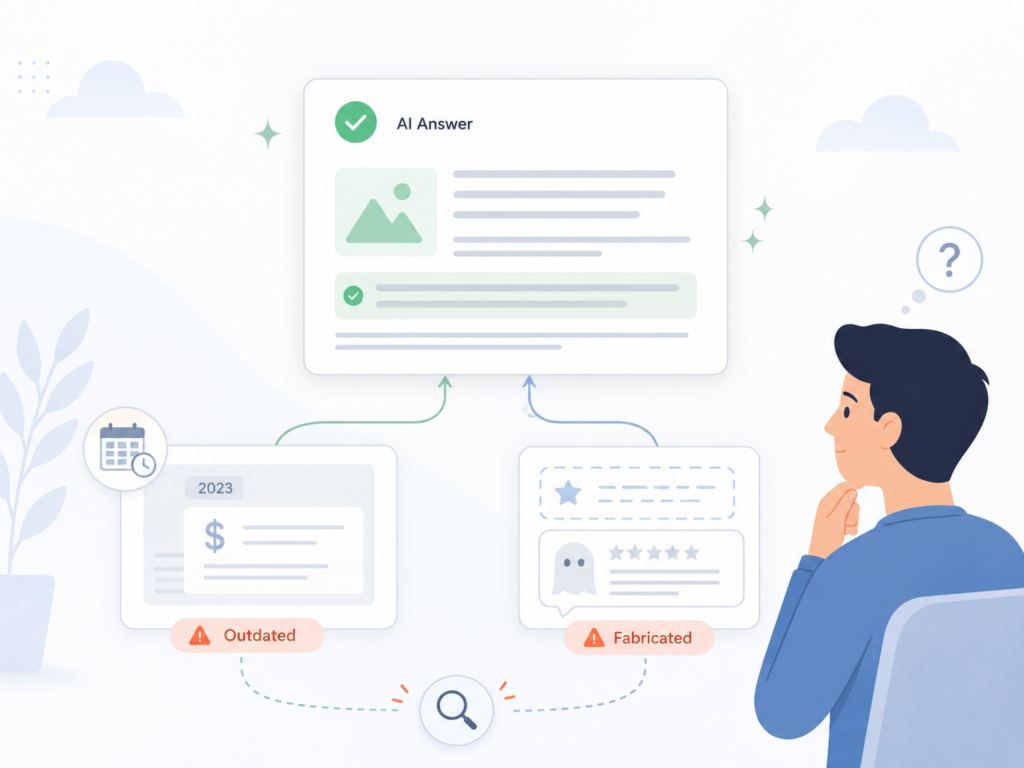
There’s also a meaningful difference between a stale fact and an invented one. A model quoting last year’s pricing is working from outdated training data, which is bad but at least traceable. A model inventing a product feature that never existed, or citing a customer review that was never written, is fabricating a detail from nothing because the pattern of a typical answer called for one. Both look identical to the person reading them.
Why Consumers Don’t Fact-Check What AI Tells Them About a Brand
Here’s the thing about automation bias: it gets stronger exactly when a system feels competent and the user is trying to save time. Researchers describe it as a documented tendency to over-trust and under-scrutinize an automated system’s output, and it’s most pronounced with tools that speak fluently and never hedge.
AI assistants rarely hedge. They deliver a wrong answer with the same tone as a right one, no uncertainty markers, no “I’m not fully sure.” That confident delivery is doing more persuasive work than the actual accuracy of the content.
A 2026 UC San Diego study puts a number on the effect. It found AI-generated summaries hallucinated 60% of the timein ways that still influenced purchase decisions, and users exposed to AI-powered summaries were roughly 30% more likely to trust incorrect outputs than they were to trust the same wrong information from a traditional source.
Trust in AI search is actually declining overall. Fractl’s Q2 2026 survey of over 1,000 U.S. consumers found the share who rate AI as more helpful than traditional search dropped from 82% in 2025 to 54% in 2026. But general skepticism toward AI as a category doesn’t stop someone from believing a specific, confidently worded answer about your specific brand in the moment they’re reading it. Skepticism in the abstract and scrutiny in the moment are two different things, and most people only have one of them.
Pew Research’s 2026 study captures that gap directly. Half of U.S. adults now use AI chatbots regularly, yet only 29% of those users say they have “a lot” or “some” trust in the information the chatbot gives them. That means roughly seven in ten people using these tools every day hold little or no trust in what they’re reading, and they keep reading it anyway because checking every claim isn’t practical mid-conversation.
How One AI Hallucination Turns Into Your Brand’s Permanent Record
A single wrong answer rarely stays a single wrong answer. Models draw on patterns across the web, including other AI-generated content that’s already circulating, so an error can get reinforced rather than corrected the next time someone asks a similar question.
The accuracy problem extends to sourcing itself. When the Tow Center for Digital Journalism tested eight AI search toolson 1,600 queries asking them to identify the correct source of a real article, the tools collectively got it wrong more than 60% of the time. If AI struggles this much to accurately attribute information it’s citing, misattributing details about a lesser-known brand is the easier failure mode, not the harder one.
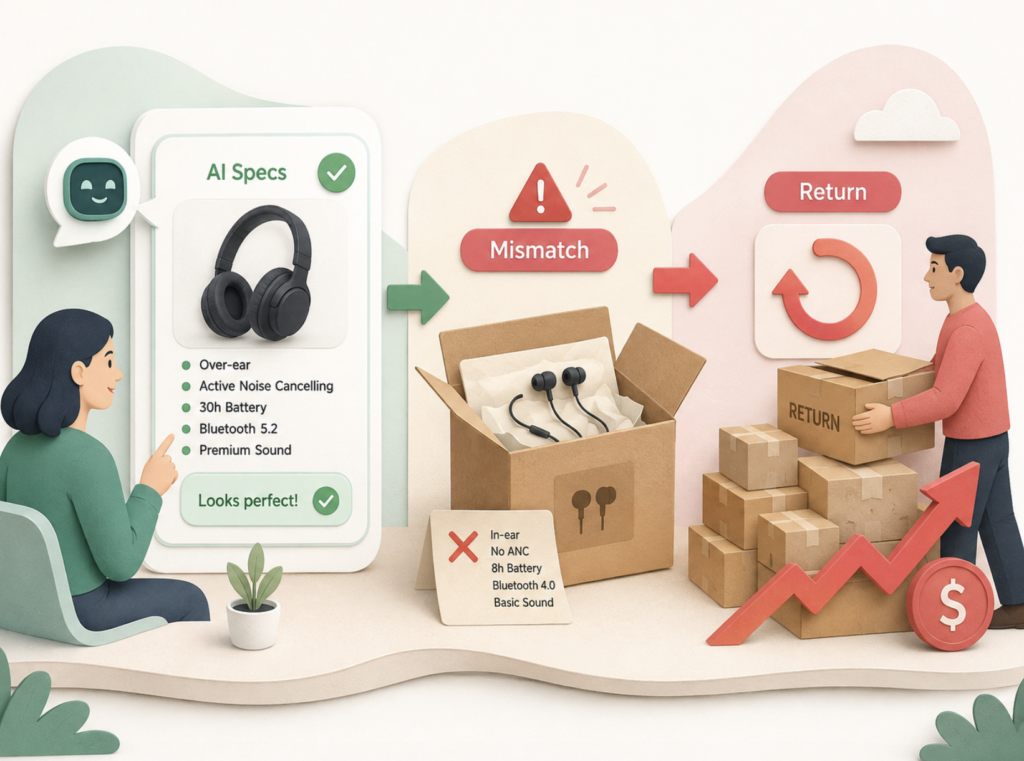
The financial consequences are already showing up. A March 2026 report documented hallucinated product specifications causing a 25% spike in returns for one electronics brand, as customers received products that didn’t match what an AI assistant had described to them.
This isn’t a marketing team’s edge case either. 47.1% of marketers now encounter AI-generated errors several times a week, and 36.5% report that hallucinated or inaccurate AI content has already made it into their own published workflows undetected.
How to Catch an AI Hallucination About Your Brand Before Customers Do
Manually asking ChatGPT about your brand once a month won’t catch this. Errors show up differently across ChatGPT, Gemini, Perplexity, and the rest, they shift as models update, and a single spot check tells you nothing about what’s happening on the platform you didn’t test.
This is the gap Topify is built to close. Its Sentiment Analysis tracks how AI systems describe your brand across major platforms and flags when that description drifts from your actual positioning, whether that’s a pricing error, an outdated feature list, or a tone that doesn’t match your messaging.
Source Analysis goes a step further and traces the problem to its root. Instead of just telling you an answer is wrong, it identifies the specific domains and URLs the AI is citing, so you can see whether an outdated third-party listing or a stale forum post is the actual source feeding the model’s mistake. In practice, that means you can trace a hallucinated claim about your product back to the exact webpage keeping it alive, rather than guessing.
Visibility Tracking rounds this out by showing whether your brand is even being mentioned in the first place, since a hallucination usually starts as a gap: the model has too little reliable information about you, so it improvises to fill the space. Seeing where you’re invisible is often the earliest warning sign of where you’re about to be misrepresented.
Teams that want to see where they stand can get started with Topify and run a baseline check across platforms before deciding what needs fixing first.
What to Do Once You’ve Found One
Catching a hallucination is only half the job. The fix usually isn’t a takedown request. It’s giving AI systems a better, more authoritative source to pull from than the one that’s currently wrong.
That typically means publishing clear, specific, and current information on your own domain about the exact facts that keep getting misstated, whether that’s pricing, specs, or leadership details. Models tend to shift once a strong, well-cited alternative source becomes available, though the correction isn’t instant. Newer model updates show this is possible at scale: GPT-5.3 Instant reduced hallucinations by 26.8% on high-stakes queries once web search was enabled, which suggests accuracy responds to better source material, not just model upgrades.
Treat this as a recurring check, not a one-time fix. Test the same core brand queries every quarter, track whether accuracy is improving or slipping, and escalate anything that touches pricing or safety claims immediately rather than waiting for the next audit cycle.
Conclusion
The uncomfortable part of AI hallucination and brand accuracy isn’t that models make mistakes. It’s that consumers extend AI the kind of unquestioning trust they stopped giving ads years ago, and that trust doesn’t require the model to be right, just confident. Brands that wait to notice this the way a customer does, by stumbling across a bad answer, are always a step behind. The ones that track it systematically get to correct the record before it becomes the default answer everyone remembers.
FAQ
Q: What exactly is an AI hallucination about a brand?
A: It’s when an AI chatbot generates factually incorrect information about a company and presents it as fact, such as wrong pricing, discontinued products listed as current, or fabricated features and reviews.
Q: How common are AI hallucinations about brands?
A: More common than most teams assume. Even the best-performing model in a 2026 accuracy study only got 59.7% of brand-related answers fully correct, and audits regularly find factual errors in the majority of brands tested.
Q: Why do people believe AI more than they should?
A: Automation bias. People tend to trust confident, fluent systems without double-checking them, especially when they’re trying to save time, and AI assistants rarely signal uncertainty even when they’re wrong.
Q: Can a brand actually fix an AI hallucination once it starts spreading?
A: Yes, though it takes time. Publishing clear, authoritative, current information about the specific fact in question gives models a better source to draw from, and tracking the correction over multiple quarters shows whether it’s taking hold.

