

Someone on your team forwards a screenshot. ChatGPT just told a customer your product line was discontinued. Or Perplexity cited a lawsuit that never happened. Or Gemini quoted pricing that hasn’t been accurate in two years. Your instinct is to treat it like a normal complaint: find who’s responsible, ask for a correction, move on.
There’s no editor to call and no takedown form for an AI hallucination. The model that got it wrong will generate a new answer the next time someone asks the same question, and it might get it wrong again, or differently. What your team does in the next few hours determines whether this stays a minor glitch or turns into a real AI hallucination PR crisis.
What Counts as an AI Hallucination Brand Crisis
Not every wrong answer is a crisis. An AI model getting your founding year off by a decade is an accuracy problem, not a reputational one.
A crisis looks different. It’s an AI system telling users your product was recalled when it wasn’t, inventing a lawsuit against your company, fabricating a negative review, or confidently misquoting your refund policy to a paying customer. The distinction matters because over 50% of informational searches now trigger some form of AI-generated response, which means a false claim about your brand isn’t sitting on some obscure forum. It’s the first thing a prospective customer sees when they ask a direct question about you.
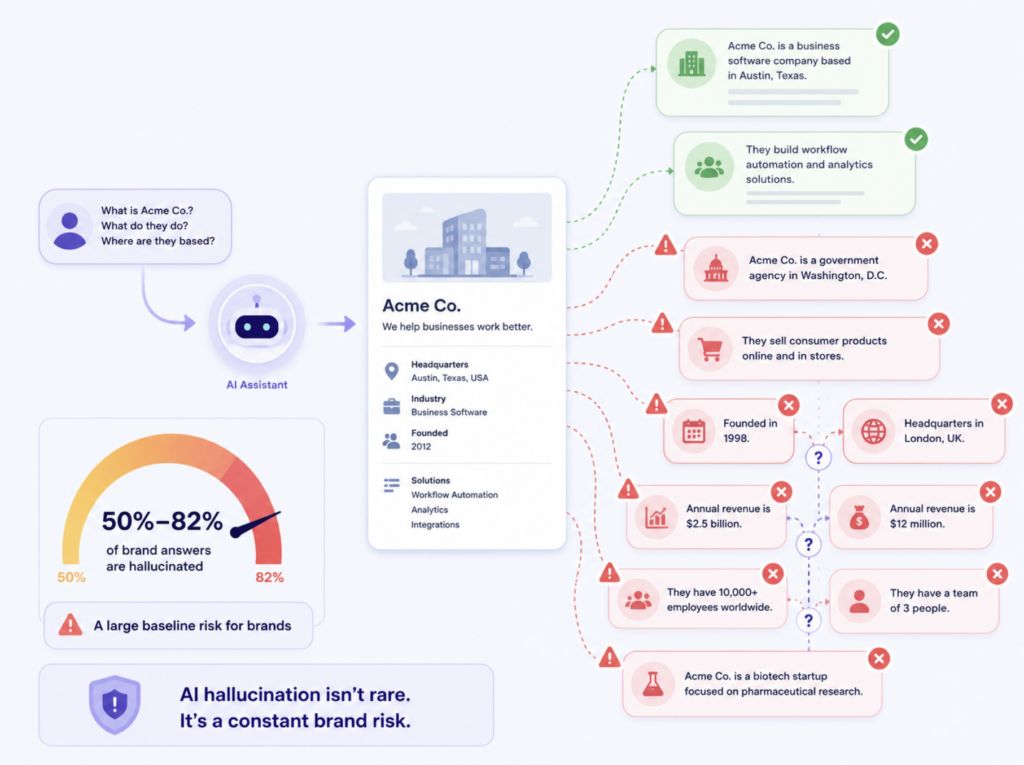
The scale of the underlying problem is bigger than most teams assume. Depending on the task and model, large language models hallucinate somewhere between 50% and 82% of the time on open-ended factual queries. That’s not a rare edge case. It’s a baseline error rate your brand is exposed to every time someone asks an AI assistant a question about you.
Why an AI Hallucination PR Crisis Moves Faster Than a Normal One
Traditional PR crises have a traceable source: a reporter, a post, a statement. You know who said it and where it’s published.
AI hallucinations don’t work that way. The same false claim can surface independently across ChatGPT, Perplexity, and Google AI Overviews, generated fresh each time rather than copied from one place. There’s no single post to get taken down, because there often isn’t a single source at all.
That’s the gap most crisis-comms plans don’t account for.
Speed matters because the damage compounds quietly. Companies have reported traffic losses of up to 10% when AI systems misrepresent their products, and the losses to trust are harder to measure but just as real. Globally, hallucinations were already estimated to cost businesses $67.4 billion as of 2024, before AI search became the default entry point for product research it is today.
Most teams don’t move fast enough. E-commerce brands take an average of 22 days to detect and correct a significant AI misinformation incident, largely because nobody’s watching for it until a customer complains. Twenty-two days is long enough for a false claim to get cited by other AI answers, screenshotted, and repeated in forums the models will scrape next.
The First 24 Hours: A Response Timeline
Hour 0 to 2: Verify Before You React
One screenshot isn’t proof of a pattern. Run the same question, and a few close variations, across ChatGPT, Perplexity, Gemini, and Google AI Overviews before you do anything else.
If it’s a one-off phrasing quirk on a single platform, you likely don’t need a public response, just a note to monitor it. If the same false claim shows up across multiple platforms, or keeps recurring on repeat queries, you’re dealing with something that needs a response plan, not a shrug.
Hour 2 to 8: Trace the Source and Align Internally
Ask what the model might be drawing from. AI answers are often grounded in something, a stale press release, an outdated Wikipedia line, a hostile blog post that ranks higher than it should. Finding that source tells you whether you’re fighting a one-time generation quirk or a piece of bad information the model keeps retrieving.
At the same time, get legal, PR, and product on the same page about the facts. This step gets skipped under time pressure, and it’s the reason companies end up issuing corrections that need correcting themselves.
Liability here isn’t fully settled, but it’s not zero either. In the widely cited Air Canada case, a tribunal held the airline responsible for a refund policy its own chatbot invented, on the reasoning that an AI system speaking on a company’s behalf is still the company’s voice. That precedent is about a brand’s own AI tool, not a third-party model like ChatGPT, but it signals where courts are headed on AI-attributed claims generally.
Hour 8 to 24: Publish the Correction and Start Watching
Put the accurate information somewhere authoritative and specific: a dedicated facts page, an updated product page, a direct statement if the claim reached public visibility. Vague reassurances don’t help here. AI systems and readers both respond better to a clear, specific correction than a general statement about “taking this seriously.”
Whether to issue a full public statement depends on reach. If the hallucination stayed inside AI answers and didn’t spread to social media or press, a quiet, well-sourced correction is often enough. If it already reached customers publicly, treat it like any other visible PR issue and communicate accordingly.
This is also when monitoring should start, not end. A correction posted once doesn’t guarantee the model updates its answer on the next query.
Tracing the Source: Where the AI Got It Wrong
AI answers aren’t invented from nothing. Most are grounded in retrieved content, meaning there’s usually a domain or URL the model is pulling from, even when it distorts what that source actually said.
Finding that source is the difference between a fix that lasts and one that doesn’t. Asking a model to “please correct this” rarely works, because the next user’s query triggers a fresh retrieval, not a memory of your request. If the underlying source, an outdated directory listing, a stale news article, an unverified forum thread, still exists and still ranks, the same hallucination tends to resurface.
This is where Topify‘s Source Analysis becomes useful for teams handling this kind of incident. It traces the exact domains and URLs that AI platforms are citing when they answer questions about your brand, which turns “some AI somewhere said something wrong” into a specific, fixable list of pages to correct, flag, or outrank with accurate content.
Did the Correction Actually Work? Monitoring After the Crisis
Publishing a correction feels like the end of the process. It usually isn’t.
The real question is whether AI platforms actually reflect it, and whether the incident left a lasting dent in how AI systems talk about your brand overall. A hallucination about pricing might get fixed in a week. Its effect on how positively or negatively a model frames your brand in unrelated answers can linger longer.
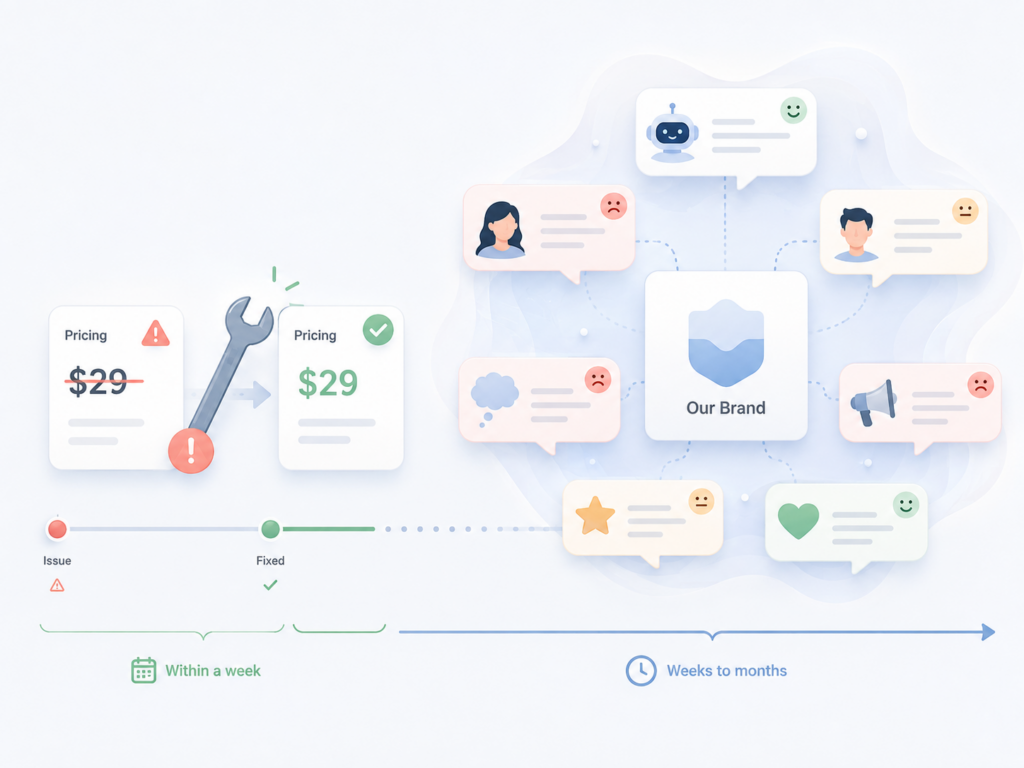
This is the gap Topify’s Sentiment Analysis is built to close. Instead of manually re-querying ChatGPT and Perplexity every few days and guessing whether tone has shifted, it tracks how AI systems talk about your brand over time, scored across platforms, so a PR team can see whether sentiment is actually recovering or just assumed to be. In practice, that means catching a lingering negative framing weeks after the original hallucination was corrected, rather than finding out from a customer months later.
For teams that want ongoing coverage rather than a one-time check after an incident, it’s worth setting up tracking before the next one hits. You can get started with Topify to establish that baseline now, rather than during the next scramble.
Conclusion
An AI hallucination about your brand isn’t a normal PR complaint, and treating it like one costs you time you don’t have. Verify fast, trace the actual source instead of just asking for a correction, and don’t consider the incident closed until you’ve confirmed AI platforms reflect the fix.
The brands that handle this well aren’t the ones with the fastest lawyers. They’re the ones who were already watching what AI systems say about them before the first hallucination showed up.
FAQ
Q: Is a brand legally responsible for what an AI hallucinates about it?
A: It depends on whose AI said it. Companies have been held liable for their own chatbot’s hallucinated claims, as in the Air Canada case. Liability for what a third-party model like ChatGPT says about your brand is less settled, and courts haven’t produced a clear doctrine yet.
Q: How long does it take for AI models to reflect a correction?
A: There’s no fixed timeline. Some platforms update within days of a source correction, others take weeks, and a correction doesn’t guarantee the model stops citing an outdated source elsewhere. This is why ongoing monitoring matters more than a single follow-up check.
Q: Should we always issue a public statement when this happens?
A: Not always. If the false claim stayed contained to AI answers and didn’t reach customers or press, a quiet, well-documented correction at the source is usually enough. Escalate to a public statement once the claim has visibly spread beyond AI platforms.
Q: How do we prevent this from becoming a recurring problem?
A: Fix the source content the model is likely retrieving from, keep a documented “brand facts” reference AI systems can cite accurately, and monitor sentiment and citations continuously rather than only after something goes wrong.

