

A prospect spent forty minutes with your sales team, nodded through the demo, and asked ChatGPT one follow-up question before signing. The answer favored your competitor, credited them with a feature you shipped two years earlier, and the deal quietly died somewhere between browser tabs. Nobody flagged it. Nothing in your CRM explains it. That’s what an AI hallucination costing you revenue actually looks like: it doesn’t announce itself, it just reroutes the decision.
Why an AI Hallucination About Your Brand Doesn’t Look Like a Normal Mistake
An AI hallucination happens when a language model generates a confident, false statement and presents it as fact. It’s not lying in the human sense. The model has no awareness that it’s wrong, it’s just producing the most statistically likely answer given incomplete or ambiguous context.
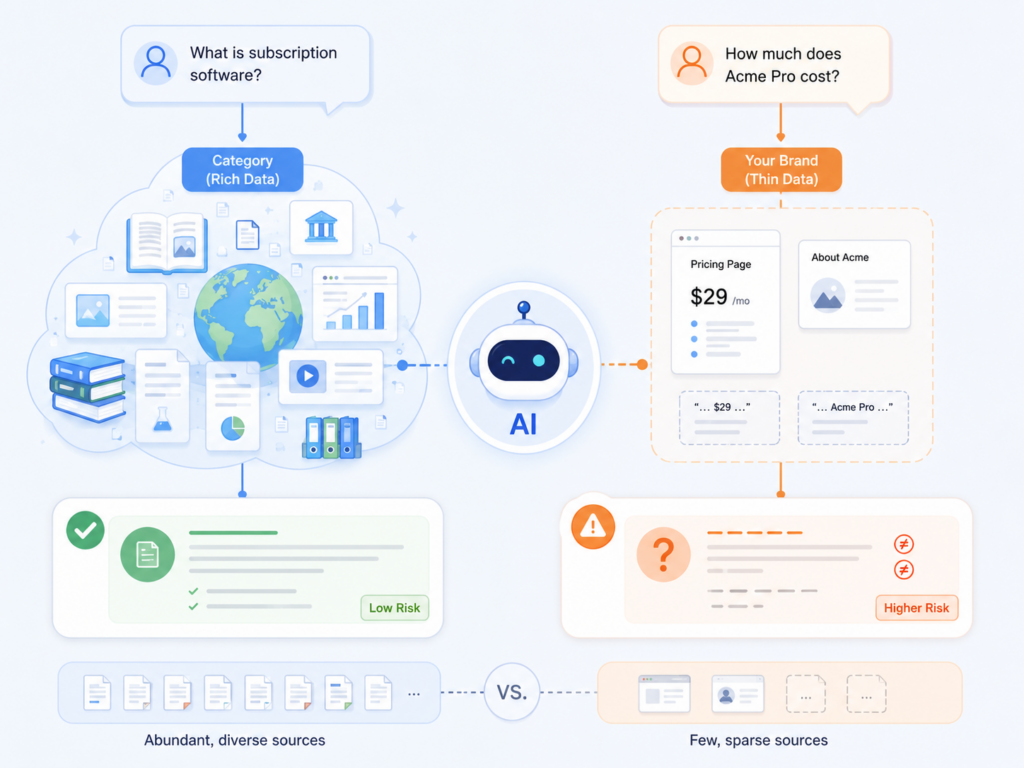
Brand facts are exactly the kind of detail that trips this up. Pricing tiers, feature lists, and executive names are what researchers call long-tail facts, and even frontier models hallucinate on 15 to 40 percent of long-tail queries, compared to 1 to 3 percent for widely documented, head-of-distribution information.
That gap matters because your brand is, almost by definition, long-tail to a general-purpose model. It hasn’t seen your latest pricing page as many times as it’s seen Wikipedia. So when a user asks about you specifically, the model is working with thinner data and higher hallucination risk than when it answers a broad category question.
The result shows up as reputation damage that nobody planned for. In 2026, 35 percent of brands report that inaccurate AI responses have already hurt their reputation. That’s not a future risk. That’s a current, measured one.
Three Ways AI Hands Your Competitor an Advantage You Never Gave Away
The damage rarely looks like an obvious lie. It shows up in three quieter patterns.
Misattribution. The model describes a feature or capability you built and credits it to a competitor instead. The user never questions it, because the answer sounds specific and confident.
Fabrication. The model invents a limitation you don’t have: a missing integration, a pricing tier that doesn’t exist, a platform you don’t support. There’s nothing to correct because there’s no source to point to.
Selective omission. In comparison queries, the model lists your competitors and simply leaves you out. This one is easy to miss because nothing looks wrong. The answer just quietly excludes you.
Part of why misattribution and omission happen so often traces back to where models pull brand information from in the first place. LLMs cite Reddit and editorial sites for more than 60 percent of brand information, not corporate websites. If a forum thread from two years ago got your positioning wrong, or praised a competitor’s roadmap item before you shipped the same thing, that’s the version the model is more likely to repeat.
None of these three paths require the model to have any opinion about you. They just require thin or skewed source material, and a user who takes the answer at face value.
Why the Market Share Leak Never Shows Up in Your Dashboards
Here’s the part that makes this different from a ranking drop or a bad review. There’s no notification.
When organic rankings slip, you see it in Search Console. When a review goes bad, you get an alert. When an AI model hallucinates your competitor into a deal you should have won, there’s no dashboard that flags it. The only signal is a deal that quietly goes quiet.
And the scale of that quiet is larger than most teams assume. 69 percent of buyers report that an AI chatbot surfaced information that led them to choose a different vendor than they’d originally planned. Separately, 49 percent of US AI users say they’re likely to try a different brand if an AI assistant suggests one as an alternative. Nearly half your funnel is persuadable by a single AI answer, and that answer might be wrong.
The timing makes it worse. Research from 6sense found that 95 percent of the time, the winning vendor was already on the buyer’s shortlist, and 80 percent of deals go to whoever the buyer contacts first. If an AI hallucination keeps you off that shortlist, or hands your spot to a competitor, you’re out before your sales team ever hears the prospect’s name.
That’s the leak. It’s not measured in impressions or click-through rate. It’s measured in deals that never had a chance to reach you.
How to Catch an AI Hallucination Before It Becomes Your Competitor’s Win
Catching this requires a different kind of monitoring than what most teams already run. Search Console tells you about Google. Nothing tells you what ChatGPT said about you an hour ago, or whether it just handed your talking point to a competitor.
Three capabilities matter here. You need to track your brand and named competitors side by side, across the same prompts, so a misattributed feature or an omitted mention is visible the moment it happens rather than months later. You need to see whether AI’s tone toward your brand is shifting, since a hallucinated flaw often shows up first as a drop in sentiment before it shows up as a lost deal. And you need this across more than one platform, because only 11 percent of domains get cited by both ChatGPT and Perplexity, meaning a hallucination that’s isolated to one engine can still sit undetected on another.
This is the gap Topify is built around. Its Dynamic Competitor Benchmarking runs your brand against named competitors on the same set of prompts, so you can see the exact moment a competitor gets credited with something that’s actually yours. Paired with Sentiment Analysis, which scores how AI’s tone toward your brand shifts over time, you get an early signal when a hallucinated claim starts pulling your perception in the wrong direction, well before it shows up as a stalled deal.
In practice, this looks less like a report you read once a quarter and more like a feed you check the way you’d check a Slack channel: a spike in a competitor’s share of voice on a prompt you used to win, tracked back to the specific query and platform where it started.
Turning a Caught Hallucination Into a Content Fix That Sticks
Catching the hallucination is half the job. The other half is figuring out why the model believed it in the first place, and closing that gap.
This is where source-level visibility earns its keep. If you can see which domains an AI platform is actually citing when it answers questions about your category, you can tell whether it’s pulling from an outdated forum post, a competitor’s comparison page, or simply nothing authoritative at all. Topify’s Source Analysis traces AI citations back to specific domains and URLs, which turns a vague “the AI got it wrong” into a specific, fixable content gap: a page you need to publish, update, or get cited more often.
Once you know the gap, closing it doesn’t have to be a manual scramble. Topify’s one-click execution lets you state the goal, review the proposed content or outreach strategy, and deploy it without building a new workflow from scratch each time.
None of this is a one-time fix. Models retrain, sources get re-crawled, and a hallucination you corrected in March can quietly resurface in a different form by summer. Treating this as a continuous loop, not a single audit, is what actually keeps the leak closed.
Conclusion
An AI hallucination about your brand isn’t a curiosity or a technical footnote. It’s a market share problem that moves quietly, one AI answer at a time, without ever showing up in the metrics you already watch. The brands catching it early aren’t the ones with the flashiest AI strategy. They’re the ones who built a way to see what AI is actually saying, before a competitor’s win depends on it.
FAQ
Q: What causes an AI hallucination about a brand?
A: It usually comes down to thin or skewed source data. Brand-specific facts like pricing or feature details are long-tail information that models have seen less often, so they’re more prone to filling gaps with plausible-sounding but incorrect answers, especially when the model’s main sources are outdated forum posts or third-party reviews rather than your own site.
Q: How can I tell if an AI hallucination is actually costing me customers?
A: There’s rarely a single smoking gun. The clearer signal is a pattern: a drop in AI-driven inquiries that coincides with a competitor gaining unexplained visibility on prompts you used to win, or a noticeable dip in how positively AI models describe you. Cross-platform tracking that compares you against named competitors is typically what surfaces this.
Q: Can you stop ChatGPT or other AI models from hallucinating about your brand?
A: Not entirely. You can’t control how a public model like ChatGPT generates answers. What you can do is reduce the frequency by making accurate, well-structured brand information easier for the model to find and cite, which tends to crowd out the outdated or third-party sources that cause hallucinations in the first place.
Q: How is this different from tracking search rankings?
A: Traditional SEO tracks position on a results page you can see. AI answers don’t have a visible ranking, and the model synthesizes a single response rather than listing options. Monitoring for AI hallucinations means checking what the model actually says about you and your competitors across specific prompts, not where you’d rank on a page that doesn’t exist in this format.

