A publisher enables paid crawler access and immediately faces a number it has never had to set: the price of one successful retrieval. Pageview revenue is an obvious reference, but it does not capture how an AI product may reuse a specialist page, how often a crawler must refresh it, or how easily the buyer can substitute another source. A high rate can turn valuable content invisible. A low rate can generate activity without meaningful return.
AI crawler pricing should begin as a measured experiment, not a declaration of what content is “worth.” The first rate needs to preserve learning, expose real demand, and create enough separation between commodity and distinctive content to support later decisions. That requires content tiers, buyer-value assumptions, stop-loss rules, and simultaneous visibility monitoring.
Crawler pricing cannot start with pageviews alone
Advertising revenue per pageview measures value created when a person loads a page. A crawler retrieval is a different event. It may support an answer, search result, recommendation, internal index, or no downstream use at all. The buyer often does not know which outcome will occur when it fetches the content.
That uncertainty is one reason Cloudflare distinguishes Pay Per Crawl from its newer Pay Per Use model. Pay Per Use ties payment to a defined downstream use, while Pay Per Crawl prices access. A crawl price therefore needs to account for the probability that the fetched page is useful, not assume every retrieval creates maximum value.
Start with a range rather than a single “fair” number. The lower bound should cover transaction, infrastructure, and administration costs at plausible volume. The upper bound should reflect the price at which a rational crawler is likely to choose a substitute or stop refreshing the page.
The goal of an initial test is to learn the demand curve between those bounds.
Segment content by uniqueness, freshness, and substitution risk
One domain can contain commodity explainers, original datasets, breaking news, public service information, and premium analysis. A single undifferentiated price ignores how differently buyers value those pages.
Create content tiers using three variables:
- Uniqueness: how difficult is it to obtain equivalent evidence elsewhere?
- Freshness value: how much does a recent version improve an answer?
- Substitution risk: how quickly can a buyer replace the page with a free source?
Original local reporting with frequently updated facts may score high on uniqueness and freshness. A glossary definition may have low uniqueness and high substitution risk. A static research archive can be unique but require infrequent refreshes.
| Content tier | Typical material | Pricing posture | Main risk |
|---|---|---|---|
| Open discovery | About, policies, public documentation | Free or very low | Losing broad discovery if priced |
| Commodity reference | Generic definitions and summaries | Low | Buyer chooses a free substitute |
| Distinctive editorial | Original reporting and expert analysis | Medium | Underpricing production value |
| Time-sensitive data | Prices, alerts, schedules, live research | Medium to high | High refresh cost for the buyer |
| Strategic asset | Proprietary dataset or premium archive | Direct license or high controlled rate | Misaligned rights and access terms |
Keep public discovery pages free when they help crawlers understand the entity, authors, policies, and structure of the publication. Charging for every URL can make the site harder to evaluate before a buyer knows whether premium access is useful.
Estimate the buyer's probable downstream value
You will not know a buyer's exact economics, but you can make explicit assumptions. Estimate how often the page is likely to support a relevant answer, how long the fact remains current, how many substitutes exist, and whether the content affects a commercial or high-stakes decision.
Avoid multiplying an imagined audience by an imagined conversion rate and calling the result value. Use ranges. A specialist comparison that influences a high-value purchase can be more useful than a popular definition, but only if the AI product retrieves and uses it.
The expected value of one crawl can be framed as:
probability of downstream use × value per use − processing and risk cost
This is a buyer-side model, not a publisher entitlement. The crawler will compare your price with alternative sources, internal generation, cache reuse, and the option to omit the evidence.
For frequently changing pages, include refresh frequency. A $0.01 access price applied once is different from the same price applied to hourly recrawls. Cloudflare's current FAQ says repeat successful crawls can each be charged, which makes freshness cadence part of the buyer's effective cost.
Set a discovery-preserving floor and ceiling
Cloudflare currently documents a minimum price of $0.01 per successful crawl. That platform constraint is not proof that one cent is economically optimal. It is simply the lowest documented setting for the current flow.
Set the floor using direct costs and the value of keeping the market observable. If the minimum price already exceeds the likely value of commodity pages, keep those pages free rather than forcing them into a paid tier.
Set the ceiling using substitute availability and lost-discovery tolerance. A page with many equivalent sources has a low ceiling. A unique dataset may justify a higher ceiling, but direct licensing could fit better than per-request pricing if rights, update frequency, and volume require negotiation.

Use a narrow opening range. Large price jumps make it difficult to separate price sensitivity from crawler or platform changes.
Run price tests without contaminating access data
A useful test compares similar content under controlled policies. Choose one paid cohort and one free cohort with comparable topic, quality, age, and existing visibility. Keep robots rules, rendering, canonicals, and page structure stable during the test.
Measure successful paid retrievals, 402 responses, crawler identity, unique URLs, repeat frequency, payout, and operational exceptions. On the visibility side, capture citations, mentions, recommendation position, and relevant referral traffic before and after the price change.
Do not test multiple prices, rewrite the content, change internal links, and move the URL in the same week. The business may accept that bundled rollout, but the resulting data will not isolate price response.
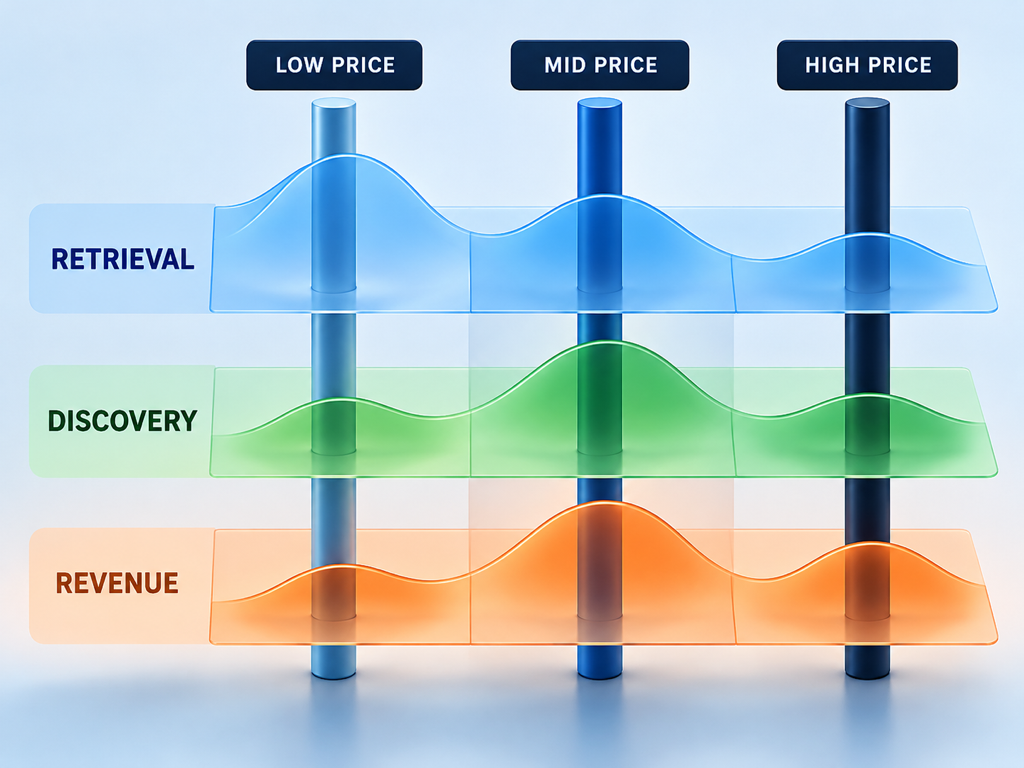
Run the test long enough to cover normal crawl cycles and answer variability. Label the result descriptive when the buyer sample is small.
Add stop-loss and renegotiation rules
Set thresholds before revenue begins. A stop-loss might pause paid access when citation share or verified search discovery falls beyond an agreed range, when crawler authentication fails repeatedly, or when dispute handling consumes too much staff time.
Also define success beyond gross fees. Net revenue should subtract platform, payment, support, and infrastructure costs. Distribution success should include citations and mentions, not just referral clicks. Strategic success may include licensing conversations or stronger knowledge of crawler demand.
Review prices when one of these conditions changes:
- the content becomes more or less substitutable;
- update frequency changes materially;
- a buyer begins requesting at a new scale;
- a direct license becomes available;
- the platform changes minimums, supported pricing, or settlement terms;
- visibility drops without adequate compensation.
Pricing is a policy loop, not a one-time field.
Use Topify to watch visibility while rates change
Topify can provide the answer-level control panel for a crawler-pricing experiment. Define prompts that depend on each priced content tier, capture a baseline by AI platform, and then monitor visibility, position, sentiment, and cited sources while the access policy changes.
Topify's public Sources Analytics documentation describes date filters, provider filters, citation totals, top domains, performance series, and opportunity sources. Pair those measures with Cloudflare's charged responses, price, repeat access, and payout. This lets a publisher see whether revenue grew while citation presence held, whether a buyer stopped fetching but other sources replaced the page, or whether a high price coincided with a measurable visibility loss. Topify cannot observe rejected buyers' private willingness to pay or prove that price caused an answer change. Use it as one evidence layer alongside access and financial records. Why AI Stops Citing Your Brand provides a useful diagnostic path when citations fall despite successful access.
Conclusion
AI crawler pricing works best when the first rate is designed to learn. Segment pages by uniqueness, freshness, and substitution risk; preserve free entity and discovery content; and reserve higher rates or direct licenses for material that buyers cannot easily replace. Model repeat access and acceptance, not just the configured price.
Run a bounded test with a comparable free cohort, predeclared stop-loss rules, and clean infrastructure controls. Reconcile successful charges with net revenue and observe the answer layer at the same time. Topify citation-source monitoring can help reveal whether paid access preserves or weakens visibility, so the next price decision reflects total content value rather than crawl fees alone.
FAQ
What is a reasonable starting price for an AI crawler?
There is no universal market price. Start within platform limits using content uniqueness, freshness, substitution risk, expected volume, and discovery value, then test a narrow range.
Should every page on a domain have the same crawl price?
Usually not. Public discovery pages, commodity content, original reporting, and proprietary data have different access economics and strategic roles.
Does a higher price always produce more publisher revenue?
No. A higher rate can reduce paid retrieval volume when crawlers choose free substitutes or stop refreshing the content.
How should publishers measure a pricing test?
Track paid access, 402 responses, repeat frequency, net payout, operational cost, citations, mentions, source share, and referrals against a pre-test baseline and a comparable free cohort.