

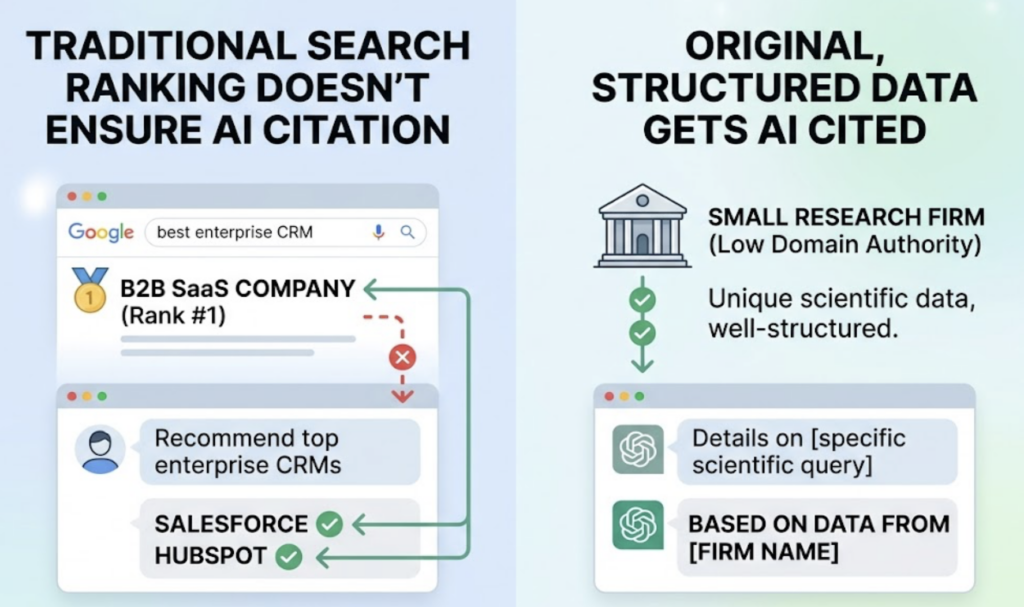
Your site ranks #1 on Google for “best enterprise CRM.” You’ve got the backlinks, the domain authority, the optimized title tag.
Then a prospect asks ChatGPT for a recommendation. It names Salesforce and HubSpot, with detailed reasoning. Your brand doesn’t appear.
That prospect never searches Google. You never know they existed.
This is the core problem with running a single-channel visibility strategy in 2026. Google rankings and AI citations are two parallel systems that measure entirely different things. Most marketing teams are only watching one of them.
Google and AI Engines Don’t Agree on What “Authority” Means
Traditional search engines like Google are built around an index. Pages earn authority through backlinks and keyword relevance. Success is measured in SERP positions and click-through rates. The output is a list of URLs.
Generative AI platforms work differently. They use Retrieval-Augmented Generation (RAG) to pull “chunks” of information from across the web and synthesize them into a single answer. There’s no list of links to click. There’s just the answer, and the sources that trained it.
| Feature | Google Search | ChatGPT / Perplexity |
|---|---|---|
| Core mechanism | Indexing & ranking | RAG synthesis |
| Success metric | SERP position + clicks | Citation frequency + sentiment |
| Content logic | Keyword relevance + backlinks | Information density + entity clarity |
| User behavior | Navigates to website | Reads the answer directly |
| Authority signal | Domain Authority / PageRank | Third-party consensus + fact verification |
These two logics regularly produce different winners. Research shows that only 17% to 38% of pages cited in Google’s AI Overviews also rank in the traditional top 10 organic results. Even more revealing: nearly 31% of AI citations come from pages that don’t appear in the top 100 Google results for the same query.
A strong Google ranking is no longer a reliable predictor of AI citability.
The Traffic That Disappears Before It Hits Analytics
Here’s the attribution gap nobody talks about enough.
When a user sees your brand in a ChatGPT answer, two things can happen. They click the source link (if there is one). Or they close the chat, open Google, and search your brand name directly. Either way, your GA4 dashboard often can’t tell you that AI was involved.
The zero-click problem is already significant. Around 60% of all searches end without a click, and for queries that trigger AI Overviews, that number jumps to 83%. Users get the answer they need and move on.
When clicks do happen from AI platforms, referrer headers are frequently stripped. A study of over 446,000 visits found that 70.6% of AI-referred traffic lands in GA4 without identifiable referrer data, classified as “Direct.” You’re looking at high-intent visitors and calling them anonymous.
This matters because AI-referred users convert differently. Users arriving from ChatGPT convert at a transactional rate of 10.21%, compared to 2.46% for non-AI sources. You’re likely misattributing some of your highest-quality traffic.
The second pattern is subtler: branded organic search as a proxy. A user sees your brand mentioned in a Perplexity answer, doesn’t click, then Googles your name later. GSC shows a branded search. You assume it’s word-of-mouth or a returning user. The AI’s role as the catalyst stays hidden without cross-platform correlation.
Why Your Best SEO Pages Often Get Ignored by AI
This is the part that surprises most SEOs: content optimized for Google rankings tends to underperform for AI citations, often because of how it’s structured.
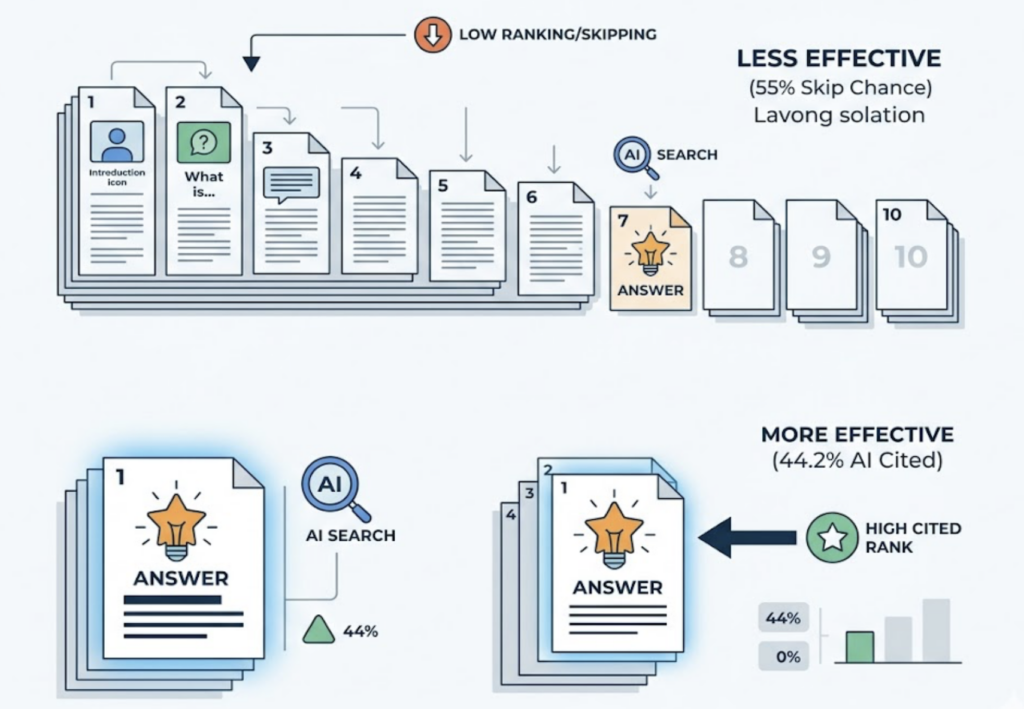
AI systems using RAG extract information efficiently. They don’t read the way humans do. Data shows that 55% of Google AI Overview citations and 44.2% of ChatGPT citations come from the first 30% of a document. If your definitive answer is buried under an intro, a subheading, and three paragraphs of context, the AI may simply skip to a source that front-loads its answer.
There’s also the consensus problem. LLMs are designed to minimize hallucination risk by seeking agreement across multiple sources. A brand-owned page is inherently self-promotional. If you claim to be “the fastest platform in the category” on your own blog but that claim isn’t echoed in Reddit threads, G2 reviews, or independent writeups, the AI discounts it.
That’s why forum posts and community discussions frequently out-cite official brand websites in AI answers. The AI isn’t impressed by your domain authority. It’s looking for consensus.
Google’s move to Gemini 3 as the default AI Overviews model in early 2026 made this worse. Gemini 3 uses a process called “query fan-out,” breaking a single user search into multiple related sub-queries. Pages that rank for the main keyword but don’t demonstrate relevance across the full intent cluster get passed over. Pages ranking for both the main query and at least one fan-out sub-query are 161% more likely to be cited.
What an AI Citation Tracker Actually Monitors
Standard analytics tools weren’t built for this. Google Search Console shows you keywords and clicks. GA4 shows you sessions and conversions. Neither shows you what AI is saying about your brand.
An AI citation tracker like Topify monitors several dimensions that are invisible to those tools:
Prompt triggering. Which specific questions and natural-language prompts cause an AI to mention your brand? Not just branded queries, but category-level questions where you should be the answer.
Recommendation position. Being the first brand named in an AI response is fundamentally different from appearing fifth in a list. Both count as a “mention.” Only one influences decisions.
Source attribution. Which URLs is the AI actually citing to justify its recommendation? Often it’s a third-party review site or a forum thread, not your own product page. That tells you exactly where to focus.
Sentiment and framing. A high-visibility mention that describes your product as “expensive and complex” is a net negative. Topify’s Sentiment Analysis tracks whether the AI is actively recommending you or just acknowledging your existence.
Topify’s Source Analysis feature goes one layer deeper: it identifies “Citation Gaps,” meaning the prompts where competitors are being recommended, and the specific sources (G2, TechCrunch, Reddit) the AI is using to justify those recommendations. That’s not just tracking. That’s competitive intelligence.
When the Two Signals Disagree, That’s Where the Problem Lives
Mismatches between Google ranking and AI citation aren’t random. They point to specific structural problems. A simple four-quadrant read tells you what to fix:
| High AI Citation | Low AI Citation | |
|---|---|---|
| High Google Ranking | Market Leader: maintain freshness, monitor competitor fan-out queries | Invisibility Paradox: domain authority without machine-readable structure |
| Low Google Ranking | Authority Anomaly: deep expert content, weak SEO technicals | Visibility Crisis: invisible across both layers |
High Google, Low AI (Invisibility Paradox). Your content has authority but isn’t structured for extraction. The fix: rewrite introductions to lead with the answer, add structured data, and build third-party mentions on Reddit and G2.
Low Google, High AI (Authority Anomaly). You have expert content that AI trusts, but lack backlinks or technical SEO fundamentals. Leverage your AI authority to attract the links and visibility that lift your rankings.
Low Google, Low AI (Visibility Crisis). Both layers are weak. Start with foundational E-E-A-T content, PR campaigns, and structured entity coverage before worrying about citations.
High Google, High AI (Market Leader). Don’t coast here. Monitor competitor fan-out queries and maintain a content refresh cycle of 14 days for high-value pages. AI citation data decays fast: frequency typically drops to 40% of its initial level within 90 days.
The case studies are telling. A B2B SaaS company might rank #1 for “best enterprise CRM” on Google but get skipped entirely by ChatGPT, which cites Salesforce and HubSpot’s deeper integration ecosystems and community discussions. The company’s ranking delivers clicks, but loses the pre-qualified leads who use AI for vetting. On the flip side, a small research firm with low Domain Authority gets cited by Perplexity 80% of the time for scientific queries because their original, structured data has no competition.
How to Track Both Without Doubling Your Workload
The goal isn’t to run two separate visibility operations. It’s to integrate AI citation data into your existing search workflow.
Step 1: Build a Prompt Map. Instead of tracking keywords, identify 30-50 high-intent prompts that mirror your customer’s actual questions, from informational (“how to…”) to comparison queries (“X vs Y”). Run these prompts through ChatGPT, Gemini, and Perplexity using a tool like Topify to establish your baseline Share of Voice and Sentiment Score.
Step 2: Correlate AI visibility with GSC data. Look for a rising relationship between your AI mention rate and branded query volume in Search Console. This gives you indirect attribution: if Topify shows your AI mentions increased 40% and GSC shows branded search up 25% in the same period, you have a defensible business case for GEO investment.
Step 3: Optimize for the CITABLE framework. For content that ranks well but earns no AI citations, apply these principles: lead with a 2-3 sentence direct answer (Bottom Line Up Front), map content to multiple sub-queries for fan-out coverage, ensure your claims are echoed on third-party platforms, and format content into 200-400 word self-contained sections that RAG systems can extract cleanly.
Step 4: Run a quarterly discrepancy audit. Pull your top 100 GSC pages by traffic. For each, check its AI citation rate in Topify. Pages with high organic traffic but zero AI citations are at risk as AI Overviews expand. These are your highest-priority structural optimization targets.
Freshness matters more than most teams expect. AI systems cite content that is, on average, 25.7% newer than traditional Google search results. ChatGPT has been observed to prefer URLs that are 393 to 458 days newer than the organic average. A “publish and forget” model doesn’t work here.
Conclusion
Google rankings aren’t going away. They remain the foundation of web traffic and domain authority. But they no longer tell the full story of whether your brand is being discovered.
AI citations operate on a different set of rules: structure over backlinks, consensus over self-promotion, answer density over narrative flow. Brands that only optimize for one system are leaving half the picture dark.
The practical shift isn’t complicated. Use GSC to defend your search layer. Use an AI citation tracker like Topify to monitor the chat layer. Then look at where those two signals disagree. That gap is where your highest-value optimization opportunities are hiding.
The brands that win in 2027 won’t just be search results. They’ll be sources of truth.
FAQ
What is an AI citation tracker?
An AI citation tracker is a tool that monitors how large language models like ChatGPT, Claude, and Perplexity reference your brand. Unlike SEO tools that track link positions, these tools monitor your Share of Voice in AI answers, where your brand appears within a generated response, which URLs the AI cites to support its recommendation, and whether the framing is positive, neutral, or negative.
Can I use Google Analytics to track AI mentions?
Not directly. GA4 only captures users who click a link and arrive at your site. Because most AI interactions are zero-click, and because referrer headers are frequently stripped, GA4 often classifies this traffic as “Direct.” You need a combination of custom referral tracking in GA4, branded query volume in GSC as a proxy for unlinked mentions, and a dedicated AI visibility tool to get close to the full picture.
How often does AI citation data change?
Significantly more often than Google rankings. Google’s AI Overviews can replace up to 45% of their cited sources in a single update, and industry coverage rates can swing 30% within a month. Content updated within the last 14 days earns roughly 2.3x more citations than older content, making regular page refreshes a core part of citation strategy.
Does being cited by AI help my Google rankings?
Indirectly, yes. Being cited as a source in an AI Overview has been shown to increase a URL’s organic CTR on that same page by 35%. Over time, the increased branded search volume and engagement signals that AI recommendations generate provide positive inputs into traditional Google rankings. The two systems are separate but interconnected.

