A publisher fixes an outdated pricing table at 9:00 a.m., confirms the live page is correct, and still sees an old claim reflected in an AI answer days later. The page changed, but the systems that discover, retrieve, and cite web content did not necessarily notice at the same time. That timing gap makes content operations harder: teams can publish correctly yet judge the result before an AI search crawler has had a fair chance to revisit the URL.
AI crawler change signals are meant to reduce that gap. They can help a crawler decide which pages are worth revisiting, but they are not an express lane to a citation. The useful question is therefore not “How do we force a recrawl?” It is “How do we make meaningful changes easier to discover, then measure what happens next?”
AI crawler change signals prioritize revisits, not rankings
An AI crawler change signal is information that suggests a page has materially changed since an earlier visit. The signal might come from a publisher-controlled source such as a sitemap timestamp, or from infrastructure that can observe that the content served at a URL changed.
In October 2026, Cloudflare described a research pilot with OpenAI in which signals from Cloudflare's network helped OpenAI's search crawler identify useful new and changed pages. Cloudflare framed the mechanism as a way to tell a crawler when a page is worth another visit and when it is not. The company also stressed that change signals do not grant a crawler access. Existing robots rules and other access controls still apply.
That distinction matters. A discovery signal can influence when a URL enters a crawl queue. It does not decide whether the page will be retrieved for a prompt, whether its passages are useful, or whether ChatGPT will cite it in an answer.
The mechanism is closer to a newsroom tip than a guaranteed headline. It says, “Something worth checking may have happened here.”
Faster discovery matters most when the answer has changed
Not every edit deserves rapid recrawling. Fixing a typo in a paragraph and replacing a discontinued product price carry different consequences for a user. A sensible change-signal strategy starts by separating cosmetic edits from changes that alter an answer.
High-priority changes usually include prices, availability, eligibility rules, product specifications, release status, safety information, official policies, and time-sensitive research findings. These facts can make an AI answer wrong even when the answer's general topic remains correct.
Medium-priority changes include a newly added comparison row, a clarified implementation step, or a stronger primary source. They improve usefulness but may not make yesterday's answer actively misleading. Low-priority changes include typography, tracking parameters, navigation labels, and other presentation changes that do not alter the page's substantive claims.
| Change type | Example | Recrawl urgency | What to verify later |
|---|---|---|---|
| Material fact | Price, plan limit, policy, compatibility | High | Old fact disappears from relevant answers |
| Availability | Beta opens, market expands, product retires | High | Answer reflects current status and date |
| Evidence | New study, official documentation, methodology | Medium to high | Source selection or cited passage changes |
| Explanation | Better workflow, comparison, or definition | Medium | More precise answer framing appears |
| Presentation | Layout, styling, analytics tag | Low | No citation test needed unless content also changed |
The table also prevents a common operational mistake: treating every content management system update as a substantive event. A crawler does not benefit from revisiting thousands of pages because a footer year changed.
The Cloudflare and OpenAI pilot changes discovery economics
Traditional recrawl systems must decide where to spend finite resources using signals that may be incomplete or delayed. A crawler can revisit popular pages too often while missing a less prominent page that received an important correction. Infrastructure-level change signals create another input for that allocation decision.
Cloudflare said its research pilot began in July 2026 on roughly one percent of its network and exposed hundreds of millions of new pages to the discovery process. Those figures describe the pilot's scale, not guaranteed coverage for a particular publisher. The practical implication is narrower: an infrastructure provider can observe changes across a large part of the web and notify a search crawler without turning that notification into permission.
This can reduce two forms of waste. The crawler spends fewer requests confirming that unchanged pages are still unchanged, while publishers have a better chance of getting meaningful updates noticed without relying only on broad recrawl cycles.
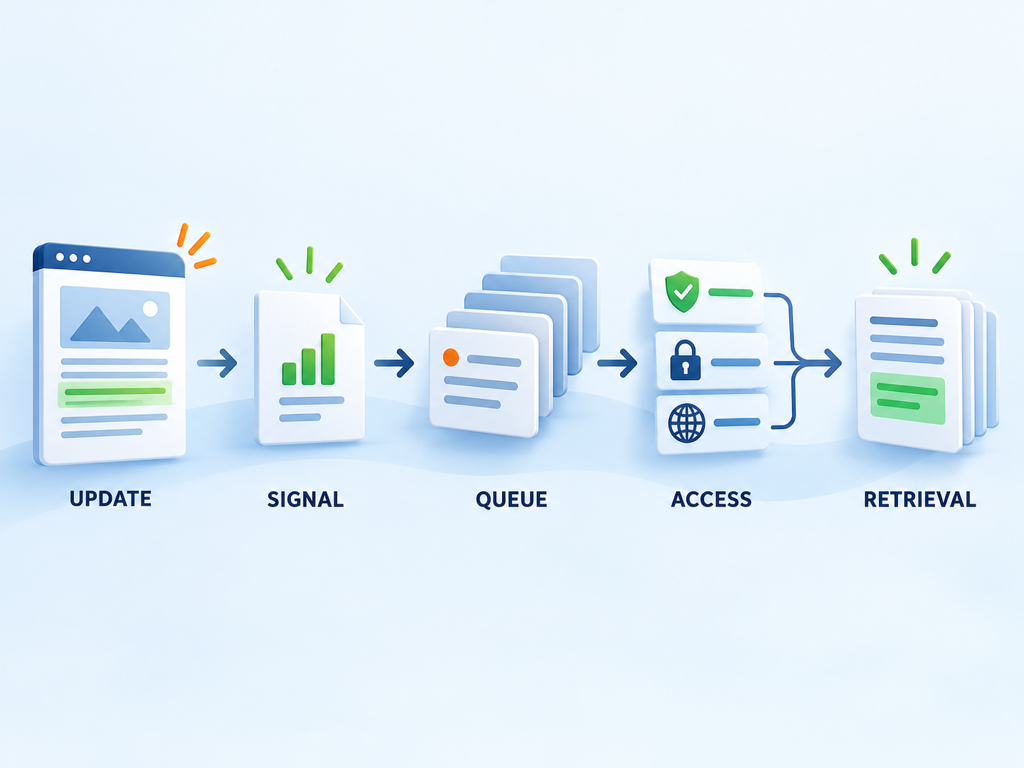
The system still contains independent gates. Discovery decides what may be fetched. Access rules decide what can be fetched. Retrieval decides what is relevant to a prompt. Citation decides what evidence the answer should expose. Collapsing those gates into a single “indexed” status produces bad diagnosis.
Signal changes that alter the page's claim or decision
A useful internal rule is to signal changes when a reasonable reader would make a different decision after seeing the new version. That test is stricter than “the HTML changed” and easier for an editorial team to apply than an abstract importance score.
Start by defining material fields for each content type. A product page might treat price, stock, compatible platforms, and shipping regions as material. A policy page might prioritize effective dates, covered users, exceptions, and enforcement terms. A research article might prioritize dataset size, methodology, finding, and limitation.
Then connect publication workflows to those fields. When an editor changes a material field, record the URL, release time, previous value, new value, and reason. That release log becomes the beginning of a discovery experiment rather than a vague note that “the page was updated.”
Structured data and visible copy should agree. A price change in JSON-LD that conflicts with the page a user reads does not create a better source. It creates two versions of the truth at one URL.
Noisy signals can make your own measurements less useful
Publishers sometimes update timestamps automatically, rebuild pages on every deployment, or expose infinite URL variations through filters and parameters. Those behaviors make a site look constantly fresh even when the underlying answer has not changed.
Noise creates three problems. It consumes crawl attention, makes server logs harder to interpret, and contaminates experiments because the team cannot identify which release might have influenced an answer. It can also hide a material update inside a stream of trivial changes.
Use stable canonical URLs, accurate lastmod values, consistent status codes, and deterministic rendering. Do not touch a modification date merely to imply freshness. For pages assembled from multiple services, calculate whether a meaning-bearing component changed rather than treating any component build as a new editorial version.

Bottom line: signal quality is an editorial governance problem as much as a technical one.
Measure discovery separately from retrieval and citation
The first measurement question is whether the crawler returned after the release. Server or CDN logs can provide evidence when the crawler identity is verifiable, but user-agent strings alone are not reliable proof. OpenAI publishes an overview of its crawlers and their documented IP ranges, including the distinct roles of OAI-SearchBot, GPTBot, ChatGPT-User, and OAI-AdsBot.
The second question is whether AI answers changed. Build a fixed set of prompts tied to the corrected claim, capture a baseline before release, and rerun them on a defined cadence. Record answer text, linked sources, unlinked mentions, dates, model or surface, and test region. Do not substitute referral traffic for citation evidence because most answer impressions never create a site visit.
Treat these as separate timestamps:
- Release time: the corrected page became publicly available.
- First verified revisit: a relevant crawler fetched the page.
- First changed answer: a monitored response reflected the new fact.
- First citation: the updated URL or passage appeared as evidence.
A missing timestamp narrows the diagnosis. No revisit suggests discovery or access trouble. A revisit with no changed answer suggests retrieval, relevance, or evidence quality. A changed answer with no citation may still indicate an unlinked influence, but it should not be reported as a citation win.
Topify closes the citation side of the feedback loop
Infrastructure logs can show visits, but they cannot tell you how often an AI answer mentioned your brand, which URL it cited, or whether a competitor replaced you. Topify can provide that downstream observation layer by running a defined prompt set across supported AI surfaces and tracking visibility, position, sentiment, and source behavior over time.
In practice, you would tag the prompts connected to a changed page, record the release date, and compare post-release answers with the pre-release baseline. Topify's documented Sources Analytics can organize cited domains, citation counts, trends, and opportunity sources. That output supports a decision about whether to wait, improve the page, or build stronger third-party corroboration. It does not prove that a particular change signal caused a citation, and sampled AI responses remain variable. Use the trend as evidence, not as a deterministic attribution claim.
This workflow pairs well with Topify's explanation of Why Your Log Files Can’t Tell AI Agents from Bots, which shows why access telemetry and answer visibility need different measurement systems.
Conclusion
AI crawler change signals can shorten the distance between a meaningful page update and a crawler's next visit, but they do not bypass access controls or guarantee retrieval, recommendation, or citation. The right operating model is to signal only decision-changing updates, keep canonical and timestamp data clean, and measure four events separately: release, revisit, answer change, and citation.
Start with five pages where stale information creates real user harm. Define their material fields, log one controlled update, and monitor a fixed prompt set. A Topify AI visibility baseline can then show whether the answer and source layer changed after the technical discovery event. That turns recrawling from a hope into a testable content operation.
FAQ
Do change signals force OAI-SearchBot to crawl a page?
No. A change signal can help prioritize discovery, but the crawler still makes its own scheduling decision and must follow applicable access controls.
Should publishers update the lastmod date on every deployment?
No. Use lastmod for meaningful content changes. Automatic timestamp churn makes the signal less informative and weakens later measurement.
How soon will ChatGPT cite an updated page?
There is no guaranteed interval. Discovery, crawl access, retrieval, answer generation, and citation are separate systems, so teams should measure each stage rather than promise a fixed delay.
Is crawler traffic enough to prove AI visibility improved?
No. Traffic proves a request reached the site. AI visibility requires separate evidence from monitored answers, mentions, positions, and citations.