Publishing the same claim on more websites does not create a stronger evidence base. It creates repetition. AI citation source diversification is the practice of making important brand and product claims verifiable through several credible source roles: accurate first-party pages, independent testing, expert explanation, customer experience, standards, and current profiles. The goal is resilience and completeness, not mention volume. A diversified portfolio should survive the loss of one page without producing contradictory facts. It should also help an AI system answer different questions with the source best suited to each claim.
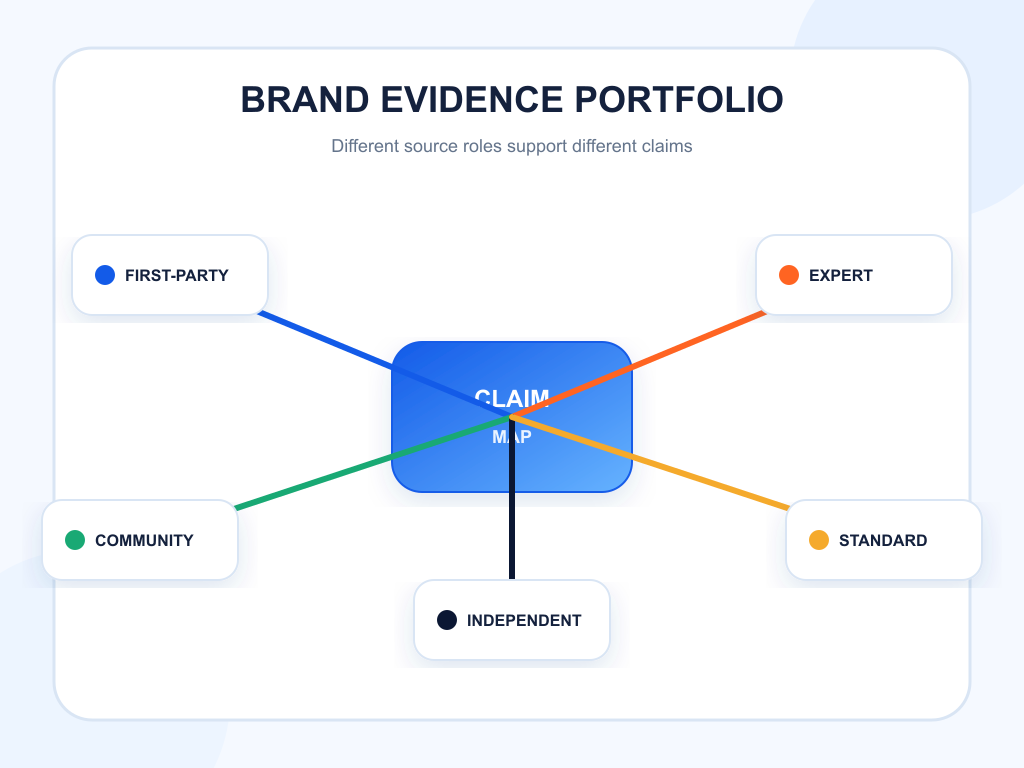
Diversification Starts With a Claim Map
List the claims that matter in AI answers: what the company does, who it serves, current features, pricing, availability, integrations, performance, limitations, reputation, and category comparisons. Assign an owner and current source for each claim.
Then classify the evidence role the claim requires. Official pricing should come from the company. Comparative performance needs independent methodology. User-experience questions benefit from real customer evidence. Regulatory or technical requirements should point to an authoritative standard or public authority.
This prevents random outreach. The plan begins with missing evidence, not a list of publishers.
Strengthen the First-Party Source of Truth
Diversification fails when the brand’s own facts are vague or inconsistent. Create canonical pages for company identity, product capabilities, pricing, policies, documentation, support, and current availability. Use clear dates where freshness matters and name the team or expert responsible for reviewed content.
Keep titles, headings, visible copy, structured data, profiles, and feeds aligned. Do not place a current price in schema while the page shows an old value. Retire or redirect obsolete pages so retrieval systems do not choose the wrong version.
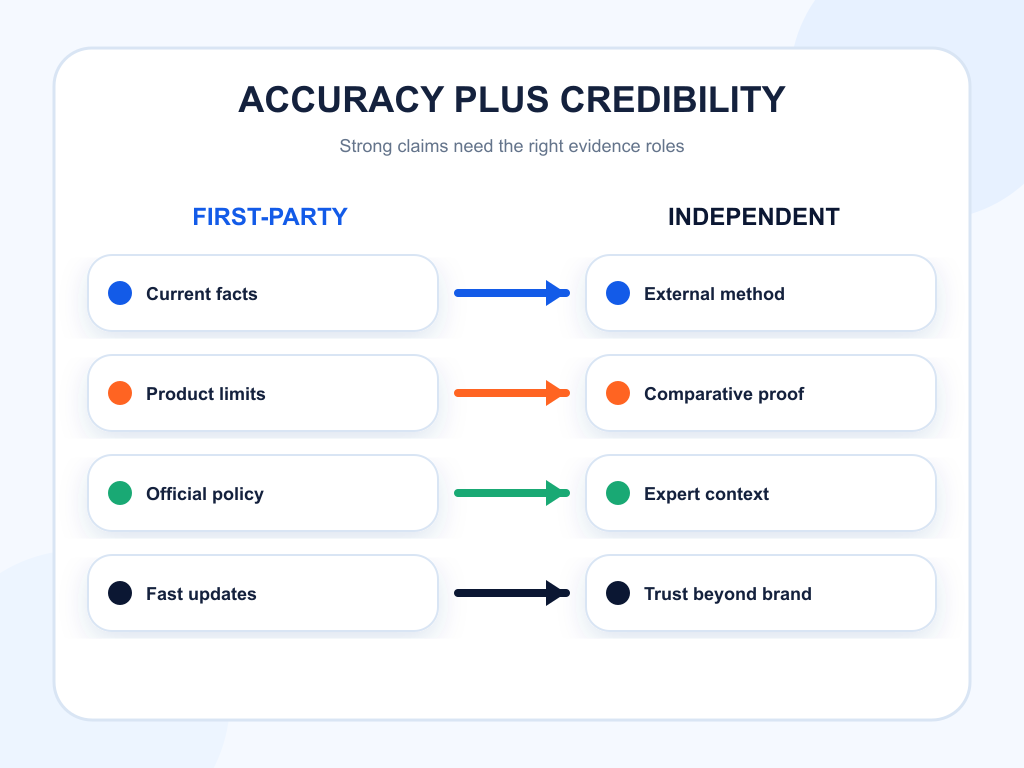
First-party evidence supplies control and current facts. It should not pretend to be independent validation.
| Source role | Best claim type | Trust strength | Brand control | Update cadence | Practical action |
|---|---|---|---|---|---|
| First-party product page | Current capability, price, availability | Canonical facts | High | At every product change | Create one maintained owner page |
| Documentation or support | Setup, limits, troubleshooting | Operational specificity | High | Continuous | Link exact tasks and known constraints |
| Independent test | Comparative performance | Method-based validation | Low | Per test cycle | Provide reproducible access and evidence |
| Expert publication | Explanation and category context | Editorial expertise | Low | As field changes | Contribute original data or analysis |
| Customer or community source | Real experience and edge cases | Lived evidence | Low | Ongoing | Support authentic participation, not scripts |
| Standard or authority | Definitions and requirements | High formal authority | None | On official revision | Reference the exact current document |
Earn Independent Evidence Instead of Syndicating Claims
Independent sources add value when they apply their own method, judgment, or experience. Give analysts and reviewers accurate access to the product, documented limitations, and reproducible facts. Do not require a favorable conclusion.
Original research can create useful editorial opportunities. Publish the methodology and underlying definitions so others can evaluate the claim. A statistic without a sample, period, or method may spread widely but remain weak evidence.
Avoid mass guest posts that repeat the same marketing paragraph. AI systems and readers need corroboration, not duplicate copy.
Cover Different Decision Roles
A resilient portfolio is not only a collection of domains. It covers the stages of a decision. Awareness content explains the category. Evaluation content compares criteria. Documentation proves implementation. Policy pages answer risk questions. Customer evidence reveals practical use.
Map prompts and grounding queries to these roles. If the brand appears in educational answers but not evaluation prompts, another broad explainer may not help. The missing source could be an independent comparison, a pricing clarification, or a credible case study.
Use Topify to monitor which sources support brand and competitor answers for selected prompts. Source gaps should lead to specific evidence work, not a generic “get more mentions” campaign.
Align Profiles and Distributed Facts
Company profiles, partner directories, marketplaces, social bios, review listings, and knowledge panels often repeat core identity facts. Audit names, descriptions, URLs, logos, locations, and product categories for consistency.
Consistency does not mean identical copy everywhere. Each platform has a purpose and audience. The underlying facts should agree while the explanation adapts to context.
Prioritize sources that are already retrieved for relevant answers. Correct stale high-impact profiles before creating new low-authority listings. Document where each fact is maintained so future changes propagate quickly.
Keep Community Evidence Authentic
Forums, social networks, and customer communities can reveal real strengths and limitations. They can also become spam targets. Do not seed undisclosed endorsements, fabricate reviews, or coordinate repetitive promotional replies.
Support subject-matter experts in answering genuine questions transparently. Make official documentation easy to cite. Invite customers to share experience without prescribing conclusions. Moderate owned communities and preserve corrections.
Authentic community evidence is valuable because it contributes independent context. It loses that value when it reads like a campaign script.
Prevent Contradiction as the Portfolio Grows
More sources create more maintenance paths. Build a claim registry with the canonical value, owner, last verified date, dependent pages, and high-impact external profiles. Monitor for changes in price, limits, availability, company identity, policies, and product names.
When an old source cannot be edited, publish a current canonical statement and contact the publisher where appropriate. Do not create additional pages that repeat the correction without ownership.
Use answer monitoring to catch contradictions. If one engine describes the brand as free and another cites current paid pricing, inspect the supporting sources before rewriting content.
Measure Resilience, Not Raw Source Count
Track unique credible domains, source-role coverage, top-one and top-five concentration, cross-engine overlap, claim consistency, and the share of high-value prompts supported by more than one appropriate evidence role.
Run loss simulations by removing the top source and recalculating coverage. A portfolio is more resilient when important claims remain supported and the brand remains accurately represented.
Do not set a universal number of sources. A niche technical claim may need one official standard and one expert implementation guide. A consumer product recommendation may require wider independent and customer evidence.
Build a 90-Day Diversification Plan
Days 1 through 30: audit claims, canonical pages, dominant sources, and contradictions. Fix first-party inaccuracies before outreach.
Days 31 through 60: prioritize two evidence gaps tied to valuable prompt or topic groups. Produce one original asset and one documentation improvement. Prepare accurate reviewer or partner materials.
Days 61 through 90: earn or update independent sources, monitor retrieval and brand framing, and recalculate concentration. Record what changed and which answers remain dependent on a fragile source.
Use a specific CTA for the next cycle. If a competitor dominates technical comparisons because of one benchmark, decide whether to reproduce the test, publish missing data, or improve distribution. Do not answer with ten generic guest posts.
Build diversification around claims, not a generic list of publishers. For each important claim, identify the best primary source, the independent source that could verify it, the expert or standard that provides context, and the community evidence that reveals real-world use. Some claims need only two roles; high-stakes comparative claims may need several. This prevents outreach from becoming a volume exercise disconnected from what answer systems actually need to support.
Then audit freshness and independence. Ten pages that all cite the same press release are not ten independent proofs. Likewise, an old review may diversify domains while repeating information that is no longer accurate. Record publication date, update date, evidence method, ownership relationship, and which underlying source the page depends on. The portfolio is stronger when sources reach the claim through different evidence paths.
Set guardrails as well as growth goals. A team might aim to reduce the leading domain’s share, add a new source type for priority claims, and maintain correct first-party documentation, while refusing low-quality syndication or unsupported placements. The goal is resilience and credibility, not maximum dispersion. If diversification weakens accuracy or introduces contradictory claims, it has failed even if the domain count rises.
Review the map quarterly and after major product changes. Remove obsolete support, flag claims with only one credible source, and assign the smallest action that improves the evidence role. A maintained portfolio is more valuable than a one-time campaign because AI answers and source availability continue to change.
Conclusion
AI citation source diversification is evidence architecture, not link volume. Start with a claim map, strengthen canonical first-party facts, and add independent sources that contribute real method, expertise, or experience. Cover different decision roles, align distributed profiles, preserve community authenticity, and prevent contradictions with ownership and review dates. Measure concentration, role coverage, cross-engine overlap, and loss resilience rather than counting mentions. A strong portfolio does not make every source say the same thing. It gives AI systems and buyers several credible ways to verify the claims that matter, even when one page or publisher disappears.
FAQ
What is AI citation source diversification?
It is the practice of supporting important brand claims through several credible pages, domains, source roles, and platforms so visibility is accurate and resilient.
Does source diversification mean getting more backlinks?
Not necessarily. The focus is evidence quality, relevance, independence, consistency, and coverage across AI answers, not raw link count.
Which sources should a brand prioritize?
Prioritize canonical first-party facts and the independent sources already influential in high-value category decisions, then fill missing evidence roles.
How can diversification be measured?
Track credible domain count, source-role coverage, concentration, cross-engine overlap, claim consistency, and visibility after removing the largest contributor.