

Your team ran a solid SEO campaign last quarter. Rankings climbed. Backlinks grew. Then someone on the leadership team typed a buying question into ChatGPT, and your brand didn’t show up once. Five competitors did.
That gap between traditional search performance and AI search presence is widening every month. And right now, only 16% of brands systematically track how they appear in AI-generated answers. The other 84% are running blind in the channel where their buyers are increasingly making decisions.
This playbook breaks AI brand visibility into four quarters of structured, measurable work, so your team stops guessing and starts building presence where it counts.
Most Marketing Teams Check ChatGPT Once and Call It a Strategy
Here’s what typically happens: someone on the marketing team asks ChatGPT about the brand, screenshots the result, shares it in Slack, and moves on. That’s curiosity, not strategy.
A one-time check can’t account for how quickly AI models update their retrieval sources. It doesn’t give you a baseline, a competitor benchmark, or a repeatable measurement framework. Without those, there’s no way to know if your visibility is improving, declining, or stuck.
The stakes are higher than most teams realize. Zero-click searches now account for 58.5% of queries in the US. When Google’s AI Overviews are present, that number jumps to 83%. In full generative AI Mode, it hits 93%. That means most of your potential buyers never leave the AI interface to visit a website.
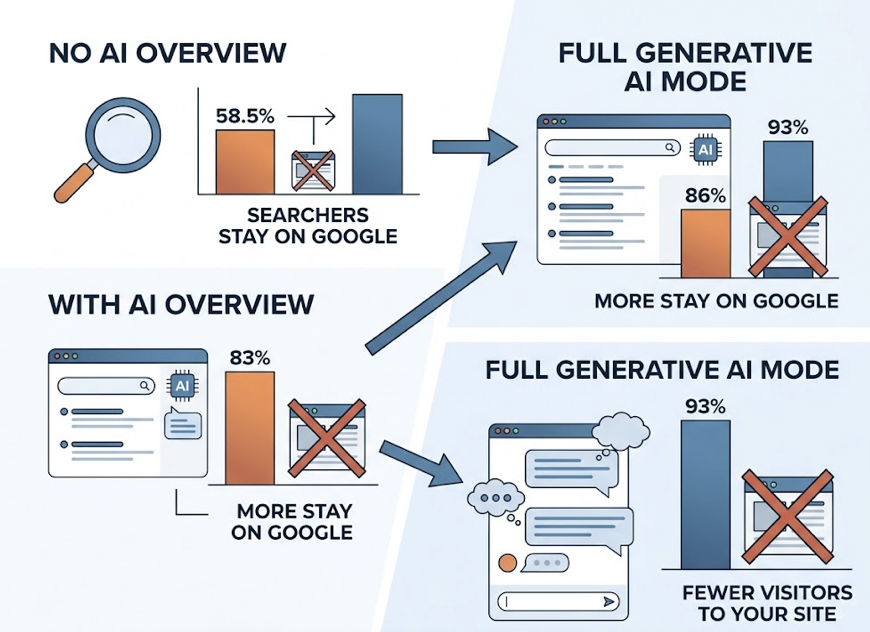
They make decisions based on what the AI tells them.
The quarterly playbook described here replaces that one-time check with a repeating cycle: diagnose, analyze, optimize, scale. Each quarter builds on the last, and each one produces measurable outputs your team can report on.
Q1: Set Your AI Brand Visibility Baseline
You can’t improve what you haven’t measured. The first quarter is entirely diagnostic: figuring out where your brand stands across the AI platforms your buyers actually use.
ChatGPT currently holds 60.6% of the AI search market, with 800 million weekly active users processing over 1 billion queries per day. Google Gemini accounts for 15.1%, Microsoft Copilot sits at 12.5%, and Perplexity captures 5.4%. But Perplexity punches above its market share in one critical way: it drives roughly 15% of all AI-driven referral traffic, making it a high-intent research channel that’s easy to overlook.
McKinsey’s research suggests that even well-performing brands often find their GEO (Generative Engine Optimization) performance lags behind their traditional SEO results by 20% to 50%. So a strong Google ranking doesn’t mean your brand is showing up in AI answers.
Pick the Right Prompts to Track, Not Just Keywords
The biggest mental shift in Q1 is moving from keyword tracking to prompt tracking. In traditional search, you’d track “CRM software.” In AI search, users ask conversational questions like “What’s the best CRM for a 50-person fintech startup focused on compliance?” AI prompts average 23 words, compared to the 4-word average of traditional search queries.
Your team should mine four sources for high-value prompts: customer support tickets (the questions people actually ask), sales call transcripts (the comparison criteria prospects use), Google Search Console long-tail queries (5+ words), and Reddit or Quora threads (how people phrase questions outside SEO constraints).
Then categorize those prompts into three clusters: awareness prompts (“How does X solve Y?”), commercial prompts (“What are the top 5 tools for Z?”), and branded prompts (“Is [brand] compliant with [regulation]?”).
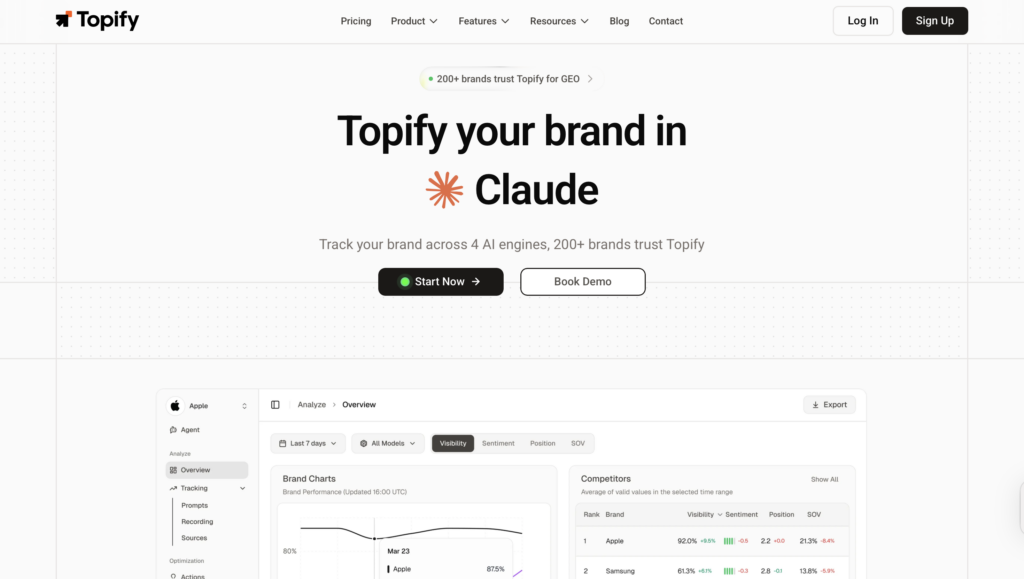
Topify‘s High-Value Prompt Discovery feature automates much of this work. It surfaces the exact questions users are asking across AI platforms and identifies which ones matter most for your category.
Seven Metrics That Define Your AI Baseline
To build a real baseline, you’ll need more than “yes, the brand appeared.” Topify tracks seven core indicators that together paint a complete picture of AI brand visibility:
| Metric | What It Measures |
|---|---|
| AI Visibility Score | % of target prompts where the brand appears |
| Citation Frequency | How often AI links to your site as a source |
| Brand Mention Rate | How often your brand is named in the response |
| AI Share of Voice | Your mention frequency vs. direct competitors |
| Sentiment Score | The tone of the AI’s portrayal (0-100 scale) |
| Position Ranking | Where you appear in AI recommendation lists |
| Information Density | How “citeable” your content is compared to competitors |
By the end of Q1, your team should have baseline scores for each metric across at least ChatGPT, Perplexity, and Google AI Overviews, plus a clear competitor benchmark.
Q2: The Gap Between Getting Mentioned and Getting Cited
Q2 shifts focus from “where do we stand” to “why aren’t we showing up where we should be.” The core concept here is what researchers call the Mention-Source Divide: the gap where AI platforms use your content as a source but don’t recommend your brand by name.
Only 28% of brands currently achieve both frequent mentions and consistent citations. That means most brands fall into one of two traps: they either get cited in footnotes (the AI trusts their data) but never named in recommendations, or they get mentioned without citation links (the AI associates the brand with the category but doesn’t trust the content enough to source it).
Those are two very different problems with two very different fixes.
Why Citations and Mentions Aren’t the Same Thing
A citation means the AI linked to your website as a reference. It proves the AI trusts your data, but it doesn’t necessarily put your brand on the buyer’s shortlist. A mention means the AI named your brand directly in its answer. That’s what puts you on the shortlist.
In regulated industries like financial services, brand-owned websites account for 47% of AI citations because the AI needs authoritative first-party sources. In tech and CPG, the AI leans more heavily on Reddit, Wikipedia, G2, and Capterra.
Topify’s Source Analysis feature lets you reverse-engineer exactly which domains the AI is citing in your category. You can see, at the URL level, which competitor pages are getting referenced and which of your pages are being overlooked.
Running a Citation Gap Analysis
The practical framework for Q2 is a four-step citation gap analysis:
Define your visibility benchmarks and identify the competitors the AI is recommending. Explore which domains the AI currently trusts as sources for your key prompts. Evaluate the gap between your citation count and your top competitor’s. Plan specific content updates to close the gap, prioritized by prompt volume and business value.
Often, the gap exists because a competitor’s page provides more “Information Gain”: original data, proprietary statistics, or expert quotes that the AI can easily extract and reference. If a competitor is cited for “best sustainable skincare in 2026” and you’re not, the fix usually isn’t more content. It’s richer content.
Entity authority also plays a role here. AI models don’t view brands as websites. They view them as entities in a knowledge graph, built through consistent mentions across trusted sources like Wikipedia, industry publications, and community forums. The more consistently these sources associate your brand with a specific category, the more confident the AI becomes in recommending you.
Q3: Optimize Your Content and Track How AI Sentiment Shifts
Q3 is the execution phase. You’ve got your baseline from Q1 and your gap analysis from Q2. Now it’s time to close those gaps with GEO (Generative Engine Optimization) tactics and monitor how the AI’s perception of your brand changes in response.
GEO works because of how AI models generate answers. Most use a process called Retrieval-Augmented Generation (RAG), which pulls “text chunks” from the web to ground responses in facts. Content that’s thin, unstructured, or lacks original data tends to get skipped by the retriever.
A joint study by Princeton and Georgia Tech found that specific GEO tactics can increase AI visibility by up to 40%. The most effective ones include adding verifiable statistics, citing authoritative external sources within your own content, incorporating expert quotes, leading sections with direct answer-first formatting, and using clear heading structures with tables and lists that help AI crawlers parse information.
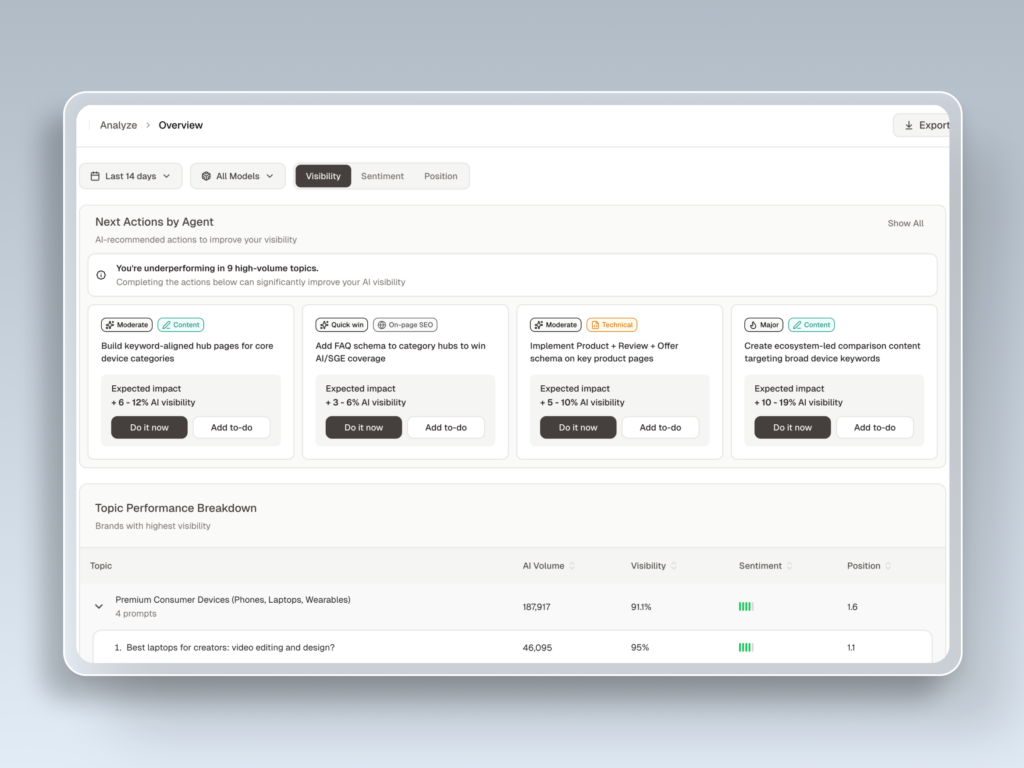
Topify’s One-Click Execution agent puts these recommendations directly into your workflow: it identifies which pages need a specific statistic added, which headers need restructuring, and deploys the changes without manual intervention.
Don’t Just Track Visibility. Track What the AI Says About You.
Appearing in an AI response with negative or inaccurate characterization is worse than not appearing at all. If the AI describes your enterprise product as “a budget option for small teams,” that’s actively working against your positioning.
Topify’s Sentiment Analysis scores your brand perception on a 0-100 scale. Scores between 85-100 mean the AI recommends you with confidence. A score around 50 is neutral: the AI mentions you without endorsement. Anything below 50 signals that the AI may be highlighting outdated pricing, quality concerns, or negative review signals.
Shifting sentiment requires what’s sometimes called “Entity Consistency.” Your brand name, core features, and value propositions need to be described in the same terms across your website, LinkedIn, PR releases, third-party directories, and community forums. When the AI triangulates information from multiple sources and finds consistent messaging, its confidence in recommending your brand goes up.
Proactively contributing helpful, non-promotional answers in Reddit discussions in your category can also influence future RAG retrievals and training data, gradually shifting how AI models characterize your brand.
Q4: Scale What Works and Prove AI Brand Visibility ROI
By Q4, your team has three quarters of data. The goal now is financial validation: proving to leadership that AI brand visibility translates to revenue, and scaling the tactics that produced the best results.
Traditional CTR doesn’t capture the full picture here, because the buyer journey increasingly happens inside the AI answer itself. Instead, your team should report on the Conversion Visibility Rate (CVR): how effectively AI mentions convert into meaningful brand interactions.
Here’s why CVR matters. AI search traffic converts at a rate 4.4 times higher than traditional organic search. The user has already been pre-qualified by the AI. By the time they click a source link, they’ve evaluated their options and are further down the purchase funnel. By May 2025, revenue per visit from AI referrals had reached up to 70% of the value of traditional traffic, and that ratio keeps improving.
Putting a Dollar Value on AI Visibility
The AI Brand Mention Valuation (ABMV) model gives marketing leadership a concrete number. It treats AI mentions like premium reach-based impressions, similar to a billboard or TV spot, but with the added context of a personalized recommendation.
The formula: multiply your category’s total monthly AI query volume by your target visibility share, apply an attention factor (1.0 for a primary recommendation, 0.5 for a footnote), then multiply by the industry-specific AI CPM. For B2B SaaS, that CPM runs around $66 per thousand impressions.
Using Topify‘s AI Volume Analytics, teams can calculate their current ABMV and compare it against program costs. In low-competition niches, teams typically see an ROI between 2.6x and 3.9x.
Moving from Quarterly Reviews to Continuous Monitoring
The final maturity step is automating the cycle. AI search results aren’t static rankings. They’re behavioral outputs that can shift within hours based on new content, social engagement, or competitor moves.
Topify’s AI Agent handles this through autonomous research (mapping visibility gaps in real time), Reddit reply generation (drafting helpful responses in active discussions), and one-click publishing (deploying optimized content with proper schema and formatting).
What Changes After a Full Year of This Playbook
When a team commits to this quarterly cadence for 12 months, the results compound. Here’s what the typical progression looks like:
| Quarter | Primary Outcome |
|---|---|
| Q1 (Months 1-3) | Baseline data, prompt library, and competitor benchmarks established |
| Q2 (Months 4-6) | Source gaps closed; brand transitions from citation-only to active mention status |
| Q3 (Months 7-9) | GEO tactics produce measurable visibility lift, typically +10-18%; sentiment stabilizes |
| Q4 (Months 10-12) | CVR and ABMV validate commercial ROI; brand becomes a consistent AI recommendation |
The difference between a team that runs this playbook and one that doesn’t isn’t just data. It’s predictability. One team knows exactly where its brand stands in AI search, how it compares to competitors, and what to do next quarter. The other team is still taking screenshots from ChatGPT and hoping for the best.
In a world where 93% of generative searches produce zero clicks, the brands that win are the ones that manage what the AI believes about them. A quarterly rhythm is how that management becomes operational.
Conclusion
AI brand visibility isn’t a one-time project. It’s an ongoing operating rhythm that compounds over four quarters, from diagnostic baseline to financial proof of ROI. The playbook above gives marketing teams a clear path: measure in Q1, analyze gaps in Q2, optimize in Q3, and scale in Q4.
The teams that start this process now will have 12 months of compounding data and improving AI presence by the time their competitors figure out where to begin. The tools and frameworks exist. The only variable is whether your team builds the cadence.
FAQ
Q: What is AI brand visibility?
A: AI brand visibility measures how often and in what context your brand appears in AI-generated answers across platforms like ChatGPT, Perplexity, and Google Gemini. It includes three dimensions: presence (does the AI mention you), sentiment (how does the AI describe you), and citations (does the AI link to your content as a source).
Q: How often should I check my brand’s AI search visibility?
A: A quarterly strategic review is the standard cadence for marketing teams. That said, high-value prompts should be monitored weekly for sentiment shifts or factual errors, and a full prompt library audit should happen monthly to track competitive share of voice.
Q: Which AI platforms matter most for brand visibility?
A: ChatGPT leads in volume with 60.6% market share. Google AI Overviews and Gemini are critical for capturing general search intent due to their integration with traditional search. Perplexity is especially important for B2B and research-heavy industries because of its high citation rate and 15% share of AI referral traffic.
Q: How long does it take to improve AI brand visibility?
A: Technical fixes like unblocking AI crawlers can take effect within days. Measurable changes in citation rates from GEO-optimized content typically appear within 60 to 90 days. Significant shifts in brand recommendations and overall sentiment usually require 6 to 12 months of consistent cross-platform entity building.

