

You searched “AI brand monitoring tool,” opened six tabs, and closed four within a minute. One only tracked ChatGPT. Another showed a dashboard full of numbers but couldn’t explain why your competitor jumped three spots in Perplexity’s recommendation list last Tuesday. The fifth tab looked promising until you realized its “multi-platform coverage” meant ChatGPT plus Google AI Overviews, nothing else.
That’s the real problem with evaluating generative search visibility tools right now. It’s not a shortage of options. It’s that most of them measure fragments of a system that only makes sense when you see the whole picture.
Most AI Brand Monitoring Tools Only Track Half the Picture
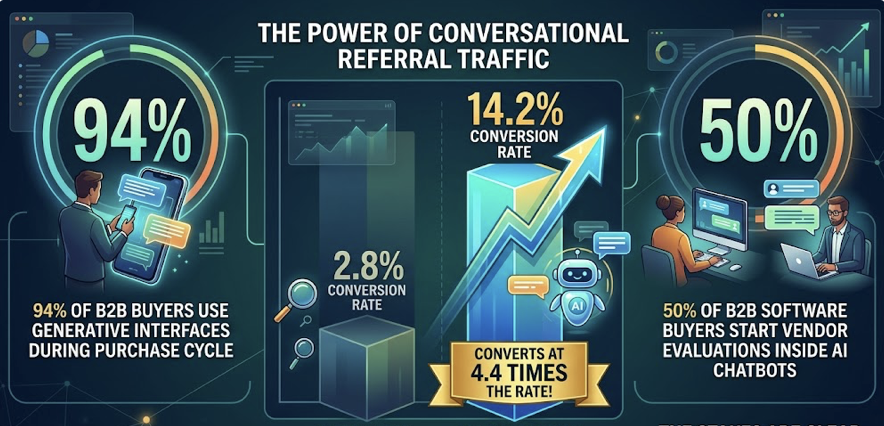
Overall search engine query volume is projected to contract by 25% as conversational agents absorb more user intent. Traditional Google searches already hit a zero-click rate of 64.82%, climbing to 77.2% on mobile. When an AI Overview is triggered, that number reaches 83%. In dedicated conversational environments like Google’s AI Mode and Perplexity, zero-click thresholds sit at 88% and 93%.
The clicks that do come through, though, are worth more. Conversational referral traffic converts at 4.4 times the rate of traditional organic search, averaging a 14.2% conversion rate compared to the standard 2.8%. With 94% of B2B buyers using generative interfaces during their purchase cycle and 50% of B2B software buyers starting vendor evaluations directly inside AI chatbots, the stakes are clear.
Yet many generative search visibility companies restrict their tracking to one or two language models. Others flood dashboards with raw mention counts but offer zero diagnostic insight into why recommendation rankings shifted.
To build a functional AI brand monitoring program, teams need to evaluate tools across five dimensions:
| Dimension | What It Means | Why It Matters |
|---|---|---|
| Platform Coverage | Simultaneous tracking across proprietary models, open-source architectures, and regional assistants | Eliminates blind spots across fragmented buyer journeys |
| Metric Depth | Sentiment polarity, recommendation hierarchies, search volume, and conversion intent | Moves beyond basic mention frequency to qualitative recommendation analysis |
| Competitor Benchmarking | Share of voice, placement displacement, and category dominance over time | Identifies where competitors are capturing the brand narrative |
| Source & Citation Analysis | Tracing third-party URLs, structured domains, and forums referenced by language models | Aligns PR and content budgets with high-authority external sources |
| Execution Closed-Loop | Integrating visibility data with automated content engineering and CMS publishing | Minimizes latency between detecting a gap and fixing it on-site |
5 Generative Search Visibility Companies Compared
Before diving into each platform, here’s the landscape at a glance.
| Platform | AI Platforms Covered | Key Metrics | Competitor Tracking | Source/Citation Analysis | Pricing |
|---|---|---|---|---|---|
| Topify | ChatGPT, Gemini, Perplexity, DeepSeek, Doubao, Qwen | Visibility, Sentiment, Position, Volume, Mentions, Intent, CVR | Side-by-side positioning, sentiment comparison, share of voice | Reverse-engineers cited URLs, categorizes source domains, identifies citation gaps | $99/mo (Basic, 100 prompts) |
| Profound | 10 engines (ChatGPT only on Starter) | AEO score, trend analysis, raw presence, basic sentiment | Mentions tracking, limited hierarchy on lower tiers | Citation intelligence restricted to enterprise plans | $99/mo (Starter, single engine) |
| GoVISIBLE | ChatGPT, Gemini, Copilot, Perplexity, Google AI Overviews | Prompt ownership, Share of Voice, sentiment index, placement depth | Competitor diagnostics, mention quality, authority gaps | Domain-level citation counts, source URLs, category patterns | $69/project |
| Peec AI | ChatGPT, Perplexity, Google AI Overviews (others via add-ons) | Share of Voice, citation frequency, brand visibility %, sentiment | Visibility %, side-by-side benchmarking, trend lines | URL classification, domain categorization, Gap Scores | $89/mo (Starter, 25 prompts) |
| Otterly.AI | ChatGPT, Perplexity, Gemini, Copilot, Google AI Overviews, AI Mode | Brand Visibility Index, raw mentions, average rank, domain citations | Side-by-side coverage comparison, positioning maps | Domain and URL citation tracking | $29/mo (Lite, 10-15 prompts) |
#1 Topify: Full-Spectrum AI Brand Monitoring Across Every Major Platform
Topify was built natively for conversational retrieval networks, not retrofitted from a legacy SEO tool. The platform tracks brand performance across seven primary indicators: visibility, sentiment, average recommendation position, search volume, mentions, intent, and CVR (Conversion Visibility Rate).
That last metric, CVR, is what separates surface-level tracking from actionable intelligence. Most generative search visibility tools count whether a brand appeared in a response. Topify’s CVR evaluates the conversational context surrounding that mention, distinguishing between a passive factual reference and an active product recommendation, then projects downstream conversion likelihood. It’s the difference between “Brand X exists” and “Brand X is the top pick for your use case.”
Topify’s sentiment engine scores brand framing on a scale of -100 to +100, letting teams detect reputation anomalies before negative narratives get baked into a model’s core training data.
The platform’s model coverage is its widest competitive advantage. Topify simultaneously monitors ChatGPT, Gemini, and Perplexity alongside the Mandarin-language AI ecosystem, including DeepSeek, Qwen, and Doubao. Brands that rank well on one system often remain invisible on others due to differing model architectures and data sources. Multi-platform coverage eliminates that blind spot.
Prompt Discovery That Goes Beyond Keywords
Traditional search queries average four words. Conversational queries average twenty-three words and contain complex constraints like budget limits, industry verticals, and geographic scenarios. Topify’s High-Value Prompt Discovery engine analyzes conversational clusters and search volume data to isolate non-branded, high-intent prompts where a brand is currently excluded. This lets content teams target gaps before competitors lock in the narrative.
Competitive Monitoring and Citation Reverse-Engineering
Topify compares brand visibility, narrative framing, and citation share side-by-side, alerting users when a new competitor enters a model’s recommendation set. Its Reverse-Engineer AI Citations feature identifies the specific third-party URLs that models reference to justify recommendations. Research indicates that citations from third-party domains carry roughly 6.5 times the authority weight of self-published material. That data point alone reshapes how marketing departments should allocate off-site PR budgets, prioritizing Reddit threads, G2 reviews, and industry trade publications over branded blog posts.
From Monitoring to Execution in One Click
Here’s the thing most generative search visibility tools miss: data without execution is just a prettier way to watch your brand lose ground.
Topify’s One-Click Execution system generates schema-rich FAQ blocks, atomic knowledge sections, and statistical proof points, then pushes them directly to live WordPress sites via a standard REST API. No manual content handoffs. No three-week lag between “we found a gap” and “we published a fix.” For agile marketing teams, agencies managing multiple clients, and SaaS brands defending category positions, that closed loop is what turns monitoring into growth.
Topify starts at $99/month on the Basic plan, which includes 100 prompts, 9,000 AI answer analyses, 4 projects, and 4 seats. The Pro plan at $199/month scales to 250 prompts and 10 seats. Enterprise packages start at $499/month with a dedicated account manager.
#2 through #5: Other Generative Search Visibility Tools Worth Knowing
Profound
Profound is an enterprise-grade measurement platform built for large organizations with established data science functions. It holds SOC 2 Type II and HIPAA compliance certifications and integrates with enterprise data stacks like Cloudflare, AWS, Adobe Analytics, and Tableau to model the revenue attribution of generative recommendations. Its Query Fanout Analysis simulates retrieval logic across hundreds of millions of historical queries.
The trade-off is accessibility. Profound’s $99/month Starter tier restricts tracking to ChatGPT only. Multi-engine coverage and advanced diagnostics require enterprise-level packages, typically a four-figure monthly commitment. Profound also lacks built-in content generation or deployment tools, functioning purely as an analytical reporting environment. For GoVISIBLE Profound generative search monitoring comparisons, the key distinction is that Profound prioritizes depth of revenue analytics over breadth of platform coverage at entry-level pricing.
GoVISIBLE
GoVISIBLE offers greater entry-level flexibility than Profound by tracking five engines simultaneously on its $69/project pricing: ChatGPT, Gemini, Copilot, Perplexity, and Google AI Overviews. The platform is anchored by the VISIBLE framework, a 7-pillar methodology designed to systematically improve conversational visibility.
GoVISIBLE tracks competitive positioning, prompt ownership, and citation categories, and features an interactive prompt sandbox for running live queries across multiple systems with immediate source URL identification. The project-based pricing model works well for focused campaigns but can require ongoing configuration for teams managing dynamic query environments at scale.
Peec AI
Peec AI is a budget-friendly option popular with startups and smaller marketing teams. For $89/month on the Starter plan, it tracks up to 25 prompts daily across ChatGPT, Perplexity, and Google AI Overviews, with unlimited user seats included.
Its standout feature is the Earned Media module, which tracks how brand mentions get generated across third-party forums, social channels, and review aggregators like Reddit, Wikipedia, and G2. The platform calculates a “Gap Score” that highlights where competitors are cited but your brand isn’t. That said, Peec AI serves strictly as a diagnostic tool with no execution or content deployment features. Acting on its insights requires a DIY approach.
Otterly.AI
Otterly.AI covers six platforms: ChatGPT, Perplexity, Google AI Overviews, Gemini, Microsoft Copilot, and Google AI Mode. It’s the most affordable entry point at $29/month (Lite tier, 10 to 15 prompts) and includes a GEO Audit engine that evaluates over 25 technical and structural factors for crawlability issues.
The platform also provides multi-country and multilingual monitoring across 50+ locations. Its main limitation is a weekly data refresh cycle, which can introduce a 7-day lag behind live model updates. For teams that need near real-time alerts on fast-moving competitive categories, that delay is worth considering.
What AI Analytics Platforms Miss About Generative Search Visibility
Traditional search analytics platforms like Semrush, Ahrefs, and Google Search Console were designed to diagnose keyword rankings, backlink distributions, and indexation rates. They’re good at what they do. But they weren’t architected for conversational search dynamics.
The core difference is structural. Traditional SEO optimizes for a search engine’s ranking algorithm to secure a high position in a list of blue links. Generative engines synthesize direct answers from multiple web references using retrieval-augmented generation (RAG) loops. In a RAG environment, visibility is driven by factual density, semantic entity clarity, structured schema markup, and third-party authority signals, not standard backlink volume.
That’s a fundamentally different optimization surface. And it’s where most AI analytics platforms generative search visibility tracking falls short.
Standard analytics tools can identify visibility deficits or compile citation rankings, but they offer no path to resolve those issues on the page. Teams end up with a reporting layer that can’t close the gap to execution.
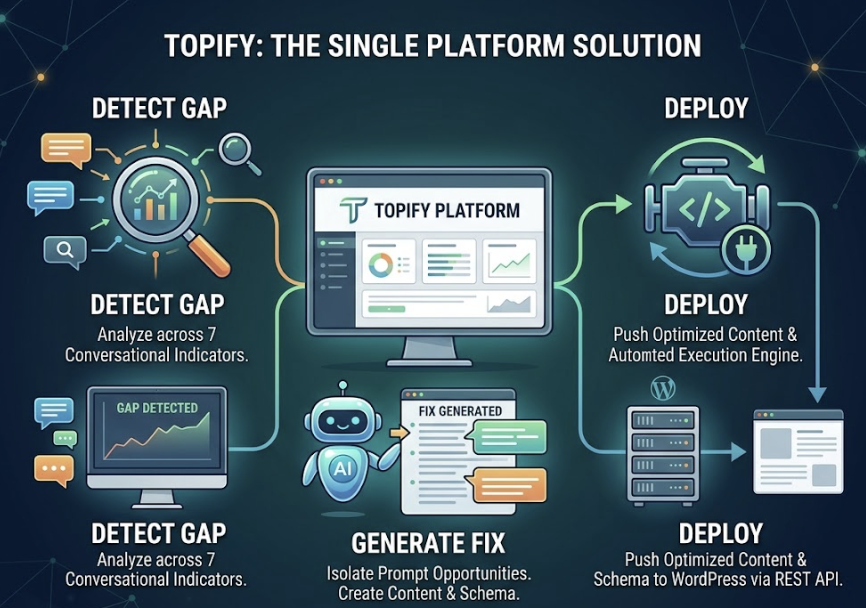
Topify addresses this disconnect directly. Its platform tracks conversational metrics across seven indicators, isolates prompt opportunities, and uses its automated execution engine to push optimized content blocks and schema to WordPress via the REST API. The workflow runs inside a single platform: detect the gap, generate the fix, deploy. No manual handoffs between analytics and content teams.
How to Pick the Right AI Brand Monitoring Tool for Your Team
The right platform depends on your team’s structure, budget, and operational priorities. Here’s a quick framework.
In-house marketing teams need platforms that simplify complex data into actionable tasks. Automated prompt discovery, sentiment alerts, and a direct CMS execution loop matter more than raw data volume. If your team doesn’t have a dedicated data analyst translating dashboards into content briefs, choose a tool that does that translation for you.
Agencies managing multiple clients need white-label reporting, multi-project dashboards, and cost-effective prompt scaling. A prompt sandbox for testing queries during client onboarding helps compress the setup timeline. Look for platforms that support competitive benchmarking across client portfolios without requiring per-project configuration overhead.
SaaS and e-commerce brands need monitoring that covers both direct AI recommendations and third-party review platforms. Track brand positioning, categorize cited domains, and calculate a conversion-focused visibility index to connect content strategy with pipeline metrics.
Across all three profiles, evaluate platforms on three criteria: breadth of platform coverage (especially beyond just ChatGPT), depth of metrics (sentiment and citation analysis, not just mention counts), and execution capability (can it deploy fixes, or just report problems).
For teams ready to establish a complete GEO workflow, getting started with Topify means importing your core domain, identifying high-volume category prompts, and activating automated monitoring and optimization from a single dashboard.
Conclusion
The selection challenge that opened this article, six tabs and four closed within a minute, isn’t going away. As more generative search visibility companies enter the market, the noise will only increase. But the evaluation framework stays the same: platform coverage, metric depth, competitive benchmarking, citation analysis, and execution capability.
Brands that treat AI brand monitoring as a reporting exercise will keep watching competitors capture their category narratives. Brands that close the loop between monitoring and on-site optimization will own the recommendations that drive 14.2% conversion rates. The gap between those two outcomes is narrowing fast.
FAQ
Q: What is AI brand monitoring and why does it matter?
A: AI brand monitoring is the process of tracking how a brand gets mentioned, cited, and recommended within conversational language models like ChatGPT, Gemini, and Perplexity. It matters because traditional search query volumes are declining as users shift to AI-powered tools for product research and buying decisions. These environments synthesize direct answers and bypass standard ranked link lists, so brands that aren’t monitoring their conversational presence risk being excluded from the consideration set entirely.
Q: What’s the difference between generative search visibility tools and traditional SEO tools?
A: Traditional SEO tools track keyword rankings in standard search results, audit on-page technical factors, and monitor backlink profiles. Generative search visibility tools measure brand presence within conversational text summaries, tracking metrics like prompt ownership, recommendation hierarchies, sentiment polarity, and citation sources. The optimization target is different: traditional tools aim for list-based search engines, while generative visibility tools optimize for retrieval-augmented generation (RAG) loops that synthesize answers from multiple sources.
Q: How do AI analytics platforms track generative search visibility?
A: These platforms use automated agents or real-world UI scraping to simulate human-like queries across multiple language models, accounting for geographic and regional parameters. They submit conversational prompt sets, capture the synthesized answers, and analyze the resulting text to determine if a brand is recommended, how it’s described, and which specific third-party URLs are cited to support the response.
Q: How often should you monitor your brand’s AI search visibility?
A: Because language models dynamically fetch real-time web data to formulate recommendations, visibility can shift frequently. Marketing teams should monitor baseline visibility metrics, sentiment changes, and competitor rankings at least weekly. Detailed technical audits, off-site citation targeting, and content refreshes should happen quarterly to maintain relevance within model databases.

