

You’ve spent two years positioning your product as the go-to solution in your category. Then you discover ChatGPT describes a competitor as “the industry standard” and barely mentions your brand. Gemini recommends three alternatives before listing you fourth. None of your existing monitoring tools flagged any of this, because they weren’t built to read AI-generated answers.
That’s the gap AI brand intelligence tracking is designed to close.
What AI Brand Intelligence Tracking Actually Means
AI brand intelligence tracking is the practice of systematically monitoring, analyzing, and acting on how AI engines describe, recommend, and position your brand in generated responses.
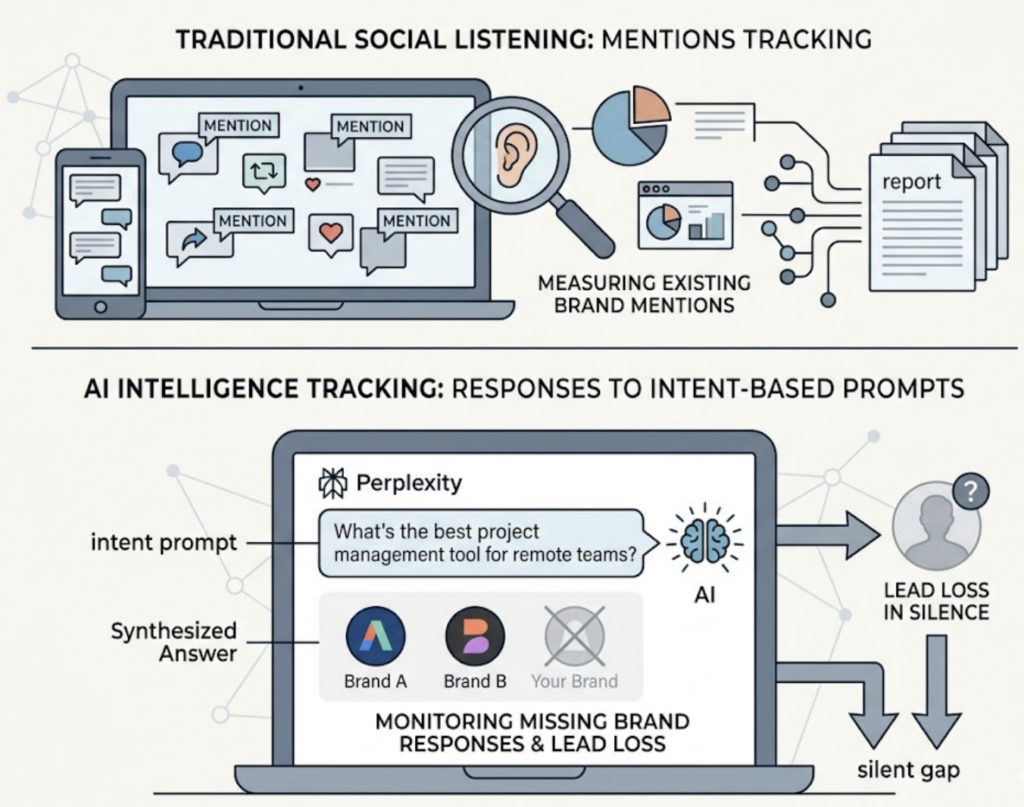
It’s different from traditional brand monitoring. Tools like Google Alerts or Brandwatch are built to crawl the web and index existing text. They’ll catch a mention in a news article or a review site. What they can’t capture is what happens when a user types a question into ChatGPT or Perplexity and the model synthesizes a recommendation on the spot.
That synthesized response is where brand perception is increasingly being formed.
The Four Layers You Need to Track
A complete AI brand intelligence tracking system monitors four distinct signals:
Visibility: Does the AI surface your brand when users ask category-related questions? This isn’t just about being mentioned. It’s about whether you appear in responses to the prompts your customers are actually typing.
Sentiment: How does the AI qualify your brand when it does mention you? Research on brand sentiment in AI modelsshows that subtle word choices, “leading provider” versus “has some limitations,” carry real weight in how users perceive and act on AI recommendations.
Position: Where do you rank relative to competitors in the AI’s suggested list? Being mentioned fourth in a five-brand recommendation carries different conversion potential than being mentioned first.
Source Citations: Which domains are the models pulling from when they form opinions about your brand? This layer reveals why the AI says what it says, and where you can intervene.
Why Your Existing Monitoring Tools Miss This Entirely
Traditional monitoring tools fail at AI intelligence tracking for a structural reason: they’re built for passive web crawling, not active response analysis.
AI answers are non-deterministic. The same prompt can produce different results based on model updates, context, and platform. There’s no static page to index. A brand might be the implicit subject of an AI response without its name appearing, or be omitted entirely despite having strong web authority.
The more significant gap is what researchers call the “synthesized content” problem. Social listening tracks mentions. AI intelligence tracking requires tracking responses to intent-based prompts. If a user asks Perplexity “what’s the best project management tool for remote teams” and your brand doesn’t appear, no traditional monitoring tool will report that loss. You’re losing leads in silence.
That’s not a data quality problem. It’s a coverage problem. And it requires a different type of system.
How AI Brand Intelligence Tracking Works
Effective tracking follows a structured cycle rather than passive observation. Here’s how the process works in practice.
Step 1: Define Intent-Based Prompts
The tracking system starts with a defined set of prompts that mirror real customer queries. These aren’t just brand name searches. They cover the category questions your audience asks when they don’t yet have a brand in mind. “What are the best tools for [use case]?” and “How do I solve [specific problem]?” are more valuable than “What is [brand name]?”
Organizing these prompts into topic clusters by customer journey stage gives you structured data rather than a random sample.
Step 2: Run Prompts Across Target AI Platforms
Coverage needs to span the major platforms where your audience is active. That typically includes conversational LLMs like ChatGPT and Claude, answer engines like Perplexity, and search-integrated AI like Google AI Overviews and Gemini. Each platform has different citation behaviors and recommendation patterns, so single-platform tracking creates blind spots.
Step 3: Extract and Analyze Signals
Each response is analyzed for four data points: whether the brand was mentioned, the sentiment polarity of the description, the competitive position in any ranked list, and the source domains the model cited. This turns raw AI output into structured intelligence.
Step 4: Connect Insights to Action
The data should feed directly into content and PR decisions. If sentiment is weak in Perplexity but strong in ChatGPT, the divergence usually traces back to which sources each platform is citing. That tells you exactly where to publish to shift the narrative.
5 Metrics That Define a Solid AI Brand Intelligence System
Moving from data collection to strategy requires quantifiable metrics. These five are the foundation of any serious AI brand intelligence tracking setup.
Visibility Rate measures the percentage of category-intent queries where your brand is featured. It’s the baseline. Without it, you don’t know your starting position.
Sentiment Score converts the qualitative tone of AI descriptions into a 0-100 scale. This metric, embedded in advanced AI brand intelligence platforms, captures whether the AI is recommending your brand enthusiastically or hedging with caveats.
Position Rank is a comparative metric: where do you appear in AI-generated lists relative to specific competitors? A brand can have high visibility but poor position rank, which means it’s being mentioned but consistently recommended after competitors.
Source Coverage tracks which domains AI models cite when referencing your brand. This is the intelligence layer that explains the other metrics. If a competitor dominates the citations from high-authority industry publications, their sentiment and position scores will reflect it.
Conversion Visibility Rate (CVR) is a predictive metric that estimates the likelihood of an AI mention driving meaningful user action. Not all AI visibility is equal: being mentioned in a direct product recommendation carries different weight than appearing in a general category overview.
Topify tracks all seven core GEO metrics, including visibility, sentiment, position, volume, mentions, intent, and CVR, across ChatGPT, Gemini, Perplexity, DeepSeek, and other major AI platforms in a single dashboard. In practice, this means you can see a drop in Perplexity position rank and immediately trace it back to a shift in source citations, within the same view.
3 Mistakes That Make AI Brand Intelligence Data Useless
Most teams starting with AI brand intelligence tracking make the same errors. They’re fixable, but they compound over time if left unaddressed.
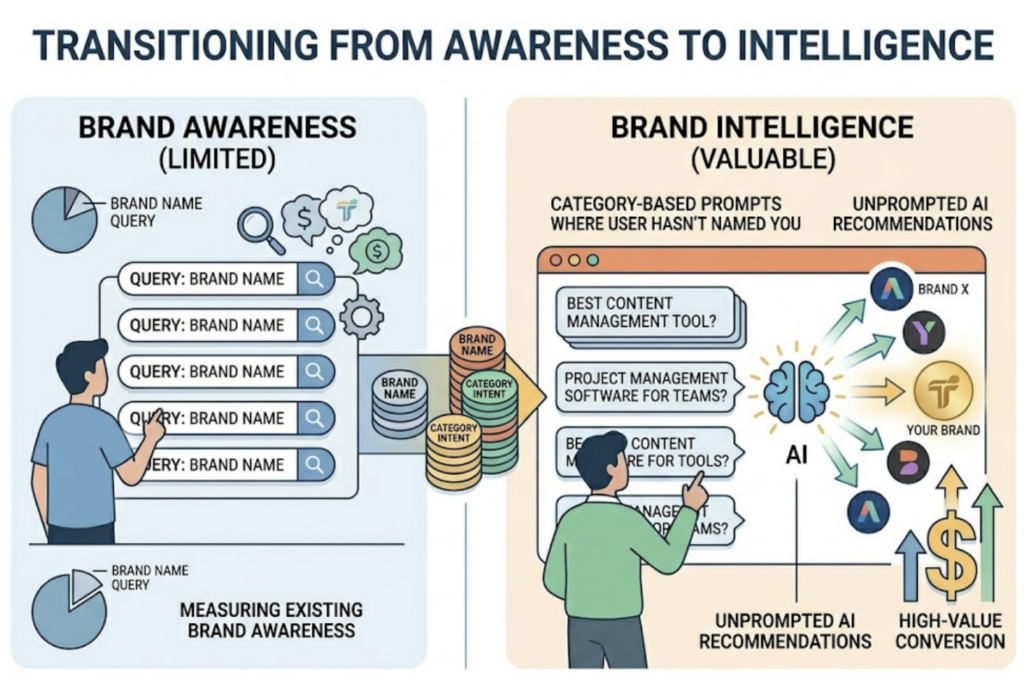
Tracking only the brand name. If you’re only running queries that include your brand name, you’re measuring brand awareness, not brand intelligence. The more valuable signal comes from category prompts where the user hasn’t named you yet. That’s where you discover whether AI is recommending you unprompted, which is where the real conversion happens.
Running one-time audits. AI models update their weights and training data regularly. A snapshot from two months ago can be significantly out of date. Brands that run quarterly audits and call it a monitoring program are flying blind between check-ins. Continuous tracking with weekly or bi-weekly data pulls is the baseline standard.
Ignoring competitive context. A brand’s visibility score only means something relative to competitors. If your visibility drops from 65% to 58% while a key competitor climbs from 50% to 70%, you’re losing ground in the AI layer even though your absolute score still looks acceptable. The relative metric is what matters for business impact.
How to Build Your AI Brand Intelligence Tracking System
Here’s a practical framework for getting started, whether you’re building from scratch or formalizing an existing ad hoc process.
Define your prompt universe. Start with 20 to 30 prompts organized by customer journey stage. Include category queries (no brand names), problem-solution queries, and comparison queries. This set becomes your tracking baseline.
Select your platform coverage. Prioritize the AI platforms your target audience actually uses. For B2B SaaS, that typically means ChatGPT and Perplexity as the primary surfaces, with Google AI Overviews as the search-integrated layer. For consumer brands, Gemini and Google AI Overviews often carry more weight.
Establish a baseline. Run your full prompt set across all target platforms and record the output. This is your Day 0 data. Without a baseline, you can’t measure the impact of any optimization work you do later.
Set a monitoring cadence. Weekly tracking is the minimum for brands in competitive categories. Monthly is acceptable for less competitive verticals. The cadence should match how frequently your category sees meaningful shifts in AI recommendation patterns.
Connect data to content and PR actions. This is where intelligence becomes strategy. Source coverage analysis tells you which publications and domains the AI is pulling from. That data directly informs your content placement strategy: publish in the sources the AI trusts, and your sentiment and position metrics will follow.
Topify’s AI agent automates this entire cycle. You define your goals in plain English, and the platform handles prompt execution, signal extraction, competitor benchmarking, and content recommendations without manual workflows. For marketing teams running this across multiple brands or accounts, that operational leverage is significant.
Topify’s Basic plan starts at $99/month and covers 100 prompts and 9,000 AI answer analyses across ChatGPT, Perplexity, and Google AI Overviews. The Pro plan at $199/month expands to 250 prompts and 22,500 analyses. Both include competitive benchmarking and source analysis out of the box.
Conclusion
AI brand intelligence tracking isn’t a supplementary monitoring tool. It’s a new category of data that captures something traditional SEO metrics and social listening never could: what AI engines are actively telling your potential customers about you, right now, without you in the room.
The brands building systematic tracking infrastructure today, with structured prompt sets, multi-platform coverage, and continuous monitoring cadences, will have the baseline data and the optimization advantage that late movers won’t be able to replicate quickly. The intelligence gap between brands that track this and brands that don’t is widening every month that AI search adoption grows.
Start with your prompt universe. Build your baseline. Then make the data actionable.
FAQ
Q: What is AI brand intelligence tracking?
A: AI brand intelligence tracking is the process of systematically monitoring how AI engines like ChatGPT, Perplexity, and Gemini describe, position, and recommend your brand in generated responses. It covers four core layers: visibility (whether your brand appears), sentiment (how it’s described), position (where it ranks relative to competitors), and source citations (which domains the AI is pulling from to form its opinion).
Q: How does AI brand intelligence tracking work?
A: The process involves defining a set of intent-based prompts that mirror real customer queries, running those prompts across target AI platforms, extracting structured signals from the responses (mention presence, sentiment score, competitive rank, cited sources), and linking those insights to content and PR actions. Platforms like Topify automate this cycle, handling prompt execution, data extraction, and competitive benchmarking in a single dashboard.
Q: How do I measure AI brand intelligence tracking?
A: The five core metrics are Visibility Rate (percentage of queries where your brand appears), Sentiment Score (0-100 scale of description favorability), Position Rank (your placement relative to competitors in AI-generated lists), Source Coverage (which domains the AI cites about your brand), and Conversion Visibility Rate (estimated likelihood that an AI mention drives user action). Tracking these metrics over time, not just as snapshots, is what turns monitoring into actionable intelligence.
Q: What are the best tools for AI brand intelligence tracking?
A: Topify is purpose-built for AI brand intelligence, covering all seven core GEO metrics across ChatGPT, Gemini, Perplexity, DeepSeek, and other major platforms. It combines visibility tracking, sentiment analysis, competitor benchmarking, and source analysis in one platform, with an AI agent that automates the optimization workflow. Pricing starts at $99/month for teams tracking up to 100 prompts.
Q: What’s the difference between AI brand intelligence tracking and traditional brand monitoring?
A: Traditional brand monitoring tools crawl the web for existing text. They capture mentions in published articles and social posts. AI brand intelligence tracking captures what happens in real-time AI-generated responses, which are synthesized on demand and not indexed anywhere. A brand can have strong web presence and still be absent from or poorly represented in AI recommendations. The two data sets measure different things and are not interchangeable.

